What a DCS System Supplier Actually Delivers to a Wastewater Plant
A distributed control system for wastewater treatment is not a single box — it is a redundant control architecture that ties together controllers, engineering workstations, operator HMIs, a process historian, and an asset management layer. In a typical industrial WWTP that means dissolved-oxygen cascade loops across the aeration basin, return and waste activated sludge (RAS/WAS) flow control, polymer and coagulant dosing, chlorine or hypochlorite residual trim, and clarifier sludge blanket tracking — all running on the same database so that an operator changing a setpoint at 02:00 sees the result at the aeration panel, the SCADA server, and the compliance report simultaneously.
For a 1,000–5,000 m³/d industrial WWTP the realistic I/O inventory is 400–1,200 hard I/O points plus 200–600 soft tags (calculated values, motor run-hours, valve cycle counts). Composition is roughly 60% analog (4–20 mA for pH, DO, TSS, flow, level), 30% digital (pump status, valve limits, MCC feedback), and 10% specialized (pH/DO probes, turbidity, ORP, gas detection for chlorine rooms or biogas handling). A supplier who cannot size your plant from a P&ID in this range is the wrong supplier.
DCS platforms — Honeywell Experion, ABB 800xA, Emerson DeltaV, Siemens PCS 7 — are best known as the backbone of continuous and batch process automation in refining, chemical, power, pulp and paper, and mining (per Industrial Monitor Direct, 2026). Wastewater sits one tier below these verticals but draws on the same engineering discipline: continuous regulatory loops, alarm management under ISA-18.2, and Safety Instrumented System (SIS) overlap for chlorine, biogas, and H₂S exposure. GlobalSpec's industrial catalog currently lists 41 dedicated DCS suppliers and 106,477 manufacturers, which gives a sense of the vendor universe before the realistic shortlist collapses to four (GlobalSpec, 2026).
Top 4 DCS System Suppliers Compared (2026 Vendor Matrix)
The 2026 market for large-scale DCS remains an oligopoly: Honeywell, ABB, and Emerson are the "big three," with Siemens PCS 7 as a credible fourth in Europe and brownfield Siemens PLC sites. The table below maps each to typical WWTP fit, SIS capability, regional strength, and a 2026 turnkey CAPEX band — the numbers are envelope figures, not list prices, and they exclude civil works and instrumentation.
| Vendor / Platform | I/O Scale | Typical WWTP Fit | SIS Integration | Regional Strength | 2026 Turnkey CAPEX Band |
|---|---|---|---|---|---|
| Honeywell Experion | 500–50,000+ | Refinery/petchem/power heritage; strong where chlorine, biogas, or H₂S exposure drives SIS demand (per Industrial Monitor Direct, 2026) | Native Safety Manager integration | North America, Middle East, India | Mid plant $120K–$450K; large cluster $500K–$1.8M |
| ABB 800xA | Skid packages to 100,000+ I/O (per Industrial Monitor Direct, 2026) | Mining, metals, pulp and paper — translates to large mixed-effluent industrial parks and brownfield migrations from Advant MOD 300 | Integrates with ABB Safety Insight | Europe, Latin America, Africa, Australia | Mid plant $100K–$420K; large cluster $480K–$2.0M |
| Emerson DeltaV | 300–30,000+ | Market leader in new oil and gas, chemical, and life sciences installations (per Industrial Monitor Direct, 2026); best when a WWTP is co-located with a regulated chemical process | DeltaV SIS is tightly co-located in the same chassis | North America, Europe, Asia-Pacific | Mid plant $110K–$430K; large cluster $520K–$1.7M |
| Siemens PCS 7 | 500–25,000+ | Positioned as second-tier vs the big three but common in Europe and at sites with existing Siemens PLC infrastructure (per Industrial Monitor Direct, 2026) — practical choice for brownfield retrofits | Integrates with Siemens SIMATIC SIS | Central Europe, China, parts of Southeast Asia | Mid plant $80K–$380K; large cluster $400K–$1.5M |
For small skid packages (200–500 I/O) the realistic 2026 band is $35K–$95K; mid plant (1,000–3,000 I/O) runs $80K–$450K; large cluster (5,000+ I/O) reaches $500K–$2M. Anything quoted below $35K for a turnkey DCS at 500+ I/O almost always excludes engineering, commissioning, or SIS — read the exclusions list before signing.
DCS vs PLC+SCADA: When Wastewater Plants Should Make the Switch
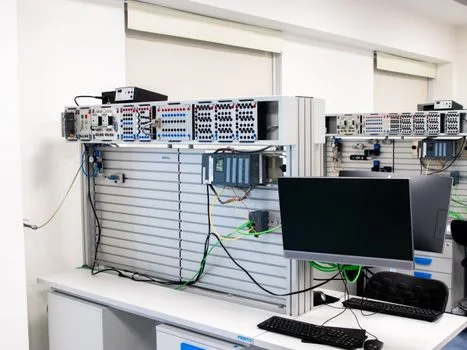
The defensible tipping point sits at I/O count and control loop density, not at brand loyalty. The table below maps the three bands most mid-sized plants fall into, with a 200 m³/h industrial WWTP used as the worked example.
| Plant Characteristic | PLC+SCADA Fit | DCS Fit |
|---|---|---|
| I/O count | Under 500 hard I/O | Over 1,500 hard I/O, or below 1,500 with advanced control |
| Control loop count | Under 30 PID loops, single operator | 50+ PID loops, alarm rationalization under ISA-18.2 |
| Regulatory complexity | Single effluent parameter (e.g., BOD or TSS) | Multi-parameter compliance: ammonia, total nitrogen, total phosphorus, heavy metals, salinity |
| Redundancy requirement | Controller-level only | Controller + network + server + power redundancy |
| Historian retention | 3–6 months | 2+ years for compliance audits |
| Multi-operator coordination | Single control room | Multiple control rooms or remote operating centers |
Below 500 I/O with a single operator, PLC+SCADA typically saves 40–60% on CAPEX and is faster to deploy — at a 200 m³/h food-processing WWTP with one aerobic basin, two clarifiers, and a sludge press, the realistic PLC+SCADA scope lands at 280–350 I/O and 18–24 control loops, which is firmly PLC territory. Between 500–1,500 I/O the decision is a gray zone: a DCS is justified if the plant runs ammonia-based aeration control, enforces strict phosphorus limits below 0.5 mg/L, or coordinates three or more unit processes in parallel. Above 1,500 I/O, or any plant with a formal Safety Instrumented Function, a DCS is effectively mandatory — alarm management under ISA-18.2 (alarm rationalization, priority filtering, deadband tuning) is impractical to implement on a stretched PLC+SCADA, and the engineering hours to force it exceed the DCS CAPEX differential inside 18 months. Lifecycle cost over 15 years runs 3–5× initial CAPEX for a DCS versus 2–3× for PLC+SCADA, but per-I/O OPEX is lower at scale because one DCS operator console can supervise what would otherwise require two or three PLC HMIs.
How to Evaluate a DCS System Supplier in 5 Steps
1. Scope the I/O before vendor contact. Produce a P&ID-level I/O list with signal type, hazardous area classification (ATEX/IECEx zones for chemical dosing rooms and biogas zones), and a redundancy tier (basic, high-availability, or fault-tolerant). A vendor who accepts a one-page scope of work should be disqualified — that vendor will change-order everything later.
2. Shortlist by application fit, not brand. A high-TSS food-processing plant with intermittent hydraulic loads has different control dynamics than a toxic chemical influent with strict ammonia-nitrogen limits. Match the vendor's installed base to your influent, not the other way around.
3. Request a pilot or skid. Reputable DCS suppliers will provide a 30–60 day pilot on a process skid package before contract. The pilot should run your actual control narrative — DO cascade, RAS flow trim, polymer dose — not a generic demo. This is also the cheapest way to validate the HMI ergonomics for your operators.
4. Validate lifecycle commitments in writing. Ask for a 10-year spare parts guarantee, a defined firmware support window (less than 10 years is a red flag), and a documented migration path. ABB 800xA, for example, supports phased migration from the legacy Advant MOD 300 (per ABB, 2026) — that pathway is exactly what a buyer with a 1990s-era install needs to verify before signing.
5. Check local service depth. For plants outside North America and Western Europe, confirm a certified system integrator within 250 km or a guaranteed 48-hour remote support SLA. Cross-check the vendor's reference list against at least three wastewater installations commissioned within the last five years — older references signal a vendor who is exiting the segment, not entering it. For broader sensor-budget context before you wire the field devices, see the 2026 industrial IoT sensor cost breakdown.
Red flags in supplier evaluation: the vendor cannot name a certified system integrator in your region; no reference list of wastewater installations within five years; firmware support window under 10 years; and a quote that bundles hardware, software, engineering, and commissioning into a single line item with no labor-hour breakdown.
2026 Pricing Structure and Total Cost of Ownership
Software licensing accounts for 25–40% of total CAPEX on a vendor DCS, and the licensing model itself varies enough to distort head-to-head comparisons. Emerson DeltaV uses per-tag fees, which can sting on soft tags; ABB 800xA and Honeywell Experion use per-server or per-system licensing, which favors plants that add scope after the initial install. Engineering and commissioning is 30–45% of CAPEX and is consistently the most underestimated line item — a mid-sized WWTP typically logs 1,800–3,500 engineering hours from kickoff to site acceptance test. Annual support runs 4–7% of initial CAPEX, with remote support the cheaper option if your plant has a stable network and a trained controls engineer on staff.
Migration cost from a legacy DCS in 2026 — for example Honeywell TPS to Experion, or ABB Advant MOD 300 to 800xA — runs 60–85% of a greenfield install. ABB continues active service for Advant MOD 300 (per ABB, 2026), which confirms the migration market is real, ongoing, and competitive. Plan migration as a phased program over 18–36 months rather than a single cutover, or you will accept a controlled shutdown your operations team cannot afford.
Frequently Asked Questions
What is the difference between a DCS and a PLC+SCADA for wastewater treatment? A DCS is an integrated control architecture with redundant controllers, a unified historian, and central alarm management designed for 500+ I/O and 30+ PID loops. PLC+SCADA is a programmable controller linked to a supervisory visualization layer, suited to plants under 500 I/O with a single operator. The economic crossover sits at roughly 1,500 I/O or any plant with formal Safety Instrumented Functions.
Which DCS vendor is best for an industrial wastewater treatment plant? For most mid-sized industrial WWTPs (500–3,000 I/O) the choice reduces to Honeywell Experion, ABB 800xA, or Emerson DeltaV, selected by influent type and regional service depth. Siemens PCS 7 is the right call only when an existing Siemens PLC infrastructure is already in place.
How much does a DCS cost for a 1,000 m³/d wastewater plant in 2026? A 1,000 m³/d industrial WWTP with 800–1,200 I/O typically lands at $120K–$380K turnkey, with software 25–40% of the total, engineering and commissioning 30–45%, and annual support 4–7% of CAPEX going forward.
Can a DCS integrate with an automatic chemical dosing skid? Yes. A modern PLC-controlled automatic chemical dosing system ships with Modbus TCP or Profinet gateways, and all four major DCS platforms can map dosing loops, pump speed, and residual analyzer feedback into the same control database as aeration and sludge handling.
Do I still need IoT sensors if I install a DCS? Yes. A DCS is the control brain; IoT and IIoT sensors are the field layer that feeds it. For a current breakdown of sensor pricing, see the 2026 industrial IoT sensor cost breakdown, which covers per-point installed cost against DCS I/O card pricing.
How long does a DCS migration take for a mid-sized WWTP? A 2026 migration of a mid-sized plant (1,000–2,000 I/O) typically takes 18–36 months including engineering, FAT, phased cutover, and SAT. Anything under 12 months means either inadequate documentation, a parallel-running period that is too short, or both.
Related Equipment
- MBR membrane bioreactor with DCS-ready control interfaces — specifications, capacity range, and technical data