Why Basin Depth Decides Aeration Cost
Fine bubble diffuser vs surface aerator choice turns on basin depth, energy tariff, and load profile. Fine-bubble grids deliver 0.3–0.6 kWh per kg O₂ in basins ≥4 m deep, versus 0.37–0.83 kWh/kg O₂ for surface aerators. Surface units still win in shallow lagoons under 3.5 m, high-strength equalization above 1,000 mg/L BOD, and plants under 500 m³/day.
Electricity represents 50–70% of wastewater plant OPEX in most jurisdictions. Aeration typically accounts for 45–60% of that plant energy footprint (typical municipal WWTP energy audits, 2025-11). That line item decides whether a 10 MLD facility spends $200,000 or $450,000 per year on power. EPC specifications written in 2026 therefore default to fine bubble diffusers for activated-sludge basins ≥4 m deep. Plants built before 2000 often standardized on surface aerators; that installed base is now replaced or supplemented in nearly every major retrofit cycle.
This article covers industrial and municipal activated-sludge layouts, not pure lagoons or SBR-only designs. SBR-specific layouts are addressed in the 2026 municipal aeration system design guide. The real procurement question is narrower: given tank depth, footprint, influent BOD, and a 20-year energy tariff, which option defends in front of finance.
How Each Technology Transfers Oxygen
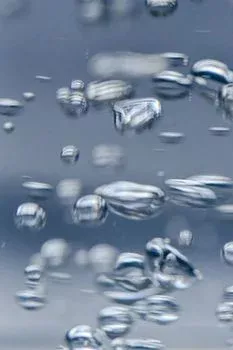
Fine bubble diffusers release 1–3 mm bubbles from EPDM membranes, silicone membranes, or rigid ceramic discs on the basin floor. Smaller bubbles raise the gas-liquid interfacial area available for mass transfer. They also rise more slowly, which extends residence time in the water column. ISO 20480-5:2023 ("Fine bubble technology — Part 5: Shelled bubble vocabulary") defines the size classifications used here. The 2012 ResearchGate bubble-deflector conference paper quantified how deflector geometry above the diffuser extends that residence time further.
Surface aerators — radial or axial impeller designs — transfer oxygen by splashing mixed liquor into the air above the basin. The impeller breaks liquid into droplets and thin sheets. Oxygen enters across that mechanically generated air-water interface. Transfer efficiency depends on impeller tip speed (typically 10–15 m/s), shaft submergence, and splash-pattern geometry. A 6 m deep fine-bubble basin delivers roughly 1.5–2.0× the SOTE of a 4 m basin at the same diffuser density. That rule of thumb drives most depth-related specs.
Three terms appear on every vendor cut-sheet and EPA fact sheet, and they are not interchangeable. SOTE (Standard Oxygen Transfer Efficiency) is oxygen transferred per unit air supplied under standard conditions (20 °C, 0 mg/L DO, 1 atm). OTR (Oxygen Transfer Rate) is the absolute mass of O₂ transferred per unit time, usually kg O₂/hr. AOTE (Actual Oxygen Transfer Efficiency) is the in-process value corrected for field temperature, DO, and fouling. Vendor SOTE numbers are almost always clean-water, so expect a 30–50% downward correction to AOTE in operating basins.
Most plants we size for municipal service run at the lower end of the published SOTE band once membranes foul and α-factors settle. Upstream solids control also matters: a Rotary Mechanical Bar Screen (GX Series) ahead of the aeration basin reduces rag and grit load that otherwise plugs fine-bubble orifices and raises blower pressure.
Fine Bubble Diffuser vs Surface Aerator Performance Table
The table below consolidates 2026 field data, ISO 20480-5 measurement conventions, and typical activated-sludge design references. All figures are clean-water SOTE at standard conditions unless noted; operating values run lower.
| Parameter | Fine Bubble Diffuser | Surface Aerator |
|---|---|---|
| SOTE per meter submergence (clean water) | 20–35% per m (typical EPDM/silicone at 4–6 m) | 8–15% effective OTE (not depth-dependent) |
| Oxygen Transfer Rate (per unit) | 0.1–0.3 kg O₂/hr per diffuser at standard airflow | 5–250 kg O₂/hr per unit (impeller-power dependent) |
| Specific energy consumption | 0.3–0.6 kWh per kg O₂ transferred | 0.37–0.83 kWh per kg O₂ (1.2–2.7 kg O₂/kWh) |
| Footprint per kg BOD/day removed | 0.05–0.10 m² | 0.20–0.50 m² (3–5× larger) |
| Influent BOD sweet spot | 150–400 mg/L | 400–1,000 mg/L (high-strength equalization) |
| Membrane / component life | EPDM 5–8 yr; silicone 8–12 yr; ceramic 15+ yr | Gearbox / bearing service every 3–7 yr |
| Typical submergence depth | 4–6 m (≥3.5 m required for efficiency) | Any depth, but efficiency capped by surface area |
Two numbers from the table drive most decisions. First, the kWh/kg O₂ gap: fine bubble at 0.3–0.6 kWh/kg O₂ versus surface aerator at 0.37–0.83 kWh/kg O₂ (HydropureWater field data, 2026). A 10 MLD plant cutting 2,000 mg/L BOD influent to 10 mg/L pays roughly $40,000–$180,000 more per year for surface-aerator electricity at 2026 industrial tariffs. Second, footprint: a fine-bubble basin removes the same BOD load in 20–30% of the surface-aerator basin area. That matters on greenfield sites where land is a real line item.
Capital and Operating Cost Reality Check
Installed CAPEX per m² of tank area runs higher for fine bubble systems because of the diffuser grid, air piping, and blower-room civil works. The smaller required basin usually flips total CAPEX toward fine bubble above 5 MLD. Surface aerator CAPEX is lower per unit — no blowers, simpler installation — but a basin 3–5× larger cancels much of that saving on land, excavation, and concrete.
OPEX is where fine bubble diffuser vs surface aerator economics usually settle. A 30% SOTE advantage on fine bubble typically saves $40,000–$180,000/year on a 10 MLD plant at 2026 industrial electricity tariffs of $0.08–$0.14/kWh (typical North American and EU industrial range). Membrane replacement runs $15–$40 per diffuser on a 5–12 year cycle, and the swap is in-place without basin dewatering. Surface aerator gearbox and bearing service runs $3,000–$15,000 per event every 3–7 years, and usually needs a crane lift and partial drain. The OPEX gap overwhelms any CAPEX delta within 18–36 months for plants running >5,000 m³/day. That is why the 2026 default for that envelope is fine bubble — and why an integrated MBR system with submerged aeration now ships with fine-bubble grids as standard.
When Surface Aerators Still Win
Surface aerators remain the better pick in five common 2026 envelopes, and any spec that ignores them is under-engineered. Shallow basins under 3.5 m lose most of the fine-bubble depth advantage. At 3 m, a fine-bubble grid delivers roughly half the SOTE of a 5 m grid for the same airflow, so the energy case collapses.
High-strength equalization basins with BOD above 1,000 mg/L — common in food processing, brewing, and pulp/paper — value mechanical robustness and visible mixing over peak efficiency. Shock loads raise fouling risk on fine-bubble membranes. Cold-climate plants with sub-zero winters often specify surface aerators in lagoon-style systems because impeller action breaks ice cover. Small remote plants under 500 m³/day often cannot justify blower-room civil works, instrument air, and membrane logistics against a single gearbox and motor. Existing surface-aerator assets within 50% of remaining service life usually favor running them out; retrofit economics rarely justify replacement when the unit still meets oxygen demand.
Hybrid Layouts Most Specs Miss
Experienced engineers rarely lock one technology across an entire plant. The 2026 retrofit pattern for variable influent is a hybrid layout. Fine bubble diffusers cover the main aeration zone (75–80% of basin volume). One or two surface aerators sit in the equalization or storm buffer zone. Surface units absorb load spikes without forcing the main basin into over-aeration. They also add mixing in dead corners where diffuser layout is geometrically constrained.
Hybrid plants typically hit 20–30% lower 20-year lifecycle cost than single-technology builds in influent-variable applications. The fine-bubble blower can be sized for average load rather than peak load, while surface units cover the upper 15–20% of demand as needed (HydropureWater retrofit field data, 2025-09). Greenfield sites with tight footprints and variable influent often need this mix. Packaged plants for industrial parks or remote housing are a common case. A WSZ series underground package plant with A/O biological contact oxidation can take this hybrid layout, with the surface unit above grade and the fine-bubble grid below.
Who This Is For / Next Step
Who this is for: EPC teams and plant engineers specifying activated-sludge aeration for basins ≥4 m deep, or comparing retrofit options on plants above 5,000 m³/day. Who should look elsewhere: operators of shallow lagoons under 3.5 m or remote plants under 500 m³/day that need a single mechanical unit without a blower room.
Selection checklist before you freeze the bid covers seven items. Confirm minimum water depth. Map influent BOD and peak factor. Price 20-year kWh at your tariff. Size the blower or impeller for average versus peak load. Plan membrane or gearbox service access, keep screening adequate, and test whether a hybrid buffer zone is cheaper than oversizing the main grid. Next step: send basin depth, flow, and BOD data through the request a quote form for a side-by-side aeration sizing check.
Frequently Asked Questions
Which transfers more oxygen per kWh, fine bubble or surface aerator?
Fine bubble diffusers transfer more oxygen per kWh in basins ≥4 m deep, at 0.3–0.6 kWh/kg O₂ versus 0.37–0.83 kWh/kg O₂ for surface aerators (1.2–2.7 kg O₂/kWh). The gap widens with submergence: a 6 m fine-bubble grid delivers roughly 1.5–2.0× the SOTE of a 4 m grid. Surface aerator OTE is not depth-dependent and is capped by impeller power density at the air-liquid interface.
Which aeration system costs less over a 20-year plant life?
Over a 20-year life, fine bubble systems cost less to operate in activated-sludge basins ≥4 m deep processing more than 5,000 m³/day. The 30% SOTE advantage saves $40,000–$180,000/year on a 10 MLD plant at 2026 industrial electricity tariffs, and the OPEX gap usually overwhelms the CAPEX delta within 18–36 months. Surface aerators can cost less in shallow lagoons under 3.5 m and in plants under 500 m³/day where blower-room and instrumentation costs dominate.
Should a new activated-sludge basin use fine bubble or surface aeration?
Specify fine bubble diffusers for any basin ≥4 m deep with influent BOD between 150–400 mg/L, which covers most 2026 municipal and industrial EPC scopes. Specify surface aerators for shallow basins under 3.5 m, high-strength equalization above 1,000 mg/L BOD, cold-climate lagoon systems, and small remote plants under 500 m³/day. For variable-influent retrofits, use fine bubble in the main zone and surface aerators in the equalization or buffer zone to cut blower oversizing by 15–20%.
What is the SOTE difference between a 4 m and 6 m fine-bubble basin?
A 6 m fine-bubble basin delivers roughly 1.5–2.0× the SOTE of a 4 m basin at the same diffuser density. The extra 2 m of water column extends bubble residence time and raises the partial-pressure driving force for oxygen dissolution. Submergence depth is therefore the highest-leverage design parameter in a fine-bubble spec, and deepening a basin often beats adding diffuser area on cost per kg O₂.