A plate frame filter press for food processing separates solids from liquids at 95–99% efficiency, operating up to 16 bar on FDA-compliant 304 or 316 stainless steel with food-grade polypropylene or nylon filter cloths. Typical cake moisture reaches 20–30% in juice clarification and edible oil refining, while PLC-controlled cycles can cut labor cost 40–60% on fully automatic units. Standard build sizes cover 1–500 m² of filtration area and 0.5–50 m³/h throughput, which suits craft juice lines through large edible-oil refineries.
Why Plate Frame Filter Presses Lead in Food Processing Filtration
A plate frame filter press delivers drier cake and tighter hygiene control than centrifuges or belt presses on juice, dairy, and edible-oil lines. Cake moisture typically lands at 20–30%, versus 40–50% for centrifuges, which cuts product loss and waste-hauling fees. Belt presses handle coarse slurries but struggle with fine solids and clean-in-place discipline, so throughput drops and cleaning windows stretch.
Food-safety rules shape the equipment choice as much as capacity does. Presses are specified to FDA 21 CFR Part 117 (Current Good Manufacturing Practice; earlier Part 110 CGMPs were modernized into Part 117), HACCP, ISO 22000, and EU Regulation (EC) No 1935/2004, with smooth, cleanable surfaces and food-grade contact materials that limit cross-contamination between batches. One juice producer we reviewed cut pulp waste by 35% and lifted juice yield by 12% after swapping centrifugal separators for a modern plate frame filter press, mostly because the press recovered more liquid from a drier cake.
Engineering Specs for Food-Grade Plate Frame Filter Presses
Sizing a plate frame filter press for food processing starts with filtration area, which scales from 1 m² for batch work up to 500 m² for industrial plants. Throughput follows area and solids loading: juice clarification usually lands at 0.5–10 m³/h, while edible oil refining pushes 5–50 m³/h. Operating pressure runs 6–16 bar, and most plants we size for run at the lower end to protect plates and gaskets.
Plate material tracks the product chemistry. 304 stainless steel covers general food contact, while 316 or 316L is specified for dairy, high-chloride CIP solutions, and heavily welded lines (316L resists intergranular corrosion after welding). FDA-compliant gaskets are EPDM or silicone. Filter cloth is polypropylene or nylon with 5–10 µm pores for fine particle capture in juice and oil work. For specific builds, see our FDA-compliant plate frame filter presses for food processing.
| Parameter | Typical Range for Food Processing | Impact/Notes |
|---|---|---|
| Filtration Area | 1–500 m² | Scales with required throughput; larger area for higher volume. |
| Operating Pressure | 6–16 bar | Higher pressure yields drier cake but requires robust construction. |
| Throughput Capacity | 0.5–50 m³/h | Varies by application (e.g., juice: 0.5-10 m³/h, edible oil: 5-50 m³/h). |
| Cake Moisture Content | 20–30% | Significantly lower than centrifuges (40-50%), reducing waste. |
| Plate Materials | 304/316/316L SS | 304 SS for general, 316/316L for corrosive/dairy/pharma. |
| Gasket Materials | EPDM, Silicone | FDA-compliant for sealing and chemical resistance. |
| Filter Cloth Materials | Polypropylene, Nylon | FDA-approved, 5–10 µm pore size for fine filtration. |
Food-Grade Materials and Contamination Prevention
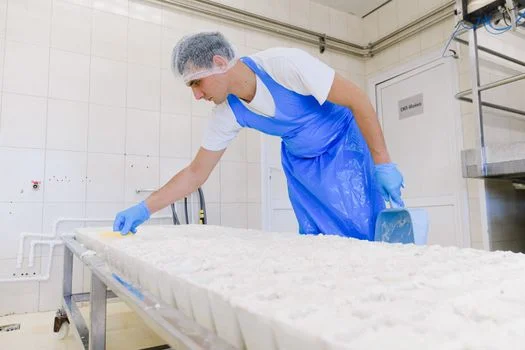
Material selection drives both regulatory pass-fail and day-to-day cleanability. Stainless steel frames and plates resist corrosion, survive repeated CIP, and shed biofilm faster than coated alternatives. Match the grade to the chemistry on site, not a generic catalog line.
- Stainless Steel Grades: 304 stainless steel covers most general food processing. 316 or 316L stainless steel is specified where chloride exposure is high or where the line welds and then runs hot CIP cycles, since 316L's lower carbon limits intergranular corrosion after welding.
- FDA Compliance: Polypropylene plates meet 21 CFR 177.1520. Nylon filter cloths meet 21 CFR 177.1500. EPDM and silicone gaskets and seals meet 21 CFR 177.2600 (rubber articles for repeated use; 21 CFR 177.2410 covers phenolic resins, not elastomers). Each citation governs extractables and food-contact safety for that component.
- Sanitization: A Clean-in-Place (CIP) cycle on a food-grade press typically runs an initial water rinse to clear gross solids, an alkaline wash (often caustic soda) to break down organics, an intermediate rinse, an acid rinse (commonly nitric acid) to strip mineral scale and neutralize alkalinity, and a final sanitizing step with a chemical such as chlorine dioxide. For related disinfection design, see FDA-compliant disinfection systems for food processing equipment.
- Cloth Lifespan: Food-grade cloths are built for repeated sanitization, typically lasting 500–1,000 cycles compared with 200–300 cycles for non-food-grade cloth, which lowers annual replacement spend and downtime.
Automation Levels: Manual, Semi-Automatic, and Fully Automatic
The automation level sets both the capital check and the headcount on shift. Match it to throughput, available labor, and how the plant absorbs downtime. Manual units fit low-volume or batch work; fully automatic presses earn their keep when the line runs two or three shifts.
- Manual Systems: CapEx $10,000–$50,000. They need 2–3 operators per shift to shift plates, discharge cake, and clean cloth, with cycle times of 30–60 minutes. Manual fits when labor cost is secondary and runs are short.
- Semi-Automatic Systems: CapEx $50,000–$150,000. Hydraulic closing and often a single plate shifter cut labor to about one operator, and cycle times drop to 15–30 minutes. Mid-sized plants get most of the labor benefit without the full automation spend.
- Fully Automatic Systems: CapEx $150,000–$500,000. PLC control, hydraulic plate shifting, automatic cake discharge (vibrating frames or plate shakers), and integrated cloth washing leave the operator in a monitoring role. Cycle times fall to 5–15 minutes. On 24/7 lines, labor savings of 40–60% typically pay back the unit in under 18 months.
| Feature | Manual System | Semi-Automatic System | Fully Automatic System |
|---|---|---|---|
| Capital Expenditure (CapEx) | $10K–$50K | $50K–$150K | $150K–$500K |
| Labor Requirement | 2–3 operators per shift | 1 operator | Zero-touch (monitoring only) |
| Cycle Time | 30–60 minutes | 15–30 minutes | 5–15 minutes |
| Plate Shifting | Manual | Manual/Single Automatic | Fully Automatic Hydraulic |
| Cake Discharge | Manual | Manual/Assisted | Automatic (vibration/shaker) |
| Cloth Washing | Manual | Manual | Automatic (integrated) |
| Control System | Basic push-button | Basic PLC/Relay | Advanced PLC (HMI, data logging) |
| Typical ROI | Longer (lower CapEx, high OPEX) | Medium (balanced) | Short (<18 months for 24/7 ops) |
Cost-Benefit Analysis for Food Processors
The capital line looks large until you stack it against three years of labor, yield, and waste savings. Procurement teams should treat the press as an operating decision, not just a purchase order, because OPEX swings more than the CapEx spread across the three automation tiers.
Capital Expenditure (CapEx) Breakdown:
- Manual Filter Press: $10,000–$50,000. Small footprint, minimal automation, fits craft and pilot lines.
- Semi-Automatic Filter Press: $50,000–$150,000. Hydraulic closing and sometimes a single plate shifter.
- Fully Automatic Filter Press: $150,000–$500,000. PLC automation, larger capacity, and specialized food-grade components.
Operational Expenditure (OPEX) Factors (Annual Estimates):
- Labor Costs: The biggest swing factor. Manual units run $30,000–$100,000 per year per unit in operator time, while fully automatic presses trim that by 40–60%.
- Filter Cloths: $2,000–$10,000 per year, driven by cloth material and CIP cycle count.
- Maintenance and Spare Parts: $5,000–$20,000 per year, covering routine checks, gasket replacement, and hydraulic service.
- Energy Consumption: $1,000–$5,000 per year, mostly the hydraulic pump and control system.
Tangible Savings and Benefits:
- Labor Reduction: Automation cuts labor 40–60% and frees operators for sanitation and changeover.
- Yield Improvement: Drier cake and tighter separation add 5–15% to recovered product in juice and oil lines.
- Downtime Reduction: Automated sequencing and food-grade design cut unplanned downtime 20–30%.
- Reduced Waste Disposal Costs: Lower cake volume reduces hauling fees and disposal surcharges.
Return on Investment (ROI) Calculator:
The ROI formula is:
ROI = (Annual Savings − Annual OPEX) ÷ CapEx
Worked example: a juice producer installs a fully automatic plate frame filter press at a CapEx of $200,000. Annual savings from reduced labor, higher yield, and lower waste disposal total $120,000. Annual OPEX for cloths, maintenance, and energy is $15,000. Annual Net Savings = $120,000 − $15,000 = $105,000. ROI = $105,000 ÷ $200,000 = 0.525, or 52.5% per year, giving a payback period of about 1.9 years.
Troubleshooting Common Food-Grade Filtration Issues
Most downtime on a food-grade press comes from four recurring causes: clogged cloth, sticky cake, contamination, and leaks. Catching each early keeps the line inside its cleaning window and the product inside spec.
- Clogging: High solids load, an overly fine cloth, or missing pre-filtration are the usual culprits. Adding pre-filtration upstream of the plate frame filter press, matching cloth pore size to actual particle distribution, and backwashing on a fixed interval restore flow. Routine cloth replacement every 500–1,000 cycles prevents falling throughput.
- Cake Discharge Failures: Check hydraulic pressure first, then plate alignment, before assuming a chemistry problem. A sticky cake often points to feed pH, feed temperature, or missing filter aid. Recalibrating PLC plate-shift speed and sequence clears most automatic-discharge faults.
- Contamination: Non-food-grade replacement parts, weak CIP, or worn seals are the three root causes we see in audits. Insist on FDA-compliant materials, run the full five-step CIP cycle, and replace gaskets on a fixed interval rather than at failure.
- Leaks: Worn gaskets, cracked plates, or low closing pressure cause almost every external leak. Inspect gaskets for compression set, inspect plates for cracks after a pressure event, and confirm the hydraulic pack reaches its rated closing pressure across the plate stack.
Who This Guide Is For and Who Should Look Elsewhere
This page fits plant engineers, EPC contractors, and procurement managers specifying a plate frame filter press for food processing on juice, dairy, or edible oil lines that need FDA, HACCP, and ISO 22000 compliance. If you are sizing a municipal biosolids dewatering line or a mining tailings circuit, the same plate-frame mechanics apply but the materials and CIP rules differ, so start with our Plate and Frame Filter Press for Sludge Dewatering page instead.
Send your feed slurry specs, target throughput, and automation preference to our engineering team and we will size a press to your duty cycle.
Request a quote with your feed slurry analysis, target throughput, and duty cycle, and our engineers will size a plate frame filter press to your line.
Frequently Asked Questions
What are the primary advantages of a plate frame filter press over a centrifuge for juice clarification?
Plate frame filter presses hit cake moisture of 20–30%, against 40–50% for centrifuges, which lifts juice yield and reduces waste volume. They also retain finer particles, giving the clear, polished look premium juice products need. Lower hauling fees follow from the drier cake, so OPEX falls even when CapEx sits higher than a centrifuge package.
How do plate frame filter presses meet strict food safety and hygiene standards?
Food-grade presses use 304 or 316L stainless steel, polypropylene plates, and EPDM or silicone gaskets specified under FDA 21 CFR food-contact rules and plant CGMPs in Part 117. Integrated Clean-in-Place cycles run alkaline, acid, and sanitizer steps that control microbial growth and cross-contamination under HACCP and ISO 22000 programs.
What is the typical lifespan of filter cloths in food processing applications?
Polypropylene and nylon food-grade cloths last 500–1,000 filtration cycles because they tolerate repeated CIP exposure. Non-food-grade cloths run 200–300 cycles, which roughly triples annual replacement spend on the same line. Spec cloth pore size to the actual particle distribution so cycles are not wasted on premature blinding.
Can an existing manual plate frame filter press be upgraded to semi-automatic or fully automatic?
Some pieces, like a hydraulic closing unit or a single plate shifter, retrofit cleanly. A full manual-to-automatic conversion usually needs a new frame, plate pack, and control system, so most plants find it cheaper to replace the press than to rebuild it, especially on regulated food lines.
What factors drive ROI on an automated plate frame filter press in a food plant?
Labor savings of 40–60%, yield gains of 5–15% from drier cake, and a 20–30% drop in unplanned downtime are the three numbers that move ROI. On 24/7 lines, those combined savings typically pay back a fully automatic press in under 18 months when CapEx sits in the mid-range of the $150,000–$500,000 band.
How does filter press maintenance affect food-safety compliance?
Scheduled maintenance keeps seals, gaskets, and cloth inside their hygienic operating window, which is what auditors check first. A documented routine, replacing gaskets before they fail and logging CIP cycle parameters, protects both uptime and your HACCP records on every shift audit.
Related Equipment
- CIP-compatible disinfection systems for food-grade filter presses — view specifications, capacity range, and technical data
Need a customized solution? Request a free quote with your specific flow rate and pollutant parameters.