Municipal sewage treatment in Egypt: what plants must deliver
Municipal sewage treatment in Egypt serves about 110 million residents generating roughly 12 million m³/d of wastewater, with earlier World Bank-linked estimates placing treated share near 50%. Untreated discharges from overloaded Cairo plants still stress the Nile under Law 48/1982. New Cairo, planned for 1.5 million people since 2000, began with little treatment capacity and leaned on freshwater irrigation. Egypt's 2020 National Water Strategy targets 100% wastewater reuse by 2030, so plants must reach Class A reuse quality with TSS below 10 mg/L.
Municipal plants targeting reuse typically design to BOD₅ ≤ 30 mg/L, COD ≤ 50 mg/L, and TSS ≤ 10 mg/L, with fecal coliforms ≤ 1,000 CFU/100 mL. CAPEX spans about $5M–$200M by population equivalent and process train. Hybrid A/O–DAF–MBR systems often cut standalone MBR CAPEX by about 30% when land and reuse class allow.
Ministry of Housing figures for June 2026 report about 621 wastewater plants and roughly 19 million m³/d of installed capacity, up from 385 plants before 2014, including 47 tertiary facilities. That capacity expansion narrows the historic treatment gap but does not remove Law 48/1982 compliance pressure on sludge and Nile discharges. Non-compliance still drives penalties that hit municipal budgets and public health outcomes.
Egypt’s 2026 effluent standards: what your plant must achieve
Egypt municipal sewage plants on reuse schemes still design to Law 48/1982 reuse packages that specify BOD₅ ≤ 30 mg/L, COD ≤ 50 mg/L, and TSS ≤ 10 mg/L. Class A reuse requires fecal coliforms ≤ 1,000 CFU/100 mL, usually met with chlorine dioxide (ClO₂) or UV. Sludge for land application must reach volatile solids ≤ 15%, often via anaerobic digestion or lime. These reuse targets sit beside WHO 2022 irrigation guidance and the EU Urban Waste Water Directive (91/271/EEC).
Separately, Law 48/1982 drain-discharge limits under the 2013 modifications set BOD 60 mg/L, COD 80 mg/L, and TSS 50 mg/L for WWTP effluent to drains (World Bank ESSA). Residual free chlorine after disinfection should sit at 0.5–1 mg/L. Buyers should confirm whether a tender cites drain discharge, Code 501 irrigation grades, or stricter Class A reuse wording before locking guarantees. For industrial discharge context beside municipal plants, see the Egypt wastewater discharge standards guide.
| Parameter | Egypt Law 48/1982 (2020 Amendments) | WHO 2022 (Reuse for Agriculture) | EU UWWTD (91/271/EEC) |
|---|---|---|---|
| BOD₅ (mg/L) | ≤ 30 | ≤ 10 (restricted irrigation) | ≥ 70% reduction / ≤ 40 mg/L |
| COD (mg/L) | ≤ 50 | N/A (BOD is primary indicator) | ≥ 75% reduction / ≤ 125 mg/L |
| TSS (mg/L) | ≤ 10 | ≤ 10 (unrestricted irrigation) | ≥ 90% reduction / ≤ 35 mg/L |
| Fecal Coliforms (CFU/100mL) | ≤ 1,000 | ≤ 1,000 (unrestricted irrigation) | N/A (focus on BOD/COD/TSS) |
Advanced disinfection for Class A reuse can use chlorine dioxide generators when residual pathogen control is specified in HCWW tenders. Cross-check numeric limits against the companion Egypt effluent compliance limits page when a site mixes municipal and industrial loads.
Process designs for Egypt’s municipal sewage: MBR vs A/O vs DAF vs hybrid systems
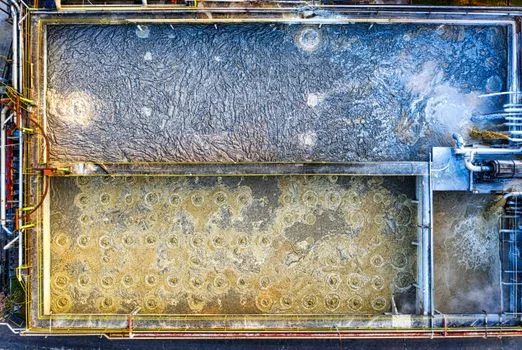
Process choice for municipal sewage treatment in Egypt turns on effluent class, footprint, and energy. Membrane Bioreactor (MBR) trains such as the DF series deliver COD < 30 mg/L with 0.1 μm pores, using about 0.2–0.4 m²/m³/day and 0.6–1.2 kWh/m³. Most plants we size for Class A reuse in dense new cities lean MBR or MBR hybrids when land is scarce. Attached-growth / activated-sludge (A/O) packages such as the WSZ series reach 92–97% COD removal on 50–500 mg/L influents, with HRT 6–12 h and CAPEX about $800–$1,500/m³/day.
Dissolved Air Flotation (DAF) units remove about 95% TSS with 30–50 μm bubbles and 10–30 mg/L PAC. Hybrid A/O + DAF + MBR trains meet Class A targets at roughly 30% lower CAPEX than standalone MBRs, as shown on New Cairo WWTP logic. Plate-frame filter presses cut sludge volume by up to 70% versus centrifuges and leave 65–75% cake moisture. Small municipalities often start with an underground A/O system, then add DAF pre-treatment when grit and FOG loads rise.
Where reuse contracts lock COD < 30 mg/L and TSS ≤ 10 mg/L, MBR systems shorten the polishing train.
What is the CAPEX and OPEX breakdown for Egyptian municipal WWTPs?
CAPEX for municipal sewage treatment plants in Egypt runs from about $5M to $200M with capacity, process depth, and civil intensity. Plants below 20,000 PE usually need $5M–$15M, driven by packaged MBR or A/O skids at $800–$1,500/m³/day. Mid-scale plants (20,000–100,000 PE) sit near $15M–$60M once reinforced basins, DAF pretreatment, and ClO₂ polishing enter the bill. Flagship expansions such as Alexandria East and 6th of October can exceed $60M and approach $150M–$200M when land, sludge halls, and SCADA are included.
Civil works typically take 35–45% of Egyptian municipal CAPEX, electro-mechanical equipment 30–40%, and instrumentation/automation 8–12%. A mid-scale 50,000 PE plant commonly lands at $25M–$45M, depending on disinfection and basin depth. Coastal and desert sites add import logistics and temporary power that most inland Delta plants avoid.
How do OPEX drivers compare with CAPEX on Egyptian municipal plants?
OPEX on Egyptian municipal WWTPs is dominated by power, chemicals, sludge haul, and staffing once the plant is online. Energy often tracks 0.6–1.2 kWh/m³ on MBR duty and less on conventional A/O at the same COD load. PAC dosing at 10–30 mg/L plus ClO₂ or UV consumables set the chemical line. Sludge haul falls sharply when presses hold 65–75% cake moisture. Most plants we commission for HCWW-style duty run power and sludge as the first two OPEX lines to stress-test before tariff talks.
Selection checklist before freezing the bid. Confirm drain versus reuse limits and lock PE with peak/average m³/d. Choose MBR, A/O, DAF, or hybrid, then size disinfection for ≤ 1,000 CFU/100 mL. Set sludge route to ≤ 15% volatile solids where land use applies. Price civil share at 35–45% of CAPEX and require FAT plus EN 12255-9 evidence.
PPP models and supplier selection for Egypt municipal plants
Egypt's Holding Company for Water and Wastewater (HCWW) leans on PPP and BOT models to add municipal sewage capacity. Concessions commonly run 20–30 years, with tariffs indexed to Egyptian Pound inflation and capped by the Egyptian Regulatory Authority for Wastewater. Supplier screening should cover ISO 9001 and ISO 14001 certificates, prior HCWW references, service depots in Cairo and Alexandria, factory acceptance testing (FAT), and performance guarantees on BOD, COD, and TSS.
Buyers should verify EN 12255-9 alignment for municipal works and insist on third-party witness testing before shipment. Letters of credit through Egyptian banks (NBE, CIB) remain standard above $1M. Coastal industrial corridors such as Hurghada industrial wastewater treatment and Sharm El Sheikh industrial wastewater treatment use related effluent logic but different salinity and tourism-peak patterns than inland municipal plants.
Who this is for / next step
This guide is for municipal utilities, EPC contractors, and procurement teams sizing New Cairo, Alexandria, and secondary-city plants against reuse or Law 48/1982 discharge limits. Look elsewhere if you only need a septic package under a few hundred m³/d with no reuse clause. To match process train, CAPEX band, and disinfection to your PE and effluent class, request a plant-specific quote with flow, BOD/COD/TSS, and reuse or drain limits.
Frequently Asked Questions
What effluent limits apply to municipal WWTPs in Egypt in 2026?
Reuse-oriented Law 48/1982 packages commonly require BOD₅ ≤ 30 mg/L, COD ≤ 50 mg/L, TSS ≤ 10 mg/L, and fecal coliforms ≤ 1,000 CFU/100 mL. Drain discharge under the 2013 Law 48 modifications is looser at BOD 60 mg/L, COD 80 mg/L, and TSS 50 mg/L. Always read which limit set the tender cites before guaranteeing performance.
What is the typical CAPEX for a 50,000 PE municipal sewage plant in Egypt?
A mid-scale 50,000 PE plant generally needs $25M–$45M in Egypt. Cost moves with civil share, often 35–45% of CAPEX, plus process choice among A/O, DAF, MBR, or hybrid trains. Packaged equipment alone often prices near $800–$1,500/m³/day before basins, sludge halls, and SCADA are added.
Is MBR or A/O better for Egyptian municipal sewage?
MBR gives the strongest path to Class A reuse when land is tight and COD < 30 mg/L is locked. A/O offers about 30% lower CAPEX where land exists and reuse is less strict. Hybrid A/O–DAF–MBR trains are the usual compromise on New Cairo-scale schemes.
How long does construction take for a 100,000 m³/day WWTP in Egypt?
Design, permitting, and construction typically need 24–36 months for a 100,000 m³/day municipal WWTP in Egypt. Commissioning and performance testing usually add another 6 months before takeover. PPP or BOT awards can extend early phases while financing packages and land acquisition close.
What disinfection system is preferred for Class A reuse?
Chlorine dioxide generators and UV systems are both accepted for Class A fecal limits. ClO₂ provides a longer residual and appears often in HCWW tender preferences. Final choice should follow residual chlorine rules when the outfall is a Law 48/1982 drain discharge.
Further Reading
Explore these in-depth articles on related wastewater treatment topics: