In 2025, wastewater treatment plant costs in Bloemfontein range from R500,000 for a 10 m³/day compact MBR system to R5.2 billion for a 200,000 m³/day municipal plant like Botshebelo WWTP. Capital costs average R15,000–R30,000 per m³/day capacity, while operational expenses add R2–R5 per m³ treated. Local compliance—including DWS discharge fees (R1.20–R3.50/m³) and NEMA permits (R50,000–R200,000)—can inflate total costs by 15–25%. This guide provides Bloemfontein-specific cost benchmarks, tech comparisons, and compliance insights to help industrial and municipal buyers budget accurately.
Why Bloemfontein’s Wastewater Treatment Costs Are Higher Than National Averages
Industrial discharge into the Bloemspruit catchment requires effluent standards that are 20–30% more stringent than the South African national average due to the limited dilution capacity of local water bodies. Unlike plants in coastal regions that may utilize deep-sea outfalls, facilities in Bloemfontein’s industrial zones, such as Bloemfontein NE and Botshebelo, must treat wastewater to a high clarity (COD <75 mg/L, TSS <25 mg/L) before it enters the sensitive Bloemspruit system. This requirement necessitates advanced secondary or tertiary treatment stages, which naturally elevates both initial capital investment and ongoing energy consumption.
Department of Water and Sanitation (DWS) discharge fees in the Mangaung Metropolitan Municipality are approximately 15% higher than those in Gauteng. For an industrial facility processing 1,000 m³/day, a discharge fee of R3.50/m³ for effluent with COD levels exceeding 75 mg/L adds R1.27 million to annual operating expenses (OPEX). These fees are structured to penalize high-strength discharge, making high-efficiency MBR systems for hospital and municipal wastewater in Bloemfontein a more financially viable long-term investment compared to basic aerobic systems that might struggle with fluctuating industrial loads.
Compliance with the National Environmental Management Act (NEMA) also carries a higher price tag locally. Environmental permits for plants exceeding 5,000 m³/day in Bloemfontein typically cost between R150,000 and R200,000. This is driven by the requirement for intensive air quality monitoring and odor control measures in proximity to residential developments. A recent case study of a Bloemfontein-based food processor highlighted these risks: the project initially budgeted R8 million for a treatment plant but faced a 30% overrun when DWS mandated additional nitrogen removal stages to meet 2024 Bloemspruit discharge standards.
The costs associated with NEMA permits and DWS discharge fees in Bloemfontein can significantly impact the total cost of ownership for wastewater treatment plants. For example, a plant with a capacity of 10,000 m³/day may incur annual DWS discharge fees of R3.5 million and NEMA permit costs of R200,000.
| Region | Avg. DWS Discharge Fee (R/m³) | NEMA Permit Cost (Range) | Effluent COD Limit (mg/L) |
|---|---|---|---|
| Bloemfontein (Mangaung) | R1.20 – R3.50 | R50,000 – R200,000 | <75 |
| Gauteng (Johannesburg) | R1.10 – R3.00 | R45,000 – R180,000 | <85 |
| Cape Town (Coastal) | R0.90 – R2.80 | R50,000 – R150,000 | <100* |
*Note: Coastal limits vary based on outfall distance. (HydropureWater field data, 2025)
Bloemfontein Wastewater Treatment Plant Cost Breakdown: CAPEX vs. OPEX by System Type
Capital expenditure (CAPEX) for wastewater treatment plants in Bloemfontein averages R15,000 to R30,000 per m³/day of capacity, with the specific technology choice serving as the primary cost driver. Anaerobic/Oxic (A/O) systems generally represent the lower end of the CAPEX spectrum but require significantly more land, which can be a hidden cost in dense industrial parks. Conversely, DAF systems for Bloemfontein’s food processing and industrial wastewater offer a middle-ground investment, specifically optimized for removing fats, oils, and grease (FOG) which are prevalent in the local manufacturing sector.
Operational expenses (OPEX) are increasingly dominated by energy and chemical costs. In Bloemfontein, electricity accounts for 40–50% of OPEX for MBR systems due to the aeration required for membrane scouring. However, these systems reduce chemical dependency compared to DAF units, which require coagulants and flocculants. When evaluating the total cost of ownership, buyers must also account for sludge disposal fees, which in the Free State range from R800 to R1,500 per ton. Selecting a system with high solids retention can significantly lower these recurring disposal costs.
| System Type | CAPEX (per m³/day) | OPEX (per m³ treated) | Typical Application |
|---|---|---|---|
| MBR (Membrane Bioreactor) | R22,000 – R30,000 | R3.50 – R5.00 | Hospitals, High-spec Industrial |
| DAF (Dissolved Air Flotation) | R15,000 – R22,000 | R2.50 – R4.00 | Food Processing, Textiles |
| A/O (Anaerobic/Oxic) | R8,000 – R15,000 | R1.50 – R2.50 | Municipal, Rural Settlements |
For instance, a textile plant in Bloemfontein processing 500 m³/day recently invested R12 million in a DAF-based system. While the CAPEX was R24,000/m³/day (including civil works and NEMA permitting), the annual OPEX was calculated at R584,000. This breakdown included R219,000 for energy, R182,500 for chemicals, and R182,500 for labor and maintenance. When comparing how Western Cape’s WWTP costs compare to Bloemfontein’s, the higher local DWS fees often result in a faster ROI for plants that achieve higher effluent quality, as they avoid the most expensive discharge tariff tiers.
MBR vs. DAF vs. A/O: Tech Comparison for Bloemfontein’s Effluent Standards
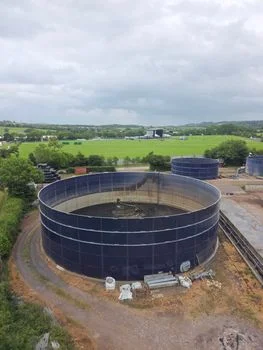
Membrane Bioreactor (MBR) systems achieve a 98% removal rate of pharmaceutical residues, making them the primary technical requirement for Bloemfontein’s hospital wastewater compliance where antibiotic persistence is a major regulatory concern. In contrast, Dissolved Air Flotation (DAF) is the preferred technology for industrial zones dealing with high Total Suspended Solids (TSS) and organic loads. While MBR provides the highest quality effluent—often exceeding DWS 2024 requirements with COD <50 mg/L—it carries a higher energy footprint that must be justified by the specific sensitivity of the discharge point.
For municipal developments or rural projects near Botshebelo, underground A/O systems for rural and municipal projects in Bloemfontein offer a low-maintenance solution. These systems utilize natural biological processes to reduce nitrogen and phosphorus. While their footprint is approximately 60% larger than an MBR system, the reduction in mechanical complexity leads to lower long-term maintenance costs. This is particularly beneficial in areas where specialized technical labor is less available.
| Feature | MBR System | DAF System | A/O System |
|---|---|---|---|
| COD Removal | >95% (<50 mg/L) | 70-85% (<150 mg/L) | 85-90% (<75 mg/L) |
| Footprint | Very Compact | Modular/Skid | Large (Land Intensive) |
| Energy Use | High (2.5 kWh/m³) | Medium (1.2 kWh/m³) | Low (0.8 kWh/m³) |
| Chemical Use | Low | High | Medium |
Industrial facility owners must weigh these trade-offs carefully. A 1,000 m³/day plant using MBR technology may save R180,000 per year in chemical costs compared to DAF, but it will likely consume R450,000 more in electricity. However, the MBR system produces water of such high quality that it can be reused for cooling towers or irrigation, potentially saving the facility R10.50/m³ in municipal water purchase costs, which significantly shifts the ROI in favor of advanced membranes.
Bloemfontein Compliance Checklist: DWS, NEMA, and Local Discharge Requirements
The Department of Water and Sanitation (DWS) 2024 revised limits for Bloemfontein mandate a Chemical Oxygen Demand (COD) of less than 75 mg/L for all industrial discharges into municipal sewers that eventually reach the Bloemspruit. Failure to meet these standards results in tiered penalties. For example, a 2,000 m³/day plant discharging effluent with a COD of 80 mg/L would be moved to the highest fee tier, resulting in annual discharge costs of approximately R2.1 million.
NEMA environmental permits are another critical hurdle, requiring a process that typically spans 6 to 12 months. This includes a full Environmental Impact Assessment (EIA) for larger plants and rigorous air quality monitoring to ensure that hydrogen sulfide (H2S) emissions do not impact surrounding communities. In Bloemfontein, the cost for these permits ranges from R50,000 for small industrial units to R200,000 for municipal-scale infrastructure.
| Compliance Parameter | DWS Limit (2024) | Monitoring Frequency | Non-Compliance Risk |
|---|---|---|---|
| COD | < 75 mg/L | Weekly | High (Tiered Fees) |
| TSS | < 25 mg/L | Weekly | Moderate (Clogging) |
| pH | 6.0 – 9.0 | Continuous | High (Pipe Corrosion) |
| Fecal Coliforms | < 1,000 CFU/100ml | Monthly | Legal Action/Fines |
Local constraints also include specific monitoring for pharmaceutical residues in hospital effluents. Research has shown that Bloemfontein’s municipal plants are not fully equipped to handle high concentrations of ciprofloxacin and other antibiotics. Consequently, new healthcare facilities are often required to install onsite pretreatment systems that target these specific micro-pollutants before they enter the municipal grid.