Photovoltaic wastewater treatment plant energy autonomy targets 98% by pairing 500 kW–2 MW solar arrays with a hybrid DAF-RO-MBR train, SiC inverters at 98.5% efficiency, and 4–8 hour storage. Plant-level LCOE lands near $0.12/kWh, against IRENA's $0.044/kWh utility-scale solar benchmark.
What Does Photovoltaic Wastewater Treatment Plant Energy Autonomy Mean in 2027?
Energy autonomy here means the fraction of annual plant demand met by on-site PV, biogas and storage rather than grid draw: (annual PV generation + biogas + storage discharge) / annual demand. A 2027 hybrid DAF-RO-MBR package reaches about 98%, with 500 kW–2 MW arrays, 98.5% SiC inverters and footprint near 40% of a clarifier baseline.
A PVWWTP, also written PV-WWTP, couples on-site solar arrays with a hybrid DAF-RO-MBR train to reach about 98% energy autonomy and a plant-level LCOE near $0.12/kWh under typical 2027 design assumptions. Core specs for the facilities we size in this class include 500 kW–2 MW PV capacity scaled to flow, 0.1 μm PVDF MBR membranes with 99.9% pathogen removal, and SiC inverters at 98.5% DC-AC conversion efficiency. The layout drops secondary clarifiers, cuts footprint by about 60% versus conventional A/O, and targets COD ≤50 mg/L with TSS ≤10 mg/L.
Traditional treatment often takes roughly 30% of a municipal utility energy budget, so power price swings hit OPEX first. A 5 MGD (about 18,900 m³/d) California plant on full grid supply can spend about $2.4M per year on electricity; the same flow on a solar-hybrid model can fall near $120,000 per year when arrays, storage, and high-efficiency modules are matched to the aeration floor. Grid electricity rose about 22% between 2020 and 2025 in many U.S. utility books, while solar costs kept falling.
Earlier project notes cited a roughly 45% drop in solar PV LCOE between 2020 and 2025. According to IRENA (2026), the global weighted-average utility-scale solar PV LCOE in 2025 stayed at USD 44/MWh ($0.044/kWh), unchanged from 2024 — so the $0.12/kWh figure in this article is a plant-level hybrid LCOE that includes treatment loads and storage, not bare utility PV alone.
Tighter discharge permits push more sites toward energy-heavy MBR and RO polishing. EPA effluent guidelines remain technology-based standards issued industry category by category rather than a single national COD number, as the agency's own program pages state (US EPA). Many 2027 reuse and industrial permits still force COD near ≤50 mg/L, and engineers then cover the extra kWh with renewables. A 2026 Arizona case on a 10 MGD plant with a 1.8 MW PV array plus anaerobic digestion reported 92% autonomy through peak summer cooling loads.
Resilience matters as much as unit cost. Islanded operation keeps sanitation online during outages if batteries or biogas cover overnight aeration. For broader cost context on energy consumption in wastewater plant budgets, compare regional OPEX models before locking array size. The guide to Solar Cell Wastewater Treatment Plant: 2027 Hybrid DAF-RO-MBR Specs covers sibling process trains that use the same backbone with different metal and fluoride loads.
What Are the Hybrid DAF-RO-MBR Membrane System Specs for 2027?
Hybrid architecture times high-draw unit operations to the solar generation curve instead of treating PV as a bolt-on credit. SiC inverters at 98.5% DC-AC efficiency cut conversion losses enough to shrink required array area by about 15% for the same treated flow, versus the 2025 silicon baselines most plants we retrofit still carry. Influent sequencing is fixed: solids first, dissolved contaminants second, polish last.
Influent first enters high-efficiency DAF systems for TSS removal in hybrid PV-WWTPs, which remove up to 95% of TSS and FOG. Early solids removal cuts downstream biological and membrane energy by about 20%. Flow then moves through MBR pathogen and organics control, then RO systems for dissolved solids removal in PV-powered wastewater reuse. Clarifiers drop out of the train because they cannot hold the dissolved-contaminant limits that 2027 reuse permits demand.
| Parameter | Conventional A/O + Clarifier | 2027 Hybrid DAF-RO-MBR (PV-Powered) |
|---|---|---|
| Energy Source | Grid Dependent (No On-Site PV) | 98% PV + Storage Autonomy |
| Inverter Efficiency | N/A | 98.5% (SiC Technology) |
| Footprint Requirement | Baseline (1.00x) | 40% (60% Reduction) |
| Effluent COD | <100 mg/L | <30 mg/L (EPA 2027 Compliant) |
| Primary Driver | Gravity/Settling | Membrane Flux/Pressure Optimization |
Storage closes the night gap. Lithium-ion banks with about 4-hour usable capacity cover rapid solar swings and peak shaving, while vanadium flow batteries at 8-hour-plus depth cover overnight blower duty. That split keeps the detailed 2027 hybrid DAF-RO-MBR equipment specs and cost models online without defaulting to the grid after sunset.
What Drives PVDF vs Ceramic Membrane MBR Fouling Cost?

Membrane fouling often accounts for about 40% of MBR/RO maintenance cost through chemicals and downtime. On a solar-hybrid plant, rising transmembrane pressure (TMP) burns scarce daytime kWh and overnight storage — so membrane choice directly sets array size. For municipal duty in 2027 projects, 0.1 μm PVDF remains the cost baseline at about $80/m² with an 8–10 year life when CIP is automated.
Industrial streams with COD >1,000 mg/L more often justify SiC membranes at about $350/m². SiC recovers about 95% of flux after CIP versus roughly 70–75% for PVDF, so pumps run at lower pressure and the array plus battery package can shrink. Alumina ceramic at 0.01–0.05 μm is usually reserved for semiconductor and pharma reuse, where reclaiming high-value materials such as GaN pays the premium. Buyers comparing +ceramic membranes wstewater options should price flux recovery against PV and storage CAPEX, not membrane sticker price alone.
| Membrane Material | Pore Size (μm) | Flux Recovery (CIP) | Lifespan | Best Use Case |
|---|---|---|---|---|
| PVDF | 0.1 | 70-75% | 8-10 Years | Municipal & General Industrial |
| SiC (Silicon Carbide) | 0.1 | 95% | 15+ Years | Food/Beverage & High-COD Industrial |
| Ceramic (Alumina) | 0.01 - 0.05 | 98% | 20 Years | Semiconductor & Pharma Reuse |
To hold those recovery numbers, 2027 zero-fouling MBR systems with 0.1 μm PVDF membranes run scheduled CIP: NaOH at pH 12 for organics, citric acid at pH 2 for inorganic scale, and targeted ozone for biofouling. Automating those cycles through a PLC-controlled chemical dosing for PV-WWTP pH adjustment and disinfection keeps solar power on useful hydraulic work instead of fighting clogged modules.
What Is the 98% Energy Autonomy Wastewater Plant Benchmark?
The 98% energy autonomy wastewater plant benchmark counts only on-site sources: annual PV generation, biogas contribution and storage discharge, divided by annual total energy demand, expressed as a percentage. A 5 MGD digestion plant typically needs about a 5 MW array plus 4 MWh of lithium-ion storage to clear it. That package holds permit limits through consecutive cloudy days without heavy grid imports, which is the point of the number.
Aeration sets the floor the benchmark must cover. Aeration blowers typically take 50–60% of plant electricity, and reference studies put aeration at 25–60% of wastewater treatment plant energy use, with sludge treatment another third of POTW electricity (University of Michigan CSS). About 2% of U.S. electricity goes to pumping and treating water and wastewater in total (University of Michigan CSS). For 98% autonomy, the array must cover daytime blower load and still charge storage for 14–16 non-generating hours.
How Does SiC Inverter Wastewater Plant Array Sizing Work?
SiC inverter wastewater plant array sizing starts from the aeration load floor — the minimum overnight power that keeps biomass alive — not from a rooftop solar spreadsheet. A practical 2027 rule of thumb is 1 MW PV per 1 MGD when anaerobic digestion supplies supplemental biogas. Aerobic-only plants often need about 1.5 MW per 1 MGD, because blowers and recycle pumps never sleep.
Silicon carbide inverters at 98.5% efficiency cut conversion losses and support about a 15% lower panel count versus 2025 benchmarks, which matters when land is scarce. Procurement teams then track the result as [(Annual PV Generation + Biogas Contribution + Storage Discharge Budget) / Annual Total Energy Demand] × 100. If you need a definition-level primer on a full photovoltaic wastewater treatment plant selection path, use that sibling guide for 2025 cost models, then return here for 2027 autonomy and membrane sizing rules.
Hybrid CAPEX, OPEX, and ROI Versus Conventional Trains
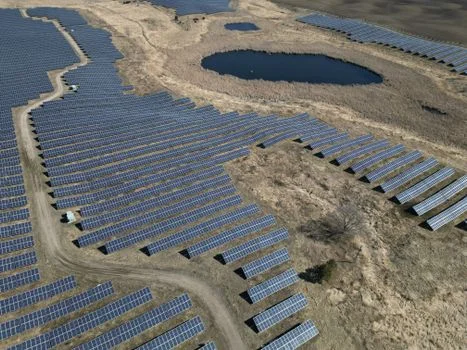
Installed CAPEX for a hybrid DAF-RO-MBR train with solar and storage runs near $3.2M per MGD in the estimates used here. A conventional A/O plant with clarifiers lands near $4.1M per MGD once land take and large settling structures are counted. The hybrid package therefore often wins on total installed cost before OPEX is even modeled.
With a plant-level LCOE of $0.12/kWh, treated-water OPEX falls near $0.45/m³ versus about $0.72/m³ on grid-only power under the same duty assumptions. A 5 MGD facility typically reaches payback in about 4.2 years. A 1 MGD plant stretches to about 6.8 years because PV procurement loses scale, yet still beats grid-only TCO across a 20-year horizon.
| Component | % of Total CAPEX | Typical Cost (per MGD) | Maintenance Interval |
|---|---|---|---|
| PV Arrays & Racking | 30% | $960,000 | Annual Cleaning |
| DAF-RO-MBR Modules | 50% | $1,600,000 | 10-Year Membrane Replace |
| SiC Inverters & Storage | 20% | $640,000 | 10-15 Year Service |
Selection checklist before you freeze the bid package:
- Confirm permit COD/TSS and reuse targets (often COD ≤50 mg/L, TSS ≤10 mg/L on 2027 reuse duty).
- Map the 24/7 aeration floor in kW, then size PV and storage to that floor, not to average daytime load alone.
- Choose membrane material from COD and CIP recovery: PVDF ~$80/m² municipal; SiC ~$350/m² high-COD industrial.
- Require SiC or equal inverter efficiency near 98.5% DC-AC if land for arrays is limited.
- Split storage: ~4 h lithium-ion for ramps, ≥8 h flow battery or biogas for overnight blowers.
- Model LCOE and $/m³ with and without 14–16 h non-generation, using $0.12/kWh only if storage is in scope.
- Budget membrane replacement at year 8–10 for PVDF and verify CIP chemical volumes in the OPEX sheet.
Who This Is For / Who Should Look Elsewhere / Next Step
This guide is for municipal and industrial buyers sizing solar-hybrid DAF-RO-MBR plants in the 1–10 MGD class who need autonomy, footprint, and membrane decisions in one place. Look elsewhere if you only need a grid-tied conventional A/O upgrade with no reuse limit, or if your site has no land or roof for arrays and no path to off-site PPAs. For a scoped equipment list and duty-point quote, send flow, COD, and autonomy targets through our request-quote form for this PV hybrid specification.
Frequently Asked Questions
What does PVWWTP mean in wastewater engineering?
PVWWTP means a wastewater treatment plant whose process power is sized around photovoltaic generation plus storage, usually with a hybrid DAF-RO-MBR train. In the 2027 design packages discussed here, buyers target about 98% energy autonomy, SiC inverter efficiency near 98.5%, and plant-level LCOE around $0.12/kWh when storage covers overnight aeration.
How much PV capacity do I need per MGD?
Most digestion-assisted plants we size use about 1 MW of PV per 1 MGD of flow. Aerobic-only plants often need about 1.5 MW per 1 MGD because blowers run continuously. A 5 MGD digestion plant aiming at 98% autonomy typically pairs a 5 MW array with about 4 MWh of lithium-ion storage.
When should I choose SiC membranes over PVDF?
Choose SiC when influent COD stays above about 1,000 mg/L and CIP must restore flux near 95%. PVDF at 0.1 μm and about $80/m² still fits most municipal duties with 70–75% flux recovery and an 8–10 year life. SiC at about $350/m² costs more upfront but can shrink pump power, array area, and battery size.
How Realistic Is Solar Wastewater Treatment LCOE 0.12 kWh?
Solar wastewater treatment LCOE of $0.12/kWh is a plant-level hybrid figure, and it is realistic only when storage and process loads are inside the calculation. According to IRENA (2026), global weighted-average utility-scale solar PV LCOE was USD 44/MWh ($0.044/kWh) in 2025, unchanged from 2024. Use the plant figure for TCO, never bare panel LCOE.
What CAPEX share goes to treatment versus solar?
In the per-MGD package used here, DAF-RO-MBR modules take about 50% ($1.6M), PV arrays and racking about 30% ($960,000), and SiC inverters plus storage about 20% ($640,000). Total hybrid CAPEX is about $3.2M per MGD versus roughly $4.1M per MGD for clarifier-heavy A/O when land is included. The split shifts toward solar as autonomy targets rise above 98%.