Why the Baghouse vs ESP Cost Debate Matters for Industrial Compliance
Baghouse vs electrostatic precipitator cost difference is mainly CAPEX versus media-driven OPEX. At 50,000 CFM, baghouse CAPEX is about $200,000–$300,000 versus $350,000–$500,000 for an ESP. Baghouses cost 30–40% less upfront, with OPEX near $0.50–$0.80 per CFM-year versus $0.30–$0.50 for ESPs. Baghouses hold 99%+ fine-particle capture; ESPs fit stable high-temperature, high-volume gas.
Plant managers facing a compliance audit treat this choice as a financial plan, not a preference. Missing EPA New Source Performance Standards (NSPS) or the EU Industrial Emissions Directive (IED) can bring civil penalties of $50,000 to $250,000 per year, plus forced shutdowns. A lower-CAPEX baghouse can fix a budget gap. High-temperature gas that destroys filter media can erase those savings through downtime.
An ESP is rugged for high-volume, high-temperature streams and needs less routine media spend. Its capture of sub-micron particles is weaker than a fabric barrier. That raises risk where PM2.5 limits are tight. The sections below give size-based cost benchmarks, efficiency by particle size, and a TCO selection checklist.
How Baghouses and Electrostatic Precipitators Work: Mechanisms and Efficiency by Particle Size
Baghouses achieve 99%+ efficiency for PM10 and PM2.5 by using a mechanical fabric barrier (EPA AP-42, 2024). In a pulse-jet baghouse, dust builds on the bag exterior and forms a dust cake. That cake raises filtration efficiency until a compressed-air pulse drops the cake into a hopper. Polyester is the usual media; PTFE-coated membranes or fiberglass handle chemical attack or temperatures up to 550°F.
Most plants we size for abrasive kiln or foundry dust run toward the higher cloth-area end to keep ΔP stable. Facilities that need high uptime often specify a Pulse Jet Baghouse Dust Collector with enough filter area to hold low pressure drop. Electrostatic precipitators rely on corona discharge instead of cloth. Discharge electrodes charge particles; grounded plates collect them; rappers drop dust into hoppers.
ESPs can treat gas volumes above 1,000,000 CFM at very low pressure drop. Efficiency often falls to 95–98% for PM2.5 because of particle re-entrainment (Torch Air, 2024). Collected dust can re-enter the gas stream before it reaches the hopper. That gap versus an absolute fabric barrier is why fine-PM permits often favor baghouses.
| Particle Size Category | Baghouse Removal Efficiency (%) | ESP Removal Efficiency (%) |
|---|---|---|
| PM10 (<10 μm) | 99.5% - 99.9% | 99.0% - 99.5% |
| PM2.5 (<2.5 μm) | 99.2% - 99.7% | 96.0% - 98.0% |
| PM1.0 (<1.0 μm) | 98.5% - 99.0% | 92.0% - 95.0% |
Temperature and dust-load stability still separate the two machines in daily operation. Baghouses fail fast on dew-point excursions; condensate turns the cake to mud and blinds the cloth. ESPs tolerate temperature spikes better and can run near 750°F, but they need a steadier dust load. Sudden particulate surges can swamp the ionization field and cut collection sharply (per GSM Industrial, 2023).
Baghouse vs Electrostatic Precipitator Cost Difference by System Size
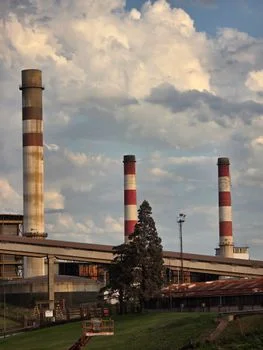
Installed CAPEX for a 50,000 CFM baghouse averages about $250,000, while a comparable ESP often needs about $400,000 (Torch Air, 2024). The gap widens at larger sizes because ESP electrical gear and heavy collection plates scale poorly. Baghouse savings are often eaten by operating cost: pulse compressed air and filter media. Standard polyester bags cost $5–$20 each; specialized PTFE bags can exceed $100 each.
On a 50,000 CFM unit with 500 bags, a full media change every 24 months runs $10,000–$50,000 in materials alone. Component wear differs by design. Baghouse pulse valves cost $200–$500 each and cages $20–$50 each. ESP cost concentrates in high-voltage supplies at $15,000–$30,000 and plate modules at $10,000–$50,000 by alloy.
| System Size (CFM) | Baghouse CAPEX (Installed) | ESP CAPEX (Installed) | Baghouse Annual OPEX | ESP Annual OPEX |
|---|---|---|---|---|
| 10,000 | $60,000 - $90,000 | $120,000 - $180,000 | $6,000 - $8,000 | $3,500 - $5,000 |
| 50,000 | $200,000 - $300,000 | $350,000 - $500,000 | $25,000 - $40,000 | $15,000 - $25,000 |
| 100,000 | $450,000 - $650,000 | $700,000 - $1,000,000 | $50,000 - $80,000 | $30,000 - $50,000 |
ESPs avoid recurring media buys, yet plate fouling is a hidden drain. Poor cleaning can cut efficiency 10–15% over five years and force a $50,000 deep clean or rebuild (HydropureWater field data, 2025). For a 50,000 CFM train, baghouse payback is about 3.5 years under standard maintenance. The ESP usually breaks even against the baghouse around year 7 or 8 because energy and media spend are lower.
Over a 15-year life, the ESP often wins on TCO when dust is stable and coarse. Baghouses win on shorter projects or when dust chemistry would foul plates. Buyers should price hopper heating, fan power, and CEMS scope into both bids before locking the PO.
What drives water treatment plant cost breakdown?
Water treatment plant cost breakdown for a combined air-and-water utility yard is still dominated by hydraulics, solids handling, and utilities. The dust collector is only one line item. Dust control CAPEX sits beside clarifiers, sludge dewatering, and pumps in a full environmental package. For liquid-side separators, see the cost and efficiency comparison for wastewater clarifiers.
Buyers who only compare baghouse and ESP stickers miss shared power, foundation, and monitoring costs. Those shared utilities often move plant-level TCO more than the collector shell price.
How do chemical precipitation costs compare long term?
Chemical precipitation costs on the water line are not interchangeable with dry particulate CAPEX, but the same TCO logic applies. Reagent dose, sludge mass, and labor often outrun the reactor vessel price within a few years. Air-side ESP owners see an analogous pattern: lower media spend, higher sensitivity to process upsets. When teams compare capex and opex across wet and dry trains, hold dust chemistry, temperature, and permit limits constant.
Industrial Use Cases: Which System Wins for Cement, Power, Metalworking, and More
Cement and mining plants standardize on baghouses for high dust loads and abrasive kiln dust. Torch Air case study data (2024) cites about 99.5% efficiency on cement kiln dust. Swapping bag media lets the plant track changing raw mixes without resizing the shell. Many sites pair dust collection with an integrated FGD scrubber for SO₂ and particulate removal for multi-pollutant permits.
In those heavy-dust rooms, an ESP needs a very large plate area to avoid overload. Coal-fired power units still favor ESPs for huge flue-gas flows and temperatures up to about 700°F with low fan ΔP. According to EPA AP-42 data, ESPs reach about 98% efficiency on fly ash. Plates often last 15 years or more in continuous utility service.
Pulp and paper recovery boilers use ESPs on sodium sulfate fume for the same reason. Low grain loading and high temperature make fabric filters a poor fit. Metalworking and pharma usually need baghouse precision. Welding shops use baghouses for hexavalent chromium and related fumes to meet OSHA PEL values of 5 μg/m³.
Pharma trains with HEPA-rated secondary filters reach 99.9% on PM1.0 so active ingredients stay inside the process envelope. Similar matching of separator to particle density shows up in liquid trains when engineers size clarifiers for specific solids.
Compliance and Emission Standards: How Baghouses and ESPs Meet EPA, EU, and Local Rules
Both baghouses and ESPs can meet the EPA NSPS (40 CFR Part 60) particulate limit of 0.03 lb/MMBtu. Baghouses usually keep a wider PM2.5 margin. Field testing shows baghouses near 0.01 lb/MMBtu, while ESPs often sit near 0.02 lb/MMBtu. Under the EU Industrial Emissions Directive (IED), baghouses are often listed as BAT for PM10 below 10 mg/Nm³ and PM2.5 below 5 mg/Nm³.
Some EU permits still push ESP plants toward a wet scrubber polish for fine PM. Local rules such as California’s South Coast AQMD Rule 1150 call for 99%+ PM10 control in listed zones. Baghouses act as absolute filters: a particle passes only if media is torn or bypassed. ESPs are probabilistic: a particle must charge and migrate to a plate before the field ends.
That difference raises ESP risk under ultra-low opacity permits. ESP trains often need richer Continuous Emissions Monitoring Systems (CEMS) for opacity and plate voltage. Those monitors can raise annual compliance cost 10–20% versus a baghouse (per EPA 2023 data). Sites that also treat liquid effluent often fold UV disinfection for industrial wastewater compliance into the same monitoring program.
Decision Framework: How to Choose Between Baghouse and ESP for Your Facility
Correct selection needs dust chemistry, gas temperature, load stability, and money on the same page. The matrix below compresses the trade-offs procurement teams use in bid reviews.
| Factor | Choose a Baghouse If... | Choose an ESP If... |
|---|---|---|
| Particle Size | PM2.5 is >30% of total dust | Dust is mostly coarse PM10 with stable resistivity |
| Gas Temperature | Gas stays within media limits (typically ≤550°F with fiberglass/PTFE) | Continuous gas temperature approaches 700–750°F |
| Dust Load | Load is high, abrasive, or highly variable | Load is steady and grain loading is moderate |
| Project Life | Life is under ~8 years or dust chemistry will change | Life is 15 years+ with stable fuel and ash |
| Fine-PM Permit | PM2.5 or opacity limits are ultra-low | Permit allows ~0.02 lb/MMBtu with CEMS oversight |
| Maintenance Model | Plant can schedule bag changes and pulse-air service | Plant prefers fewer media outages and accepts plate cleaning |
Selection checklist most plants we size still walk before freezing the PO:
- Measure particle-size distribution, including PM2.5 and PM1.0 mass share.
- Map peak and average gas temperature against media or plate limits.
- Quantify dust-load swings over a full production cycle, not a design average.
- Price 10-year media, compressed air, or plate-cleaning labor into TCO.
- Confirm NSPS, IED, or local opacity limits with the same CEMS scope in both bids.
- Check footprint, fan ΔP, and hopper heating needs for winter starts.
- Align expected service life with the 3.5-year baghouse payback versus year 7–8 ESP break-even.
Who This Is For / Who Should Look Elsewhere / Next Step
This comparison is for plant engineers, EPC leads, and procurement managers sizing industrial dust control for cement, metals, power, or process vents. Look elsewhere if you only need a portable shop vac unit or a residential furnace filter. If your duty includes sticky, high-temperature, or PM2.5-heavy dust, send duty-cycle data and permit limits through our request-quote form for baghouse vs ESP sizing so the bid reflects real TCO, not sticker price alone.
Frequently Asked Questions
Is a baghouse cheaper than an electrostatic precipitator?
Yes. Baghouses typically cost 30–40% less in installed CAPEX than ESPs at the same CFM. For 50,000 CFM, baghouse CAPEX is about $200,000–$300,000 versus $350,000–$500,000 for an ESP. Annual OPEX is higher for baghouses at roughly $0.50–$0.80 per CFM versus $0.30–$0.50 per CFM for ESPs, so long-life plants must model TCO, not only the purchase order.
When does an ESP beat a baghouse on total cost?
An ESP usually breaks even against a baghouse around year 7 or 8 when dust load is stable and media changes dominate baghouse spend. Over a 15-year life with high temperature and low ΔP needs, the ESP often wins. If dust is abrasive, sticky, or rich in PM2.5, the baghouse still wins despite higher operating cost.
Can both systems meet EPA NSPS particulate limits?
Yes. Both can meet the EPA NSPS 40 CFR Part 60 limit of 0.03 lb/MMBtu for particulate matter. Baghouses often test near 0.01 lb/MMBtu, while ESPs often sit near 0.02 lb/MMBtu. Ultra-low PM2.5 or opacity permits therefore leave less margin on ESP-only trains without polishing stages.
What particle sizes favor a baghouse over an ESP?
Baghouses are stronger on fine fractions: about 99.2–99.7% on PM2.5 and 98.5–99.0% on PM1.0 in the comparison table above. Choose a baghouse when PM2.5 is more than about 30% of total dust mass.
How often do baghouse filters need replacement?
Many 50,000 CFM industrial baghouses plan a full media change about every 24 months under standard duty. Material cost alone can run $10,000–$50,000 for roughly 500 bags, before labor and disposal. PTFE or high-temperature media costs more per bag but can extend life when gas chemistry or heat would destroy polyester.