Hexavalent chromium ion exchange resin selection starts with strong-base anion media for plating rinse water. SBA beds remove 98–99.9% of Cr(VI) at pH 2.0–4.0 and recover 95–98% chromate without hydroxide sludge. California’s Cr(VI) drinking-water MCL of 0.010 mg/L took effect October 1, 2024.
Why Ion Exchange Beats Chemical Reduction for Cr(VI)
Hexavalent chromium ion exchange recovers chromate on strong-base anion resin while chemical reduction converts Cr(VI) to Cr(III) and precipitates hydroxide sludge. Closed-loop IX typically leaves 0.1–0.3 ppm residual Cr(VI) and recovers 95–98% chromate at pH 2.0–4.0. Ferrous-sulfate reduction more often leaves 0.5–1.0 mg/L total chromium without polishing and generates hazardous solids.
Chemical reduction at pH 2.0–3.0 converts Cr(VI) to Cr(III) and precipitates hydroxide sludge. According to Department of Defense (DoD) data cited in prior plant surveys, that path generates over 2,000 tons of chromium hydroxide sludge per year across major industrial sites. Hazardous disposal then costs $500–$1,200 per ton.
Most plants we size for chrome rinse recovery run the column at the lower end of the acidic window. Chemical reduction needs tight pH control at 2.0–3.0. Ion exchange stays effective across pH 2.0–4.0, which lowers dosing volatility. Parallel rinse lines often share design lessons with Electroplating Wastewater Treatment by Ion Exchange: 2026 Engineering Specs when several metal anions share one ETP.
| Parameter | Chemical Reduction (Ferrous Sulfate) | Ion Exchange (IX) Recovery |
|---|---|---|
| Sludge Generation | High (Chromium Hydroxide Sludge) | Zero (Closed-loop recovery) |
| Effluent Cr(VI) | 0.5 – 1.0 mg/L | 0.01 – 0.3 mg/L |
| Operational pH | 2.0 – 3.0 (Strict) | 2.0 – 4.0 (Flexible) |
| Resource Recovery | None (Waste generation) | 95–98% Chromate Recovery |
| Disposal Costs | $500 – $1,200 per ton | Negligible |
How Hexavalent Chromium Ion Exchange Captures Cr(VI)
Hexavalent chromium in industrial wastewater exists mainly as chromate (CrO₄²⁻) or dichromate (Cr₂O₇²⁻). Below about pH 6.5 the equilibrium shifts toward dichromate. Dichromate carries two chromium atoms per two negative charges, so acidic service can raise chromium mass loaded per equivalent of resin sites. That speciation rule drives why engineers keep the feed acidic rather than near neutral.
Strong Base Anion (SBA) resins use Type I or Type II quaternary ammonium groups on a polystyrene-divinylbenzene matrix. Those sites stay positively charged across the pH range and exchange Cl⁻ or OH⁻ for chromate and dichromate. When Total Dissolved Solids (TDS) exceed about 5,000 mg/L, competitive anions blunt SBA capacity; chelating resins with iminodiacetic acid groups then form coordination bonds that hold chromium more selectively. Facilities hold that window with PLC-controlled chemical dosing for pH adjustment and resin regeneration so influent stays near pH 2–4.
Inside each bead, positively charged sites line the pores. Large Cr₂O₇²⁻ anions displace smaller Cl⁻ ions as the bed loads. Regeneration with concentrated NaOH or brine strips chromium into a chromate-rich liquor that can return to the plating line after adjustment. That cycle is what sustains the 294.11 mg/g capacity reported for high-performance resins such as Indion GS-300 under laboratory isotherm conditions.
Hexavalent Chromium Ion Exchange Resin Selection
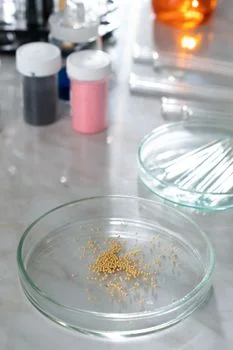
Resin choice trades CapEx against fouling risk. SBA grades such as Purolite A860 or Dow Marathon A cost about $8–$15 per liter and exchange quickly. They foul when plating organics or surfactants adsorb irreversibly. Cleaner rinse waters below about 5,000 mg/L TDS usually pay back fastest on SBA. Chelating grades such as Lewatit TP 207 or Amberlite IRC748 cost about $25–$40 per liter and tolerate TDS up to about 10,000 mg/L when sulfate competes hard with chromate.
SBA beds typically regenerate every 10–15 bed volumes (BV) with 4–8% NaOH. Chelating beds often reach 20–30 BV before breakthrough, then need a stronger 10% HCl strip. Regenerant chemistry must match downstream concentrators; many shops pair the strip liquor with RO systems for chromate concentrate recovery and water reuse. Casting shops that already run an Ion Exchange System for Casting Wastewater still need Cr(VI)-selective anion media—those hardness or general-cation trains do not substitute for chromate anion exchange.
| Feature | Strong Base Anion (SBA) | Chelating Resin |
|---|---|---|
| Common Examples | Purolite A860, Dow Marathon A | Lewatit TP 207, Amberlite IRC748 |
| Cost per Liter | $8 – $15 | $25 – $40 |
| TDS Tolerance | < 5,000 mg/L | Up to 10,000 mg/L |
| Regenerant | 4 – 8% NaOH | 10% HCl |
| Service Life | 3 – 5 Years (2,000+ cycles) | 5 – 7 Years (3,000+ cycles) |
| Selectivity | Moderate (Sensitive to sulfates) | Very High (Selective for Cr) |
Strong Base Anion Resin for Chromate Recovery: Which Works?
Strong-base anion resin for chromate recovery should be a Type I or Type II quaternary ammonium SBA grade sized for 5–15 BV/h at feed pH 2.0–4.0. Chromate-selective SBA media outperform general-purpose anion resins when sulfate exceeds about 500 mg/L, because sulfate otherwise steals exchange sites and shortens the run. Most plating rinse skids we commission start with SBA when TDS stays below about 5,000 mg/L and organics are low.
Switch to a chelating resin when TDS climbs toward 10,000 mg/L or sulfate competition forces SBA cycles below about 10 BV. Pair either choice with regenerant reuse: 4–8% NaOH for SBA, or 10% HCl for chelating beds, then concentrate the strip liquor for bath makeup. That decision tree is the practical core of hexavalent chromium ion exchange resin selection on an industrial rinse line.
Process Design Parameters for Cr(VI) Anion Exchange Beds
Service velocity sets contact time for Cr(VI) anion exchange beds. SBA resins typically run at 5–15 BV/h; chelating resins need 2–8 BV/h because coordination kinetics are slower. Push the rate too high and the mass-transfer zone exits before the bed is exhausted, so effluent can exceed a 0.05 mg/L Cr(VI) trip point while resin capacity remains unused.
Bed depth should stay between 0.8 and 1.5 m. Shallower beds channel; deeper beds raise pressure drop to about 0.2–0.5 bar/m and force oversized pumps. Influent TSS must stay below 10 mg/L for SBA service, usually via pre-treatment filtration to protect ion exchange resins from TSS fouling. pH control with 98% H₂SO₄ at roughly 0.1–0.3 L/m³ keeps the dichromate window open.
| Design Parameter | SBA Resin Specification | Chelating Resin Specification |
|---|---|---|
| Service Flow Rate | 5 – 15 BV/h | 2 – 8 BV/h |
| Minimum Bed Depth | 0.8 m | 1.0 m |
| Regeneration Frequency | Every 10 – 15 BV | Every 20 – 30 BV |
| Regenerant Dosage | 50 – 100 g NaOH / L resin | 100 – 150 g HCl / L resin |
| Influent TSS Limit | < 10 mg/L | < 5 mg/L |
| Breakthrough Monitor | 0.05 mg/L Cr(VI) | 0.01 mg/L Cr(VI) |
Can Ion Exchange Remove Hardness and Heavy Metals Together?
Ion exchange can remove hardness cations and Cr(VI) anions, but not on the same resin bed under one regenerant chemistry. Softening uses cation resin in the Na⁺ or H⁺ form; chromate capture needs anion or specialized selective media. Plants that blend hard city water into rinse make-up often install an Industrial Water Softener System (KJ-WT Series) upstream so calcium does not scale heat exchangers or compete inside later polishing stages. Treat hardness and Cr(VI) as sequential unit operations, not a single mixed-bed shortcut.
Cost Breakdown: Ion Exchange vs. Chemical Reduction for Cr(VI) Treatment
A 10 m³/h ion exchange skid typically costs $150,000–$250,000 installed with resin, automation, and pre-filtration. A comparable chemical-reduction train may cost only $80,000–$120,000. Five-year total cost of ownership still favors ion exchange in most plating shops because ferrous sulfate at $0.30–$0.60/kg and sludge disposal at $500–$1,200/ton dominate OpEx on the chemical path.
At 50 m³/h, chromate recovery plus sludge elimination can exceed $2 million per year in savings based on A-LIX pilot studies, with ROI often inside 1.5–3 years. Compared with nickel wastewater treatment by ion exchange or copper wastewater treatment via ion exchange, chromium recovery usually shows a stronger cash case because chromic acid concentrate carries higher reuse value inside the plating line.
| Cost Category (5-Year TCO) | Chemical Reduction (10 m³/h) | Ion Exchange (10 m³/h) | Chemical Reduction (50 m³/h) | Ion Exchange (50 m³/h) |
|---|---|---|---|---|
| Initial CapEx | $100,000 | $180,000 | $250,000 | $450,000 |
| Annual OpEx (Chemicals) | $45,000 | $12,000 | $220,000 | $55,000 |
| Annual Sludge Disposal | $120,000 | $0 | $600,000 | $0 |
| Annual Resource Recovery | $0 | ($35,000) | $0 | ($175,000) |
| Total 5-Year TCO | $925,000 | $65,000 | $4,350,000 | ($150,000) |
Compliance Checklist: Meeting Global Hexavalent Chromium Discharge Limits
Discharge limits for chromium remain tight because Cr(VI) is carcinogenic. Earlier plant planning often used 0.1 mg/L total chromium as a design target aligned with the U.S. EPA drinking-water standard, which is 0.1 mg/L (100 ppb) for total chromium (US EPA). For metal-finishing pretreatment, the PSES table in 40 CFR 433.15 lists Chromium (T) at 2.77 mg/L for any single day and 1.71 mg/L as the monthly average (Cornell LII, 40 CFR 433.15). Local POTW limits can be stricter. Ion exchange systems in this design envelope routinely hold 0.05 mg/L Cr(VI) or lower at breakthrough monitors.
Earlier California drinking-water discussion used a 0.01 mg/L Cr(VI) target. According to the California State Water Resources Control Board (2024), the hexavalent chromium MCL of 0.010 mg/L (10 µg/L) took effect on October 1, 2024. The total chromium MCL remains 50 µg/L. Ion exchange remains listed among Best Available Technologies for that drinking-water MCL. Large plating shops in published pilot comparisons have cut disposal cost by up to $2M/year when chromate is recovered instead of precipitated.
In the EU, IED 2010/75/EU BAT reference values near 0.1 mg/L apply for many surface-water discharges. China’s GB 21900-2008 electroplating limit is 0.5 mg/L Cr(VI), with some provinces at 0.1 mg/L. Start a new resin cycle with hourly samples for the first 24 hours, then move to daily checks with online colorimeters. Keep feed pH below 5.0; a rise above that range can desorb chromium and spike effluent within one shift.
| Jurisdiction | Regulation | Cr(VI) Limit | IX Performance Capability |
|---|---|---|---|
| USA (EPA) | 40 CFR 433 | 0.1 mg/L (Total Cr) | 0.01 – 0.05 mg/L |
| California | HSC 116365 | 0.01 mg/L | < 0.001 mg/L (1 µg/L) |
| European Union | IED 2010/75/EU | 0.1 mg/L | < 0.01 mg/L |
| China | GB 21900-2008 | 0.5 mg/L | 0.1 – 0.3 mg/L |
Selection checklist before you buy
- Confirm Cr(VI) as chromate/dichromate (not only total Cr) on the design sample.
- Measure sulfate, chloride, and TDS; choose SBA versus chelating media from those numbers.
- Hold influent TSS < 10 mg/L (SBA) or < 5 mg/L (chelating) with filtration.
- Lock feed pH at 2.0–4.0 with automated acid dosing and alarms.
- Size service flow at 5–15 BV/h (SBA) or 2–8 BV/h (chelating) with 0.8–1.5 m bed depth.
- Plan regenerant reuse via evaporation or RO; budget hazardous disposal only for the small reject.
- Set online Cr(VI) breakthrough at 0.05 mg/L (SBA) or 0.01 mg/L (chelating).
What Limits Reclaim and Recovery Scaling for Cr(VI) Systems?
Reclaim and recovery scaling for Cr(VI) ion exchange is limited by regenerant purity, competing anions, and bath chemistry—not by resin capacity alone. Strip liquor returned to a chrome bath must meet plating specs for sodium, sulfate, and organics; evaporation or RO concentrate steps fail when those impurities build faster than drag-out makeup. Semiconductor-style zero-liquid-discharge targets amplify the same constraint: every kilogram of salt kept in the loop eventually forces a blowdown. Most plating ETPs we review therefore reclaim 95–98% of chromate mass while still allowing a controlled bleed rather than forcing absolute ZLD.
Who This Is For / Next Step
This approach fits chrome plating, chromate conversion, and metal-finishing rinse lines that need sub-0.1 mg/L Cr(VI) with chromate reuse. Look elsewhere if your load is mostly Cr(III) solids, or if you only need occasional batch destruction without recovery. To size resin volume, regenerant reuse, and monitoring setpoints for your flow sheet, request a process review with your Cr(VI), TDS, and sulfate data.
Frequently Asked Questions
How often does ion exchange resin need replacement for Cr(VI)?
SBA resins typically last 3 to 5 years, or about 2,000 to 3,000 regeneration cycles, when TSS stays below 10 mg/L and feed pH stays in the 2.0–4.0 window. Chelating resins often reach about 7 years under the same care. Replace the bed when capacity falls about 20% or pressure drop rises from bead breakage.
Can ion exchange handle wastewater with high sulfate levels?
SBA resins compete for sulfate, which cuts chromium loading when sulfate exceeds about 500 mg/L. Use a chromate-selective SBA grade, a chelating resin, or a two-stage anion train that fractionates sulfate from chromate. Without that change, breakthrough arrives early even though total anion capacity looks adequate on paper.
What is the best way to handle Cr(VI) regenerant solution?
Concentrated sodium chromate regenerant can often return to the plating bath after pH adjustment and concentration by evaporation or reverse osmosis. If bath specs block reuse, treat the small concentrate by batch chemical reduction or ship it to a recycler. That path still cuts waste volume by about 90% versus conventional hydroxide sludge.
Is pH adjustment required before the ion exchange column?
Yes. Keep influent pH between 2.0 and 4.0 so chromium stays as dichromate (Cr₂O₇²⁻), which raises mass loading per exchange site. The same acidic window also limits precipitation of other metal hydroxides that would clog resin pores and create channeling.
How does California’s 2024 Cr(VI) MCL affect industrial ETPs?
California’s drinking-water hexavalent chromium MCL is 0.010 mg/L (10 µg/L) effective October 1, 2024, with ion exchange among listed Best Available Technologies (California State Water Board, 2024). Industrial wastewater permits remain separate. Many California plants still design rinse recovery near that 10 µg/L order of magnitude for sewer reviews.