What Ion Exchange Achieves for Copper Wastewater
Copper ion exchange removes dissolved Cu²⁺ from industrial wastewater by exchanging copper onto cation resin for H⁺ or Na⁺. With strong-acid cation resins at pH 3–5 and contact time of 10–30 minutes, plants routinely reach 99.5%+ removal and effluent below 0.1 mg/L Cu for influent in the 50–5,000 mg/L range.
Earlier guidance and many plant narratives treated 1.3 mg/L Cu as the discharge target. That 1.3 mg/L figure is the EPA drinking-water copper action level under 40 CFR 141.80, not a categorical industrial effluent limit. For metal finishing and captive printed-circuit-board (PCB) operations under 40 CFR Part 433, copper limits remain 3.38 mg/L daily maximum and 2.07 mg/L monthly average (eCFR Part 433, current text). Local pretreatment permits are often tighter than the federal floor, so design to the permit, not to the drinking-water action level alone.
Why Copper Treatment Fails: Precipitation Limits and Ion Exchange Recovery
A PCB plant discharging 4.2 mg/L Cu against a 1.3 mg/L internal target—while influent spikes reached 850 mg/L—illustrates a common failure mode. Chemical precipitation sized for average flow often misses peak loads, leaves 0.5–2.0 mg/L Cu in effluent, and generates 0.5–2.0 kg/m³ of hazardous hydroxide sludge. Membrane systems foul on copper and organics; single-pass adsorbents exhaust quickly at continuous high metal load.
Ion exchange fixes the compliance gap by capturing Cu²⁺ on resin beads, then releasing a concentrated regenerant for recovery. Plants that size for breakthrough at 5–10% of influent Cu, not for average load alone, keep effluent stable. Most plants we size for PCB and metal-finishing rinse water run at the lower end of the EBCT band (about 10–15 minutes) when influent is under 500 mg/L Cu and pretreatment is clean.
Copper Ion Exchange Process Physics, Resin Selection, and Engineering Parameters

Cu²⁺ binds to sulfonic-acid groups on strong-acid cation (SAC) resin, exchanging for H⁺ or Na⁺ across a wide pH window. Weak-acid cation (WAC) resins with carboxylic groups offer higher capacity but lose performance as pH falls. Chelating iminodiacetate resins raise copper capacity further in the acidic band used for selective metal capture.
For copper service, hold influent at pH 3–5. Below about pH 2, H⁺ competes strongly with Cu²⁺. Above pH 6, copper hydroxide can precipitate and foul the bed (HydropureWater field data, 2025). EBCT of 10–30 minutes supports 99%+ removal for influent up to 500 mg/L Cu when linear velocity stays near 5–15 m/h. Organics, iron, and hardness foul resin; pre-filtration plus an automated pH adjustment and regenerant dosing system for ion exchange systems extend cycle length.
According to the US EPA capsule report on approaching zero discharge in surface finishing (EPA/625/R-99/008), ion exchange is a primary rinse-purification tool in metal finishing. Spent regenerant is routed to reuse or metals recovery such as electrowinning.
| Resin Type | Functional Group | Copper Capacity (mg Cu/g resin) | Optimal pH Range | Regeneration Efficiency |
|---|---|---|---|---|
| Purolite C100 (SAC) | Sulfonic Acid | 50-80 | 2-8 | 90-95% with H₂SO₄/NaCl |
| Dowex HCR-S (SAC) | Sulfonic Acid | 55-85 | 2-8 | 90-95% with H₂SO₄/NaCl |
| Lewatit TP 207 (Chelating) | Iminodiacetate | 80-120 | 2-5 | 85-90% with H₂SO₄ |
Step-by-Step Ion Exchange System Design for Copper Compliance
Ion exchange system design for copper starts with pretreatment that protects resin capacity and ends with regenerant recovery that funds operating cost. Skip any stage and breakthrough arrives early.
Influent pretreatment: Cut TSS below 10 mg/L with pretreatment screening to protect ion exchange resins from fouling, clarification, or multi-media filtration. Then adjust pH to 3–5 with sulfuric acid under automated control so copper does not precipitate onto the beads.
Resin bed design: Bed depth of 0.8–1.5 m and linear velocity of 5–15 m/h set EBCT. Example: a 10 m³/h train with a 1.5 m diameter column (area ≈ 1.77 m²) and 1.5 m bed depth yields bed volume ≈ 2.66 m³; at 10 m³/h the EBCT is about 16 minutes.
Regeneration: Exhausted SAC resin typically takes 5–10% H₂SO₄ or NaCl at 2–5 bed volumes per hour for 30–60 minutes. Copper leaves in a concentrated regenerant suitable for electrowinning or precipitation recovery. Acid regenerant favors copper sulfate recovery pathways; salt regenerant favors chloride-based recovery trains.
Rinse: Use 2–3 bed volumes of clean water after regeneration. Incomplete rinse causes pH spikes and regenerant carryover into the treated line. Duplex columns keep one bed in service while the other regenerates.
Copper Wastewater Methods Compared: Ion Exchange, Precipitation, Membranes, Adsorption
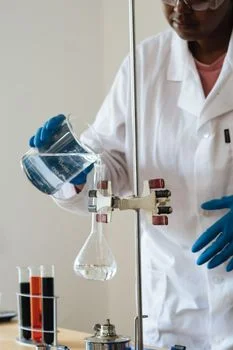
Ion exchange for copper wastewater delivers 99.5%+ removal and effluent often below 0.1 mg/L Cu, with metal recovery and essentially no primary-process sludge (HydropureWater field data, 2025). It fits 50–5,000 mg/L Cu streams. Above about 10,000 mg/L Cu, precipitate first, then polish with resin. Fouling from organics or competing metals remains the main operating risk.
Chemical precipitation costs less in CapEx but struggles below 0.5 mg/L Cu and creates hazardous sludge. Reverse osmosis can push effluent below 0.05 mg/L Cu yet needs high pressure and heavy pretreatment. Activated-carbon adsorption sits in the middle on removal and loses economy when media replacement dominates OpEx. For PCB, semiconductor, and metal-finishing plants chasing permit limits near or below 1.0 mg/L Cu, resin systems usually win on recovery value. Regional permit context still matters; see regional compliance strategies for copper discharge limits when state or POTW rules tighten the federal floor.
| Treatment Method | Copper Removal Efficiency (%) | Effluent Concentration (mg/L) | CapEx ($/m³/h) | OpEx ($/m³) | Sludge Generation (kg/m³) | Scalability |
|---|---|---|---|---|---|---|
| Ion Exchange | 99.5%+ | <0.1 | 12,000-20,000 | 0.80-2.50 | 0 (concentrated solution for recovery) | High |
| Chemical Precipitation | 85-95% | 0.5-2.0 | 5,000-10,000 | 0.50-1.50 (excl. sludge) | 0.5-2.0 (hazardous) | High |
| Membrane Filtration (RO) | 98-99%+ | <0.05 | 20,000-40,000 | 2.00-5.00 | 0.1-0.5 (concentrated brine) | Medium |
| Adsorption (Activated Carbon) | 80-90% | 0.5-5.0 | 3,000-8,000 | 1.00-3.00 (media replacement) | 0.1-0.3 (spent media) | Low-Medium |
When Is Ion Exchange Better Than RO for Copper?
Selective cation resin outperforms reverse osmosis when the goal is selective Cu²⁺ capture and metal recovery rather than broad dissolved-solids rejection. Resin CapEx for a 10 m³/h copper train is typically $120,000–$200,000 ($12,000–$20,000 per m³/h), versus $20,000–$40,000 per m³/h for RO. OpEx for ion exchange stays near $0.80–$2.50/m³; RO often runs $2.00–$5.00/m³ under copper fouling pressure.
Choose RO when you must also reject salts, silica, or organics to ultrapure standards. Choose resin when copper is the compliance driver, influent is 50–5,000 mg/L Cu, and regenerant can feed electrowinning. Mixed-bed or EDI skids belong in biopharmaceutical pure-water loops, not in copper rinse treatment—different feed chemistry, different duty.
Cost Breakdown: CapEx, OpEx, and ROI for a 10 m³/h System
A 10 m³/h copper ion exchange package usually budgets $120,000–$200,000 CapEx for duplex columns, first resin charge, pumps, valves, instrumentation, dosing, and install. Automation level and materials of construction move the number inside that band.
OpEx lands at $0.80–$2.50 per m³ treated. Chemicals dominate; resin amortization is small when life reaches 5–10 years.
| OpEx Category | Cost per m³ Treated | Annual Cost (10 m³/h, 8000 h/year) | Notes |
|---|---|---|---|
| Resin Replacement | $0.06–$0.12 | $5,000–$10,000 | Resin lifespan 5–10 years; amortized cost. |
| Chemicals (Regenerant, pH adjust) | $0.30–$0.80 | $24,000–$64,000 | H₂SO₄/NaCl, NaOH for pH/cleaning. |
| Labor | $0.20–$0.50 | $16,000–$40,000 | Monitoring, maintenance, regeneration. |
| Energy (Pumps, Controls) | $0.10–$0.30 | $8,000–$24,000 | Low pressure drop system. |
| Maintenance & Spares | $0.14–$0.28 | $11,200–$22,400 | Routine checks, minor part replacements. |
| Total OpEx | $0.80–$2.50 | $64,200–$200,400 | Excludes copper recovery processing costs. |
At 500 mg/L influent Cu, 95% recovery, 10 m³/h, and 8,000 h/year, recovered copper is about 38,000 kg/year (10 × 8000 × 0.5 × 0.95). At $8,000 per ton Cu, that is roughly $304,000/year, or about $3.80/m³ of treated water—enough to cover OpEx in many duty cycles (HydropureWater field data, 2025). Stretch cycles with real breakthrough curves (often 50–100 bed volumes), reuse a fraction of spent regenerant when chemistry allows, and keep pretreatment tight so resin lasts.
Does Ion Exchange Remove Hardness Along With Copper?
Ion exchange removes hardness cations (Ca²⁺, Mg²⁺) on the same SAC sites that bind Cu²⁺, so hardness shortens copper run length if it is not managed upstream. For rinse water that carries both copper and hardness, most plants we size either soften the make-up water or use a dedicated hardness guard bed before the copper columns.
An Industrial Water Softener System (KJ-WT Series) on make-up or recycle loops cuts competing divalent load and stabilizes EBCT. Softening does not replace copper-selective resin; it protects capacity so copper breakthrough stays predictable. Where fluoride or other anions share the same plant sewer, pair cation copper treatment with the anion path described for heavy metals like fluoride rather than forcing one resin to do both jobs.
Troubleshooting: Resin Fouling, Breakthrough Curves, and pH Drift
Resin fouling shows up as shorter service cycles, higher pressure drop, and lost capacity. Organics, Fe²⁺/Fe³⁺, and hardness are the usual causes. Keep multi-media filtration and pH control online; clean organics with about 4% NaOH and dissolve iron or calcium scale with acid washes. Regular backwash limits channeling.
Breakthrough curves plot effluent Cu versus bed volumes treated. Start regeneration when effluent Cu reaches 5–10% of influent Cu. Early regenerations waste acid; late regenerations risk permit breaches. Online copper analyzers tied to an automated pH adjustment and regenerant dosing system for ion exchange systems trigger cycles without waiting for a lab lag.
pH drift after service usually means incomplete rinse, unstable influent pH, or weak buffering. Extend the rinse to 2–3 bed volumes, lock influent pH with dosing control, and add a polishing pH stage if the sewer limit is narrow. Resin degradation from oxidants, thermal shock, or chronic off-spec pH shortens the 5–10 year life window—keep chlorine off the cation bed.
Who This Is For, Selection Checklist, and Next Step
Who this is for: PCB, semiconductor, mining, and metal-finishing plants with 50–5,000 mg/L dissolved copper. These sites must meet categorical or local Cu limits and want metal recovery instead of sludge.
Who should look elsewhere: Streams above ~10,000 mg/L Cu without a precipitation front-end; feeds dominated by chelated copper that need specialty chelating resin trials; plants whose real problem is TDS or silica rather than copper.
Selection checklist:
- Confirm permit: 40 CFR 433 floor (3.38 / 2.07 mg/L Cu) versus local POTW limit.
- Map influent Cu, pH, TSS, organics, iron, and hardness over peak shifts.
- Set EBCT 10–30 minutes and bed depth 0.8–1.5 m at 5–15 m/h.
- Choose SAC vs chelating resin from capacity and pH data, not brand preference alone.
- Size regenerant storage and copper recovery (electrowinning or precipitation).
- Budget OpEx at $0.80–$2.50/m³ and credit recovered copper separately.
- Specify duplex columns and online Cu monitoring before startup.
If you are sizing a copper rinse or etching-waste train, share flow, peak Cu, and permit limits via our request a copper ion-exchange quote form and we will return a duty-specific resin and CapEx/OpEx sketch.
Frequently Asked Questions
What are the advantages of ion exchange over precipitation for copper?
Ion exchange typically reaches effluent below 0.1 mg/L Cu, while precipitation often leaves 0.5–2.0 mg/L Cu and creates 0.5–2.0 kg/m³ of hazardous sludge. Resin systems also concentrate copper into regenerant for recovery, so disposal cost and metal loss both fall. Precipitation remains useful as a high-load front-end before resin polish when influent exceeds about 10,000 mg/L Cu.
How does influent pH affect copper removal by ion exchange?
Strong-acid cation resins remove copper best at pH 3–5. Below pH 2, hydrogen ions outcompete Cu²⁺ and capacity drops. Above pH 6, copper hydroxide can precipitate on the beads and foul the bed. Stable automated acid dosing before the columns is therefore part of the process design, not an optional accessory.
What is the typical resin lifespan in copper wastewater service?
Strong-acid cation resins in copper service usually last 5–10 years when pretreatment holds TSS below 10 mg/L and oxidants stay off the bed. Severe organic or iron fouling, chlorine exposure, thermal shock, or chronic operation outside the design pH window shortens that life. Planned caustic and acid cleans, plus real breakthrough-based regeneration, protect the amortization line in the OpEx table.
Can the same system recover nickel, zinc, or other metals?
Yes. Cation and chelating resins also capture nickel, zinc, chromium, and lead when selectivity and regenerant chemistry are matched to each metal. Lewatit TP 207-type iminodiacetate resins are often chosen for selective nickel or copper polish to very low residual. Multi-metal feeds need jar tests or pilot columns before full-scale resin fill, because competing ions change breakthrough order.
What copper discharge limit should a US metal-finishing plant design to?
Design first to your NPDES or pretreatment permit. Under 40 CFR Part 433, copper limits for metal finishing are 3.38 mg/L daily maximum and 2.07 mg/L monthly average. The 1.3 mg/L figure often quoted from older plant notes is the EPA drinking-water action level in 40 CFR 141.80, not the categorical industrial standard. Many POTWs set tighter local limits, so verify that letter before locking resin capacity.