An automatic dosing pump working principle rests on positive displacement: each stroke traps a fixed chemical volume and pushes it into the process line, independent of moderate backpressure changes within the pump rating. In industrial wastewater plants, that stroke-to-volume relationship governs pH control, coagulation, and disinfection dose. A 1% dosing error can raise annual chemical and sludge handling costs by 8% to 12% in high-volume facilities.
Under the Clean Water Act, effluent and pretreatment violations can trigger civil penalties; earlier informal figures near $12,000 per day are outdated. According to 40 CFR 19.4 as adjusted effective January 8, 2025, the statutory maximum under 33 U.S.C. 1319(d) is $68,445 per violation per day for assessments on or after that date (EPA, 2025).
Automatic Dosing Pump Working Principle: Positive Displacement Physics
An automatic dosing pump traps a fixed chamber volume on each suction stroke and discharges it when chamber pressure exceeds line backpressure. Within rated pressure and NPSH limits, volume per stroke stays nearly constant, unlike centrifugal pumps whose flow falls as head rises. API 675 targets ±1% steady-state accuracy of rated flow over at least a 10:1 turndown.
That isolation supports the accuracy needed in polymer and coagulant feed, including how PAM dosing systems optimize flocculation in wastewater treatment.
The cycle has two phases: suction and discharge. In suction, the motor or solenoid pulls the diaphragm or piston back and creates a local vacuum in the pump head, typically about 0.5 to 0.8 bar below atmosphere. Atmospheric pressure then drives chemical from the day tank through the suction check valve into the chamber. The discharge check valve stays seated so pressurized process liquid cannot reverse into the head.
In discharge, the drive reverses and chamber pressure rises. When that pressure exceeds line backpressure—often 1 to 20 bar in wastewater injection—the suction valve closes and the discharge valve opens. Fluid leaves as a discrete slug.
API 675 requires steady-state accuracy within ±1% of rated flow over at least a 10:1 turndown for controlled-volume pumps that claim the standard. Cycle times commonly run from about 0.1 to 10 seconds, set by required L/h and strokes per minute.
Why Dosing Pump Accuracy Matters in Industrial Wastewater Treatment
Industrial wastewater dosing pump accuracy near ±1% of set point across the usable turndown band keeps pH, coagulant, and disinfectant feed stable. Missed set points raise chemical use, sludge mass, and permit-excursion risk when sensors and actuators drift. Calibrated stroke and flow logs also support compliance reviews of continuous effluent monitoring records.
In a typical plant, pH still swings after manual stroke changes because the pump cannot keep a linear stroke-to-flow relationship when discharge pressure varies. Many discharge permits keep effluent pH between 6.0 and 9.0 to limit metal leaching and protect concrete and metal assets. A PLC-linked Automatic Chemical Dosing System closes that loop by trimming stroke frequency from a 4–20 mA pH or flow signal. The same precision matters when feed supports on-site ClO₂ generation for wastewater disinfection: under-dosing leaves pathogens; over-dosing raises oxidant byproduct risk.
As agencies add real-time effluent telemetry, calibrated dosing logs become part of the compliance file. High-precision metering is therefore a core process control item, not an optional upgrade for plants that must show consistent chemical application day after day.
What Is an Automatic Dosing System?
An automatic dosing system is a metering pump plus sensors, a controller, and injection hardware that adjusts chemical feed without constant manual stroke changes. In wastewater service the controller usually reads flow, pH, ORP, or residual chlorine and writes a 4–20 mA or pulse command to stroke speed. The skid may also include calibration columns, relief valves, backpressure valves, and leak detection between dual diaphragms. Specifying the full Automatic Chemical Dosing System package reduces field mismatches between pump, tank, and analyzer.
Manual stroke setting still suits steady, low-variability streams. Flow-paced or closed-loop control is the better default when influent strength, temperature, or plant flow changes through the day. Match the signal type and fail-safe mode (hold last, go to zero, or go to preset) to the hazard of the chemical before purchase.
2025 Engineering Specs: Flow Rates, Pressures, and Material Compatibility

Current industrial metering specs emphasize usable turndown—the band where accuracy still holds. Many industrial units offer 100:1 turndown; some electronic drives claim up to 1000:1 when stroke length and frequency both modulate. Head material choice still sets mean time between failures because the wetted parts see neat acid, alkali, or oxidant.
| Parameter | Mechanical Diaphragm | Hydraulic Diaphragm | Piston / Plunger | Peristaltic |
|---|---|---|---|---|
| Max Flow Rate | 0.1 – 2,000 L/h | 10 – 10,000 L/h | 0.5 – 20,000 L/h | 0.01 – 1,000 L/h |
| Max Pressure | 10 – 12 bar | 20 – 100 bar | Up to 500 bar | 2 – 8 bar |
| Dosing Accuracy | ±2.0% | ±0.5% - ±1.0% | ±0.5% | ±1.0% |
| Viscosity Limit | < 100 cP | < 500 cP | < 1,000 cP | < 5,000 cP |
| Head Materials | PVDF, PVC, PP | 316L SS, PTFE | 316L SS, Ceramic | Santoprene, Tygon |
Material selection should follow ASTM D543 chemical-resistance practice at the real storage temperature, not only room-temperature charts. PVDF is a common choice for 98% sulfuric acid up to about 50°C, yet it degrades in acetone and some ketones; PTFE or 316L stainless steel is then required. At 5 bar backpressure, many diaphragm pumps show a 2% to 5% shortfall versus theoretical flow from diaphragm compressibility and check-valve lag. Calibrate stroke length (often 1–100 mm) and frequency (often 1–180 strokes/min) against the installed backpressure.
Key Components: How Drive Mechanisms, Pump Heads, and Valves Control Dosing
Drive power converts into controlled chamber motion with limited hysteresis. Electric motors from about 0.1 to 2 kW are common and often pair with a VFD for speed trim. In hazardous or remote areas, pneumatic drives on 3–8 bar air can give 0–100% stroke control without electrical spark at the pump.
Only the pump head contacts the chemical. PVDF heads suit many strong acids in wastewater service; PVC often suffices for sodium hypochlorite. Boiler feed or deep-well injection above about 20 bar usually needs 316L stainless steel heads.
Dual check valves on suction and discharge block siphoning when the tank sits above the injection point or the process runs under vacuum. Spring-loaded valves help viscous fluids up to about 1,000 cP seat fast enough to hold accuracy.
Seals and O-rings fail first in many plants. According to 2024 maintenance logs from major industrial sites, seal wear can cut dosing accuracy by 15–20% before a visible leak appears. Viton suits many solvents and oils; EPDM suits general water chemicals; PTFE suits strong oxidizers. Dual-diaphragm heads with an interspace pressure switch catch rupture early on critical feeds.
Dosing Pump Types Compared: Diaphragm vs. Piston vs. Peristaltic for Wastewater

Wrong pump type is a frequent cause of early failure and unstable chemistry. Diaphragm pumps dominate corrosive chemical feed because the diaphragm hermetically separates drive oil or mechanics from the fluid. Mechanical diaphragms still fatigue; field replacement intervals often fall between 10,000 and 15,000 operating hours (HydropureWater field data, 2025).
| Pump Type | Best For... | Maintenance Interval | Relative CapEx | Common Failure Mode |
|---|---|---|---|---|
| Diaphragm | Acids, Bases, Oxidizers | 6,000 - 12,000 hrs | Medium | Diaphragm Rupture |
| Piston | High Pressure, Viscous | 4,000 - 8,000 hrs | High | Seal Wear / Leakage |
| Peristaltic | Slurries, Polymers | 2,000 - 4,000 hrs | Low-Medium | Tube Fatigue |
Piston pumps fit pressures above 20 bar or viscous oils and slurries. They offer high volumetric efficiency but use wet seals that eventually weep, so they are a poor fit when zero external leakage is mandatory. Peristaltic pumps suit shear-sensitive polymers used ahead of sludge dewatering after chemical dosing in wastewater treatment. Fluid stays inside the tube, so there are no check valves to foul; limits are usually under 8 bar and short tube life that needs planned change-outs.
How Does an Automatic Chemical Dosing System Control Feed Rate?
An automatic chemical dosing system controls feed rate by mapping an analog or pulse input to stroke length, stroke frequency, or both. Flow-proportional mode multiplies a water-meter pulse count by a dose factor in mg/L. Closed-loop pH or ORP mode compares the probe reading to set point and trims pump output through PID or simple proportional control. Always size so normal duty sits between about 30% and 85% of maximum capacity; chronic operation near 100% leaves no headroom for shock loads.
- Define process parameters: Set required L/h and maximum backpressure in bar, including injection-quill and elevation losses.
- Verify chemical compatibility: Check head, seals, and tubing at outdoor tank temperature, not only laboratory room temperature.
- Select pump technology: Use diaphragm units for most corrosives, peristaltic for polymers and abrasives, and piston units for high pressure or viscosity above about 1,000 cP.
- Determine control strategy: Keep manual stroke only for steady loads; specify 4–20 mA or pulse input for paced or closed-loop duty.
- Confirm compliance standards: Call API 675 when the datasheet claims controlled-volume metering performance; require NSF/ANSI 61 only when the pump feeds potable water.
- Plan calibration access: Include a calibration column and isolation valves so operators can verify L/h without opening the process line.
- Add overpressure protection: Fit a discharge relief valve set below pipe and pump design pressure.
Following this checklist cuts both under-spec downtime and over-spec capital spend. A correctly sized industrial metering pump commonly serves 10–15 years when diaphragms, seals, and valves are replaced on schedule.
Common Dosing Pump Failures and How to Prevent Them
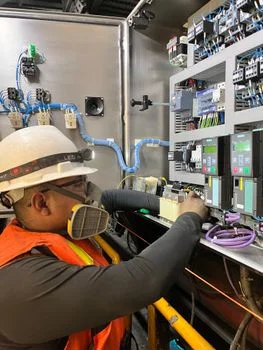
Reactive maintenance turns small mechanical wear into apparent “control” problems. Worn check valves are the leading cause of slip: fluid leaks back to suction during discharge, so delivered L/h falls while the display still shows the old set point. Replacing valve cartridges on a fixed interval—often every 6 months in dirty service—prevents that drift.
Gas locking is common with outgassing chemicals such as sodium hypochlorite. Air in the head compresses instead of moving liquid. An automatic vent on the head, a short suction line, and a continuous upward slope reduce trapped gas. Motor overload usually signals blocked discharge or a fouled injection quill; a relief valve on the discharge line protects pipe and pump.
Weekly drawdown tests remain the strongest preventive check. Catch pump output in a graduated cylinder for 60 seconds and compare to theoretical flow. If actual flow is more than 5% off theory, inspect seals and valves. Monthly, look for diaphragm stress whitening or hairline cracks, and keep suction fittings tight—about 20 Nm on many plastic unions—to avoid air leaks that destroy priming.
Who this is for: plant engineers and EPC designers sizing acid, alkali, oxidant, or polymer feed on industrial or municipal wastewater trains. Who should look elsewhere: buyers needing only laboratory syringe pumps or sanitary hygienic pumps outside wastewater duty. For a packaged skid review, share design flow, chemical list, and backpressure with the equipment supplier before freezing the P&ID.
Frequently Asked Questions
What is the difference between a dosing pump and a metering pump?
There is no technical difference in normal wastewater practice; both names describe positive-displacement pumps built for precise chemical delivery. Datasheets that claim API 675 performance must still meet that standard’s steady-state accuracy, linearity, and repeatability tests. Ask for the test basis (rated flow, turndown, and pressure) rather than relying on the marketing name alone when you compare bids.
How do I calculate the required flow rate for a dosing pump?
Use Flow Rate (L/h) = (Target Dose (mg/L) × System Flow (m³/h)) / (Chemical Concentration (g/L) × 1,000). For example, dosing 5 mg/L chlorine into 10 m³/h with 12% NaOCl (120 g/L) gives (5 × 10) / (120 × 1,000) = 0.42 L/h. Then pick a pump whose 30–85% band covers that duty, not a unit that only reaches it at maximum stroke.
Can dosing pumps handle viscous fluids like polymers?
Yes, if the pump type matches viscosity and shear limits. Piston pumps commonly handle up to about 1,000 cP, while peristaltic tubes can reach about 5,000 cP for many polymer blends. Standard mechanical diaphragm pumps often struggle above about 100 cP unless spring-loaded valves and flooded suction are provided. Always confirm manufacturer data at your polymer temperature and concentration.
What is the lifespan of an industrial dosing pump?
With planned parts replacement, a high-quality industrial dosing pump often lasts 10–15 years in wastewater chemical service. Diaphragms are commonly changed every 6–12 months, seals every 12–18 months, and pump heads every 5–10 years depending on corrosivity and duty cycle. Track actual operating hours, not only calendar time, when the pump idles through low-flow seasons.
How do I automate a dosing pump for pH control?
Most modern metering pumps accept a 4–20 mA or pulse input from a PLC or dedicated pH controller. Wire a downstream pH probe to the controller, set the desired pH band, and let the controller trim stroke frequency. Confirm probe location after the mixing point, set a safe fail mode on signal loss, and calibrate both probe and pump weekly during commissioning.