Industrial wastewater treatment in Qatar: cost and specs
Industrial wastewater treatment in Qatar follows Ashghal 2025 Doha Industrial Area specs. Those specs cap COD ≤ 120 mg/L, BOD ≤ 30 mg/L, TSS ≤ 30 mg/L, and oil and grease ≤ 10 mg/L, with pH held at 6–9. A 100 m³/h equipment cost band is $0.8–1.2M for DAF, $1.5–2.5M for MBR, and $1.0–1.8M for RO, before civil works.
Penalties run QAR 50,000–500,000 per violation. National reuse previously cited near 60% is now reported at 98% by Ashghal (2026), with 3.46 billion m³ reused. According to The Peninsula, citing Ashghal, that reused volume was split about 32% to green-space irrigation, 31% to fodder, 22% to aquifer recharge, and 14% to seasonal lagoons.
Qatar Vision 2030 still drives industrial sites toward high reuse and, where permits require it, ZLD-ready trains. A 2023 Mesaieed food-plant case showed repeat offenses can escalate to shutdown risk beyond the fine band. Oil and gas (about 35%), food processing (25%), chemical manufacturing (20%), and textiles (15%) dominate load. Each stream needs a different primary step before discharge or reuse polishing.
Compared with average EU urban limits and older US EPA secondary figures in the table below, Ashghal’s COD and oil limits are the tighter local design drivers for plant engineers in Doha and Mesaieed.
| Parameter | Ashghal 2025 (Doha Industrial Area) | EPA Secondary Treatment Standards (USA) | EU Urban Wastewater Treatment Directive (Average) |
|---|---|---|---|
| COD (mg/L) | ≤ 120 | ≤ 250 | ≤ 125 |
| BOD (mg/L) | ≤ 30 | ≤ 250 | ≤ 25 |
| TSS (mg/L) | ≤ 30 | ≤ 300 | ≤ 35 |
| Oil & Grease (mg/L) | ≤ 10 | ≤ 100 | N/A (industry-specific) |
| pH | 6–9 | 6–9 | 6–9 |
EU plants sizing against the EU Urban Wastewater Treatment Directive still face different nutrient and micropollutant rules than Qatar industrial sites. Local designs should start from Ashghal limits, then add reuse or ZLD targets set by the facility permit. On tanker jobs we review in Doha, oil and grease fails the discharge table before BOD does.
Engineering specs: influent characteristics and treatment targets
Oil and gas influent in Qatar typically shows COD of 1,200–3,500 mg/L, TSS of 300–800 mg/L, and oil and grease of 200–500 mg/L. Food processing often adds BOD of 500–1,500 mg/L and FOG of 100–400 mg/L beside COD of 800–2,500 mg/L. Chemical plants may run lower organics, with COD of 500–2,000 mg/L. Ashghal’s 2025 guidelines cap example metals at Cr(VI) ≤ 0.1 mg/L, Ni ≤ 0.5 mg/L, and Cu ≤ 0.5 mg/L.
Qatar’s arid climate changes tank and aeration design. Evaporation rates of 2,500–3,000 mm/year push covered tanks and careful aeration control. Most plants we size for Doha Industrial Area equalization run 10–15% larger than humid-climate baselines for the same daily flow. High-salinity streams above 10,000 mg/L TDS, common in oil and gas, need RO or evaporative crystallizers when ZLD is required.
The IIWWTW Phase I design includes two-stage RO at about 75% recovery for those high-TDS loads.
| Industry | Typical COD (mg/L) | Typical BOD (mg/L) | Typical TSS (mg/L) | Typical Oil & Grease (mg/L) | Typical Heavy Metals (mg/L) |
|---|---|---|---|---|---|
| Oil & Gas | 1,200–3,500 | 500–1,500 | 300–800 | 200–500 | Varies (e.g., Cr, Ni, Cu) |
| Food Processing | 800–2,500 | 500–1,500 | 100–400 | 100–400 (FOG) | Low |
| Chemical Manufacturing | 500–2,000 | 200–1,000 | 50–200 | Low–Moderate | 5–50 (e.g., Cr, Ni, Cu, Pb) |
| Textiles | 300–1,500 | 150–700 | 50–300 | Low | Varies (dyes, metals) |
For produced water and other brine-heavy streams, see high-salinity wastewater treatment for Qatar’s oil & gas sector before locking membrane recovery and brine handling.
When does Qatar oil and gas wastewater treatment need ZLD?
Qatar oil and gas wastewater treatment needs ZLD when the permit bars liquid brine discharge and TDS is above 10,000 mg/L. Two-stage RO at about 75% recovery, as cited for IIWWTW Phase I, is the usual desalting step before any crystallizer. Most oil and gas plants we size stop at RO plus a managed brine tank unless the permit text requires zero liquid discharge. Food and textile tenants rarely need that last step.
Technology comparison: MBR vs DAF vs RO
Dissolved air flotation (DAF) typically removes 70–85% COD, 90–95% TSS, and 92–97% FOG at 0.3–0.5 kWh/m³. Footprint is near 1.2 m²/m³. CAPEX for a 100 m³/h DAF package commonly falls in the $0.8–1.2M band.
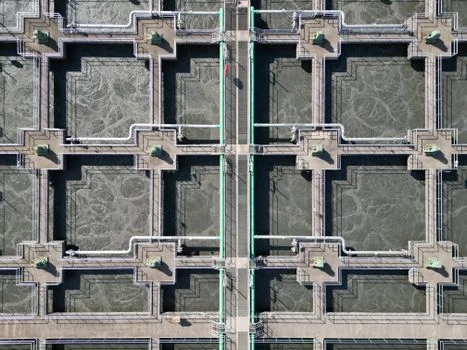
DAF systems for high-FOG wastewater in Qatar are usually paired with equalization of 2–4 hours HRT. Most food plants we size in Mesaieed add that DAF once incoming FOG passes about 100 mg/L. The unit is a primary step, not a reuse polisher.
Membrane bioreactor (MBR) trains deliver reuse-ready solids control: 95–98% COD removal and about 99.9% TSS removal at 0.8–1.2 kWh/m³ and roughly 0.5 m²/m³ footprint. CAPEX for 100 m³/h often sits at $1.5–2.5M. OPEX can run up to 30% lower than some advanced options when sludge haulage and reuse credits are counted. MBR systems for Qatar’s industrial wastewater fit mixed industrial parks aiming for irrigation-grade effluent.
Reverse osmosis (RO) is the polishing or ZLD gate for high TDS and strict reuse TDS targets, with >99% removal for most dissolved ions at 1.5–2.5 kWh/m³ and about 0.8 m²/m³ footprint. CAPEX near $1.0–1.8M for 100 m³/h is typical before civil works. RO systems for Qatar’s water reuse goals need reliable DAF or MBR pretreatment to limit fouling. Local labor at $15–25/hour and power near $0.03/kWh pull 10-year TCO for 100 m³/h toward about $1.2M (DAF), $2.0M (MBR), and $1.8M (RO), before reuse savings.
Buyers comparing industrial wastewater treatment in Qatar should price DAF, MBR, and RO on the same 100 m³/h basis before adding civil works.
| Parameter | MBR | DAF | RO |
|---|---|---|---|
| Typical COD Removal (%) | 95–98% | 70–85% | >99% |
| Typical TSS Removal (%) | 99.9% | 90–95% | 99.9% |
| Typical FOG Removal (%) | High | 92–97% | High |
| Footprint (m²/m³) | 0.5 | 1.2 | 0.8 |
| Energy Use (kWh/m³) | 0.8–1.2 | 0.3–0.5 | 1.5–2.5 |
| Typical CAPEX (100 m³/h, $M) | 1.5–2.5 | 0.8–1.2 | 1.0–1.8 |
| Typical OPEX (100 m³/h/year, $K) | 70–100 | 100–150 | 120–180 |
Cost breakdown: CAPEX, OPEX, and ROI in Qatar
CAPEX for Qatar industrial trains, based on 2024 local EPC quotes, often ranges $800–1,500/m³/day for DAF, $1,200–2,000/m³/day for MBR, and $1,000–1,800/m³/day for RO equipment. Civil works add 20–30% of equipment cost. Installation adds 15–25%. Energy usually takes 40–50% of OPEX at about $0.03/kWh.
Chemicals take 20–30% of OPEX, labor 15–20%, and sludge disposal 10–15% at QAR 350–550/ton ($100–150/ton). For a 100 m³/h plant, annual OPEX near $120,000 (DAF), $90,000 (MBR), and $150,000 (RO) is a common planning band. Most plants we cost in Qatar see the energy line, not chemicals, set whether the 10-year model closes.
| Cost Component | Typical Range (QAR/m³/day) | Typical Range ($/m³/day) | Notes |
|---|---|---|---|
| CAPEX: DAF Equipment | 2,900–4,400 | 800–1,200 | Subject to system size and customization |
| CAPEX: MBR Equipment | 4,400–7,300 | 1,200–2,000 | Includes membranes, bioreactors |
| CAPEX: RO Equipment | 3,700–6,600 | 1,000–1,800 | Includes pre-treatment and membranes |
| CAPEX: Civil Works | 20–30% of equipment cost | 20–30% of equipment cost | Site preparation, tanks, piping |
| CAPEX: Installation & Commissioning | 15–25% of equipment cost | 15–25% of equipment cost | Labor, site supervision |
| OPEX: Energy | ~40–50% of OPEX | ~40–50% of OPEX | Qatar electricity rate: ~$0.03/kWh |
| OPEX: Chemicals | ~20–30% of OPEX | ~20–30% of OPEX | Coagulants, flocculants, disinfectants |
| OPEX: Labor | ~15–20% of OPEX | ~15–20% of OPEX | Operators, maintenance staff |
| OPEX: Sludge Disposal | ~10–15% of OPEX | ~10–15% of OPEX | Qatar disposal rates: QAR 350–550/ton ($100–150/ton) |
What industrial wastewater reuse ROI does Qatar Vision 2030 expect?
Industrial wastewater reuse ROI under Qatar Vision 2030 is usually a 3–5 year payback on MBR trains when reuse credits are real. Reuse savings of QAR 10–15/m³ versus desalinated water, plus avoided penalties of QAR 50,000–500,000 per violation, drive that payback. DAF-led packages often land in 5–7 years when FOG control is the main value. Qatar Development Bank Green Financing has been cited at about 5% interest over 10 years, covering up to 70% of CAPEX for Vision 2030-aligned systems, with PPP models used on large Ashghal works.
How do you estimate maintenance cost in OPEX?
Maintenance cost in OPEX is estimated from membrane and CIP kits, rotating equipment overhaul, and instrument calibration, not from equipment CAPEX alone. For MBR and RO trains in Gulf service, many owners budget maintenance inside the 15–20% labor line plus the 20–30% chemicals line. They then add scheduled membrane replacement every 5–8 years of operation. Separate spare parts from the capitalized asset so CIP chemicals do not vanish into a single “misc” line.
What drives lifecycle cost for treatment equipment?
Lifecycle cost for treatment equipment in Qatar is driven by energy at $0.03/kWh, sludge haulage at $100–150/ton, membrane replacement, and avoided discharge penalties. A lower-CAPEX DAF can lose on lifecycle cost if FOG breakthrough forces tanker disposal or overtime cleaning. Compact package plants such as an Underground Package Sewage Treatment Plant (WSZ Series) can cut civil cost for satellite flows. High-strength industrial COD still needs DAF, MBR, or RO upstream of any package polishing step.
What is Ashghal IIWWTW Phase I design capacity?
Ashghal IIWWTW Phase I design capacity is 10,000 m³/day of tankered industrial wastewater. The works sit about 2 km southwest of the Doha Industrial Area. Earlier project summaries described the plant as operational since 2024. Gulf Times reporting in December 2024 stated Ashghal scheduled Phase 1 completion for the third quarter of 2025, at an estimated cost of QR 692,952,097.
Ashghal’s project page still lists Phase I as in progress, with that same third-quarter 2025 date. The page names Larsen & Toubro as contractor and Egis International as consultant. The same Ashghal record lists a start date of 24 January 2021. Treat the 2024 operation note as background, not as the current official status.
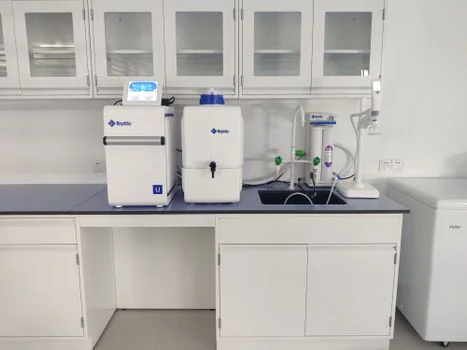
The design train starts with screening and equalization, then DAF for bulk FOG and solids, MBR for biological polishing, RO for desalination, and chlorine dioxide disinfection for reuse. Design performance cited for the hybrid train includes about 97% COD removal, 99.9% TSS removal, and up to 98% water reuse for irrigation, with two-stage RO addressing TDS up to about 12,000 mg/L. Automated CIP with citric acid and NaOH is specified for membrane fouling control. Modular layout supports later phases, and remote monitoring was projected to cut O&M labor by about 40% versus fully manned shifts.
Disinfection for reuse-grade effluent commonly uses chlorine dioxide disinfection for Qatar’s reuse standards to target multi-log pathogen reduction before irrigation or industrial reuse headers. Most reuse headers we check still fail on residual control, not on the generator nameplate.
Compliance checklist for Ashghal 2025 discharge limits
Facilities discharging to sewer or tanker reception should keep pH in the 6–9 band and hold oil and grease ≤ 10 mg/L. Many plants target ≤ 5 mg/L, and they provide 2–4 hours equalization HRT. Primary DAF should deliver ≥ 90% TSS and >95% FOG removal where FOG dominates. MBR primary and secondary paths target about 99.9% TSS.
Secondary biological stages should reach ≥ 95% COD and BOD removal on MBR, or ≥ 85% on conventional activated sludge when that is the permitted path. For reuse, RO permeate near ≤ 500 mg/L TDS is a common planning target. Disinfection to < 10 MPN/100 mL E. coli, or a tighter permit limit, sits beside that TDS cap. Keep Ashghal permits, O&M logs, and ISO 17025 third-party lab reports current.
Documentation gaps alone have been associated with penalties in the QAR 50,000–200,000 range. Most sites we audit miss the paper pack, not the online meter, when fines land in that band.
Selection starts with the measured load. Measure COD, BOD, TSS, FOG, and TDS on representative weeks, confirm discharge versus reuse, and size equalization for peak tanker arrivals. Choose DAF if FOG is above 100 mg/L, add MBR when reuse solids limits are tight, and add RO when TDS or ZLD rules apply. Lock lab and CIP budgets before CAPEX approval.
| Stage | Key Compliance Parameters | Target Effluent Quality (Examples) | Ashghal 2025 Limits |
|---|---|---|---|
| Pre-treatment | pH | 6–9 | 6–9 |
| Oil & Grease | ≤ 5 mg/L | ≤ 10 mg/L | |
| Primary Treatment | TSS | DAF: ≤ 30 mg/L; MBR: ≤ 5 mg/L | ≤ 30 mg/L |
| FOG (from DAF) | ≤ 5 mg/L | ≤ 10 mg/L | |
| Secondary Treatment | COD | MBR: ≤ 50 mg/L; Activated Sludge: ≤ 100 mg/L | ≤ 120 mg/L |
| BOD | MBR: ≤ 10 mg/L; Activated Sludge: ≤ 25 mg/L | ≤ 30 mg/L | |
| Tertiary Treatment (for Reuse) | TDS (RO Permeate) | ≤ 500 mg/L | N/A (industry-specific reuse standards) |
| Disinfection (e.g., E. coli) | < 10 MPN/100mL | N/A (industry-specific reuse standards) |
Operators comparing GCC permit packs may also review the Christchurch industrial wastewater engineering guide for a contrasting municipal-industrial checklist structure.
Who this is for and next step
This guide is for plant engineers, EPC contractors, and procurement teams sizing DAF, MBR, or RO trains for Doha Industrial Area, Mesaieed, and similar Qatar sites at about 100 m³/h. Procurement packs we receive usually lead with COD, FOG, TDS, and the reuse endpoint.
Buyers chasing only municipal sewer polishing, without industrial FOG or salinity loads, should look at lighter package options first. For a duty-matched equipment list and budget band, request a technical quote with your COD, FOG, TDS, and reuse target. Parallel city guides such as industrial wastewater treatment in Ajman show how nearby GCC permits differ on the same unit processes.
Frequently Asked Questions
What are Ashghal’s 2025 discharge limits for industrial wastewater in Qatar?
Ashghal’s 2025 Doha Industrial Area limits are COD ≤ 120 mg/L, BOD ≤ 30 mg/L, TSS ≤ 30 mg/L, oil and grease ≤ 10 mg/L, and pH 6–9. These COD and oil limits are tighter than the EPA secondary COD figure of ≤ 250 mg/L shown in the comparison table. Plants targeting reuse must still meet separate TSE or end-use TDS and pathogen rules beyond the discharge table. Meeting the sewer table is the discharge decision, not the reuse decision.
How much does an industrial wastewater treatment plant cost in Qatar?
A 100 m³/h system commonly budgets about $0.8–1.2M for DAF, $1.5–2.5M for MBR, and $1.0–1.8M for RO equipment, with annual OPEX near $90,000–150,000. Qatar power at about $0.03/kWh and sludge disposal at $100–150/ton keep OPEX lower than many European sites. Civil works of 20–30% and installation of 15–25% sit on top of equipment CAPEX. Quote those adders before comparing vendor skid prices.
Which technology is best for high-FOG wastewater in Qatar?
DAF is the usual first step for food and oil streams, removing 92–97% FOG at roughly $0.8–1.2M for 100 m³/h. When the permit or reuse scheme needs near-complete TSS control, MBR follows at 30–50% higher equipment CAPEX. RO is added only when TDS or ZLD targets require dissolved-solids removal after FOG and solids are controlled. Do not buy RO to solve a grease problem.
What are the penalties for non-compliance with Qatar’s wastewater regulations?
Penalties range from QAR 50,000 for lesser breaches to QAR 500,000 with possible shutdown for repeat offenses. Documentation failures alone have been linked to QAR 50,000–200,000 exposures. Quarterly inspection readiness plus ISO 17025 lab packs remain the practical control for tanker and sewer dischargers. A fine is smaller than a shutdown, and the file is what the inspector asks for first.
How can I finance a wastewater treatment system in Qatar?
Qatar Development Bank’s Green Financing Program has been cited at about 5% interest over 10 years, covering up to 70% of CAPEX for Vision 2030-aligned systems. Large Ashghal works have used PPP/DBOM structures, as on IIWWTW Phase I. Vendor financing with 10–15% down payment is sometimes available for packaged DAF, MBR, or RO skids. Treat the interest rate as a cited program term, not a term sheet for your site.