Check the discharge route before choosing equipment
For a sewage treatment plant in Jamaica, first establish whether the site can lawfully connect to the National Water Commission (NWC) sewerage system. NWC may require an owner within its service area to connect after written notice, and the occupier must apply within three months of receiving that notice. If connection is unavailable or refused, compare an A/O package plant with MBR against verified flows, effluent requirements, footprint, installation conditions, and operating resources. Do not order equipment until the receiving authority confirms the discharge route.
The National Water Commission is the primary provider of wastewater services in Jamaica, and its collection system serves more than 700,000 persons. Connection assessment is the first procurement step: proximity to a sewer is not, by itself, confirmation that the premises can connect.
Ask NWC for written confirmation of the service boundary, connection point, applicable sewerage charges, and project-specific discharge conditions. NWC reserves the right to apply sewerage charges to an account once premises are within 100 yards (91.4 metres) of the sewerage system. The connection application still requires the applicable route and charge confirmation.
| Discharge route or influent problem | Governing rule or process option | What data settles it |
|---|---|---|
| Premises are within an NWC service area | NWC may require connection after written notice; the occupier must apply within three months of receiving it | Written NWC service-area notice, connection application status, and confirmation of the connection point |
| Public sewer is nearby | Do not treat proximity as an approved discharge route | NWC confirmation of availability, boundary, charges, and project-specific acceptance requirements |
| No practical NWC connection exists | Screen a domestic sewage package plant: A/O for a conventional biological route or MBR where the effluent objective and site constraints justify membrane separation | Verified flows, treatment objective, footprint, soil, groundwater, access, power, and confirmed non-sewer effluent route |
| Effluent will be reused or discharged away from NWC | Define the reuse target or receiving-water route before selecting treatment stages | Written requirements from the receiving authority or reuse user, including sampling and demonstration conditions |
If a private plant is required, request a buried A/O package sewage treatment plant proposal and an MBR wastewater treatment system proposal against the same verified site data. This provides a common basis for comparing process, installation, civil work, and acceptance obligations.
Match Jamaica's treatment methods to the site
Select the treatment route based on actual wastewater and discharge requirements rather than process labels. NWC identifies oxidation ditches, activated-sludge systems, waste stabilization ponds, and primary treatment as sewage treatment facilities used in Jamaica. About 50% of all sewage NWC treats is processed to secondary levels or higher.
An A/O package plant follows the biological-treatment logic associated with activated sludge, combining biological treatment, clarification, and disinfection in a packaged arrangement. MBR combines biological treatment with membrane separation, making it relevant where the required effluent quality, reuse objective, or site footprint makes clarification limitations unacceptable.
NWC uses waste stabilization ponds whenever possible due to lower maintenance and operating costs and reduced breakdown risks. These benefits do not determine private-package-plant selection, where land availability, influent characteristics, groundwater, installation depth, access, and the effluent route remain the primary variables.
For a non-sewer site, use the comparison of sewer discharge and an underground A/O plant as a decision prompt, then use the comparison of A/O and MBR package treatment options to identify the questions that must be answered by site data. No process description substitutes for an approved discharge route or a verified wastewater plant sizing basis.
Turn site data into an equipment decision
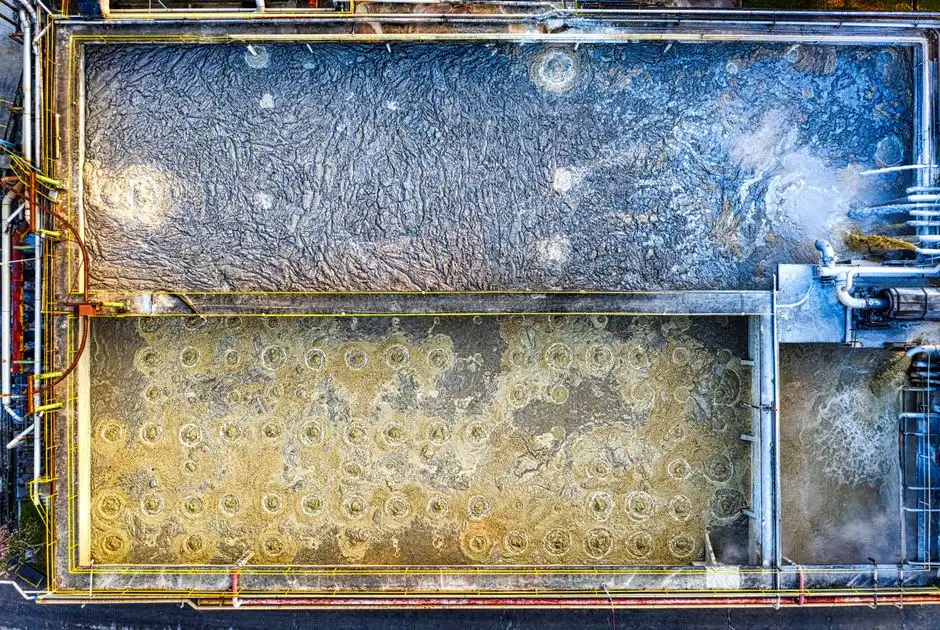
Size equipment from verified duty data and a stated flow basis. Request average and peak domestic sewage flow, seasonal variation, stormwater entry, and confirmation of whether each quoted capacity refers to average, peak, or another duty definition.
Determine the treatment boundary by confirming whether the incoming duty is domestic sewage only or includes industrial wastewater. Industrial composition can change pretreatment requirements, process selection, controls, and effluent performance, making a generic domestic package specification insufficient.
Record the physical constraints that determine delivery and installation: available footprint, soil condition, groundwater level, installation depth, lifting access, and vehicle access. Also record access requirements for future media or membrane replacement. A buried system may be spatially efficient, but its below-grade installation, access covers, lifting provisions, and maintainability must be included in the supplier’s responsibility.
Before comparing quotations, define the required effluent quality, reuse target, receiving-water route, and applicable Jamaican approval conditions. Where no written requirement is available, request the document or authority decision that will settle the requirement rather than accepting an unspecified “compliant” claim.
- Obtain flow records or a documented design-flow calculation covering average, peak, and seasonal conditions.
- Characterize the influent and exclude uncontrolled stormwater where it is outside the treatment design.
- Confirm the footprint, installation depth, soil, groundwater, and equipment-access constraints.
- Define the effluent objective and receiving route in writing.
- Ask each supplier to state its flow basis, process duty, pretreatment requirements, and capacity margin.
The containerized sewage treatment plant sizing method illustrates why the sizing calculation must remain visible in the enquiry rather than appearing only as a supplier selection.
Build an RFQ that defines the whole supply
Make the RFQ technically complete before asking for a price. State the design flow, peak flow, influent basis, treatment stages, effluent objective, installation depth, footprint, and power supply. Attach the supporting flow calculation and site information, and require the supplier to identify any assumption affecting capacity or performance.
| Quote line item | Technical scope to specify | Red flags to check before signing |
|---|---|---|
| Process design and equipment supply | Design basis, flow unit, treatment stages, controls, alarms, drawings, O&M documentation, and utilities required | Capacity stated on a different flow basis; performance promised without a duty definition; process design left undefined |
| Civil works and installation | Excavation, foundations, pipework, access covers, lifting, controls, cabling, connections, and site restoration | Civil work excluded without a named contractor or allowance; buried equipment omits access, lifting, or odour-control requirements |
| Commissioning and acceptance | Factory and site tests, agreed effluent samples, responsible testing party, acceptance procedure, and remedy for failed results | No sample protocol or qualified tester; acceptance based only on visual operation; remedy for non-performance omitted |
| Power and utilities | Supply voltage, connected load, control supply, backup-power interface, and responsibility for utility connections | Power availability excluded; backup generation left undefined; utility capacity not verified |
| Sludge and discharge | Sludge handling or removal, approved discharge route, sampling, monitoring, and disposal documentation | No lawful outlet identified; sludge destination and transport responsibility omitted |
| Training, warranty and spares | Operator training, handover, warranty scope, critical spares, membrane or media replacement method, and remote support | Training limited to handover; membrane replacement excluded; warranty excludes consumables, labour, or site conditions |
Define the factory and site acceptance tests against the agreed design basis. Identify who supplies power and water, who secures discharge approval, and who arranges sludge disposal. Ask suppliers to state exclusions, delivery boundaries, installation method, commissioning duration, and any capacity stated on another flow basis.
The RFQ should also provide a fillable data-request sheet. Require the buyer or design adviser to enter verified average flow, peak flow, seasonal factor, stormwater entry, influent analysis, effluent objective, reuse or discharge route, available footprint, installation depth, soil report, groundwater level, power supply, backup-power requirement, operator skill, and delivery access. Mark each field “verified,” “estimated,” or “not provided.” No supplier should fill unsupported site inputs without identifying their source and responsibility.
For comparison, the containerized sewage treatment plant sizing in Djibouti provides a useful reference for keeping site constraints and quoted capacity in the same review.
Review performance, ownership and delivery risk
Assign responsibility before accepting the quotation. Confirm whether the supplier is accountable for process design, equipment selection, civil interfaces, installation, operator training, and performance demonstration. A written statement of responsibility is more useful than an ambiguous promise to “supply and install.”
Agree to the start-up sampling protocol: sampling points, sample timing, operating period, parameter list, laboratory or qualified tester, reporting method, and the remedy if the acceptance result is not achieved. Tie acceptance to the same flow and influent basis used in the RFQ.
Request the control philosophy, alarm list, routine maintenance schedule, critical spares, replacement method, and remote-support arrangements. For an MBR, include membrane cleaning, replacement, and fouling-control provisions in the agreement. A membrane module should not be treated as an unqualified consumable.
For a buried A/O package installation, confirm below-grade requirements, access covers, lifting provisions, odour control, disinfection, and the operator skill needed for routine operation. For either package option, check that delivery, excavation, installation, electrical connection, commissioning, and training have defined responsibility boundaries.
Commercial red flags include an omitted civil or electrical scope, capacity stated on an undefined flow basis, performance acceptance without a sampling protocol, no named party responsible for discharge approval, and exclusions that shift membrane or media replacement onto the owner unexpectedly.
Frequently Asked Questions
Must I use an NWC connection when a public sewer is available?
Do not assume that you may install a private plant merely because sewer infrastructure is nearby. NWC may require an owner within the service area to connect after written notice, and the occupier must apply within three months of receiving that notice. Obtain written confirmation of the service boundary, connection point, charges, and project-specific requirements before treating the public sewer as your project’s effluent route.
How should A/O and MBR systems be matched to flow and site constraints?
Give both routes the same verified inputs: average and peak flow, seasonal and stormwater variation, influent characteristics, effluent objective, footprint, soil, groundwater, installation depth, access, power, and operator resources. Compare the buried A/O package sewage treatment plant with the MBR wastewater treatment system only after each supplier confirms the flow basis and design duty. Do not select solely by footprint or peak flow.
What information is needed to obtain comparable quotations?
Request a common design basis, flow calculation, influent basis, treatment stages, effluent objective, installation depth, footprint, power data, site-access information, drawings, controls scope, and O&M requirements. Also require a line-by-line schedule separating supply, civil work, electrical work, installation, commissioning, training, consumables, warranty, spares, and exclusions. That schedule exposes different flow assumptions and missing responsibilities before prices are compared.
Which acceptance and supplier terms should be written into the purchase agreement?
Write down the design flow, test procedure, sampling points, operating condition, parameter list, qualified tester, reporting process, and remedy for a failed acceptance result. Also allocate process design, civil interfaces, installation, utility connections, sludge disposal, discharge approval, operator training, maintenance, and remote support. For MBR, specifically include membrane cleaning, replacement, and fouling control; for a buried A/O system, include installation, access, lifting, odour control, and disinfection obligations.