Choose the discharge route before choosing equipment
For a hospital wastewater treatment and disinfection system in Eritrea, first decide whether the treated flow will enter a municipal sewer or be discharged directly. Hospitals may have no reliable sewer connection, so a mechanical pretreatment and disinfection unit can provide a practical on-site barrier. For larger or more variable facilities, an A/O package plant or MBR may be required for biological treatment before final disinfection. No Eritrea-specific permit or discharge limit is established in the available evidence, so the receiving route, wastewater profile and regulator-approved criteria must be confirmed before selecting equipment.
Different jurisdictions treat hospital wastewater differently: some apply the municipal-wastewater route, while others require pretreatment or dedicated treatment before environmental discharge. Eritrea-specific requirements are not established here. The buyer should obtain written confirmation of the applicable permit, sewer-acceptance conditions and responsible reviewing authority before placing an order.
Newster describes mechanical pretreatment followed by disinfection before discharge to either the environment or a sewer, depending on local legislation. That distinction determines whether the equipment must provide a stand-alone environmental-discharge barrier or only meet the sewer authority’s pretreatment and acceptance requirements. See the related hospital wastewater treatment and disinfection system in Burundi comparison and hospital wastewater treatment guide for Luanda.
| Discharge route or influent problem | Governing rule or process option | What data settles it |
|---|---|---|
| Direct environmental discharge | Use the treatment route approved for the receiving environment; do not assume a sewer-treatment train is sufficient. | Discharge point, receiving-water sensitivity, permit conditions and the responsible authority |
| Municipal-sewer discharge | Define mechanical pretreatment and final treatment against the sewer authority’s written acceptance criteria. | Connection approval, prohibited discharges, sewer flow conditions and required sampling parameters |
| No reliable sewer connection | Consider an on-site pretreatment and disinfection barrier, or a biological package route where the waste profile requires it. | Site flow record, land availability, power availability and the destination of the final effluent |
| Mixed hospital streams | Segregate laboratory, pharmacy, cleaning, infectious-area, imaging and radioactive streams before selecting a common treatment train. | Waste-stream inventory, sampling plan and agreement with the reviewing authority on separate handling |
Match the process route to the hospital waste profile
Size the system from site evidence, not municipal averages alone. An MDPI review reports that selected hospital-wastewater contaminants can occur at two to 150 times the concentrations found in urban wastewater. The hospital must provide flow records, peak-demand data and an influent analysis covering COD, BOD, suspended solids, turbidity, pH, temperature and salinity.
Segregation comes before equipment selection. Infectious-area wastewater may carry pathogens and biological hazards; laboratory and pharmacy streams can contain chemical and pharmaceutical loads; cleaning areas can contribute chemically aggressive wastewater; and imaging or radioactive-medicine areas require separate assessment. The buyer should identify which streams can enter a common train, which require equalization or dedicated pretreatment, and which require another disposal route. The following table summarizes how to address these variable influent conditions.
| Discharge route or influent problem | Governing rule or process option | What data settles it |
|---|---|---|
| Variable or high hospital flow | Compare an A/O package plant with an MBR after establishing the design flow, hourly peaks and required duty cycle. | Water meter history, occupied-bed data, operating shifts and seasonal demand |
| High-strength or variable organic load | Provide biological treatment and equalization rather than relying on disinfection alone. | COD, BOD and suspended-solids results from representative sampling |
| Turbid or solids-carrying discharge | Define the required pretreatment and the water-quality envelope for the disinfection barrier. | Turbidity, suspended-solids data and the upstream treatment sequence |
| Laboratory, pharmacy or radioactive stream | Segregate the stream and obtain an approved treatment or disposal method before system integration. | Waste-stream inventory, chemical inventory, radiological assessment where relevant and authority concurrence |
For a wastewater profile that includes dialysis or other concentrated hospital flows, the 30 m³/day hospital MBR case study illustrates why the project should distinguish a documented case from transferable site data. Its title is not evidence that the same flow applies to another hospital. Use it to define the information request, not as a design flow.
Select a disinfection barrier from the required evidence
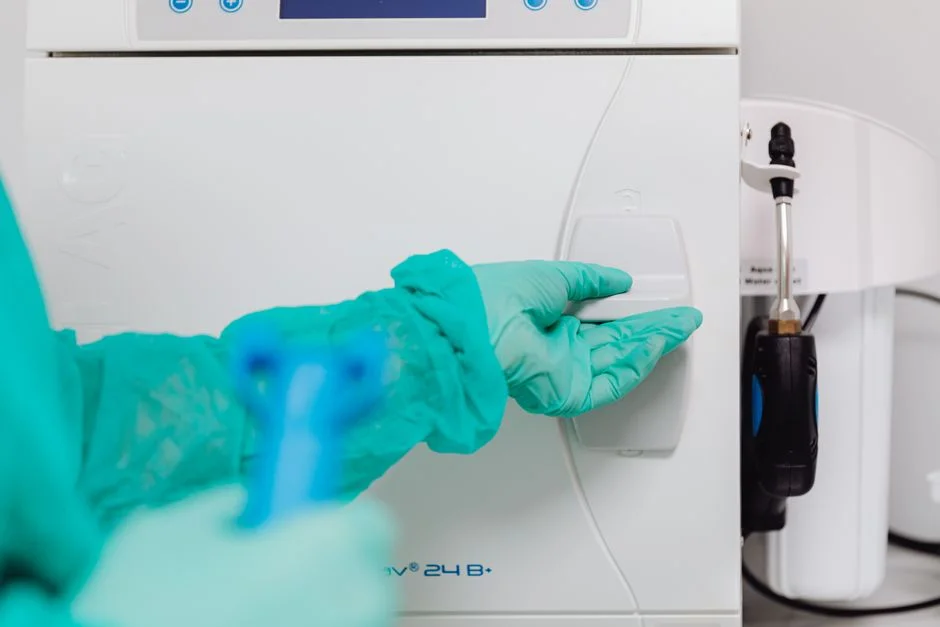
Choose disinfection by its evidence, not by a headline kill rate. The MDPI review describes typical hospital-wastewater disinfection performance as ≥3–5 log reduction for bacterial indicators and ≥2–4 log reduction for viral surrogates. These are stated performance levels for comparison; they are not Eritrea permit limits or sewer-acceptance criteria.
Chlorination can form disinfection by-products. Ozone leaves no residual disinfectant, while UV performance depends on water quality and may not inactivate viruses adequately at typical doses. The final barrier should be selected against the approved discharge route, downstream residual requirements and the contaminants that must be controlled.
Ask each supplier to define the monitored organisms, test method, operating dose or CT, contact time, hydraulic variation covered by the guarantee, water-quality operating envelope and recontamination control. For a chemical barrier, ask about residual monitoring and disinfection-by-product formation. For UV, ask for the validated dose under the project’s worst-case water quality and whether a downstream residual barrier is required. Proper selection requires matching these technical specifications to the site's specific discharge requirements.
The chlorine-dioxide equipment page and UV sterilizer product information can support equipment comparisons, but their claims must be matched to the project’s approved performance basis. Carleton University’s 2012 thesis on peracetic acid versus sodium hypochlorite disinfection-by-product formation supports research into that comparison; it is not current Eritrea-specific acceptance evidence.
Turn the concept into an RFQ and acceptance plan
Issue one RFQ that makes every offer auditable against the same inputs and acceptance tests. The supplier should receive the flow record and peak factor, waste-stream segregation plan, influent analysis, discharge route, applicable regulatory basis, treatment objectives, utility requirements, installation constraints and required deliverables. Unresolved regulatory items should be listed as exclusions rather than filled with assumed limits.
Use the quotation matrix to distinguish package-plant, MBR and disinfection-equipment scopes. A WSZ hospital wastewater package plant, an MBR and a disinfection-only package are not equivalent offers unless their treatment objectives and boundaries match. The medical and hospital wastewater treatment system description should be treated as a technical scope to be defined, not as acceptance evidence by itself.
| Quote line item | Technical scope to specify | Red flags to check before signing |
|---|---|---|
| Design basis | Design flow, hourly peak demand, duty cycle, influent envelope, discharge route and regulatory basis | Capacity quoted without site data or an assumed municipal flow profile |
| Treatment scope | Screening, equalization, biological treatment, solids handling, final disinfection and defined stream segregation | Disinfection-only scope offered where biological treatment or pretreatment is required |
| Disinfection guarantee | Organisms, test method, dose or CT, contact time, hydraulic conditions, water-quality envelope and residual control | Kill-rate claim without sampling conditions or downstream residual requirements |
| Acceptance testing | Factory and site tests, sampling plan, analytical methods, witnessing, handover criteria and corrective-action process | No protocol, no responsible sampler or no defined remedy after failed testing |
| Installation and utilities | Civil works, foundations, drainage, power, backup power, controls, footprint and access requirements | Equipment price presented as a complete installed project with civil or electrical works excluded |
| Operations and handover | O&M scope, operator training, manuals, spares, remote monitoring, sludge disposal and commissioning records | Training, sludge handling, regulatory coordination or monitoring assigned to neither party |
Before signature, identify the owner of sampling, local regulatory review, sewer coordination, civil works, power supply, sludge disposal, remote monitoring and operator training. Reject a quote that gives headline capacity but leaves these boundaries ambiguous.
Further Reading
Frequently Asked Questions
How should a hospital in Eritrea size a wastewater treatment and disinfection system?
Base the size on measured wastewater flow, hourly peaks, influent characteristics, waste-stream segregation and the approved discharge route. Ask the supplier to state its design flow, duty cycle and treatment capacity separately, then demonstrate how the quoted scope covers the hospital’s recorded demand and worst-case influent conditions.
When is municipal-sewer pretreatment more practical than an on-site MBR or package plant?
Sewer pretreatment may be practical when a connected sewer accepts the proposed effluent and the sewer authority defines manageable pretreatment requirements. Obtain written connection and acceptance criteria first. If there is no reliable sewer, the receiving route is sensitive, or the waste profile requires biological treatment, compare an on-site package plant or MBR instead.
Which supplier and acceptance evidence should be selected for an Eritrean hospital project?
Select the supplier whose quoted process matches the site waste profile and whose acceptance evidence addresses organisms, sampling conditions, dose or CT, contact time, hydraulic variation, water-quality limits and downstream residual control. Also verify which party owns Eritrea-specific regulatory review, sewer coordination, commissioning sampling and failed-test remediation.
What should a hospital wastewater treatment quotation include so that installation, commissioning and compliance costs are not understated?
Request itemized pricing for equipment, civil works, electrical supply, backup power, controls, installation, commissioning, analytical testing, training, spares, O&M, sludge disposal and regulatory or sewer coordination. The buyer should provide the site drawings, flow data, influent results, discharge route, utility information and applicable permit documents so that each allowance can be traced to a defined scope.