Set the Treatment Objective Before Selecting Equipment
Selecting an industrial effluent treatment and reverse osmosis plant in São Tomé and Príncipe requires choosing RO only when reuse or water-quality requirements justify it; otherwise, specify pretreatment for the permitted discharge route. RO applies pressure above osmotic pressure to separate permeate from a concentrate stream, so the decision depends on flow, effluent composition, recovery and concentrate handling. Protect the membranes where colloids, organics or scale-forming salts are present. Published membrane applications span 5–10 bar to 50–80 bar, but no São Tomé-specific limits or site data are established here.
Define the required outcome first: permitted discharge, reuse in an industrial process, boiler feed or another high-quality application. Reuse does not automatically require RO. Establish the receiving process’s water-quality specification first, then decide whether conventional solids removal, biological treatment, filtration and disinfection are sufficient or whether dissolved contaminants require reverse osmosis. Use this industrial effluent treatment and RO decision guide to structure that comparison.
Before selecting equipment, obtain the permitted discharge route and applicable São Tomé and Príncipe environmental and water-authority requirements. Also identify what will happen to the RO concentrate. The equipment train cannot be considered complete until its final liquid stream has a lawful destination and the facility has the utilities, footprint, operator capability and maintenance arrangements needed to operate it.
Classify the Effluent Problems That Change the Treatment Train
Effluent classification centers on the specific failures it can cause, such as suspended solids, colloids, organics, scale-forming salts or biofouling. Flow alone cannot select an RO train. Request COD, BOD, TSS, oil and grease, pH, TDS or conductivity, hardness, silica, chlorides, metals and relevant process-consumable concentrations from the plant operator or a qualified local laboratory. Then map the confirmed results to the treatment barriers that must be removed before RO.
Condorchem identifies salt precipitation, suspended colloids and biological growth as RO fouling mechanisms. Membranes.com similarly distinguishes colloidal, biological, scaling and organic fouling in tertiary municipal wastewater. These categories are useful for industrial effluent characterization because each points to a different control: solids removal, filtration or UF, chemical dosing and recovery management, or biological and organic-fouling control.
| Discharge route or influent problem | Governing rule or process option | What data settles it |
|---|---|---|
| Permitted discharge without a reuse-quality requirement | Specify solids removal, biological treatment where required, filtration and disinfection against the confirmed permit; add RO only when the discharge specification requires dissolved-salt or dissolved-contaminant removal. | Permit conditions, receiving-water or sewer route, average and peak influent flow, COD, BOD, TSS and discharge quality specification. |
| Process-water reuse | Define the receiving process’s quality requirements before choosing pretreatment; include an industrial reverse osmosis system where dissolved contaminants must be removed. | Intended reuse application, required permeate conductivity or TDS, relevant constituent limits, temperature and demand profile. |
| High suspended solids, oil or grease | Remove the material before membrane systems. Evaluate an appropriate solids or oil-removal stage such as dissolved-air flotation equipment against the analysis. | TSS, oil and grease, settleable solids, flow variability and existing equalization or primary-treatment performance. |
| Colloidal carryover | Evaluate filtration followed by UF or MF before RO. | Turbidity, particle-size distribution, TSS and existing filtration performance. |
| Scale-forming salts or excessive salinity | Control feed chemistry and recovery; do not promise recovery before establishing the concentrate route. | TDS, hardness, silica, chlorides, pH, alkalinity, sulfate, phosphate and concentrate-disposal option. |
Compare Discharge Pretreatment with a Pretreatment-RO Train
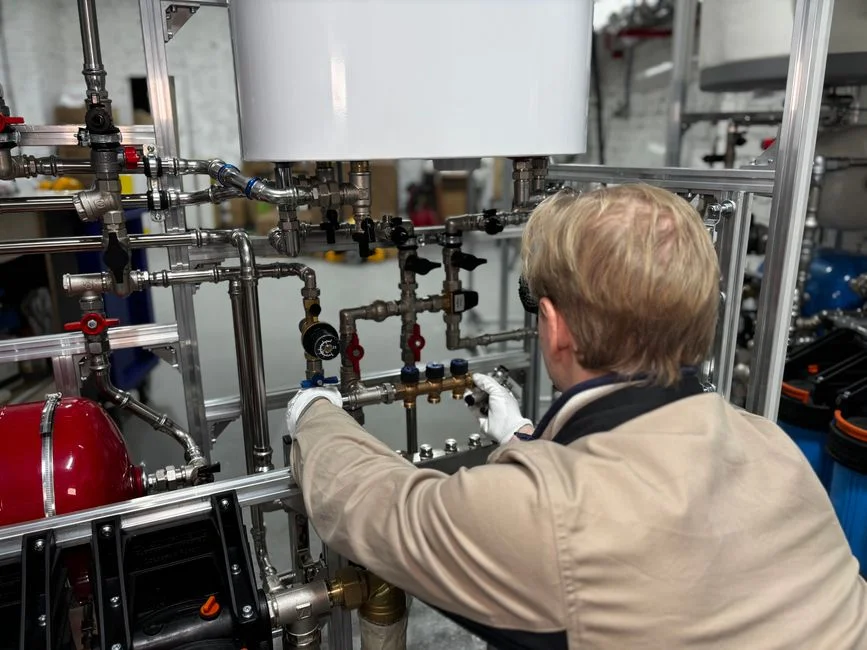
Choosing the correct treatment train depends on whether the goal is simple discharge or high-quality reuse. Choose discharge pretreatment when the confirmed requirement is limited to the permitted discharge quality and the added RO operating burden has no justified reuse value. Choose pretreatment plus RO when the permeate specification, process reuse requirement or dissolved-contaminant removal makes membrane separation necessary. Clean Water Technology states that untreated wastewater can foul, plug or damage RO membranes, making upstream treatment part of the RO scope rather than an optional accessory.
The membrane pressure must be selected from the application and feed chemistry. Condorchem identifies 5–10 bar for ultrapure water, 10–20 bar for nitrate and organic-substance removal, 20–40 bar for separation and concentration, and 50–80 bar for seawater desalination. These are application examples, not operating settings for a São Tomé plant. The local feed analysis, osmotic demand, recovery and membrane configuration must determine the design.
Recovery is also a site decision. In the membranes.com reclamation case, the design flux was 19 lmh and recovery was 85%; that result belongs to the described case and cannot be transferred to an uncharacterized industrial effluent. For industrial wastewater reuse, evaluate the UF pretreatment for industrial RO against colloidal loading and the resulting RO-feed quality. Base the local recovery target on feed chemistry, anticipated scaling and fouling, and a feasible concentrate route.
- Confirm the discharge or reuse objective.
- Obtain representative flow, composition and temperature data.
- Remove suspended material and control organics before RO.
- Add filtration and UF or MF where colloidal carryover remains.
- Set recovery and chemical control from the confirmed feed chemistry.
- Verify the concentrate destination and then compare total operating scope.
Design Pretreatment Around the Dominant RO Failure Risk
Pretreatment design must align with the dominant fouling mechanism, with suppliers demonstrating how each barrier protects the RO. Membranes.com identifies UF or MF as effective controls for colloidal material. In its cited case, secondary municipal wastewater effluent was treated by HYDRAcap UF hollow-fiber membranes to produce RO feed water with a turbidity of 0.03 NTU. Use that value as a case-specific reference, not a universal acceptance criterion for this project.
For mineral scaling, evaluate suitable antiscalant chemicals, an appropriate recovery limit and lower pH where appropriate. Membranes.com identifies calcium, silica, phosphate, carbonate and other ions as possible scale constituents; silica can be particularly difficult to remove. For biofouling, evaluate biological-control measures and the residual carried into the RO train. The same source states that RO membranes have little tolerance for free chlorine but greater tolerance to chloramines, so any upstream disinfection strategy must be checked for membrane compatibility.
Ask the supplier to explain the multi-media filtration stage, chemical controls and RO and UF membrane or filter-element selection against the complete analysis. Cleaning triggers, chemicals, cleaning frequency and expected membrane life should remain conditional on that review. Untreated wastewater can foul or damage RO membranes, so an unsupported fouling-control strategy is a procurement exclusion.
Turn the Selected Process into a Supplier RFQ and Acceptance Plan

Bidders must state the design flow, average and peak flow, feed-water basis, permeate quality, recovery, train arrangement, utilities, controls and concentrate handling in the quotation. Make the complete wastewater analysis a contractual basis for membrane, pretreatment and antiscalant selection. Where information is missing, require a written clarification or assumption rather than accepting an unsupported guarantee. Use the water-treatment RFQ checklist structure to turn the process decision into comparable technical scope.
| Quote line item | Technical scope to specify | Red flags to check before signing |
|---|---|---|
| Design basis and feed analysis | Average and peak flow; representative analysis; reuse or discharge objective; required permeate quality; feed temperature and utility requirements. | Guarantee based on an unspecified effluent; omitted sampling period; no named analysis methods or unresolved data. |
| Pretreatment and fouling control | Equipment sequence, filtration basis, UF or MF scope where justified, chemical dosing, residual control, cleaning strategy and operating interlocks. | No explanation of how colloidal, biological, scaling or organic fouling will be controlled. |
| RO performance | Stated feed basis, permeate flow, recovery, permeate quality, membrane arrangement, operating pressure and normalization conditions. | Recovery guarantee without feed chemistry; undefined permeate guarantees; operating pressure presented without application context. |
| Concentrate handling | Concentrate flow and quality estimate, collection method, transfer equipment, destination and operator responsibilities. | No concentrate route; discharge assumed without authority approval; disposal costs omitted. |
| Acceptance and handover | FAT, site acceptance, membrane-integrity checks, permeate-quality and flow tests, recovery verification, training, documentation and spares. | Acceptance conditions differ between quotation and contract; commissioning or installation excluded; operator training omitted. |
Further Reading
Frequently Asked Questions
When is a pretreatment-RO train justified instead of discharge pretreatment?
Pretreatment plus RO is justified when the receiving process or discharge requirement specifically needs the dissolved-contaminant separation and water quality that RO provides. First obtain the required permeate specification and compare it with the performance of solids removal, biological treatment, filtration and disinfection. Do not add RO merely because reuse is mentioned; untreated wastewater can foul or damage the membranes.
Which site data controls equipment sizing and the recovery target?
Hourly and daily peak flows control hydraulic sizing, while the complete effluent analysis controls pretreatment, membrane selection and recovery. Require COD, BOD, TSS, oil and grease, pH, TDS or conductivity, hardness, silica, chlorides, metals and process-consumable concentrations. The 85% recovery reported in the membranes.com reclamation case is not transferable until local feed chemistry and concentrate disposal are established.
What should the supplier quote, and what should be verified during acceptance?
Request design flow, feed-water basis, permeate quality, recovery, train arrangement, utilities, controls and concentrate handling in the quotation. Make the analysis and stated design basis contractual. During FAT and site acceptance, verify membrane integrity, permeate quality, permeate flow and recovery against agreed conditions; also confirm training, documentation, spares and completion of installation and commissioning.
How do local discharge, reuse and concentrate requirements affect supplier selection?
Bidders must demonstrate compliance with the identified discharge route and reuse specification, and provide a defined concentrate solution. The supplier’s quotation should identify all three streams and their destinations. Where São Tomé and Príncipe requirements have not been supplied, obtain the applicable environmental and water-authority requirements before relying on any discharge or reuse compliance statement.