Start With the Cooling Design, Not the Treatment Package
A data center in Likasi needs treatment systems matched to each wastewater stream, not one universal package. The final route depends on the cooling topology, water balance, local discharge permissions, and reuse demand. Equipment selection should follow stream segregation: sanitary wastewater, cooling blowdown, RO reject, maintenance drains, and glycol-bearing closed-loop water require different treatment, monitoring, and disposal decisions.
The first deliverable should therefore be a cooling-and-water concept, not a treatment-package quotation. HOBI (2026) explains that data-center water outcomes vary with cooling design, climate, and source-water quality. The project team should obtain the planned IT load, cooling topology, number and capacity of cooling towers, future expansion phases, expected staffing, and any proposed liquid cooling or alternative water sources.
Glycol normally remains inside a closed loop. Drainage during maintenance, refresh, or decommissioning creates a separate stream. HOBI (2026) notes that ethylene and propylene glycol can reduce dissolved oxygen if released to surface water, with ethylene glycol also presenting higher toxicity concerns. That drain should therefore remain segregated from cooling blowdown and be routed to a documented, compliant removal process.
| Stream | Typical source | Design question before treatment selection |
|---|---|---|
| Sanitary wastewater | Restrooms, kitchens, staff facilities | What are the average and peak sanitary flows, and will the route be sewer connection or on-site treatment? |
| Cooling-tower blowdown | Evaporative cooling system | What are the chemistry, temperature, flow, cooling cycles, and permitted discharge route? |
| Once-through or thermal discharge | Surface-water cooling | Is the receiving water suitable, and what temperature and discharge controls apply? |
| RO reject or softening waste | Makeup-water treatment | What are the concentrate chemistry, salinity, and recovery requirement? |
| Maintenance drains | Cooling equipment and process systems | Which drains are routine, which are emergency dumps, and how are they contained? |
| Glycol-bearing closed-loop drains | Maintenance or decommissioning | Which glycol type and concentration are involved, and what qualified removal route is available? |
The Gold Coast data center wastewater treatment guide provides a useful comparative discussion of cooling configuration, but its regulatory and infrastructure context is not a substitute for a Likasi-specific study.
Build a Likasi Water Balance That Captures Average and Peak Loads
Water treatment sizing must start with a segmented Likasi water balance, because average annual demand does not establish treatment or conveyance capacity. Measure or estimate makeup water, evaporation, blowdown, sanitary flow, RO reject, maintenance drains, and closed-loop drain-down separately. Record normal operating flows, peak cooling periods, simultaneous discharges, startup conditions, and future expansion phases.
For an evaporative cooling system, the theoretical blowdown ratio can be calculated as 1 divided by cycles of concentration minus 1. Genesis Water Technologies (2026) gives 25 percent of makeup water at four cycles and 20 percent at six cycles. The site model must still account for measured operating practices and variable evaporation rather than treating either ratio as a guaranteed discharge.
The U.S. Department of Energy benchmark cited by HOBI (2026) indicates that raising concentration cycles from three to six can reduce makeup water by about 20 percent and blowdown by about 50 percent. That comparison applies to the cited operating scenario; it does not establish savings for a Likasi system without a site water balance, source-water analysis, and control-system review.
Water Usage Effectiveness, or WUE, tracks site water use relative to IT energy use. It is an efficiency indicator, not evidence that blowdown meets discharge limits or can be reused. HOBI (2026) also notes that a source-based WUE can include upstream water used to generate on-site energy.
| Water-balance component | Measurement or calculation basis | Sizing use |
|---|---|---|
| Makeup water | Site meter reconciled with source records | Establishes incoming demand and baseline water cost |
| Evaporation | Measured cooling-system water balance | Separates consumptive loss from discharge |
| Cooling blowdown | Continuous flow, operating calculation, and calibrated meter | Sizes equalization, pretreatment, and disposal or reuse equipment |
| Sanitary wastewater | Fixture count and operating schedule, validated by meter | Determines biological treatment and effluent storage needs |
| RO reject and softener waste | Recovery, feed quality, and operating logs | Determines residual-flow handling and concentrate treatment |
| Maintenance and emergency drains | Equipment volumes and drain-down procedures | Tests containment, equalization, and upset-event capacity |
International consumption examples should remain contextual. Commercial Water Lab (2026), citing a June 2026 University of Georgia Extension publication, reports that a medium-sized data center can use up to 300,000 gallons per day for cooling. That figure is not a Likasi design input. The data center wastewater treatment in Hwaseong-si illustrates how location-specific planning should be structured.
Match Each Stream to Its Required Treatment
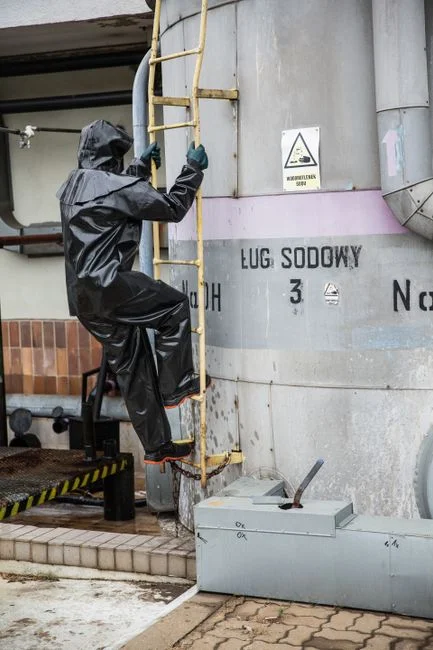
Each Likasi stream needs a defined effluent or reuse objective before a treatment train is selected. Cooling blowdown analysis should cover conductivity or total dissolved solids, suspended solids, pH, temperature, residual chlorine where used, biocides, corrosion inhibitors, scale inhibitors, and relevant metals. The selected route determines which parameters control pretreatment and final compliance.
For sanitary wastewater, evaluate anoxic or aerobic biological treatment with clarification and disinfection. A packaged sewage treatment plant for data-center sanitary wastewater may be a candidate for smaller flows, but it remains a flow-based design subject to local approval and performance testing rather than a default installation.
For reuse polishing, an ultrafiltration system for blowdown pretreatment and reuse can provide a physical barrier for bacteria, colloids, and suspended solids, with automatic backwash and air scour. The published catalog range is 2,000–40,000 L/h, and the stated membrane pore size is 0.03 micron. Neither figure establishes suitability without feed-water testing and a defined reuse specification.
For suspended solids, oil and grease, or colloidal material, a DAF system for suspended-solids pretreatment may precede membrane or reuse equipment. The catalog range is 4–300 m³/h across 13 standard models. Automatic chemical dosing should be introduced only where analysis confirms a need for pH adjustment, coagulation, or residual control; unnecessary dissolved chemicals can complicate downstream reuse and effluent compliance.
| Stream and objective | Treatment concept | Critical design or procurement evidence |
|---|---|---|
| Cooling blowdown to sewer | Equalization, solids or oil control as required, chemical adjustment where justified, and local pretreatment compliance | Representative analysis, written utility limits, average and peak flows |
| Cooling blowdown for physical reuse | DAF or filtration followed by targeted polishing | Use-specific quality specification and reuse demand |
| Sanitary wastewater | Anoxic or aerobic biological treatment, clarification, and disinfection | Sanitary flow, load, effluent objective, and approved route |
| RO reject | Segregated equalization and permitted disposal or further concentration | Resistivity, conductivity, flow, and local discharge criteria |
| Glycol-bearing drain | Containment followed by qualified treatment or waste-partner removal | Glycol type, concentration, volume, and written disposal method |
| Reuse polishing | UF and other targeted barriers selected from analysis | Feed-water membrane compatibility, cleaning needs, and performance test |
A automatic chemical dosing system for pH and coagulation control should be tied to an approved chemical strategy, storage plan, interlocks, and operator competence—not selected merely because the stream is described as blowdown.
Choose the Discharge Route Before Finalizing the Treatment Train
The preferred discharge route must be established before equipment procurement because sewer, surface-water, and reuse pathways impose different quality, capacity, and documentation requirements. For municipal sewer service, obtain written acceptance from the relevant authority or utility. The submission should identify process-water limits, connection conditions, sampling duties, and capacity for average and peak flows through the sewer, lift station, and treatment plant.
For surface-water discharge, engage the competent DRC environmental authority early. Assess the receiving water, seasonal low flow, temperature, dissolved solids, chemical residuals, and outfall feasibility. A legal outlet is not automatically a compliant outlet.
For reuse, match final quality to the intended function. Toilet flushing, equipment washing, process water, and cooling makeup have different treatment and health-safety requirements. A reused stream should not be routed to a non-potable service merely because analytical results appear favorable at the equipment outlet.
Black & Veatch’s 2026 guide cites a U.S. significant-industrial-user screening reference of an average of at least 25,000 gallons per day of process wastewater, plus capacity and harm tests. That is not a DRC threshold. The guide also reports a $36 million developer contribution toward an approximately $90 million expansion in Goodyear, Arizona, and estimates about 2.5 million gallons per day of wastewater and blowdown for a proposed Shreveport development. These examples demonstrate the scale of infrastructure commitments; they are not Likasi projections.
| Route | Required decision | Evidence to obtain |
|---|---|---|
| Municipal sewer | Will the utility accept the discharge? | Written acceptance, industrial user permit requirements, local limits, sampling plan, and capacity confirmation |
| Surface water | Is the receiving water and outfall permissible? | Authority consultation, receiving-water assessment, temperature and chemistry limits, seasonal assessment |
| Internal reuse | Does treated quality match the intended use? | Use-specific specification, demand profile, health-safety review, distribution and backflow controls |
| Contained disposal | Is an approved waste route available? | Qualified waste partner, transport documentation, receiving-site acceptance, volumes |
The South Memphis data center treatment requirements provides a comparable route-selection framework, but U.S. permitting references do not establish Likasi or DRC compliance.
Design for Reuse Without Hiding the Energy and Maintenance Trade-offs
Reuse should be developed in stages rather than presented as an automatic net saving. Begin with leak repair, suspended-solids control, optimized cooling controls, and safe operating increases in cycles of concentration. Genesis Water Technologies (2026) recommends measurement and baseline definition, optimization of existing systems, chemical review, targeted blowdown treatment and reuse, and only then advanced integration. This sequence limits capital expenditure where simpler operational measures already reduce discharge.
The 2026 Open Engineering study found that its wastewater scenario had about twice the global warming potential of the freshwater scenario. Treatment energy explained roughly 80 percent of the difference, and the UF+RO scenario used more than five times the energy of the freshwater case. The study also found improved cycles of concentration and freshwater displacement as countervailing benefits, but it does not establish that reverse osmosis or zero liquid discharge is economical for every site.
| Architecture | Water-quality objective | Utility demand | Operating consideration |
|---|---|---|---|
| Discharge to sewer | Meets written utility limits | Water purchase and sewer capacity | Lowest process complexity, but discharge remains and sewer capacity must be confirmed |
| Physical treatment plus reuse | Meets the specified non-critical reuse quality | Treatment power and chemical demand | Requires source segregation, monitoring, and matched reuse demand |
| Advanced polishing | Meets a more stringent reuse specification | Higher electricity demand and membrane maintenance | Needs competent operators and reliable pretreatment |
| Full recovery or zero liquid discharge | Minimizes liquid discharge | Substantial energy demand | Requires brine, sludge, or residual handling and a clear economic driver |
For equipment evaluation, the reverse osmosis system for advanced water polishing and integrated wastewater treatment system are options to assess only after water quality, reuse value, staffing, and residual disposal are defined. The ZLD capacity guide provides a useful framework for advanced recovery, but a gigafactory-scale case cannot be scaled directly to Likasi.
Turn the Concept Into an Auditable Procurement Package
Procurement should begin only after the water balance, route decision, stream segregation, and treatment objectives are documented. The mechanical engineer should issue a signed mass balance with average, peak, seasonal, and future-phase flows for every source. The package should separately identify evaporation, blowdown, sanitary wastewater, RO reject, softener waste, routine maintenance drains, emergency dumps, and glycol-bearing drains.
Require representative source and blowdown sampling rather than relying only on desk analysis. The laboratory program should include conductivity, total dissolved solids, suspended solids, pH, temperature, hardness, chemical residuals, and route-relevant metals. Sampling should reflect normal and peak operating conditions and identify glycol type and concentration where relevant.
Treatment guarantees should state final effluent or reuse-water parameters, equipment availability, automatic-control functions, backup-power requirements, maintenance access, remote monitoring, and reagent consumption. A guarantee based only on inlet flow does not establish treatment performance. Conceptual and detailed layouts should show segregated streams, equalization, pretreatment, final treatment, storage, reuse distribution, residual sludge management, and controlled bypass or upset conditions.
Suppliers should state capacity in both m³/h and m³/day, treatment performance, local utility requirements, installation constraints, commissioning prerequisites, operator training, spare-parts availability, and service support in the DRC. Avoid adopting an international capital-cost figure as a Likasi estimate. Request a site-specific quotation after confirming water prices, sewer charges, energy costs, civil works, import logistics, taxes and duties, and the selected discharge route.
The Najaf data center wastewater and cooling blowdown guide can support supplier discussions, but the buyer should issue Likasi-specific data, route requirements, and performance criteria in the RFQ rather than transferring an international solution without local verification.
Frequently Asked Questions
Which authority must approve a data center wastewater discharge route in Likasi?
The responsible decision depends on the route. Sewer discharge requires confirmation from the local authority or receiving utility, while surface-water discharge requires engagement with the competent DRC environmental authority. A reuse route also requires confirmation that the intended use and treatment system satisfy applicable public-health and water-quality requirements. Obtain a written route decision before ordering equipment, because approval may change the required treatment objective, monitoring, and discharge limits.
How should treatment capacity be sized for a Likasi data center?
Size from a signed, segmented water balance rather than an international flow benchmark. Include daily and peak sanitary flows, evaporation, calculated and metered cooling blowdown, RO reject, maintenance drains, future expansion, and simultaneous discharge conditions. Equipment capacity should be checked against both the selected route’s limits and the intended reuse demand, with contingency based on documented operational risks. No Likasi flow can be inferred from the data-center examples cited in the research.
Is a modular treatment system appropriate, and what should the RFQ require?
Modularity can be appropriate where streams and treatment stages are clearly segregated, but the RFQ must require capacity in m³/h and m³/day, final-water performance, automatic controls, availability, backup power, maintenance access, commissioning tests, operator training, spare parts, and local service support. Ask suppliers to identify every utility, chemical, civil-work, and residual-management assumption. This supports a technical comparison instead of an equipment-only price comparison.
What could force a costly retrofit?
A common retrofit occurs when sanitary wastewater, cooling blowdown, RO reject, and glycol drains are mixed without a common treatment objective, or when a sewer connection is assumed before the utility confirms hydraulic and treatment capacity. Such decisions can add equipment, storage, monitoring, and chemical complexity while increasing the risk of non-compliance. A segregated process flow and written capacity confirmation are the main safeguards.
When are advanced RO or zero-liquid-discharge systems justified?
Advanced recovery should be justified by measurable reuse value, disposal constraints, energy availability, operator capability, residual-brine or sludge handling, and the scale of the recoverable flow. The 2026 Open Engineering study shows that advanced treatment can carry substantially higher energy demand. Use site water analysis, a total-cost comparison, and a written residual-disposal plan rather than treating zero liquid discharge as the default treatment objective.