What Effluent Treatment Must Achieve in Chiang Mai
An industrial effluent treatment plant in Chiang Mai should be selected from the wastewater profile and final reuse or discharge target, not from capacity alone. DAF is practical for FOG, oil and suspended solids; MBR is generally stronger for high COD, dyes and advanced reuse. HydropureWater’s published planning guide cites 2025 PCD targets of BOD <20 mg/L, COD <120 mg/L, TSS <50 mg/L and FOG <10 mg/L, with indicative MBR CAPEX of THB 3M–50M and OPEX of THB 0.8–2.5/m³ treated. These are preliminary benchmarks: confirm current permit conditions, sample the actual effluent and validate the selected train through pilot testing.
An effluent treatment plant is the complete treatment train used to remove contaminants before lawful discharge or reuse. Define the receiving route before equipment selection: direct discharge, controlled sewer discharge, irrigation, process rinsing, cooling or another application. Each route imposes a different treatment and verification requirement.
HydropureWater’s 2025 commercial guide lists PCD planning values of BOD <20 mg/L, COD <120 mg/L, TSS <50 mg/L, FOG <10 mg/L, and Cu, Ni and Cr each <0.5 mg/L. These are commercial planning values, not confirmed current primary-source permit conditions. The facility’s current permit and applicable PCD Region 1 requirements must therefore be checked before a performance guarantee is drafted.
Preliminary site data are also not acceptance testing. The design flow, operating pattern and contaminant ranges should be verified through representative sampling, after which the supplier can demonstrate whether the proposed train meets the agreed discharge or reuse specification.
Characterize the Wastewater Before Sizing the Plant
Daily flow, pH and a comprehensive contaminant profile are the minimum basis for ETP process design, according to HydropureWater’s 2025 industrial wastewater guide. Factory wastewater is not a single uniform stream, so a quotation based only on average daily flow will leave peak loads, contaminants and treatment scope undefined.
Begin with flow-duration data covering production shifts, cleaning cycles, rainfall or wash-water contributions, discharge points and anticipated production growth. Record the peak-to-average ratio and whether batches are continuous or intermittent. For food processing, prioritize FOG and TSS; for textiles, examine COD, color and dye chemistry; for electronics, test metals, pH, acidity or alkalinity, and precipitation chemistry.
HydropureWater’s 2025 guide lists textile wastewater at COD 800–2,500 mg/L, TSS 300–800 mg/L and reactive, disperse or sulfur-dye color of 500–2,000 Pt-Co. These are sector planning values and must not be assumed to represent a specific factory. For CMP slurry or etching waste, the same guide lists Cu 5–20 mg/L, Ni 2–8 mg/L and TDS 1,500–4,000 mg/L.
| Sector | Wastewater profile to investigate | Procurement implication |
|---|---|---|
| Food processing | FOG and TSS | Determine whether DAF should precede biological treatment. |
| Textiles | COD 800–2,500 mg/L; TSS 300–800 mg/L; color 500–2,000 Pt-Co | Confirm actual dye and COD concentrations; assess DAF pretreatment followed by biological treatment. |
| Electronics | Cu 5–20 mg/L; Ni 2–8 mg/L; TDS 1,500–4,000 mg/L | Include pH adjustment, chemical dosing, sedimentation and residual-metal testing. |
Use 24-hour composite samples and event samples across representative operating conditions. State analytical methods and detection limits in the procurement document, and include acid/alkali demand where precipitation chemistry matters. The supplier’s automatic chemical dosing system should be assessed against the measured chemistry, not dosed from a generic initial concentration.
Choose Between DAF and MBR by Treatment Duty
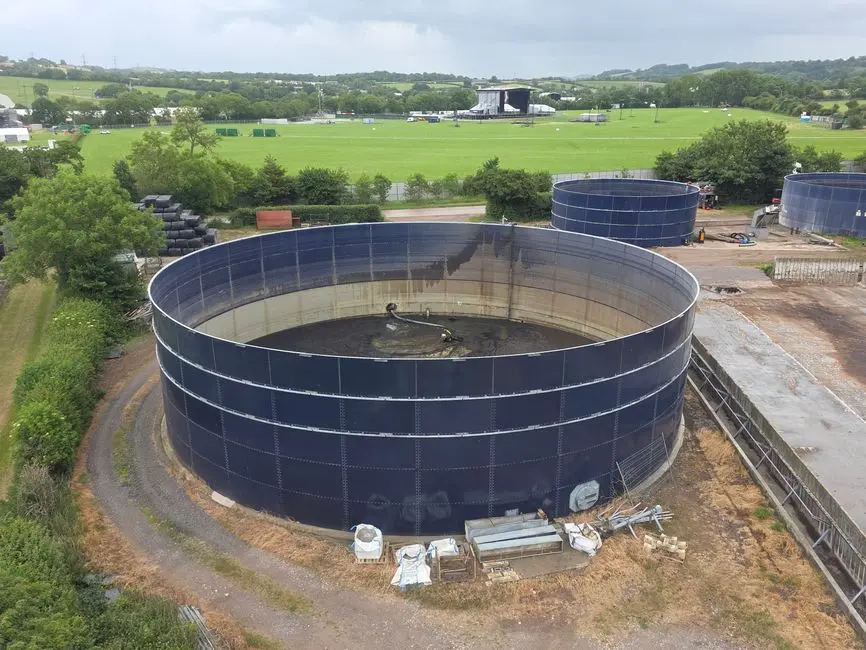
DAF and MBR perform different duties in an ETP process design, so they should not be treated as interchangeable. DAF is primarily a solids, oil and FOG separator; MBR combines biological treatment with membrane separation and is normally the stronger option when low suspended solids, complex dye removal or advanced reuse is required.
HydropureWater’s 2025 guide identifies DAF as the first line of defense for high FOG and TSS. It reports DAF removal of FOG at 90–98%, TSS at 60–80%, and COD at 50–70%. These are design-reference efficiencies, not guaranteed results; wastewater chemistry, pH, chemical conditioning and operating control affect actual performance.
For high COD, complex dyes, stringent reuse requirements and effective biological separation, HydropureWater identifies MBR. Its guide reports BOD removal of 95–99%, COD removal of 90–95% and pathogen removal of 99.9%. The published configuration uses submerged membranes with a 0.1 μm pore size, MLSS of 8,000–12,000 mg/L and flux of 15–25 LMH. These are reference values that must be validated against the actual wastewater.
| Decision point | DAF | MBR |
|---|---|---|
| Primary removal role | FOG, oil and suspended solids | Organic load and biological solids separation |
| Published removal efficiencies | FOG 90–98%; TSS 60–80%; COD 50–70% | BOD 95–99%; COD 90–95%; pathogens 99.9% |
| Published design references | Air pressure 4–6 bar; recycle ratio 10–30%; hydraulic loading 5–10 m/h | 0.1 μm membranes; MLSS 8,000–12,000 mg/L; flux 15–25 LMH |
| Appropriate selection | Food-processing pretreatment or solids/FOG control | Textile wastewater, complex dyes, stringent reuse and low TSS |
A dissolved air flotation pretreatment system is suitable when oil, FOG or settleable solids could impair downstream biology. An integrated MBR wastewater treatment system is more relevant where biological treatment and membrane separation are required in one package. Neither selection should proceed before representative wastewater data and a defined reuse or discharge target are available.
The commercial supplier directory from San-Lan, published in 2026, identifies a Chiang Mai-based modular supplier serving factories and agricultural processors. That demonstrates local modular-system activity, but it is a directory rather than an engineering performance source.
Build the Right Treatment Train for Each Factory
An industrial wastewater treatment plant is a process train, not a single machine. The right sequence depends on contaminant concentration, hydraulic variation and whether the final water will be discharged or reused.
For food processing, use the FOG and TSS profile to determine whether DAF should precede biological treatment. HydropureWater’s 2025 guide identifies DAF as suitable for FOG and TSS removal before the biological stage, reducing the contaminant load entering downstream biology.
For textile wastewater, evaluate DAF pretreatment followed by MBR when the objective includes high COD and color removal or reuse. This arrangement separates the mechanical pretreatment duty from biological treatment and membrane separation; it should not be assumed from a generic technology list.
For electronics wastewater, HydropureWater identifies chemical dosing and sedimentation for heavy-metal removal. Its 2025 guide reports Cu and Ni removal of 70–90% and COD reduction of 60–80% for that approach. It lists chemical dosing at 50–200 mg/L and flocculant at 1–5 mg/L, but jar or pilot tests must establish actual doses.
Where reuse requires very low dissolved solids, discuss RO or another polishing stage after biological and membrane treatment. HydropureWater reports MBR plus RO permeate at TDS <50 mg/L for demanding reuse applications. Evaluate the reverse osmosis water purification system against the required water quality and reject-water management.
Add sludge dewatering wherever biological solids or precipitation residues are generated. HydropureWater’s filter-press reference specifies 6–15 bar and 2–4-hour cycles; suitability must be checked against solids rheology and operating schedule. The plate-and-frame filter press should therefore be evaluated as part of the solids-management train.
Specialized membrane distillation should not be presented as a standard Chiang Mai ETP recommendation. Research published in 2023 by Ho Chi Minh City University of Technology and Engineering reported 51 kg/m²/h flux at 60°C feed and 20°C permeate, limited ammonia rejection, and a 15% flux decline after NaOCl pretreatment over 28 hours. Its municipal-effluent scope and specialized operating conditions require separate review before use in an industrial treatment train.
Compare 2026 Capital and Operating Cost Benchmarks
Published cost ranges can frame an initial budget, but they cannot support a purchase award without current, site-specific quotations. HydropureWater’s 2025 commercial guide gives Chiang Mai planning ranges of THB 1.2M–15M for DAF CAPEX and THB 3M–50M for MBR CAPEX. These are not universal prices for every factory.
The same source gives a more specific planning example: THB 3M for a 50 m³/day MBR and THB 50M for a 500 m³/day MBR with RO. HydropureWater reports total treatment OPEX of THB 0.8–2.5/m³, with DAF at the lower end and MBR at the higher end because of membrane maintenance and power consumption.
| Cost item | Published planning benchmark | Evidence boundary |
|---|---|---|
| DAF CAPEX | THB 1.2M–15M | HydropureWater 2025 commercial guide; not a quotation. |
| MBR CAPEX | THB 3M–50M | HydropureWater 2025 commercial guide; not a quotation. |
| Example MBR CAPEX | THB 3M for 50 m³/day | HydropureWater 2025 commercial planning example. |
| Example MBR + RO CAPEX | THB 50M for 500 m³/day | HydropureWater 2025 commercial planning example. |
| Total treatment OPEX | THB 0.8–2.5/m³ | HydropureWater 2025 commercial guide; actual cost depends on scope and operation. |
HydropureWater reports potential freshwater savings of THB 5–10/m³ and a typical 3–5-year ROI for industrial reuse initiatives. Calculate the project’s own ROI from avoided freshwater, discharge fees, recovered water, energy, chemicals, sludge disposal and maintenance; do not transfer the published ROI to an unrelated factory.
Request quotations on one consistent scope: flow basis, duty cycle, pretreatment, biological stage, membrane or RO polishing, sludge handling, installation, commissioning, controls, spares, warranties and five-year operating costs. Use the ETP supplier comparison and cost guide as a structural reference, but confirm current local quotations, site conditions and the applicable regulatory basis before award.
Use a Five-Step Supplier Selection and Validation Process
A staged procurement process separates commercial claims from demonstrated performance. The critical step is to characterize the wastewater before asking suppliers to size or guarantee an industrial wastewater treatment plant.
- Characterize: Obtain flow, pH, COD, BOD, TSS, FOG, color, metals, TDS and the applicable discharge or reuse criteria. Include operating shifts, batch discharges and planned production growth.
- Shortlist: Request a process narrative, equipment schedule, electrical load, utility requirements, footprint, performance guarantees and exclusions. Ask each supplier to identify which results depend on pretreatment, chemical dosing or external polishing.
- Pilot: HydropureWater’s 2025 guide recommends pilot testing for significant DAF or MBR investments to collect site-specific flux, removal-efficiency and membrane-fouling data. For DAF, test solids capture and FOG removal; for MBR, examine flux stability, cleaning response and achievable biological performance.
- Validate the commercial model: Compare life-cycle cost, membrane replacement, chemical use, energy, operator hours, sludge disposal and expansion provisions. Use the industrial ETP and DAF selection guide to frame technical questions rather than relying on headline capacity.
- Confirm acceptance: Define sampling frequency, laboratory methods, guarantee conditions, bypass response, alarm handling, operator training, commissioning tests and warranty boundaries in the contract. Clarify who bears the risk when influent characteristics exceed the agreed envelope.
Supplier references should be checked against the proposed configuration. San-Lan’s 2026 directory describes modular systems as easy to install and gives a solar-powered coffee-processing wastewater example in Mae Hong Son at 200 m³/day, with treated water used for shade-tree irrigation. That is evidence of a modular deployment concept, not proof of performance for a different factory. Require suppliers to substantiate site-energy assumptions, operating staffing and maintenance capability.
Frequently Asked Questions
What will an industrial effluent treatment plant in Chiang Mai cost?
HydropureWater’s 2025 commercial guide gives preliminary planning ranges of THB 1.2M–15M for DAF CAPEX, THB 3M–50M for MBR CAPEX and THB 0.8–2.5/m³ for total treatment OPEX. These are not guaranteed project prices. Request an itemized quotation using the same flow basis, treatment scope, utilities, installation, commissioning, sludge handling, controls, spares, warranty and five-year operating-cost basis for every shortlisted supplier.
Should a factory choose DAF or MBR?
Choose DAF when the primary duty is FOG, oil or suspended-solids removal, especially as pretreatment ahead of biological treatment. Choose MBR when the duty includes high COD, complex dyes, stringent reuse quality or low suspended solids after biological treatment. Confirm that choice against measured wastewater chemistry and, for significant investment, pilot results rather than relying on published removal efficiencies.
How much wastewater capacity should the ETP be sized for?
Size the ETP from verified flow-duration data, including average and peak flow, production shifts, batch discharges, wash water, rainfall contributions and planned growth. A daily average alone does not establish hydraulic or contaminant capacity. Require each supplier to state its design flow, peak-flow response, operating duty cycle and treatment-train turndown assumptions.
What compliance risks should be included in the purchase request?
The main risk is treating a commercial planning value as a verified legal requirement. HydropureWater’s 2025 guide lists BOD <20 mg/L, COD <120 mg/L, TSS <50 mg/L, FOG <10 mg/L and Cu, Ni and Cr <0.5 mg/L, but the buyer should obtain the facility’s current permit and confirm applicable primary-source conditions. Contractual acceptance tests should specify sampling frequency, analytical methods, guarantee conditions, bypass response and responsibility for off-spec influent.
How can a supplier be checked before award?
Ask for a wastewater characterization, treatment proposal and itemized lifecycle-cost breakdown from each shortlisted supplier. Check the proposed process against actual sample results, local operating experience, pilot evidence, electrical and utility loads, operator requirements and warranty boundaries. The next procurement action should be a common RFQ package supported by representative wastewater data and the current permit, so quotations can be compared on the same technical and commercial basis.