Which Treatment Is the Better Fit for a Wood Dale Semiconductor Plant?
Wood Dale semiconductor facilities should choose DAF when wastewater contains floatable oils, FOG, colloids, or conditioned fine solids that must be removed before downstream treatment. Choose a clarifier when the dominant load is settleable solids and lower mechanical complexity is the priority. Neither technology should be selected from flow rate alone: characterize the wastewater, conduct jar or bench testing, and validate performance with a pilot when warranted. Semiconductor streams vary, so chemical compatibility, reuse targets, sludge handling, controls, and the Wood Dale sewer or discharge permit must also be evaluated.
The decisive question is what the plant must remove and what could fail downstream. DAF, or dissolved air flotation, is the stronger candidate when the treatment objective is capture of floatable material or chemically conditioned particles before filtration, MBR, or RO. A clarifier is the stronger candidate when bulk settling of sufficiently heavy solids is the objective and simpler equipment and operation are priorities.
A hybrid train may be justified for a complex stream. Ecologix, in its DAF vs. Clarifier: Industrial Wastewater Selection Guide, confirms that DAF and clarifiers can be combined to address complex wastewater. That option should be evaluated against the simpler alternatives using the same wastewater data, treatment goals, and total-cost criteria.
For a Wood Dale facility, the decision should connect to chip fab wastewater treatment design and, where advanced packaging operations are involved, advanced packaging wastewater treatment design. Capacity alone does not establish which unit is appropriate; wastewater character, reuse requirements, operating constraints, sludge fate, and applicable sewer or discharge conditions determine the defensible choice.
How Semiconductor Wastewater Changes the Separation Problem
DAF separates particles by attaching them to microbubbles and floating them, whereas a clarifier separates sufficiently settleable solids by gravity. That mechanical distinction determines which contaminants each process can remove.
First, divide the wastewater by source rather than treating it as one uniform effluent. A semiconductor plant may generate streams with different flow variability, suspended solids, colloids, oil or FOG, metals, pH, and constituents that matter to reuse or downstream pretreatment limits. Representative characterization is therefore more useful than a single average flow or suspended-solids result.
In an industrial DAF system, microbubbles attach to or carry conditioned particles toward the surface, and a skimmer removes the float. Clearwater Industries’ April 2026 DAF guide describes standard microbubbles in the 30–50 micron range; DAF Corp separately states that its microbubble generator produces 20–40 micron bubbles. These are equipment-source descriptions, not a basis for selecting one bubble system without wastewater testing.
A conventional clarifier uses gravity sedimentation: heavier solids settle to the bottom for sludge withdrawal. A high-efficiency lamella clarifier adds inclined plates, increasing available settling surface within a compact structure.
Chemical conditioning can change the separation result. Clearwater Industries states that coagulation and flocculation increase particle size and contactability with microbubbles. In DAF, chemical dosing, mixing, pH control, and sludge behavior are therefore part of the process—not accessories to be added after selecting a tank.
Neither mechanism removes dissolved contaminants as suspended solids. If characterization shows dissolved species that must be reduced, biological treatment, membrane treatment, oxidation, or another downstream process remains necessary. The physical pretreatment unit protects that downstream train; it does not replace it.
DAF and Clarifier Performance Compared
Published removal results are only transferable when their wastewater and operating conditions match the Wood Dale application; the comparison below therefore separates mechanism, operating implications, and source-scoped examples.
| Parameter | Dissolved air flotation | Clarifier |
|---|---|---|
| Dominant mechanism | Microbubble flotation and surface skimming | Gravity sedimentation and bottom sludge withdrawal; inclined plates in a lamella design |
| Best-fit material | Floatable oils, FOG, colloids, and conditioned fine solids | Sufficiently settleable solids and bulk sediment |
| Footprint and mechanical complexity | More equipment and mechanical duties, including air generation and surface skimming | Generally simpler; lamella equipment adds inclined-plate media |
| Chemical-conditioning relevance | Coagulation and flocculation can be central to particle capture and flotation | May assist settling, but the process depends more heavily on particle settling behavior |
| Sludge behavior | Float plus heavier bottom solids must be handled | Settled solids accumulate as sludge and require withdrawal |
| Downstream protection | Potentially useful before sensitive membranes when floatables and fine conditioned solids are present | Potentially useful for bulk solids removal when settleable material is the limiting load |
| Operating considerations | Chemical dosing, bubble generation, skimming, controls, odor and solids handling | Hydraulic distribution, settling, sludge withdrawal, cleaning access, odor control |
| Wood Dale decision fit | When floatable oils, FOG, colloids, or conditioned fines drive pretreatment risk | When settling performance, equipment simplicity, and lower operating complexity dominate |
Ecologix’s food-processing example reports 95% removal of oils and greases by DAF versus 70% efficiency for a clarifier on the same stream. Its mining example reports 90% solids reduction by a clarifier at lower cost. Neither result establishes semiconductor performance.
DAF Corp claims 92%–98% TSS removal for its circular FC Maximizer and 85%–90% for its rectangular RC UniMax. The company also presents an FC-150 design example for 500 GPM, clarifying 2,000 PPM suspended solids to 50 PPM. These are model-specific vendor claims and a stated design example, not guarantees for Wood Dale wastewater.
Clearwater Industries states that one Compact DAF skid handles 66 GPM or less, while larger flows use a modular two-skid arrangement. That is a manufacturer configuration statement, not a general sizing rule.
HydropureWater’s lamella-clarifier specifications state surface loading rates of 20–40 m/h and up to 30% lower chemical consumption. These are product-specific design claims. Buyers still need actual wastewater testing, because solids character, conditioning, hydraulic variation, and operating conditions govern performance.
Select DAF When Floatable or Conditioned Solids Drive the Risk
DAF becomes the stronger candidate when oils, FOG, colloids, or low-buoyancy fine solids could impair downstream membranes or other sensitive process equipment.
Chemical coagulation and flocculation belong in the project scope when the wastewater requires them. Clearwater Industries identifies serpentine flocculator mix tubes or chemical mix tanks as part of its DAF pretreatment approach. The system should also be designed around two distinct solids-removal duties: paddle skimmers remove floated material, while heavier solids settle in a collection zone and leave through an auger.
For larger installations, compare layouts by flow and solids loading rather than model name. Clearwater distinguishes FPAC equipment for small-to-medium flows with high TSS and FOG loads, FPBC equipment for low-to-medium solids loads including low-buoyancy particles, FPHF equipment for high flows with low-to-large solids loads, and Compact DAF for smaller packaged installations. The industrial DAF system selected for Wood Dale should therefore be based on measured hydraulic and solids conditions.
During procurement, review wetted materials, chemical compatibility, controls, automation, access, and maintainability. Clearwater Industries states that its standard DAF clarifiers use 304 stainless steel and are available in 316 stainless steel, polypropylene, and other materials upon request. Those options should be checked against the actual wastewater chemistry and cleaning practices rather than accepted generically.
Chemical feed accuracy is a process-critical interface. A PLC-controlled chemical dosing system should be evaluated together with the separation unit, including tank arrangement, sensor strategy, fail-safe behavior, and operator controls.
Do not transfer the food-processing 95% oil-and-grease result to semiconductor wastewater. The cited result applies only to that application; Wood Dale performance must be demonstrated with representative wastewater.
Choose a Clarifier When Settling Performance and Simplicity Dominate
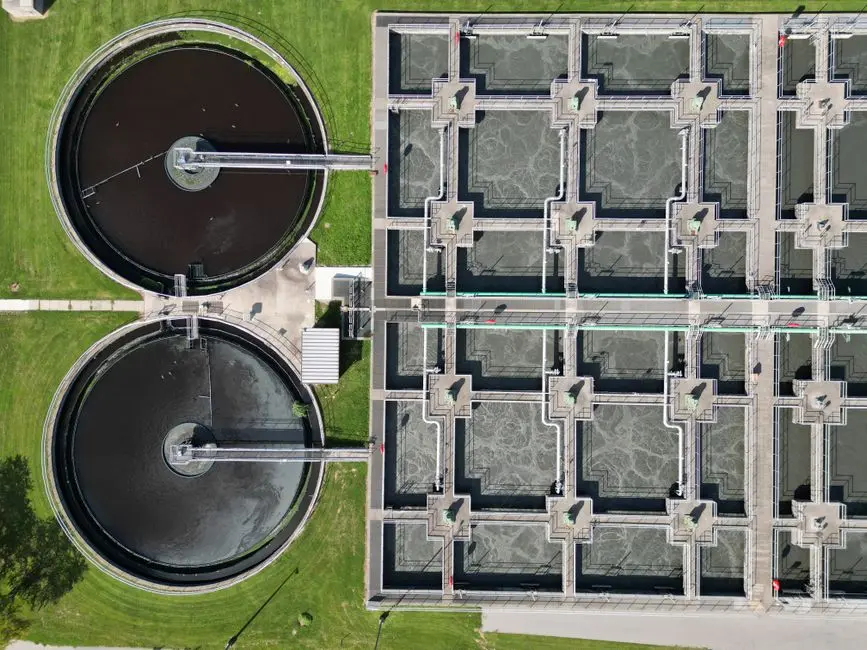
A clarifier is the more practical choice when the principal solids are sufficiently settleable, the objective is bulk solids removal, and lower equipment complexity and operating cost are priorities. Ecologix states that clarifiers generally have lower operating costs, while DAF may be more cost-effective for specific contaminants such as oils.
Conventional gravity separation depends on solids settling and reliable sludge handling. A lamella clarifier adds inclined-plate surface area to improve separation within a compact structure. HydropureWater’s stated 20–40 m/h surface loading rates and up to 30% reduction in chemical consumption are product-specific claims, not universal operating guarantees.
The important limitation is contaminant character. A clarifier may be less suitable when floatable oils, FOG, or very fine conditioned particles dominate because those materials may remain in the clarified water or interfere with sludge handling. In that case, suitable upstream removal or a hybrid train may be necessary.
Assess more than tank footprint. Review sludge characteristics, withdrawal reliability, cleaning access, odor control, and integration with downstream equipment. For a Wood Dale application, also confirm how routine maintenance can occur without disrupting production or downstream treatment.
If chemical conditioning is used with the selected high-efficiency lamella clarifier, define the chemical demand during testing and size the PLC-controlled chemical dosing system from measured results rather than a generic application rate.
Use a Stage-Gated Selection and Pilot Process
A Wood Dale purchase should proceed through defined evidence gates, with each stage producing an input for the next decision.
| Stage | Required evidence | Procurement decision supported |
|---|---|---|
| 1. Characterization | Representative samples across production conditions; flow, TSS, settleable solids, FOG or oil, colloids, metals, pH, and chemical demand | Define candidate separation mechanisms and treatment objectives |
| 2. Bench or jar testing | DAF and clarifier trials using actual wastewater and candidate conditioning chemicals | Reject mechanisms that do not meet the required separation duty |
| 3. Pilot validation | Solids capture, float or sludge behavior, chemical use, and control settings | Select the preferred train and confirm scale-up assumptions |
| 4. Engineering review | Flow and load variation, footprint, utilities, access, materials, controls, sludge handling, and downstream integration | Define the supplier’s design and interface scope |
| 5. Procurement and acceptance | Submittals, commissioning, training, performance tests, guarantees, and acceptance criteria | Convert test results into enforceable purchase requirements |
| 6. Operations readiness | Monitoring for flow, solids loading, pH, chemical dose, float level, and sludge withdrawal | Establish operating limits and an off-condition response plan |
DAF Corp explicitly offers laboratory DAF feasibility analysis and on-site pilot feasibility studies. That work should verify, rather than assume, solids capture, chemical use, float behavior, sludge withdrawal, and control response. Clearwater Industries also states that DAF should be paired with proper chemical coagulation and flocculation for optimal performance.
Keep the recommendation conditional until the evidence supports it. Both Ecologix and DAF Corp emphasize that wastewater analysis or a comprehensive study is needed to identify and eliminate potential difficulties. The equipment package should then reflect the chip fab wastewater treatment design actually demonstrated by the site data.
Budget, Supplier, and Compliance Questions to Resolve Before Purchase
No verified Wood Dale capital-cost or operating-cost ranges were supplied, so the defensible cost conclusion is comparative: clarifiers generally have lower operating costs, while DAF may be more cost-effective for specific contaminants such as oils, according to Ecologix.
Require comparable proposals that separate the following costs instead of presenting one equipment price:
| Cost element | Information bidders must provide |
|---|---|
| Equipment and foundations | Delivered equipment scope, support structure, installation requirements, and civil work |
| Conditioning and controls | Chemical equipment, sensors, electrical work, PLC scope, and downstream interfaces |
| Utilities and commissioning | Power, air, water, startup support, training, and performance testing |
| Sludge and operating costs | Float or sludge handling, anticipated chemical demand, maintenance, spares, and monitoring |
| Risk allocation | Performance guarantees, exclusions, liquidated remedies, and responsibilities at off-condition wastewater |
Ask each supplier to define its test protocol, acceptance criteria, materials options, controls scope, spare parts, documentation, training, and local service support. A supplier should also demonstrate proof using representative Wood Dale wastewater—not only a model calculation or wastewater from another industry.
Verify that the proposed train protects downstream MBR, RO, or other sensitive equipment without implying that DAF or clarification removes dissolved contaminants. Semiconductor wastewater pretreatment limits should be applied only after the discharge route, sewer-authority requirements, permit conditions, treated-water objectives, reuse criteria, and sludge disposition are confirmed.
For a complex stream, price a hybrid DAF–clarifier option against each single-unit alternative using the same wastewater test data and total-cost criteria. The lowest equipment quotation is not necessarily the lowest compliance or lifecycle risk.
Frequently Asked Questions
Should a Wood Dale semiconductor plant choose DAF or a clarifier?
Choose DAF when floatable oils, FOG, colloids, or conditioned fine solids are the principal pretreatment risk. Choose a clarifier when the main objective is removing sufficiently settleable solids with simpler equipment. Confirm the selection with representative wastewater characterization, bench testing, and pilot validation where warranted.
How much will DAF or a clarifier cost?
No verified Wood Dale price was supplied. Ask bidders for comparable installed scopes covering equipment, foundations, chemical conditioning, controls, utilities, installation, commissioning, sludge handling, maintenance, and monitoring. Evaluate those proposals against measured chemical demand and validated performance rather than comparing equipment prices alone.
What size unit should the plant purchase?
Size from actual flow and solids-loading variation, including the wastewater characteristics that determine floatability or settleability. Request the sizing calculations, duty assumptions, chemical inventory, and performance test basis from each supplier, then confirm them through the site’s characterization and testing stages.
How should a supplier be selected?
Require proof using the plant’s representative wastewater, a defined test protocol, enforceable acceptance criteria, complete materials and controls scope, commissioning and training plans, performance guarantees, and a clear allocation of off-condition risks. Review local service support and spare-parts availability as part of the technical proposal.
Can either unit guarantee regulatory compliance?
No. Compliance depends on the applicable discharge route, sewer-authority or permit conditions, and final treated-water and sludge characteristics. Confirm those requirements before defining acceptance criteria, and retain performance guarantees in the purchase package only with the duty, test method, wastewater basis, and operating conditions clearly stated.