Separate the wastewater before selecting equipment
A data center in Cotonou needs separate treatment routes for cooling-tower blowdown, commissioning fill-and-flush water, and oily generator condensate because their flows, contaminants, and discharge risks differ. Blowdown is continuous and normally enters equalization, solids or oil removal, filtration, and—if reuse is required—a biological and membrane barrier. Fill-and-flush water should be held, sampled, neutralized, and independently assessed before authorized discharge or licensed haul-off. Generator condensate must not cross-connect into a reuse stream.
Humidifier or evaporative-cooler drift, chiller bleed-off, and closed-loop glycol discharge also require separate characterization. Drift is not blowdown; glycol circuits may contain glycol, corrosion inhibitors, and heat-transfer-fluid degradation products; chiller bleed-off chemistry depends on the refrigerant and loop materials. A commissioning wastewater management plan can inform the batch-treatment workflow, but it cannot substitute for a Cotonou site survey.
Before equipment sizing, sample the source water and each candidate wastewater stream for pH, conductivity or TDS, suspended solids, temperature, oil and grease, copper, zinc, biocides, corrosion inhibitors, and TOC. Establish actual collection points and verify whether the receiving sewer accepts industrial flow.
| Stream | Operating pattern | Design basis | Permitted destination |
|---|---|---|---|
| Cooling-tower blowdown | Continuous | Measured evaporation, drift, cycles of concentration, and variability | Confirmed discharge route or specified reuse endpoint |
| Fill-and-flush water | Episodic batch | Chemical inventory, flush sequence, holding volume, sample plan | Accepted discharge or licensed off-site treatment |
| Generator oily condensate | Intermittent | Oil and grease, suspended solids, source generator and separator condition | Segregated treatment before any reuse decision |
| Chiller bleed-off or glycol loop | System-dependent | Fluid chemistry and contamination history | Separate route established after characterization |
Calculate the blowdown that treatment equipment must handle
The blowdown mass balance is B = E / (COC − 1), where E is evaporation, B is blowdown, and COC is cooling tower cycles of concentration; makeup is M = E + B + drift. This calculation should establish the preliminary flow, not the final procurement capacity. The supplied Ecologix data in the data center blowdown treatment guide uses drift equal to 0.02% of circulation rate, but the design team should confirm that assumption against the cooling-system documents and a measured water balance.
Genesis Water Technologies’ 2026 cooling-blowdown guidance states that at 4 cycles of concentration, blowdown equals 25% of makeup water; at 6 cycles, it falls to 20%. The improvement is five percentage points, or 20% relative—not the 50% often assumed from comparing cycle numbers. Increasing COC also raises scaling, corrosion, and biological-control demands, so the selected operating condition must remain compatible with the cooling system and downstream treatment.
The Ecologix reference calculation in the supplied guide reports approximately 99,537 kg/h of evaporation for a 50 MW heat load at 80% efficiency. That is a reference calculation, not a design load for Cotonou. Recalculate from the facility’s actual heat rejection, wet-bulb conditions, cooling configuration, makeup-water chemistry, seasonal operation, and measured drift. Genesis also notes that actual blowdown can exceed theoretical estimates by 15–30% because of unmeasured losses and emergency dumps, so equalization and treatment capacity should include documented variability rather than only the theoretical minimum.
| Calculation step | Relationship | Engineering use |
|---|---|---|
| Evaporation | Determine from site heat rejection and cooling configuration | Defines the source term in the water balance |
| Blowdown | B = E / (COC − 1) | Sets preliminary treatment flow |
| Drift | Confirm the assumed percentage against the cooling design | Completes the water balance |
| Makeup | M = E + B + drift | Estimates water demand and reuse value |
| Equipment sizing | Use selected blowdown rate plus expected variability | Includes operational dumps and measured departures from theory |
Set treatment targets from the cooling-water chemistry
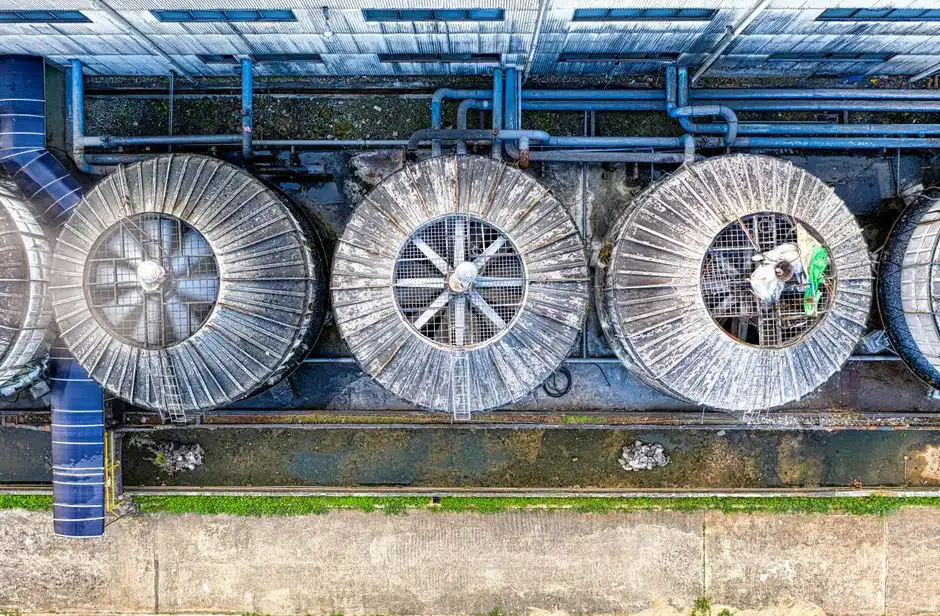
Cooling-tower blowdown chemistry depends on makeup water and chemical treatment, so representative Cotonou samples must replace generic design assumptions. The supplied Ecologix data reports typical blowdown TDS at 4–8 times makeup water, or 1,200–6,000 mg/L, and suspended solids at 10–50 mg/L. The same source reports effluent temperatures of 30–40°C and states that a temperature rise greater than 5°C often requires on-site cooling or stricter discharge controls. These are process benchmarks from the supplied guide, not enforceable Cotonou limits.
Evaluate scaling and corrosion with LSI = pH − pHs and RSI = 2pHs − pH. Ecologix, as cited in the supplied research, targets LSI between −0.5 and +0.5. Feed-water filtration below 10–15 microns is recommended, and a multi-media filtration stage should protect downstream membranes. For reuse, verify compatibility among the cooling-water chemical program, antiscalant, pH control, and every membrane and disinfection process.
Do not use LSI alone to accept feed to reverse osmosis pretreatment. Obtain membrane-specific limits for turbidity, SDI, particle size, iron, manganese, calcium, alkalinity, organics, and oxidant exposure. The supplied Ecologix train describes a multi-media filter cutting to 5–10 µm, but that benchmark must still be checked against the selected membrane warranty.
| Parameter | Supplied process benchmark | Design action |
|---|---|---|
| TDS | 1,200–6,000 mg/L at 4–8 times makeup water, according to Ecologix in the supplied guide | Measure source and blowdown values; evaluate salinity and scaling |
| Suspended solids | 10–50 mg/L, according to Ecologix in the supplied guide | Confirm the equalization and clarification performance |
| Temperature | 30–40°C; ΔT above 5°C often triggers tighter controls, according to Ecologix | Confirm receiving-system and reuse temperature limits |
| Scale control | LSI −0.5 to +0.5 recommended by Ecologix | Calculate pHs from actual chemistry and temperature |
| Filtration | Below 10–15 µm; Ecologix train describes 5–10 µm | Apply the selected membrane’s warranty limits |
Build a treatment train that matches the discharge or reuse route
The treatment train should begin with equalization to stabilize flow, temperature, and chemistry, followed by clarification or dissolved air flotation for suspended solids, colloids, free oil, and precipitated metals. A DAF system for cooling blowdown pretreatment should be evaluated against representative oily-condensate conditions and the required removal duty. Ecologix, as cited in the supplied guide, reports 90–95% metals removal through lime precipitation; treat that as a screening reference and require confirmation through representative testing and reagent dosing.
For industrial reuse, the supplied train adds 0.01–0.1 µm PVDF ultrafiltration at 90–95% stage recovery. A PVDF ultrafiltration system provides a biological barrier and removes biofilm fragments, but its recovery and compatibility claims require pilot or supplier validation. Its feed must meet the membrane supplier’s turbidity, SDI, chemistry, and chemical-resistance requirements.
Advanced reuse can include industrial RO. The supplied guide cites 95–99% TDS rejection, operating pressure of 150–400 psi, and 50–85% direct blowdown recovery. Confirm these values against the actual feed chemistry, recovery definition, antiscalant demand, energy calculation, cleaning method, and concentrate disposition. Disinfect the reuse loop with a validated process; the supplied research discusses chlorine dioxide and UV, while Water Utility Report’s 14 April 2026 guidance specifically identifies chlorine-resistant Cryptosporidium and Giardia.
Brine management is a separate approval gate. No supplied source establishes an accepted Cotonou route for RO concentrate. Require written acceptance from the receiving utility or a permitted hauler before committing to advanced reuse.
| Stage | Primary function | Evidence status | Decision gate |
|---|---|---|---|
| Equalization | Stabilize flow, temperature, and chemistry | Process practice; no supplied numerical duty | Use measured flow and operating variability |
| DAF or clarification | Remove solids, colloids, free oil, and precipitated metals | Ecologix cites 90–95% metals removal through lime precipitation | Validate representative feed and reagents |
| Multi-media filtration | Reduce suspended solids before membranes | Supplied guide describes 5–10 µm filtration | Meet selected membrane warranty |
| UF | Provide a biological barrier and protect RO | 0.01–0.1 µm PVDF; 90–95% stage recovery cited by Ecologix | Validate feed chemistry and recovery |
| RO | Produce low-TDS reuse water | 95–99% TDS rejection and 50–85% direct blowdown recovery cited by Ecologix | Confirm feed, recovery definition, and concentrate route |
| Disinfection | Control reuse-loop pathogens | Chlorine dioxide and UV discussed in supplied research | Validate organisms, dose, and residual |
Compare discharge polishing, partial reuse and zero liquid discharge
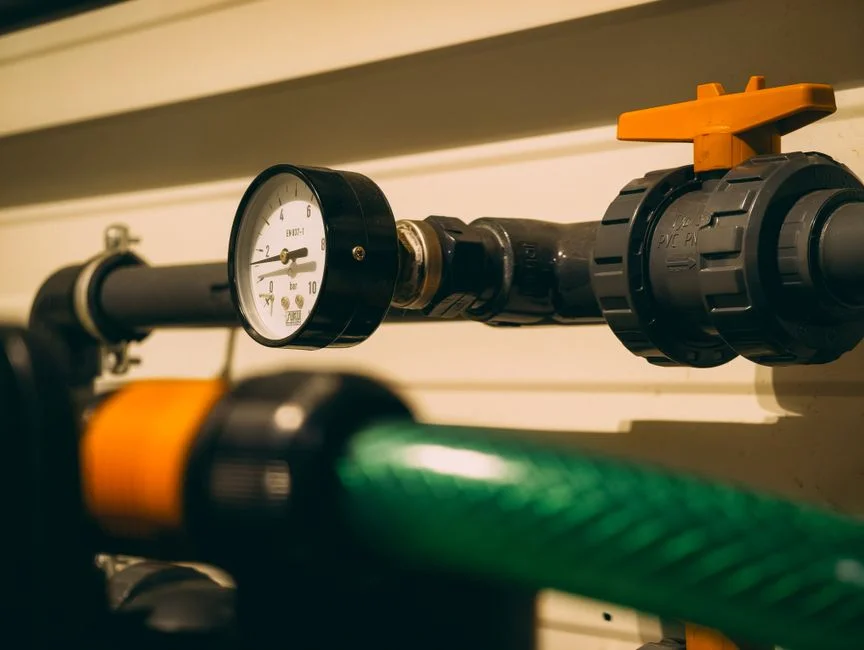
Discharge polishing is the least complex option, but it remains conditional on written acceptance of volume, TDS, temperature, treatment chemistry, and operating schedule. Partial reuse may provide greater water value where cooling makeup is costly or constrained. Advanced reuse should not be selected merely because it removes more dissolved solids; the receiving endpoint, operator capability, energy use, and brine route determine whether it is technically and economically defensible.
Genesis Water Technologies’ 2026 guidance cites 60–85% overall recovery for cooling-tower makeup reuse and 50–85% recovery for direct RO treatment of blowdown. These are recovery benchmarks, not guaranteed Cotonou performance. Ecologix’s decision rule in the supplied guide calls for on-site treatment where effluent TDS exceeds 2,000 mg/L, temperature rise exceeds 5°C, or municipal wastewater capacity cannot absorb a cited 1.14–1.70 ML/day envelope for hyperscale AI facilities. Treat these thresholds as screening criteria, not proof of a local permit requirement.
Zero liquid discharge is described at 95–99% recovery, but the supplied U.S. reference estimates are $3–8 million CAPEX and $5–15 per thousand gallons OPEX. Those figures carry U.S. geographic scope and must not be transferred directly into a Cotonou affordability case. Energy availability, generator use, brine transport, local disposal fees, footprint, and operator capability need local feasibility work.
For a mid-size facility, the supplied Ecologix guide proposes an MBR-integrated wastewater treatment package as an intermediate path that can buffer variable loads and segregate oily condensate. It is not a default answer: discharge quality, footprint, reuse objectives, and staffing must support that choice.
| Route | Supplied recovery or cost benchmark | Geographic scope | Go/no-go condition |
|---|---|---|---|
| Discharge polishing | Recovery not specified | Local acceptance and pricing unresolved | Receiving authority accepts volume, TDS, temperature, and chemistry |
| Cooling makeup reuse | 60–85% overall recovery | Genesis Water Technologies, 2026; not Cotonou-specific | Reuse chemistry, demand, and treatment train verified |
| Direct RO blowdown reuse | 50–85% recovery | Genesis Water Technologies, 2026; not Cotonou-specific | Feed chemistry, recovery definition, and brine route confirmed |
| ZLD | 95–99% recovery; $3–8 million CAPEX; $5–15 per thousand gallons OPEX | U.S. reference figures in the supplied guide | Local feasibility, disposal, power, and operator assessment completed |
Control commissioning wastewater as a permit and waste risk
Construction-phase fill-and-flush water should be collected in onsite holding tanks and treated as a controlled batch, not routed through the continuous blowdown train by default. The supplied Ecologix guidance recommends batch testing, chemical neutralization to pH 6.5–8.5, and licensed haul-off when the water cannot be accepted for discharge. These are source recommendations; the Cotonou authority must establish the actual acceptance route and applicable limits.
Follow the commissioning-control model attributed to Loudoun Water in the supplied research: independent third-party testing for copper, zinc, nutrients, TOC, and a microbiological panel. Extend the panel according to the actual flush chemistry, including glycol, surfactants, corrosion inhibitors, biocides, and residual disinfectants where relevant. Prepare the written plan before flushing starts, covering the chemical inventory, flush sequence, neutralization, sample points, acceptance criteria, chain of custody, and a pre-registered treatment or haul-off option.
The reported Cheyenne permit revocation and $10,000 fine are risk lessons from the supplied research, not legal determinations for Cotonou. The case involved cupriavidus gilardii, a bacterium associated with the project’s cooling loops, and illustrates how an unanticipated biological contaminant can invalidate a discharge plan. If reuse equipment will be selected, compare chlorine dioxide treatment and UV sterilization against the organisms, chemistry, and intended reuse endpoint rather than choosing a unit from a catalog.
- Inventory all commissioning chemicals and identify incompatible or sewer-disruptive products.
- Estimate each flush volume and provide dedicated holding capacity.
- Define sampling points, holding times, analytical methods, and acceptance criteria.
- Neutralize only after representative testing identifies the required adjustment.
- Pre-register an authorized discharge, on-site treatment, or licensed haul-off route.
- Maintain batch records and chain-of-custody documentation.
Build a locally verified procurement and commissioning plan
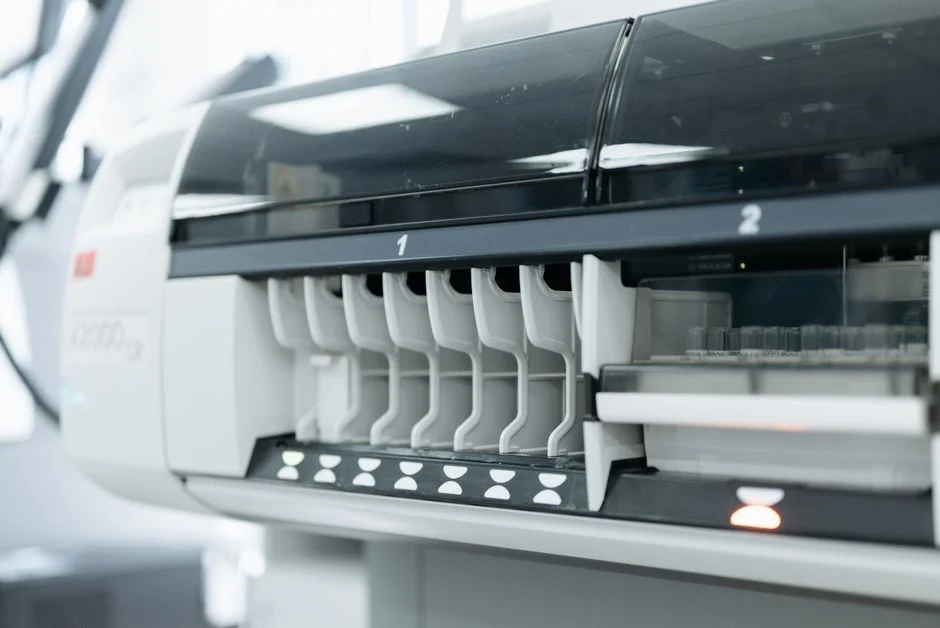
International treatment benchmarks should be converted into a local bid specification, not copied as 2026 Cotonou prices. Genesis Water Technologies’ 50,000 GPD RO reference of $250,000–$500,000 installed and operating cost of $1.50–$3.00 per thousand gallons are U.S. figures. The supplied guide also gives a Nigerian skid-mounted 50,000 GPD RO estimate of $120,000–$180,000 with OPEX of $0.40–$0.75 per cubic metre. Their scopes are not demonstrated as equivalent, so require like-for-like pricing before comparison.
Specify the source-water analysis, utilities, pretreatment, controls, redundancy, operator requirements, membrane availability, chemical consumption, waste-disposal assumptions, performance guarantees, commissioning tests, and the intended reuse endpoint. Confirm permits, sewer capacity, receiving-water constraints, and permitted waste contractors directly with the relevant Cotonou and national authorities.
Supplier selection should test more than price. Require evidence that the proposed RO can meet the guaranteed permeate flow at the selected recovery, with the stated feed chemistry and pretreatment. The guarantee should address TDS rejection, permeate quality, recovery, energy demand, cleaning frequency, membrane life, downtime, and concentrate handling rather than relying on generic recovery percentages.
| Commercial item | Supplied benchmark | Required local action |
|---|---|---|
| 50,000 GPD RO installed cost | $250,000–$500,000, U.S. reference from Genesis Water Technologies | Obtain a Benin quote with duties, logistics, power, foundations, and installation |
| 50,000 GPD RO operating cost | $1.50–$3.00 per thousand gallons, U.S. reference from Genesis Water Technologies | Reprice membrane replacement, antiscalant, energy, labor, and waste disposal |
| Nigerian skid-mounted RO | $120,000–$180,000 CAPEX; $0.40–$0.75 per m³ OPEX, according to the supplied guide | Define scope and demand like-for-like bids |
| Supplier guarantee | No universal guaranteed capacity supplied | Require feed-specific flow, recovery, permeate, energy, cleaning, and availability commitments |
Frequently Asked Questions
What treatment does a data center in Cotonou need for cooling blowdown?
It normally needs equalization, solids or oil removal, filtration, and a treatment step matched to the endpoint. Partial reuse may use filtration and disinfection; cooling-makeup reuse generally requires biological protection and usually reverse-osmosis pretreatment. Confirm the train through Cotonou source-water testing, a measured blowdown mass balance, and written receiving-system acceptance.
Should fill-and-flush water be treated with the cooling-tower blowdown system?
Do not assume so. Fill-and-flush water is episodic and may contain commissioning chemicals or atypical organisms that are absent from steady cooling blowdown. The supplied Ecologix guidance supports holding, batch testing, neutralization to pH 6.5–8.5, and licensed haul-off where discharge is not accepted.
How much does cooling blowdown treatment cost in Benin in 2026?
No supplied quotation establishes a 2026 Cotonou price. The U.S. references are $250,000–$500,000 installed for 50,000 GPD RO and $1.50–$3.00 per thousand gallons OPEX, while the supplied Nigerian skid estimate is $120,000–$180,000 CAPEX and $0.40–$0.75 per cubic metre OPEX. Ask suppliers for like-for-like scopes including pretreatment, installation, power, chemicals, membranes, labor, and waste disposal.
What capacity and pretreatment should an RO supplier guarantee?
The supplier should guarantee permeate flow at the selected feed rate, recovery, feed chemistry, and pretreatment conditions. Ask for supporting membrane calculations and a site trial where representative feed water is available. Also see the 2026 cooling-blowdown treatment options for the broader route comparison.
What must be confirmed with Cotonou authorities before discharge?
Confirm the authorized receiving point, permitted flow, temperature, TDS, pH, metals, treatment chemistry, monitoring frequency, commissioning acceptance, and whether industrial blowdown or hauled waste requires separate approval. A sewer connection does not itself establish permission to discharge concentrated cooling wastewater.
Related Equipment
- DAF system for cooling blowdown pretreatment — specifications, capacity range, and technical data