Which packaged plant fits a San Diego housing development?
For a San Diego housing development, a buried anoxic/aerobic package plant is the baseline candidate when a permitted sewer or surface-discharge route is available and reuse-grade effluent is unnecessary. Select an MBR when land is constrained, the flow exceeds the WSZ operating envelope, or the project needs a pathway toward California Title 22 recycled water quality. The HydropureWater 2026 San Diego guide uses 100–150 gpd per person and 3.0 persons per unit in its 100-unit example, yielding approximately 114–170 m³/day. That example lies within the published 1–80 m³/h WSZ range but below the MBR range of 10–2,000 m³/day; final selection still requires site-specific hydraulic, geotechnical and permit review.
The buried WSZ A/O sewage treatment package is therefore the first candidate to test, not an automatic selection. It combines anoxic/aerobic contact oxidation, sedimentation and disinfection in one buried unit. Where the development needs tighter solids separation, a smaller footprint or reuse-oriented treatment, compare it against the integrated MBR wastewater treatment system instead.
Before requesting proposals, assemble the unit count, design occupancy, average and peak flow, wastewater characteristics, discharge point, groundwater conditions, usable footprint, electrical supply and maintenance-access requirements. Groundwater cannot be inferred from the city label alone. The USGS 2015 Borrego Valley study documented groundwater-level declines exceeding 100 feet in parts of its 110-square-mile San Diego County study area, although that report concerns Borrego Valley rather than every San Diego parcel. Site-specific geotechnical and groundwater investigation may therefore affect burial depth, buoyancy control, excavation, access and discharge feasibility.
Turn the housing program into a design flow
Residential wastewater flow design must distinguish average daily production from the instantaneous and peak-hour capacity required by the reviewing authority. The HydropureWater 2026 San Diego engineering guide establishes a preliminary residential baseline of 100–150 gpd per person and uses 3.0 persons per unit for its 100-unit housing example. That produces approximately 30,000–45,000 gpd, or 114–170 m³/day, before applying a peak-flow basis.
- Confirm the unit count and design occupancy rather than relying on bedroom count alone.
- Calculate preliminary average daily flow from the agreed per-person basis.
- Obtain the applicable peak factor from the reviewing authority and project engineer.
- Match peak capacity, process loading and redundancy to the selected discharge or reuse route.
- Develop the wastewater stream from representative sampling rather than residential assumptions alone.
The supplied research provides no San Diego peak-factor requirement, so a permit-ready design cannot be completed from the residential baseline and equipment ranges alone. The project engineer must obtain the applicable peak-flow basis and reconcile it with the vendor’s hydraulic design. The same caution applies to process loads: the 2026 guide lists typical residential and small-commercial streams at 150–250 mg/L BOD, 150–300 mg/L TSS and 20–40 mg/L ammonia-nitrogen. These are preliminary characterization values, not guarantees for a particular subdivision.
| Design input | Published reference | Procurement use |
|---|---|---|
| Residential flow | 100–150 gpd per person, HydropureWater 2026 guide | Estimate average daily flow |
| 100-unit example occupancy | 3.0 persons per unit, HydropureWater 2026 guide | Apply the residential baseline |
| Calculated example flow | Approximately 30,000–45,000 gpd, or 114–170 m³/day, HydropureWater 2026 guide | Carry into preliminary capacity screening |
| WSZ published capacity | 1–80 m³/h, HydropureWater 2026 guide | Do not compare directly with daily flow without conversion and a design basis |
| Integrated MBR published capacity | 10–2,000 m³/day, HydropureWater 2026 guide | Screen against daily flow, then check peak and loading conditions |
| Residential and small-commercial loads | 150–250 mg/L BOD; 150–300 mg/L TSS; 20–40 mg/L ammonia-nitrogen, HydropureWater 2026 guide | Replace with project sampling where available |
Request data covering BOD, TSS, ammonia-nitrogen, FOG, oil and grease, pH, temperature and seasonal variation. Further packaged sewage treatment options for Southern California housing provide a useful decision framework, but site-specific wastewater data and agency criteria remain necessary for sizing.
Choose the treatment train from the discharge route
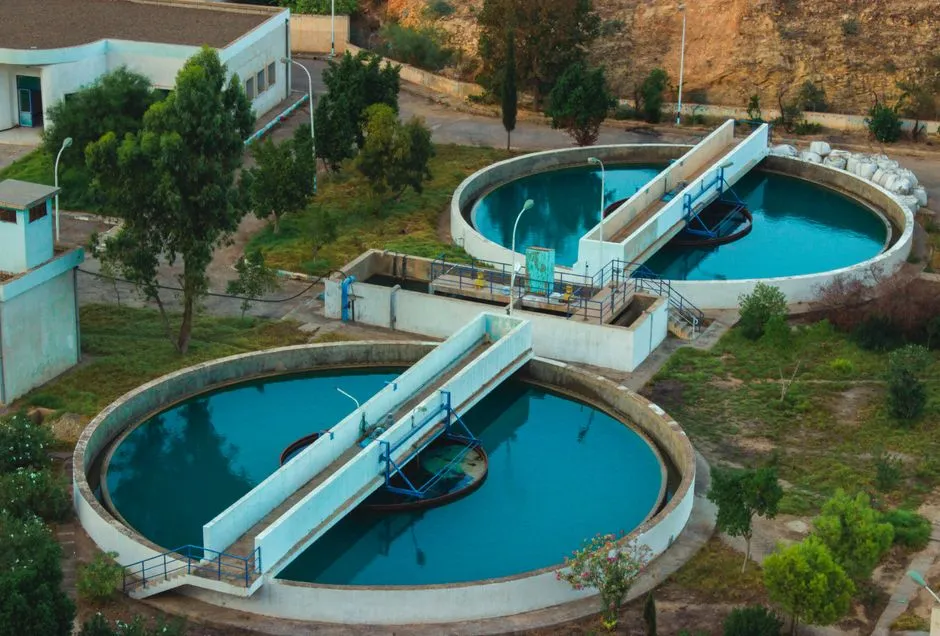
The discharge objective determines the treatment train more directly than the product category. A conventional permitted discharge generally calls for biological treatment, solids separation and disinfection. A reuse strategy requires tighter solids removal, documented pathogen-control performance and the additional disinfection or polishing arrangements needed for the intended recycled water application.
For a standard discharge route, the WSZ architecture integrates anoxic/aerobic contact oxidation, sedimentation and disinfection in a single buried package. For a reuse strategy, the published MBR combines activated sludge with submerged PVDF filtration below 1 μm, followed by the disinfection and polishing arrangement selected for the reuse objective. The 2026 HydropureWater guide identifies an MBR followed by an on-site chlorine dioxide disinfection system as the shortest compliant train it identifies for Title 22 reuse quality. That is a preliminary process route, not a project-specific approval.
| Project objective | Provisional treatment architecture | Regulatory and design checks |
|---|---|---|
| Conventional permitted discharge | Biological treatment, solids separation and disinfection; WSZ as the baseline candidate | Confirm receiving point, discharge limits, pretreatment requirements and disinfection criteria |
| Reuse-oriented development | MBR with required disinfection and polishing; assess chlorine dioxide where appropriate | Define the reuse endpoint and applicable California Title 22 criteria |
| High FOG, oil and grease or colloidal load | Add appropriate pretreatment before the biological stage | Confirm load characteristics and the pretreatment performance required by the reviewing authority |
The regulatory stack identified in the HydropureWater 2026 guide includes the federal Clean Water Act, the California Toxics Rule, the City of San Diego Industrial Wastewater Control ordinance for pretreatment into the municipal system, and California Title 22 recycled water criteria when effluent is intended for reuse. These are distinct requirements: a connection to a municipal sewer does not eliminate pretreatment review, and San Diego’s water-reuse planning does not automatically make every housing project a Title 22 project.
San Diego’s indirect potable reuse strategy increases the relevance of near-reuse quality, according to the 2026 guide, but the project must still define whether its objective is sewer discharge, surface discharge or reuse. Coastal receiving-water protection also belongs in siting and compliance review. An American Geophysical Union report on research near Imperial Beach found that up to 76% of bacteria in collected aerosols could be traced to sewage in the Tijuana River. That evidence does not establish a project-specific standard, but it reinforces the need to avoid uncontrolled wastewater discharge near sensitive receiving waters.
Compare buried A/O and MBR systems for the site
The WSZ and MBR differ most clearly in process architecture and design basis. The published WSZ range is 1–80 m³/h, while the integrated MBR range is 10–2,000 m³/day. These figures cannot be compared directly without converting the units and establishing whether each manufacturer’s capacity refers to average flow, peak flow or another operating basis. A capacity table is therefore a screening tool, not a compliance calculation.
| Criterion | WSZ buried A/O | Integrated MBR | Decision consequence |
|---|---|---|---|
| Published capacity | 1–80 m³/h | 10–2,000 m³/day | Normalize units and confirm the vendor’s design basis |
| Biological process | Anoxic/aerobic contact oxidation with sedimentation | Activated sludge coupled with membrane separation | Match process load and effluent objective |
| Solids separation | Sedimentation within the integrated package | Submerged PVDF filtration below 1 μm | Review solids handling and required effluent quality |
| Footprint | Actual arrangement must be checked against the available plan area | Published 60% reduction versus conventional activated sludge | Compare complete plot plans, not tank area alone |
| Optional flat-sheet module | Not the defining feature of the WSZ | DF modules use 0.1 μm membranes in 80–225 m² configurations producing 32–135 m³/day | Check module arrangement, cleaning and redundancy |
| Energy | No comparative energy figure is supplied in the research | DF series claims 10–20× lower energy than external cross-flow designs | Treat as a design comparison, not a universal saving |
| Operation | Described as fully automated with no operator required | Requires membrane and biological-system maintenance planning | Assign O&M responsibility, remote access and spare parts |
The MBR’s stated 60% smaller footprint than conventional activated sludge may matter on a constrained parcel, but the actual WSZ installation must be laid out with access, excavation, utilities, odor control and maintenance clearances. Conversely, footprint reduction does not establish lower installed cost. Membrane replacement, cleaning, controls and specialist maintenance must be included in life-cycle planning.
The optional DF flat-sheet membrane bioreactor modules extend the MBR comparison: the 2026 guide states that their 0.1 μm membranes are available in 80–225 m² configurations producing 32–135 m³/day. It also reports energy use 10–20 times lower than external cross-flow designs, a qualified comparison rather than proof of lower energy than WSZ treatment.
The WSZ is described as fully automated with no operator required, but that does not eliminate ownership obligations. The development still needs an O&M responsibility plan, remote-monitoring access, consumables, spare-parts strategy and physical maintenance access. Do not select DAF as the default housing package. The DAF pretreatment machine is relevant only if the wastewater stream includes material FOG, oil and grease or colloidal loads that require removal before biological treatment.
Budget for the complete wastewater scope
The available 2026 equipment references are preliminary cost benchmarks, not installed housing-development budgets. HydropureWater’s 2026 San Diego guide lists $40,000–$90,000 for a delivered buried WSZ A/O package serving a 50 m³/day commercial or HOA case, and $120,000–$220,000 for an MBR plus chlorine dioxide train engineered for reuse quality. These figures describe one flow case and exclude much of the work required to make a treatment system operational.
| Cost element | How to treat it in procurement |
|---|---|
| WSZ equipment reference | $40,000–$90,000 for the 50 m³/day delivered WSZ package case, HydropureWater 2026 guide |
| MBR reuse-train equipment reference | $120,000–$220,000 for the 50 m³/day MBR plus chlorine dioxide case, HydropureWater 2026 guide |
| Geotechnical and permit allowance | 10–20% addition cited by the 2026 guide; confirm applicability and exclusions |
| Civil and installation works | Scope excavation, tankage, piping, pumps, controls and site restoration separately |
| Electrical and auxiliary systems | Price service, controls, fencing, odor control, access and monitoring separately |
| Startup and long-term costs | Include commissioning, monitoring, operator training, consumables, membrane or media maintenance and sludge disposal |
The MBR’s higher equipment-price position should be weighed against its published 60% footprint reduction and potential planning value. That is a site-value trade-off, not a guaranteed payback. Land cost, reuse polishing and construction constraints can change the result.
A reliable installed estimate requires parcel geometry, utility routes, excavation depth, groundwater conditions, electrical service, receiving-point requirements, sludge-handling assumptions and the commissioning schedule. Bids should separate the treatment package from civil works. Supporting equipment must be identified rather than left as an undefined allowance; the research also points to a mechanical bar screen and treatment valves and filter media as separately scoped items where required.
Build a permit-ready procurement specification
A defensible procurement package must define performance and responsibility, not merely state a treatment technology and nominal capacity. Require every bidder to state design flow, peak-flow basis, process assumptions, hydraulic retention, loading bases, media or membrane specifications, disinfection performance, residual-monitoring provisions and guarantee points. Compare bids on the same flow basis and effluent objective.
- Define the housing program and attach the preliminary average and peak-flow basis.
- State the discharge point, permit pathway and reuse objective, if any.
- Provide representative influent data and identify sampling gaps.
- Require site-specific geotechnical coordination, burial-depth limits, buoyancy control, access hatches and odor-control provisions.
- Define power supply, redundancy, alarms, remote monitoring, startup support and training.
- Attach an O&M plan covering inspections, membrane or media maintenance, consumables, spare parts and sludge disposal.
- Require performance testing and a written corrective-action protocol if guarantees are not achieved.
- Separate equipment, civil works, sewer installation, electrical service and permit fees.
Effluent guarantees should follow the selected permit route or reuse objective. Generic language such as “meets all requirements” is inadequate unless the identified permit and guaranteed parameters are attached. The [Southern California housing treatment comparison](/blog/14136-what-packaged-sewage-treatment-plant-fits-los-angeles-housing.html) supports a staged review: screen the discharge route, calculate flow, compare treatment architectures and then issue a coordinated technical package.
Also require vendors to identify buried components requiring excavation access, temporary pumping, groundwater management, noise limits, traffic loading and future excavation restrictions. An O&M responsibility matrix should identify who monitors performance, responds to alarms, performs routine work, orders spare parts and disposes of residuals. A manufacturer-supplied system does not transfer those obligations to the manufacturer unless the contract expressly does so.
Frequently Asked Questions
How much does a packaged sewage treatment plant cost for a San Diego housing development?
For preliminary screening, the HydropureWater 2026 guide lists $40,000–$90,000 for a delivered buried WSZ A/O package and $120,000–$220,000 for an MBR plus chlorine dioxide train in a 50 m³/day commercial or HOA case. The same guide cites a 10–20% addition for site geotechnics and discharge-permit fees. Buyers should request separate installed-cost scopes for excavation, tankage, piping, pumps, controls, electrical work, odor control, commissioning, monitoring and long-term O&M rather than treating the equipment ranges as turnkey budgets.
Should a housing development choose a buried A/O package or an MBR?
Choose the WSZ as the baseline candidate for a straightforward permitted discharge where reuse-grade effluent is unnecessary and its verified plan arrangement fits the site. Choose the MBR when land is constrained, reuse quality is required, or the verified daily-flow and peak-load basis makes WSZ parallel units less practical. The decision must also account for groundwater, access, controls, membrane maintenance and the developer’s O&M capacity.
What information should a wastewater package supplier request before pricing?
Require unit count, design occupancy, average and peak flow, wastewater characteristics, discharge point, reuse objective, geotechnical and groundwater information, available footprint, electrical supply, utility routing, maintenance access and the anticipated permit pathway. Also provide the intended sludge-handling method and commissioning schedule. Without these inputs, a supplier cannot establish a comparable equipment basis or complete installation scope.
What is the compliance risk of selecting a package only by treatment capacity?
Capacity alone establishes neither effluent quality nor permit compliance. The permit route may require specific treatment, disinfection, monitoring and reporting performance that the package must demonstrate under representative loading. A reuse project adds a separate quality objective. Require discharge-route-specific guarantees, performance testing and corrective-action provisions in addition to nominal capacity.
Can one WSZ package treat a 100-unit housing development?
Not as a defensible conclusion from the published ranges alone. The HydropureWater 2026 guide’s 100-unit example produces approximately 114–170 m³/day, while the WSZ is published at 1–80 m³/h. After converting the flow bases, establishing the authority-approved peak factor and checking the plant configuration, one WSZ may suffice, parallel WSZ units may be required, or the integrated MBR wastewater treatment system may provide a simpler single-train arrangement. The buried WSZ A/O sewage treatment package should be selected only after that hydraulic comparison is completed.