First establish whether Denver needs a package plant
A package plant should be selected only after confirming that the development lacks a feasible public-sewer connection and that Colorado and local agencies will permit decentralized treatment. For a Denver housing development without adequate public-sewer access, compare direct sewer connection, local pretreatment and an on-site wastewater package plant before evaluating equipment. A buried WSZ system is a practical default where compact installation and automated operation are required; an MBR system may better fit reuse-oriented treatment objectives. Size the plant for residential peaks, not average daily demand, and verify the discharge route, soil conditions, reuse plan and Colorado permit requirements before procurement.
Clearfox identifies direct connection to a municipal sewer as the simplest housing-development wastewater solution where available, though developments may still require on-site treatment when the main sewer is at capacity (Clearfox, Housing Development Wastewater Treatment). The first engineering task is a capacity and responsibility check, not an equipment selection exercise.
Use Denver’s Department of Transportation and Infrastructure wastewater infrastructure resources as the starting point for identifying the public-system pathway (City and County of Denver, DOTI Infrastructure Build – Wastewater Resources). Ask the sewer authority whether it has capacity, what off-site infrastructure the developer must construct, and whether local pretreatment is required. Until those answers are documented, a package plant remains an alternative rather than a predetermined solution.
For a tract that cannot be served conventionally, distinguish a cluster system serving a grouping of homes from a community-scale system serving the entire development through a central package plant. Anua International describes cluster systems as collecting wastewater from a home grouping by gravity or pumping to a centralized treatment point, while community systems collect from each home and convey flow to a larger centralized package plant (Anua International, Residential Wastewater Solutions). The site, reuse plan and phasing requirements determine which scale is appropriate.
Build a preliminary residential wastewater design basis
A defensible preliminary design basis converts occupancy and development phasing into average, peak-hour and minimum-flow requirements before vendors size equipment. The supplied residential wastewater references provide useful screening assumptions, but they do not replace a project-specific engineering analysis or confirmation of the applicable local method.
Compile the total homes or units, bedrooms, design occupancy, anticipated construction phases, average and peak-hour flows, minimum flow, and every non-residential wastewater contribution. Clearfox states that residential peak flows typically occur in the morning, late afternoon and evening, while treatment systems must also accommodate low-flow periods (Clearfox, Housing Development Wastewater Treatment). These surge and minimum-flow cases belong in the supplier’s sizing calculation.
For preliminary population-equivalent screening, Clearfox gives a U.S. reference of 100 gallons and 0.2 pounds of BOD per person for one PE, and identifies 1.5 persons per bedroom as a typical occupancy assumption while cautioning that population varies by location and regional regulations (Clearfox, Housing Development Wastewater Treatment). Verify those assumptions against the applicable method before final sizing; do not present them as universal Denver criteria.
| Design input | Evidence-supported screening reference | Project information required |
|---|---|---|
| Population equivalent | Clearfox identifies 100 gallons and 0.2 pounds BOD per person as one U.S. PE reference. | Occupancy basis and applicable local design method. |
| Occupancy | Clearfox identifies 1.5 persons per bedroom as a typical assumption, subject to local variation and regulation. | Unit mix, bedrooms, phased occupancy and seasonal use. |
| Hydraulic profile | Clearfox identifies morning, late-afternoon and evening peaks and the need to handle low flow. | Average flow, peak-hour flow, minimum flow and collection-system profile. |
| Wastewater quality | Clearfox notes that household wastewater composition and pollutant loads vary with residential activity and cleaning products. | Characterization where restaurants, laundry, grease interceptors or unusual chemical sources are proposed. |
Request wastewater characterization if restaurants, shared laundry, grease interceptors, cleaning chemicals or other non-domestic sources are planned. These streams change both hydraulic loading and treatment objectives, and residential sizing assumptions cannot cover them without additional information.
Choose the collection architecture before selecting equipment
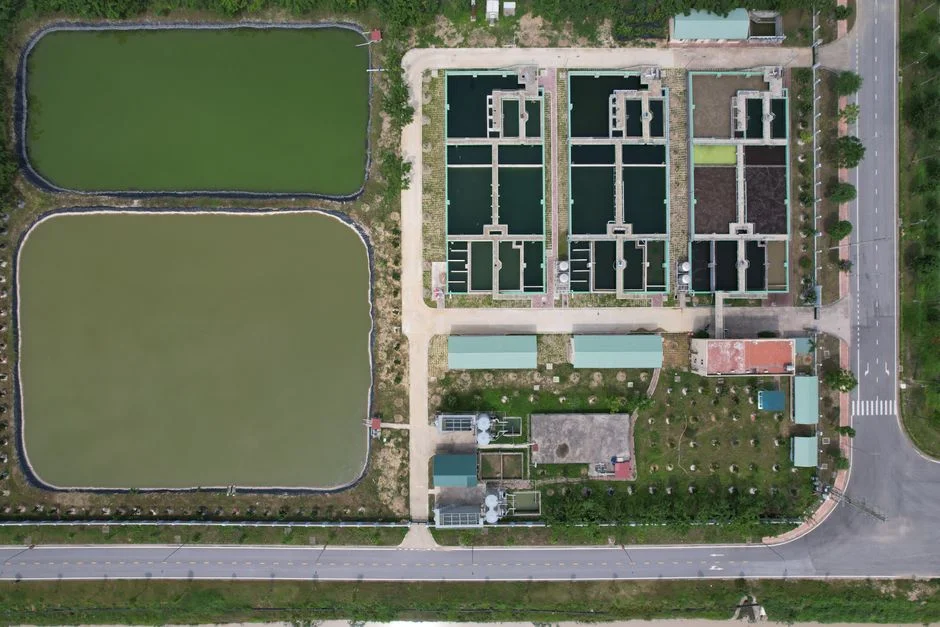
Collection architecture determines whether the package plant is a small local installation, a cluster treatment point or a community-wide facility. Anua International describes cluster systems as collecting wastewater from each residence in a grouping and conveying it by gravity or pumping to a central treatment and dispersal or beneficial-reuse point (Anua International, Residential Wastewater Solutions).
At community scale, wastewater is collected from each home and conveyed by gravity or pumping to a larger centralized package plant (Anua International, Residential Wastewater Solutions). A central arrangement may simplify treatment and maintenance, but it concentrates the consequences of trunk-main capacity, wet-well design, odor control and future access in one location.
Compare gravity and pumping on project-specific facts rather than assuming one is cheaper. Review required wet wells, lift stations and standby power; trench length and depth; odor-generation points; pumping energy; maintenance access; and the consequences of a collection-system failure. Obtain a civil profile showing available head and confirm how the selected route handles peak flow, not just average flow.
Test reuse early. Anua International identifies community green-space irrigation and other beneficial reuse as possible outcomes after treatment, while Clearfox identifies garden irrigation, toilet flushing and laundry-machine uses as non-potable applications for appropriately treated water (Anua International, Residential Wastewater Solutions; Clearfox, Housing Development Wastewater Treatment). Any reuse route remains subject to the applicable permit, treatment objectives and agency approval.
Compare buried A/O and MBR package plants
The buried WSZ and MBR systems differ in process architecture, hydraulic scale and reuse potential. The correct comparison is between the developer’s design flow, loading pattern, footprint, receiving route and operating objectives.
The buried WSZ integrated sewage treatment plant uses anoxic/aerobic biological contact oxidation followed by sedimentation and disinfection within one below-grade package. HydropureWater specifies a capacity range of 1–80 m³/h, fully automated operation, and below-grade installation with landscaping above; the system can also be trailer-mounted for mobile deployment. It is suited to developments prioritizing an integrated biological, settling and disinfection train in a compact buried package.
The MBR membrane bioreactor package system combines activated sludge with submerged PVDF membrane filtration. HydropureWater identifies applications from 10–2,000 m³/day and effluent filtration below 1 μm, and states that the MBR footprint is 60% smaller than conventional systems. Those specifications make MBR the more specialized option when membrane solids separation or a reuse-oriented treatment objective justifies the added process complexity. For additional process context, a comparison of A/O, MBR and MBR-UF package plants for housing developments distinguishes membrane and non-membrane configurations.
| Selection factor | WSZ buried A/O package | MBR package |
|---|---|---|
| Process configuration | Anoxic/aerobic contact oxidation, sedimentation and disinfection in one buried package. | Activated sludge combined with submerged PVDF membrane filtration. |
| Hydraulic scope | 1–80 m³/h, according to HydropureWater. | 10–2,000 m³/day applications, according to HydropureWater. |
| Footprint and installation | Below-grade installation with landscaping above; also available trailer-mounted. | HydropureWater states its footprint is 60% smaller than conventional systems. |
| Automation and operation | Fully automated and specified as requiring no operator. | Require the supplier to specify controls, membrane maintenance, cleaning and recovery. |
| Primary selection condition | Integrated biological treatment, settling, disinfection and compact buried installation are the priorities. | Membrane solids separation or a reuse-oriented treatment objective justifies specialized equipment. |
Do not transfer performance from another process to either package automatically. Clearfox reports SBR BOD removal of 85–95 percent and process guarantees below 10 mg/L BOD, 10 mg/L TSS, 5–8 mg/L total nitrogen and 1–2 mg/L total phosphorus (Clearfox, Housing Development Wastewater Treatment). Those are supplied SBR process references, not WSZ or MBR guarantees. Clearfox also reports that fixed-bed biological reactor modules can be configured from 10–3,000 m³/day; this demonstrates an available biofilm alternative if the procurement remains open. A separate buried A/O, MBR and biofilm package-plant comparison can support that process review, while decentralized sewage-treatment options for developments without sewer access provides additional context for off-grid applications.
Match the package to Denver-area site and discharge constraints

A technically attractive package can still be the wrong investment if it does not fit the site, discharge route or development sequence. Site and permit verification must therefore precede final equipment selection.
Confirm available footprint, excavation access, groundwater conditions, soil suitability, setbacks, utilities and vehicle access before choosing a buried or containerized configuration. Clearfox identifies underground installation as a way to preserve surface space and minimize visual impact, while containerized systems are useful for constrained sites, rapid delivery and phased capacity additions (Clearfox, Housing Development Wastewater Treatment).
Identify the receiving point first: public sanitary sewer, permitted land application, groundwater discharge or approved reuse. The route determines the treatment and disinfection objectives. Obtain site-specific requirements from the applicable Colorado and local authorities. The supplied research does not provide a universal effluent-limit value for a Denver housing development, so an engineer must obtain the final permit conditions rather than import limits from another jurisdiction.
| Constraint to verify | Evidence needed before selection | Decision consequence |
|---|---|---|
| Receiving route | Written route from the authority, including discharge point or reuse application. | Sets required treatment and disinfection performance. |
| Site and excavation | Geotechnical information, groundwater data, setbacks, utility survey and access plan. | May favor buried A/O, a containerized system or another layout. |
| Colorado discharge permit | Site-specific permit criteria from the applicable state and local authorities. | Prevents use of generic or assumed effluent limits. |
| Phased development | Installed and ultimate flow, occupancy schedule and future train arrangement. | May require modular capacity additions instead of replacement. |
| Operations | Energy demand, controls, solids handling, odor control, access and remote-monitoring scope. | Defines life-cycle cost and maintainability. |
For phased developments, require the selected architecture to add capacity as demand grows. Clearfox states that modular treatment can support expansion without replacing the complete system and that containerized systems can add treatment capacity incrementally (Clearfox, Housing Development Wastewater Treatment). At the same time, price the full operating chain: power, controls, residuals or sludge handling, odor control, maintenance access and monitoring should be evaluated alongside excavation and equipment capital cost.
Issue a procurement-ready package-plant specification
A comparable request for quotation must define the development, collection system, discharge route and future demand before asking for a price. Give bidders the same engineering basis and identify which permits, drawings and performance demonstrations each supplier will provide.
- Provide total unit count, bedroom mix, occupancy basis, average and peak design flows, minimum flow, collection method and anticipated development phases.
- Identify the discharge point or reuse application, proposed reuse volume, applicable permit status and the final agency-approved criteria.
- Require each bidder to state its process train, treatment capacity, hydraulic and organic loading basis, controls, duty/standby strategy, utility requirements, maintenance access and installation method.
- Allocate responsibilities for permits, design documents, construction, commissioning, monitoring, operator training and residual management.
- Require a performance demonstration against the final permit criteria, not a generic claim that a package is suitable for residential development.
- Request separate capital and lifecycle prices for excavation, the collection system, controls, utilities, permitting, commissioning, solids handling, maintenance and consumables.
Ask bidders to identify any design assumptions and exclusions. That exposes whether the quoted plant was sized for the submitted peak flow or for average daily flow, whether the bid includes the collection system, and whether reuse performance has been evaluated against the intended receiving route.
Frequently Asked Questions
What is the best packaged sewage treatment plant for a Denver housing development?
The best fit
Frequently Asked Questions
What is the best packaged sewage treatment plant for a Denver housing development?
The optimal system for Denver housing is a Membrane Bioreactor (MBR) system, particularly for developments with limited space or proximity to sensitive watersheds. Given Colorado Department of Public Health and Environment (CDPHE) Regulation 85, MBR systems provide the high-quality effluent required for potential water reuse and consistently meet stringent nutrient removal standards, often achieving total nitrogen levels below 10 mg/L.
How much does a packaged sewage treatment plant cost for a housing development?
Capital costs for packaged sewage treatment plants typically range from $15,000 to $25,000 per home served, depending on the design flow and required level of treatment. For a standard 50-home development, total installed costs often fall between $800,000 and $1.5 million, excluding land acquisition, lift stations, and deep utility trenching required to meet Colorado frost-depth mandates.
Should I choose an MBR or buried A/O package plant for a Denver subdivision?
An MBR (Membrane Bioreactor) is preferred over a traditional buried A/O (Anoxic/Oxic) plant when the site requires a small physical footprint or if the effluent will be discharged into high-quality surface waters. While A/O plants are more affordable to operate and have lower energy demands, MBR systems eliminate the need for secondary clarifiers and provide a superior physical barrier to bacteria, which is critical for complying with increasingly strict Colorado discharge permits.
How is a residential wastewater package plant sized for peak flow?
Residential systems are sized based on the average daily flow, typically estimated at 200 to 300 gallons per day (GPD) per single-family residence, multiplied by a peaking factor. In Denver’s climate, engineers apply a peaking factor of 3.0 to 4.0 to account for diurnal fluctuations and potential inflow and infiltration (I&I) from high-altitude snowmelt, ensuring the hydraulic capacity does not lead to washout of the biomass during extreme weather events.
What should I include in a wastewater-treatment supplier request for quotation?
A comprehensive Request for Quotation (RFQ) must include the design average daily flow (in GPD), the anticipated peak hourly flow, and the specific influent characteristics (BOD, TSS, and TKN levels). You must also specify the required effluent quality targets based on local discharge permits, the available site area in square feet, the required electrical service voltage, and a request for a 20-year lifecycle cost analysis including energy consumption and sludge disposal estimates.