What Makes Mexico City Sewage Treatment Projects Different?
Greater Mexico City’s sanitation challenge starts with its drainage architecture: the Wikipedia overview, Water management in Greater Mexico City, states that a single combined sewer collects municipal wastewater, industrial wastewater and stormwater. The same overview reports current metropolitan generation of 40 m³/s against built treatment capacity of 10 m³/s. A 44 m³/s dry-weather flow estimate for Greater Mexico City dates to 1993 and shows the historical scale of the drainage challenge. For buyers, the practical consequence is clear: establish whether the proposed unit will receive domestic sewage only, receive a combined flow, or provide pretreatment before a municipal connection. That distinction affects hydraulic loading, treatment objectives, pretreatment needs, controls and permitting.
This approach prevents a metropolitan statistic from substituting for project evidence. A hotel, hospital, residence cluster, factory or mixed-use development may have a different flow profile from the wider sewer system and may face a restricted connection, flooding exposure or a specific reuse destination. The equipment selection should begin with the wastewater entering the proposed unit, the route available for treated effluent and the operating responsibilities the owner can sustain.
Choose the Treatment Objective Before Choosing Equipment
The correct treatment objective determines whether a packaged biological system, membrane system or decentralized arrangement is appropriate. Test four alternatives:
- Conveyance: the objective is to provide treatment that satisfies the requirements of the available sewer route before discharge or entry into the municipal system.
- Decentralized treatment: the objective is to treat sewage near its source where downstream conveyance is limited or uncertain.
- On-site reuse: the objective is to produce water for a defined use, with the receiving standard incorporated into the process design.
- Hybrid treatment: the objective is pretreatment followed by controlled conveyance or discharge, which may be appropriate where industrial inputs, stormwater or a sewer interface complicate the downstream route.
A buried A/O package sewage treatment plant uses a compact sequence of inlet conditioning, anoxic/aerobic biological contact oxidation, sedimentation and disinfection before effluent management. This arrangement supports decentralized treatment where below-grade installation is feasible. The process removes biodegradable organics biologically and separates solids before the disinfection stage, but the hydraulic and organic design must still match the project.
An MBR sewage treatment system combines activated sludge with submerged PVDF membrane filtration. The product catalog specifies filtration below 1 μm, which supports a more refined solids-separation role than conventional clarification. It does not by itself establish fitness for reuse. The receiving standard, intended use, residual disinfection requirements and distribution system still need separate definition. For broader process context, this comparison of buried A/O, MBR and biofilm package plants shows how installation format and treatment objectives affect process choice.
Compare Packaged A/O, MBR and Decentralized Treatment
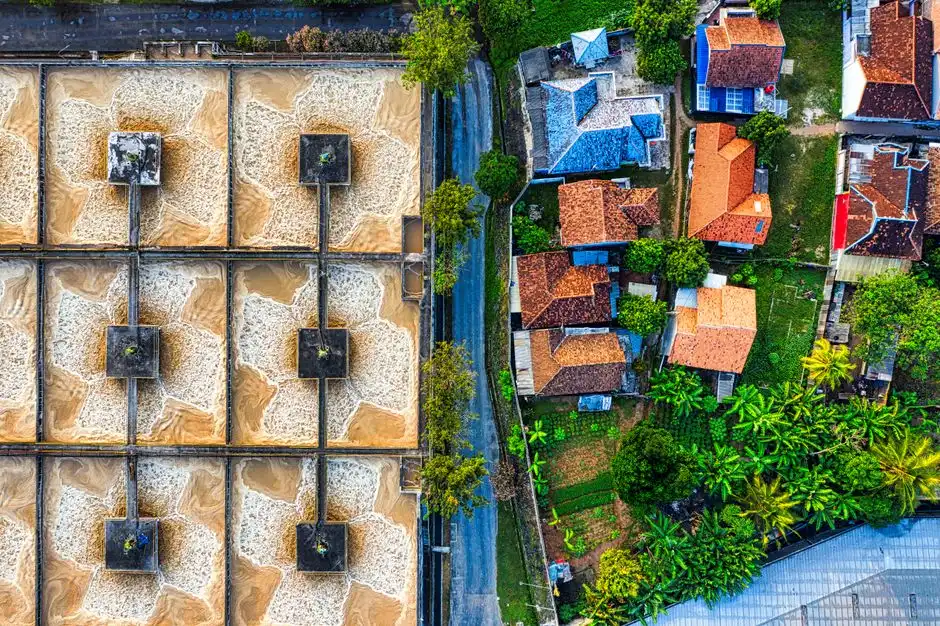
The principal trade-off is between a compact buried biological package, a membrane-based system and less conventional decentralized options. Catalog specifications establish product envelopes, but they are not substitutes for a site-specific design.
| Decision factor | WSZ buried A/O package | MBR membrane system | Other decentralized treatment |
|---|---|---|---|
| Reference configuration | Underground package combining anoxic/aerobic A/O biological contact oxidation, sedimentation and disinfection | Integrated activated sludge and submerged PVDF membrane filtration | Vermifiltration combines filtration with earthworms |
| Catalog capacity | 1–80 m³/h | 10–2,000 m³/day | No Mexico City project capacity is supplied |
| Installation | Below grade with landscaping above, or trailer-mounted for mobile deployment | Requires space for the integrated system and maintenance access | Requires a site-specific process and civil design |
| Solids separation | Sedimentation within the package | Submerged membrane filtration; catalog specifies below 1 μm | Depends on the selected process |
| Operator implications | Catalog states fully automated with no operator required | Requires membrane cleaning, replacement planning and control-system support | Operational requirements must be demonstrated |
| Reuse relevance | Depends on the complete treatment train and receiving standard | Higher separation performance supports reuse-oriented designs, subject to the applicable standard | Must be assessed against the intended use |
The HydropureWater verified product catalog describes an underground, fully automated unit with no operator required and a flow range of 1–80 m³/h for the WSZ configuration. Its attraction is compactness and a defined biological process, while excavation, access, odor control and above-grade maintenance remain project issues.
The MBR catalog describes integrated activated-sludge treatment, submerged PVDF membranes, filtration below 1 μm and a 60% smaller footprint than conventional systems, with capacity from 10–2,000 m³/day. That 60% figure is a manufacturer claim and must be checked using the same design basis, treatment objectives and site constraints applied to every alternative.
Vermifiltration is a credible academic decentralized concept: the IntechOpen study describes it as combining filtration and earthworms for domestic sewage treatment in Zimbabwe. However, the supplied excerpt provides no Mexico City project data or complete commercial specification, so it remains context rather than a directly procurable option.
Size the Plant from Verified Project Inputs
A defensible size follows from measured and documented project inputs, not a generic per-capita factor or a catalog capacity label. Request the following before comparing equipment:
- Average and peak domestic flow, including the design horizon.
- Wastewater BOD, COD, TSS and other relevant characterization.
- The contribution from industrial users or mixed tenancy.
- Evidence of stormwater entry, illegal inflows or other combined-sewer conditions.
- The required effluent use and applicable receiving requirements.
- The operating schedule, including whether flow continues outside staffed hours.
Domestic wastewater is municipal sewage in the terminology used by the IntechOpen chapter on treatment of domestic or municipal wastewater. That definition matters in Greater Mexico City because the Wikipedia overview says municipal wastewater, industrial wastewater and stormwater share the combined sewer. An upstream industrial contribution may require characterization and pretreatment rather than being treated as an unexplained variation in domestic loading.
| Sizing input | Question the design must answer | Evidence required |
|---|---|---|
| Hydraulic load | What are the average and peak flows, and how are short peaks handled? | Measured flow data or a documented design forecast |
| Organic and solids load | Can the biological and solids-handling stages meet the design conditions? | Representative wastewater characterization |
| Inflow composition | Is the unit receiving domestic sewage, industrial wastewater or stormwater? | Tenant inventory, process review and drainage assessment |
| Treatment objective | Is the required result conveyance, discharge or defined reuse? | Authority requirements and intended-use specification |
| Operating conditions | Does the selected process operate correctly across the expected flow and load range? | Process design calculations and manufacturer criteria |
The WSZ range of 1–80 m³/h is a product envelope, not evidence that a particular development fits it. Capacity must be checked against both hydraulic and organic loading, with allowance for the treatment train and flow equalization where required. Similarly, the MBR envelope of 10–2,000 m³/day must be reconciled with wastewater characteristics, treatment objectives and membrane-design conditions.
The supplied research contains no universal Mexico City unit-loading rate, tank-retention time or per-capita flow factor. Those inputs must come from the applicable design code and the project engineer; inventing them would create false precision.
Plan Site Integration, Reuse and Operational Risk
A treatment unit becomes bankable only after its interfaces are resolved. Evaluate inlet works, screening, flow equalization, odor control, electrical supply, standby provisions, sludge removal, effluent storage and the route to sewer or reuse. The supplied research does not justify prescribing the same configuration for every site, so each item should follow from the design basis and site constraints.
| Interface | Buried A/O package | MBR system | Project decision |
|---|---|---|---|
| Inlet | Confirm incoming solids and required inlet conditioning | Protect membranes from inappropriate incoming solids | Characterize the flow and select screening or equalization |
| Installation | Resolve excavation, access, landscaping and flooding constraints | Confirm available footprint and maintenance clearance | Locate the unit around access, utilities and flood exposure |
| Odor | Assess buried process ventilation and maintenance effects | Assess containment and odor control around process equipment | Set odor-management responsibilities |
| Operations | Confirm automation and access to routine inspections | Define cleaning, replacement, aeration and controls support | Assign trained support and spare-parts arrangements |
| Solids | Define sludge withdrawal and removal | Define excess-sludge handling | Secure a lawful and sustainable disposal route |
| Effluent | Define storage and sewer or reuse connection | Define storage, reuse destination and discharge point | Obtain authority acceptance before design freeze |
For underground systems, excavation, access, landscaping, flooding and maintenance constraints may govern whether the apparent footprint advantage remains practical. A rotary mechanical bar screen may be relevant where the selected inlet design requires mechanical screening, but its selection must follow incoming wastewater and flow data. A chlorine dioxide generator may form part of a disinfection solution, while its application and dosing basis require project-specific engineering.
For MBR installations, membrane cleaning, replacement, aeration and controls add maintenance requirements that must be covered operationally.
Treated sewage should be managed as a microbial exposure, not assumed sterile. A 2026 Environmental Microbiology Reports study in Hiroshima, Japan, found that 13.7% of 365 E. coli isolates from treated sewage carried one or more virulence genes and 50.0% carried antimicrobial-resistance genes. These Japan results do not establish prevalence in Mexico City; they support monitoring, hygienic controls and risk-based reuse planning. Request the applicable permit, reuse destination and water-quality requirements from the responsible authority and local utility. The supplied research contains no current numerical Mexico City discharge limit, so none should be assumed.
Build a Supplier Comparison and Due-Diligence Checklist
Compare bids against a common design basis and defined acceptance evidence, not unit price or headline capacity. Every supplier should identify the flow basis, wastewater characterization, treatment objectives, process guarantee, civil works, utilities, commissioning responsibility and excluded items.
| Due-diligence item | Evidence to request | Reason it matters |
|---|---|---|
| Design basis | Average and peak flow, loading data, reuse objective and applicable requirements | Prevents unlike bids from appearing comparable |
| Process scope | Treatment stages, duty arrangement, controls, civil interfaces and utilities | Defines what the supplier is actually supplying |
| Capacity basis | Whether stated capacity is average or peak and the associated loading assumptions | Separates a product envelope from a selected duty |
| Performance evidence | Commissioning method, acceptance criteria and proposed site-specific testing | Converts catalog claims into verifiable performance obligations |
| O&M support | Attendance, remote-control scope, training, spares, consumables and sludge arrangements | Identifies long-term operating dependencies |
| Commercial terms | Warranty, exclusions, schedule, payment milestones and acceptance responsibilities | Exposes risk beyond the equipment price |
Use the WSZ reference configuration—an integrated buried A/O, sedimentation and disinfection system from 1–80 m³/h—and the MBR reference configuration—activated sludge and submerged PVDF filtration from 10–2,000 m³/day—as reference cases only. Neither represents a completed proposal until the supplier submits the project-specific design basis and guarantees.
Capital and operating costs must also be quoted for the actual site. The supplied research provides no defensible Mexico City installed-system price or cost per cubic metre. A comparable quotation should include civil works, excavation, utilities, controls, commissioning, training, consumables, maintenance, membrane or spare-parts exposure and sludge handling.
Frequently Asked Questions
How should I size domestic sewage treatment for a site in Mexico City?
Base preliminary sizing on average and peak flow, representative wastewater characterization, the industrial contribution, stormwater entry, the reuse objective and applicable design criteria. The supplied research provides no universal Mexico City per-capita flow factor, unit-loading rate or retention time, so request those criteria from the project engineer and applicable code rather than substituting a generic factor.
How do I compare
Frequently Asked Questions
How do I size a sewage treatment plant for a property in Mexico City?
Sizing is determined by the daily volumetric flow rate (m³/day) based on the NOM-006-CONAGUA-1997 standard. For residential units in Mexico City, a conservative design flow of 150 to 200 liters per inhabitant per day is recommended to account for peak hydraulic loads.
You must calculate the total hydraulic load by multiplying the number of inhabitants by the per-capita usage, then adding a 20% safety factor to account for hydraulic surges during morning and evening peak hours.
Should I choose a buried A/O package plant or an MBR system for a mixed-use development?
For mixed-use developments where space is constrained and water reuse is intended, a Membrane Bioreactor (MBR) system is superior. MBR systems produce high-quality effluent (BOD5 < 5 mg/L, TSS < 1 mg/L) suitable for non-potable reuse in toilets and irrigation, whereas Anoxic/Oxic (A/O) plants typically require secondary sand filtration to meet similar standards.
While A/O systems offer lower capital expenditure and lower energy consumption (approx. 0.3-0.5 kWh/m³), the MBR system’s smaller footprint—often 50% less than conventional systems—is critical for high-density Mexico City urban projects.
What should I request from a sewage treatment equipment supplier before comparing quotations?
Request a detailed Process Flow Diagram (PFD) and a mass balance calculation showing the expected influent and effluent concentrations for BOD5, COD, TSS, and Nitrogen. Ensure the quote explicitly includes the blower capacity (in m³/hr), pump head requirements, and the expected electrical consumption in kWh/m³.
Additionally, request a list of three local reference projects in the Mexico City metropolitan area that have been operational for at least 24 months, along with the manufacturer’s warranty terms regarding the membrane lifespan or mechanical component longevity.
What permits and discharge requirements apply to domestic sewage treatment in Mexico City?
All treated effluent must comply with NOM-003-SEMARNAT-1997 for reuse in public services or NOM-001-SEMARNAT-2021 for discharge into national water bodies or sewage networks. In Mexico City, you must secure a "Descarga de Aguas Residuales" permit from SACMEX (Sistema de Aguas de la Ciudad de México).
Operators are required to submit quarterly laboratory reports from a certified EMA (Entidad Mexicana de Acreditación) laboratory to prove compliance with the specific parameters outlined in your discharge permit, including pH, fecal coliforms, and total suspended solids.
What site conditions should be resolved before installing a packaged sewage treatment plant?
Before installation, you must conduct a geotechnical survey to verify soil bearing capacity and depth to the water table, as high groundwater levels in certain Mexico City zones require structural anchoring to prevent the tank from floating when empty. Ensure the site has adequate electrical service (220V/440V) and a dedicated space for odor control systems, such as activated carbon filters.
Access for heavy machinery and vacuum trucks for periodic sludge removal (desazolve) must be guaranteed. The site layout must also provide a minimum clearance of 1.5 meters around the unit to facilitate routine maintenance of blowers, pumps, and sensors.