Stockholm's industrial wastewater treatment landscape is transforming in 2025, driven by the €1.2 billion Henriksdal plant upgrade and Baltic Sea Action Plan requirements. The new MBR membrane system at Henriksdal achieves 99.9% bacteria removal and <10 mg/L TSS, while the 14-kilometer underground tunnel (4.5m x 5m) transports 400,000 m³/day from Bromma to Sickla for primary treatment. Industrial facilities must now meet stricter limits: 10 mg/L nitrogen, 0.5 mg/L phosphorus, and 75 mg/L COD for direct discharges. This guide provides 2025 technical specs, cost benchmarks, and equipment selection criteria for compliance.
Why Stockholm’s Wastewater Infrastructure Upgrade Matters for Industrial Facilities
The environmental management of the Baltic Sea has reached a critical juncture in 2025, necessitating a massive overhaul of how industrial wastewater treatment in Stockholm is managed. According to HELCOM 2023 data, approximately 600,000 tons of nitrogen and 30,000 tons of phosphorus enter the Baltic Sea annually, fueling severe eutrophication that threatens marine biodiversity. In response, the Stockholm region is aggressively implementing the EU Water Framework Directive and the Baltic Sea Action Plan, which mandate a 50% reduction in nutrient loading by 2027. This regulatory pressure is the primary driver behind the "Stockholm’s Future Wastewater Treatment" (SFA) project.
The center of this transformation is the Henriksdal plant upgrade, which is progressing through three distinct phases. Phase 1 (2023-2025) focused on the installation of the Membrane Bioreactor (MBR) system, effectively making it one of the largest MBR facilities in the world. Phase 2 (2025-2027) involves the completion of the wastewater tunnel from Bromma, and Phase 3 (2027-2030) will see the plant reach full operational capacity. For industrial operators, this timeline is not merely an infrastructure update; it represents a fundamental shift in discharge accountability.
As the Henriksdal facility transitions to advanced membrane technology, the tolerance for industrial pollutants that can foul membranes or disrupt biological processes has decreased. Industrial facilities are facing stricter pre-treatment requirements and significantly higher surcharges for non-compliance. In 2025, Stockholm Water and Waste (Stockholm Vatten och Avfall) has begun revising discharge permits to align with the new plant’s influent specifications. Facilities failing to optimize their on-site industrial effluent pre-treatment Stockholm systems risk not only financial penalties but also the revocation of discharge permits as the city prioritizes the protection of Lake Mälaren and the Baltic Sea.
Stockholm’s Wastewater Treatment Process: A Technical Breakdown for Industrial Operators
The integrated Sickla-Henriksdal system employs a multi-stage process designed to handle both municipal and industrial influent with high efficiency. For industrial operators, understanding the retention times and screening thresholds at the Sickla facility is critical for designing compatible pre-treatment stages. The process begins at Sickla with coarse screening using 6mm bar spacing, followed by aerated sand traps with a retention time of 30-60 seconds to remove inorganic grit. Primary sedimentation follows, utilizing a 2-hour hydraulic retention time (HRT) to settle out larger organic solids before the effluent enters the main transport tunnel.
The 14-kilometer wastewater tunnel infrastructure in Stockholm is an engineering marvel, measuring 4.5 meters in width and 5 meters in height. With a 1% slope and a maximum depth of 43 meters, it is engineered to handle a peak flow of 400,000 m³/day. This tunnel serves as a buffer and transport mechanism, delivering pre-treated influent to the Henriksdal MBR system. The MBR stage utilizes 0.1 μm PVDF (Polyvinylidene Fluoride) membranes, operating at a flux rate of 15-25 LMH (liters per square meter per hour). This system is capable of 99.9% bacteria removal and 92-97% COD removal, significantly outperforming traditional secondary clarifiers.
Sludge handling in the 2025 framework emphasizes resource recovery. Excess biological sludge undergoes anaerobic digestion at 35°C with a 20-day solids retention time (SRT). This process captures biogas with a 60% methane content, which is used for local energy production. The final residue is dewatered to achieve 25% dry solids, meeting the strict criteria for land application or further processing. For industrial facilities, the discharge to this system must meet specific thresholds to avoid disrupting the MBR membranes or the anaerobic digestion process.
| Parameter | Sickla Primary Treatment | Henriksdal MBR System | Industrial Discharge Limit (2025) |
|---|---|---|---|
| Screening/Filtration | 6mm Bar Spacing | 0.1 μm Membrane | TSS <350 mg/L (Pre-tunnel) |
| Retention Time (HRT) | 2 Hours (Sedimentation) | 6-10 Hours (Biological) | N/A |
| COD Removal | 30-40% | 92-97% | <75 mg/L (Direct) |
| Phosphorus (P) | Mechanical Removal | Enhanced Biological/Chem | <0.5 mg/L |
| Bacteria Removal | Minimal | 99.9% | N/A |
MBR vs. DAF vs. Chemical Dosing: Equipment Selection for Stockholm’s Industrial Wastewater
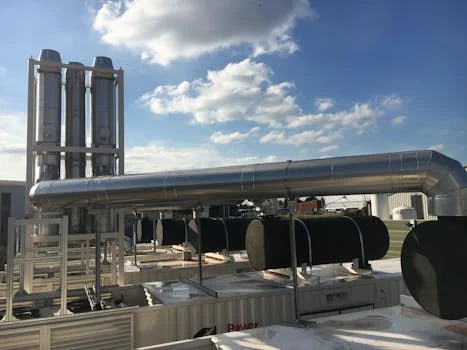
Selecting the appropriate technology for industrial wastewater treatment in Stockholm depends on the specific pollutant profile of the facility and the desired discharge point (direct to the environment vs. discharge to the sewer). Membrane Bioreactor (MBR) systems, such as the Stockholm-compliant MBR systems for industrial wastewater, represent the gold standard for high-strength industrial effluent. These systems integrate biological treatment with 0.1 μm ultrafiltration, providing a footprint that is up to 60% smaller than conventional activated sludge plants. They are particularly effective for pharmaceutical and chemical industries where COD levels range from 500 to 5,000 mg/L.
For industries characterized by high levels of Fats, Oils, and Grease (FOG) or suspended solids, such as food processing and pulp and paper, Dissolved Air Flotation (DAF) is often the more cost-effective primary treatment. DAF systems for food processing and metalworking effluents in Stockholm utilize micro-bubbles to float solids to the surface for mechanical skimming. These units typically handle capacities from 4 to 300 m³/h and can achieve 90-95% TSS removal and up to 85% FOG removal, ensuring the effluent meets the <100 mg/L FOG limit for sewer discharge.
Chemical dosing remains a critical component for meeting Stockholm’s stringent phosphorus limit of 0.5 mg/L. PLC-controlled chemical dosing for Stockholm’s phosphorus limits allows for precise injection of coagulants like Polyaluminum Chloride (PAC) at dosages of 5-50 mg/L and flocculants at 0.5-5 mg/L. This is often paired with pH adjustment systems to maintain the required 6-9 range. While chemical dosing has a lower CAPEX than MBR, its OPEX is higher due to ongoing reagent costs and increased sludge production.
| Technology | Primary Application | Removal Efficiency (TSS/COD) | Footprint | OPEX Level |
|---|---|---|---|---|
| MBR (HydropureWater DF) | High-strength Organic | 99% / 95% | Very Small | Moderate (Energy/Membrane) |
| DAF (HydropureWater) | FOG/Oily Wastewater | 90% / 60% | Moderate | Low (Mechanical) |
| Chemical Dosing | Nutrient/pH Control | Varies / Low | Minimal | High (Chemical costs) |
When comparing regional standards, it is useful to note how Gdańsk’s industrial wastewater regulations compare to Stockholm’s, as both cities are bound by Baltic Sea Action Plan targets but employ different infrastructure scales. For operators in Stockholm, the choice often comes down to the trade-off between the high filtration quality of MBR and the robust solids-handling capability of DAF. Detailed how to select the right DAF system for Stockholm’s compliance requirements can help in evaluating these trade-offs against specific 2025 discharge permits.
Cost Benchmarks for Industrial Wastewater Treatment in Stockholm (2025)
Budgeting for industrial wastewater compliance in Stockholm requires a granular understanding of both capital expenditure (CAPEX) and ongoing operational expenditure (OPEX). In 2025, CAPEX for MBR systems typically ranges from €1,200 to €2,500 per m³/day of capacity, depending on the complexity of the influent. DAF systems are more affordable upfront, ranging from €800 to €1,500 per m³/day. Chemical dosing skids, which are essential for phosphorus and pH control, can range from €50,000 to €200,000 for fully automated, PLC-controlled units.
OPEX is dominated by energy consumption and chemical reagents. MBR systems consume between 0.3 and 0.8 kWh/m³, largely due to membrane scouring air requirements. DAF systems are more energy-efficient, typically requiring 0.1 to 0.3 kWh/m³. However, chemical costs for phosphorus removal can add €0.10 to €0.50 per cubic meter of treated water. MBR membranes require replacement every 5 to 8 years, with costs estimated at €50 to €100 per square meter of membrane area. For a deep dive into these financial metrics, industrial managers can review MBR system performance and ROI benchmarks for industrial applications.
Stockholm-specific sewer surcharges provide a strong financial incentive for on-site pre-treatment. Currently, industrial surcharges range from €1.20 to €3.50 per m³ for effluent that exceeds standard municipal strengths. A food processing facility discharging 100 m³/day could save upwards of €80,000 per year in surcharges by installing a DAF pre-treatment system, resulting in a payback period of approximately 3 to 5 years. This ROI calculation must also factor in the avoidance of potential fines, which for significant non-compliance in the Stockholm region can range from €10,000 to €100,000 per year.
| Cost Category | MBR System (per m³/day) | DAF System (per m³/day) | Chemical Dosing (Skid) |
|---|---|---|---|
| CAPEX | €1,200 – €2,500 | €800 – €1,500 | €50,000 – €200,000 |
| Energy (kWh/m³) | 0.3 – 0.8 | 0.1 – 0.3 | Minimal |
| Chemicals (€/m³) | €0.05 – €0.15 | €0.10 – €0.30 | €0.10 – €0.50 |
| Maintenance | High (Membranes) | Low (Mechanical) | Moderate (Sensors) |
Compliance Checklist for Industrial Facilities Discharging to Stockholm’s Wastewater System
To ensure compliance with Stockholm Water and Waste discharge permits in 2025, industrial facilities should audit their current treatment performance against the following technical requirements. Failure to meet these parameters can lead to immediate surcharges or mandatory infrastructure upgrades.
- Effluent Parameters: Ensure direct discharge levels are below COD <75 mg/L, BOD <15 mg/L, and TSS <30 mg/L.
- Nutrient Control: Verify that Total Nitrogen is <10 mg/L and Total Phosphorus is <0.5 mg/L.
- Physical Limits: Maintain pH between 6.0 and 9.0 and ensure effluent temperature does not exceed 40°C at the point of discharge.
- FOG Management: Fats, Oils, and Grease must be kept below 10 mg/L for direct discharge and <100 mg/L for sewer entry.
- Monitoring: Implement continuous pH and temperature logging with weekly composite sampling for organic loads.
- Sludge Management: Utilize sludge dewatering to 25% dry solids for Stockholm compliance to meet Swedish EPA 2024 guidelines for disposal and land application.
- Equipment Validation: Schedule third-party performance testing for MBR or DAF systems, as this is now frequently required for permit renewals in 2025.
- Emergency Protocol: Maintain an updated spill containment plan and establish a 24/7 contact protocol with Stockholm Water and Waste.
Frequently Asked Questions
What are the 2025 phosphorus discharge limits for Stockholm industries?For 2025, the direct discharge limit for phosphorus in the Stockholm region is 0.5 mg/L, aligned with the Baltic Sea Action Plan. Facilities discharging to the municipal sewer must typically pre-treat to reach levels that do not exceed the capacity of the Henriksdal MBR system, often requiring chemical dosing to stay below 1.5-2.0 mg/L prior to the sewer connection.
How does the Henriksdal MBR upgrade affect my current discharge permit?The upgrade allows the city to enforce stricter influent standards to protect the 0.1 μm PVDF membranes from fouling. Industrial permits are being revised in 2025 to lower the allowable thresholds for TSS and FOG, meaning many facilities will need to upgrade their primary screening or flotation systems to avoid heavy surcharges.
What is the typical ROI for an industrial MBR system in Stockholm?The ROI for a Stockholm-based MBR system typically falls between 4 and 7 years. This calculation is based on the reduction of high-strength sewer surcharges (€1.20-€3.50/m³), the elimination of off-site disposal costs for liquid waste, and the potential for water reuse in non-potable industrial processes, which is increasingly incentivized.
Are there specific sludge dewatering requirements in Sweden for 2025?Yes, the Swedish EPA 2024 guidelines require industrial sludge to reach a minimum of 25% dry solids (DS) for most land-based disposal or composting routes. Achieving this usually requires high-pressure filtration equipment, such as a plate and frame filter press, often following anaerobic digestion or chemical conditioning.
Can DAF systems alone meet Stockholm’s 2025 COD limits?A DAF system can remove 60-70% of insoluble COD associated with suspended solids and fats. However, for facilities with high levels of soluble COD (such as breweries or chemical plants), a DAF system is usually a pre-treatment step followed by an MBR or biological stage to reach the final <75 mg/L limit required for direct discharge.