Why Copenhagen housing projects need a packaged plant, not a municipal tap-in
The reason a packaged sewage treatment plant is often the right answer for a new Copenhagen housing project is geographic, not technical. The city's municipal sewage is treated at the three BIOFOS Rensesanlæg sites — Avedøre (RA), Damshusåen (RD), and Lynetten (RL) — which have been the routine sampling points for Copenhagen wastewater surveillance since late 2015 (Springer, 2024).
For sites on the urban fringe, inside the BIOFOS catchment but not adjacent to a trunk sewer, a factory-built buried unit is faster to install and cheaper than extending the public network. The Danish Environmental Protection Agency reports more than 1,000 sewage treatment plants in Denmark and approximately 281,500 properties without a sewer connection as of 2015, confirming that decentralised packaged units are an accepted and long-standing part of Danish wastewater infrastructure (Danish EPA, eng.mst.dk/water/waste-water). All discharges — including those from a packaged plant — require a permit setting both concentration and pollutant-load conditions, so the engineering decision cannot be separated from the BIOFOS connection letter.
Step 1 — Size the development: population, per-capita flow, and peak factor
A defensible sizing assumption starts with the population the development will actually house, not the tank a vendor wants to quote. The calculation is: number of dwellings × average occupancy × per-capita flow × peaking factor = design flow in m³/day, then convert to m³/h when comparing packaged units. The per-capita flow for Danish residential developments is governed by the current Danish Water Pollution Council norm; the supplied research does not state a specific litre-per-person-per-day figure, so confirm the current norm with BIOFOS or the local municipality before locking the spec. The same caveat applies to organic load per person expressed as kg BOD₅/person·day — the supplied Danish EPA page does not quote a value, so request the latest figure from BIOFOS or fall back to the reference assumptions in EU Urban Waste Water Directive 91/271/EEC only as a placeholder. A peak hourly factor of 2.0–2.5 on the average daily flow is standard for residential hydraulic design; the supplied research does not quote a specific peak factor for Copenhagen housing, so verify against the BIOFOS connection guidance for the receiving site. The modular sewage treatment system design criteria walkthrough is a useful cross-check on the same calculation in another climate.
| Sizing input | Value to obtain from BIOFOS / Danish Water Pollution Council | Why it matters |
|---|---|---|
| Average occupancy (persons per dwelling) | Site-specific — request from developer brief | Drives population equivalent (PE) |
| Per-capita domestic wastewater flow | Current Danish norm in L/person·day | Sets average daily flow (m³/day) |
| Per-capita BOD₅ load | kg BOD₅/person·day from BIOFOS or EU UWWTD placeholder | Sets aeration tank and biological capacity |
| Peak hourly factor | 2.0–2.5 typical, confirm with BIOFOS | Sets hydraulic sizing in m³/h |
| Receiving BIOFOS site | RA, RD, or RL | Determines effluent limits and connection point |
Step 2 — Match the unit to the site: WSZ buried A/O vs MBR skid
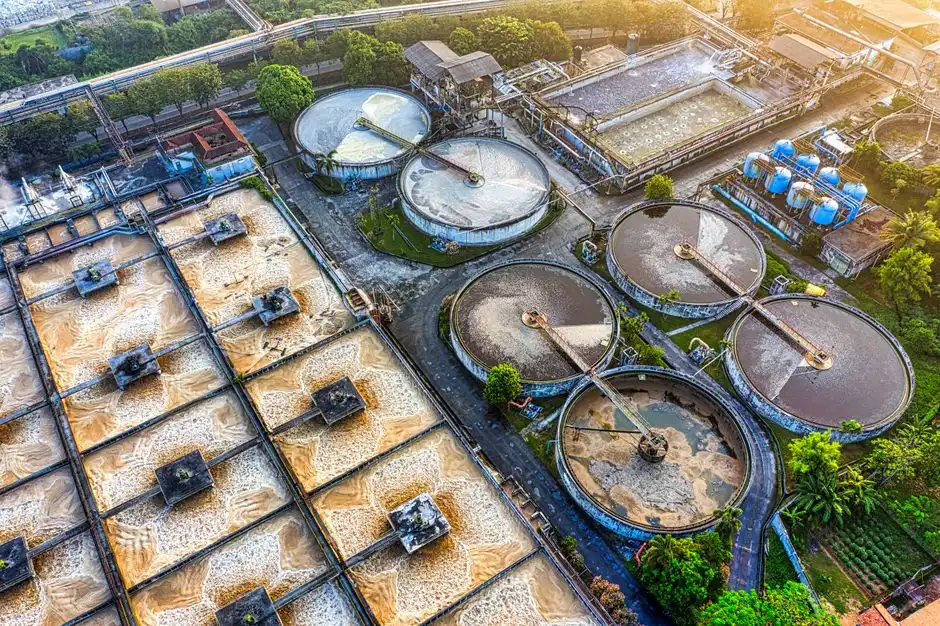
The technology choice between a buried A/O contact-oxidation package and an MBR skid is driven by three site facts: available footprint, the BIOFOS effluent ceiling, and whether the tank must sit below landscaping. A WSZ underground integrated sewage treatment plant combines A/O biological contact oxidation, sedimentation, and disinfection in a single buried unit, runs fully automatically without an operator, and fits residential, hotel, hospital, and rural sites where the tank can be installed below a lawn or paved area. An MBR membrane bioreactor system couples activated sludge with submerged PVDF membrane filtration at a pore size below 1 μm, delivering near-reuse effluent from a footprint roughly 60% smaller than a conventional activated-sludge plant of the same capacity, which is the right answer where the building plate is constrained or the discharge limits are tight. Cold-climate deployment dictates the configuration: a buried WSZ unit stays above frost without external heating because it sits below the frost line and below landscaping, while an above-ground MBR skid in a Copenhagen winter needs enclosure heat-tracing on pipework and membranes — call that out in the spec and the price enquiry. The MBR as standard for sewage treatment plants guide covers the membrane-side design choices in more depth.
| Selection criterion | WSZ buried A/O package | MBR skid with PVDF membranes |
|---|---|---|
| Process train | A/O contact oxidation + sedimentation + disinfection in one buried tank | Activated sludge + submerged PVDF membrane filtration (<1 μm) + disinfection |
| Typical capacity range | Suited to small-to-mid residential flows (verify m³/h against Step 1) | Suited to tight-footprint sites and stricter discharge (verify m³/day against Step 1) |
| Footprint | Larger plan area, but the tank is buried and the surface is landscapable | About 60% smaller footprint than conventional activated sludge at the same capacity |
| Effluent quality | Meets typical Danish residential discharge after disinfection | Near-reuse quality; preferred where the receiving BIOFOS limit is tight |
| Civil works | Excavation, burial, and landscaping restoration | Concrete plinth, enclosure, and heat-tracing for Copenhagen winters |
| Operation | Fully automatic, no on-site operator | Automatic with periodic membrane cleaning; membrane integrity must be monitored |
Step 3 — Pretreatment that protects the biological stage
A packaged biological stage only holds its BIOFOS effluent quality if the headworks in front of it actually strip the grit, rags, and grease that a housing development puts down the drain. A rotary mechanical bar screen at the inlet is the standard first step for removing rags, plastics, and fibrous debris that would otherwise blind aerator diffusers or wrap around MBR membrane modules; the supplied research does not quote a specific bar spacing for residential flows, so specify against the expected solids loading from the development. Equalisation upstream of the A/O or MBR stage is essential because Danish housing flows vary sharply between morning and evening peaks; the supplied research does not give a specific buffer volume, so model the equalisation tank from the peak factor used in Step 1. For sites with kitchen grease from apartment blocks — a common load in Copenhagen residential schemes — a dissolved air flotation unit ahead of the biological stage strips FOG before it loads the aeration tank, which is why packaged plants serving multi-block developments usually include DAF as a pre-stage.
Step 4 — Disinfection, sludge handling, and the BIOFOS permit
Selection is only complete when disinfection, the sludge route, and the permit conditions are all addressed in the same specification. Disinfection to meet Danish EPA permit conditions can be delivered with a UV pipeline unit, which is chemical-free and produces no disinfection by-products, or with a chlorine dioxide generator where a residual is required in the receiving sewer. Sludge from a packaged residential plant is normally dewatered on-site with a plate and frame filter press before removal by a licensed hauler; the supplied research does not give a specific cake-dryness target, so confirm the receiving hauler's requirement before sizing the press. The Danish EPA makes the permit logic explicit: discharge permits set both concentration and pollutant-load conditions, and BIOFOS is the utility that issues the connection letter specifying the actual CBOD, TSS, nitrogen, phosphorus, and temperature ceilings for the receiving site (Avedøre, Damshusåen, or Lynetten). Request that letter before purchase, and the engineered package plant follows from it rather than the other way round.
Frequently Asked Questions
What size packaged plant do I need for a Copenhagen housing development?
Size it from population, not tank volume. Multiply dwellings × average occupancy × the current Danish per-capita flow norm × a 2.0–2.5 peak factor to get m³/day, then convert to m³/h. The per-capita flow, the kg BOD₅/person·day load, and any site-specific peak factor must be confirmed with BIOFOS for the receiving site before the vendor quotation is locked.
How much does a packaged sewage treatment plant cost for a Copenhagen housing project?
The supplied research does not include a price for a packaged plant in Denmark, so request a written quotation that itemises the biological unit, the headworks, the disinfection stage, the sludge dewatering press, and the civil works for burial or plinth — plus a separate line for BIOFOS connection fees and the Danish EPA permit application. Compare like-for-like scope, not headline tank price.
How do I choose between a buried WSZ unit and an MBR skid for a Copenhagen site?
Choose the buried WSZ unit when the plot allows burial below landscaping and the BIOFOS effluent ceiling is achievable with A/O contact oxidation plus disinfection. Choose the MBR skid when footprint is tight, the discharge limit is stricter than conventional secondary treatment can meet, or near-reuse quality is specified — and budget for an enclosure with heat-tracing for the Copenhagen winter.
What permits and pre-treatment does BIOFOS require before a packaged plant can discharge?
A Danish EPA discharge permit is mandatory for any discharge, and the BIOFOS connection letter sets the site-specific concentration and load limits for CBOD, TSS, nitrogen, phosphorus, and temperature at the receiving plant (Avedøre, Damshusåen, or Lynetten). Pretreatment must include bar screening and flow balancing at minimum, with DAF added where kitchen grease is a significant load.