What a Dust Control System Actually Has to Do in 2026
A dust control system is no longer a single piece of equipment picked off a shelf — it is an integrated set of suppression, capture, filtration, and wastewater-handling measures that keeps a facility inside two separate permits at once. The U.S. EPA Stormwater Best Management Practice for Dust Control (2021) defines airborne particulate as either PM2.5 (fine inhalable particles ≤2.5 µm) or PM10 (inhalable particles ≤10 µm), and warns that the same dust "can impact nearby waterbodies due to direct deposition or transport by stormwater." That single sentence is the reason a 2026 dust control system must be designed as a coupled air-and-water compliance problem, not a one-stack engineering choice. The EPA BMP lists the source activities that trigger this dual exposure — clearing, excavation, demolition, haul-road traffic, earthmoving — and the same logic applies to industrial sources such as coal-fired boilers, clinker coolers, lime/limestone handling, and aggregate transfer points.
On the air side, a 2026 specifier must reconcile U.S. EPA NSPS for particulate matter, the EU Industrial Emissions Directive 2010/75/EU, and the BAT-AEL ranges published under that directive. The 2021 EPA BMP fact sheet is silent on the EU framework, so any project shipped to, sourced from, or financed under European rules has to add those limits on top of the EPA narrative. The air-side target is now routinely <10 mg/Nm³ at the stack for fine-particulate-heavy processes, which is a regime where water sprinkling alone cannot keep up. On the water side, every water- or chemical-based control generates runoff, scrubber blowdown, or wash-water that carries the captured fines — including particulate-bound heavy metals — into a side-stream the specifier must also treat before discharge or reuse.
How PM2.5 and PM10 Behave Differently in a Capture Device
PM10 and PM2.5 are regulated as one problem, but they enter a control device through very different mechanisms, and that gap drives every downstream sizing decision. The EPA BMP, citing Azarmi et al. (2016) and Muleski et al. (2005), notes that PM10 is dominated by mechanical entrainment from haul roads, stockpiles, and earthmoving, while PM2.5 is dominated by combustion, condensation, and fine-process emissions such as clinker cooler exhaust, lime/limestone FGD carryover, and CKD handling. That difference matters because the same windbreak that drops PM10 to the ground will not stop PM2.5 from crossing the property line.
For stockpile and haul-road planning, the EPA BMP gives a usable rule of thumb: for each foot of vertical windbreak height, an 8- to 10-foot deposition zone forms on the leeward side of the barrier, and more permeable barriers are less effective than more impermeable ones. That is enough to size a wind-screen layout around a limestone pile or a CKD silo pad. PM2.5, however, cannot be settled by gravity or removed by water spray at industrial scale — fine particles follow the airstream around droplets and through low-velocity zones. This is the bridge from passive suppression to engineered capture (wet scrubbers, fabric-filter baghouses, FGD units), where residence time, L/G ratio, and filter media take over from physics of deposition.
Once fine particulate is captured, it does not disappear — it shows up in the wet-end wastewater. The academic literature treats this as a sorption problem: Mustafa et al. (2017), studying cement kiln dust as a low-cost adsorbent, found a Langmuir maximum sorption capacity of 28.5 mg/g for Cr+3 at pH 4, 60 min contact, 200 rpm, and 20 g/L CKD. For the specifier, that number is a useful justification for including a CKD-aided or equivalent coagulation/polishing step in the water side-stream train, because the same metals that the baghouse misses on the air side will reappear dissolved in the scrubber blowdown.
Five Dust Control Technologies Compared
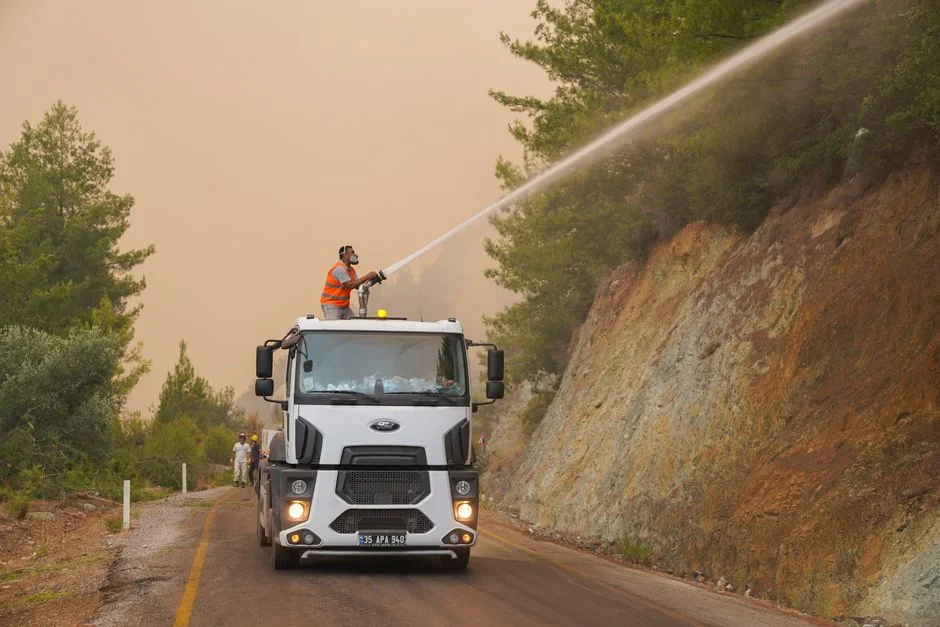
The EPA BMP lists options as bullet points; for a 2026 procurement decision, the same list has to be put on a single axis so the engineer can see what each technology buys and what it costs on the water side. The five families are water sprinkling/irrigation, vegetative cover and wind breaks, mulch and stone blankets, chemical soil palliatives, and engineered capture (wet scrubber, FGD, fabric-filter baghouse). The table below reorganizes the EPA BMP effectiveness data and adds the engineered-capture outlet that the fact sheet itself does not quantify.
| Technology | Typical PM reduction / outlet | Reapplication cadence | Water side-stream? | Key compliance anchor |
|---|---|---|---|---|
| Water sprinkling / irrigation | Effective on haul roads; no quantified outlet in EPA BMP | Frequent (per shift in arid conditions) | Yes — runoff and mud tracking | EPA Stormwater BMP (2021) |
| Vegetative cover / wind break | 8–10 ft leeward deposition zone per 1 ft barrier height (EPA BMP, 2021) | Establishment period, then seasonal | Negligible once established | EPA Stormwater BMP (2021) |
| Mulch blanket | 75–95% wind-erosion reduction vs. unstabilized soils (MPCA, 2019, via EPA BMP, 2021) | Single application per disturbance | Negligible | EPA Stormwater BMP (2021) |
| Stone / gravel blanket | 95% soil-loss reduction vs. unstabilized soils (MPCA, 2019, via EPA BMP, 2021) | Single application | Negligible | EPA Stormwater BMP (2021) |
| Chemical soil palliative | Variable; site- and product-specific (EPA BMP, 2021, citing Jones, 2017) | Seasonal to annual | Possible if misapplied — risk of surface- and groundwater contamination | EPA Stormwater BMP (2021) |
| Engineered capture (wet scrubber, FGD, fabric filter) | <10 mg/Nm³ outlet for the Pulse Jet Baghouse Dust Collector on hot dry industrial streams | Continuous; consumables per run-hour | Yes — scrubber blowdown and purge water | EPA NSPS; EU IED 2010/75/EU; BAT-AEL |
Two practical notes sit on top of the table. First, the EPA BMP itself flags that water is "time-intensive," can "result in discharge from the site or vehicles tracking mud," and is "inappropriate in water-scarce regions" — and that chemical misuse "can create hazardous working conditions, increase surface water pollution from discharges or contaminate groundwater." Second, every water- or chemical-based control on the rows above creates a wastewater side-stream the next section has to handle; only the structural/vegetative rows (wind break, established cover, stone) leave the water loop alone.
The Wastewater Side of a Dust Control System
Once suppression water, scrubber blowdown, or palliative runoff leaves the air-side equipment, it becomes a wastewater compliance problem with its own parameters. The chemistry of the water matters as much as the chemistry of the air, and the published data makes that explicit. The OGPW dust-suppressant study (PMC, 2021) showed that dust suppression efficacy itself tracks the sodium absorption ratio (SAR) and total dissolved solids (TDS) of the applied water — low SAR and high TDS performed best, while high SAR and low TDS generated more dust. That is the same water that, after it has done its suppression job, has to be handled on the way off-site.
For the cement and lime industry, where CKD and lime/limestone handling are the source, the wastewater side has been studied directly. The Ain Shams Engineering Journal study on cement kiln dust as a wastewater treatment agent reported optimum operating conditions of pH 8.1, 1.9 g dosage, 0.1 mm grain size, 30 min contact, and 150 rpm, with reported removals of BOD 85.3%, COD 81.6%, TP 97.1%, TN 86.8%, TDS 36%, salinity 74%, conductivity 61.2%, and turbidity 94.6%. The same Mustafa et al. (2017) study cited above gave a Langmuir qm of 28.5 mg/g for Cr+3 on CKD at pH 4, 60 min, 200 rpm, 20 g/L CKD. The two results sit on opposite sides of the pH scale, which is the engineer's cue that equalization, pH adjustment, and a flexible sorption stage are not optional.
The practical treatment train that the dust-system water side needs is therefore equalization → coagulation/flocculation (where CKD or equivalent sorbent can substitute for or supplement commercial coagulant) → sedimentation or Dissolved Air Flotation (DAF) system → filtration → sludge dewatering on a plate and frame filter press (with a high-efficiency sedimentation tank as the alternative clarifier upstream of the press). The DAF/sedimentation/filter-press combination is the natural pairing once any water- or chemical-based dust control is in scope, and it is the missing link on every top-ranking page that treats dust as an air problem only. For a deeper process view, the DAF system design guide for 2026 walks through clarifier sizing in a comparable flow sheet, and the 2026 buyer's guide to industrial wastewater management providers frames the supplier-selection step.
Decision Matrix: Which Dust Control System Fits Your Site
The five technology rows above collapse into a small number of real site profiles, and the matrix below pairs each profile with a primary control, a secondary control, the wastewater side-stream it generates, and the compliance reference that closes the audit trail. Use it as the first filter before opening a supplier datasheet.
| Site profile | Primary control | Secondary control | Wastewater side-stream | Key compliance reference |
|---|---|---|---|---|
| Open stockpile or haul road, PM10-dominated, temperate climate | Water sprinkling or vegetative cover | Mulch blanket or stone (MPCA, 2019, via EPA BMP, 2021) | Sprinkling runoff; mud tracking | EPA Stormwater BMP (2021) |
| Open stockpile or haul road, arid / water-scarce | Chemical soil palliative | Wind break sized at 8–10 ft leeward zone per 1 ft height (EPA BMP, 2021) | Possible contamination if misapplied (EPA BMP, 2021) | EPA Stormwater BMP (2021); local water-quality limits |
| Hot dry industrial stack, PM2.5/PM10 mixed (boiler, kiln, clinker cooler) | Fabric-filter baghouse at <10 mg/Nm³ outlet | A FGD scrubber system for SO2/HCl co-control if flue gas requires it | Intermittent purge water; any CKD or lime slurry blowdown | EPA NSPS; EU IED 2010/75/EU; BAT-AEL |
| Saturated or wet gas stream (FGD absorber tail gas, wet limestone handling) | Wet scrubber / FGD | Demister or downstream fabric filter for entrainment | Continuous scrubber blowdown — DAF or sedimentation plus filter press | EPA NSPS; EU IED 2010/75/EU; BAT-AEL; local discharge permit |
| Construction or temporary site, EPA-MS4 jurisdiction | Sprinkling plus wind break plus palliative | Mulch or stone on slopes steeper than 1V:2.5H (EPA BMP, 2021) | Runoff to sediment basin | EPA Stormwater BMP (2021); MS4 permit |
The matrix is deliberately written so that the wastewater column is never blank on the engineered-capture rows. If a profile points to a fabric filter or a wet scrubber, the next conversation has to be about the DAF/sedimentation/filter-press train, not about the baghouse alone.
Procurement Checklist for a 2026 Dust Control System
A 2026 procurement file should contain the following inputs, organized so the supplier quotation can be checked against them line by line.
- Dust characterization. PM2.5/PM10 split by on-site or stack testing, total dust loading (mg/Nm³ or grains/scf), gas temperature, gas moisture, and a metals scan that includes Cr+3 and any other analyte the local discharge permit limits.
- Compliance target. Outlet concentration (the Pulse Jet Baghouse Dust Collector is rated to <10 mg/Nm³ on hot dry industrial streams, against EPA NSPS, EU IED 2010/75/EU, and BAT-AEL), applicable standard by jurisdiction, and the wastewater discharge limit that suppression water and scrubber blowdown must meet.
- Supplier deliverables to request. Fabric area, air-to-cloth ratio, filter media grade, pulse-cleaning pressure, scrubber L/G ratio, expected blowdown volume, and a written reuse/recycle plan for the wastewater side-stream (including the Dissolved Air Flotation (DAF) system and plate and frame filter press sizing basis).
- Cost and labor framing, taken from the EPA BMP (2021). Water itself is inexpensive but requires significantly more frequent reapplication than chemical stabilizers, plus specialized machinery, so total cost of water-based control can run higher than alternatives. Chemical soil treatments typically need only seasonal or annual application, but may require special storage and application equipment. Once established, vegetation is the most cost-effective long-term stabilization. Engineered capture has higher CAPEX than any of the above but lower OPEX per ton of dust controlled and a stack outlet the air permit will accept.
For facilities outside North America, the effluent treatment plant process and buyer guide gives a comparable procurement template adapted to a non-U.S. regulatory environment.
Frequently Asked Questions
What does a dust control system actually include?
It includes the suppression method (water, palliative, vegetative cover, mulch, stone, or wind break), the capture device where one is required (wet scrubber, FGD, or fabric-filter baghouse), and the wastewater treatment train that handles the runoff or blowdown the suppression and capture steps generate. The EPA Stormwater BMP for Dust Control (2021) treats the first two as the dust control system; a 2026 specifier should add the wastewater train because the same dust becomes a stormwater pollutant once deposited or washed off-site (EPA BMP, 2021).
Which dust control technology should we pick for a hot dry PM2.5/PM10 stream?
For a hot dry industrial stream where both PM2.5 and PM10 are present, the primary control is a fabric-filter baghouse rated below 10 mg/Nm³ at the stack — the operating point the Pulse Jet Baghouse Dust Collector is built to, against EPA NSPS, EU IED 2010/75/EU, and BAT-AEL. The secondary control is an FGD scrubber system if the gas also needs acid-gas removal. Water spray, mulch, stone, and chemical palliatives are not designed to meet an outlet concentration in mg/Nm³ and should not be specified as the primary control on this profile.
How much does an industrial dust control system cost in 2026?
The supplied research does not quote a 2026 system price, so any budget number has to come from the supplier against the inputs above. What the EPA BMP (2021) does say, citing Jones (2017), is that water itself is inexpensive but requires significantly more frequent reapplication than chemical stabilizers plus specialized machinery, so total cost of water-based control can run higher than alternatives; chemical soil treatments typically need only seasonal or annual application but may need special storage; and vegetation is the most cost-effective long-term stabilization. For engineered capture, the buyer should ask the supplier for a written cost per ton of dust controlled, not just CAPEX, and should ask whether OPEX includes the DAF, sedimentation, and filter-press side-stream.
How do we pick a dust control system supplier in 2026?
Pick on the basis of three things the supplied research can support: a guaranteed outlet concentration against the standard that applies (EPA NSPS, EU IED 2010/75/EU, or BAT-AEL), a written water-loop integration plan covering the Dissolved Air Flotation (DAF) system, high-efficiency sedimentation tank, and plate and frame filter press sizing, and a documented delivery and lead-time commitment in writing. A supplier that quotes only the air-side equipment without a wastewater plan is quoting against a 2021 EPA BMP, not a 2026 two-permit problem. The 2026 buyer's guide to industrial wastewater management providers walks through the supplier-comparison step in more detail.