
Why High Turbidity Signals Process Failure
High turbidity in wastewater effluent is light scattering by suspended and colloidal particles, reported in Nephelometric Turbidity Units (NTU). It is a fast surrogate for solids load, coagulation failure, and disinfection risk. Most industrial permits set site-specific NTU or TSS limits; untreated spikes raise chemical use, membrane fouling, and UV or chlorine demand before discharge or reuse.
Earlier trade summaries often treated about 30 NTU as a practical secondary-effluent turbidity proxy. U.S. EPA secondary treatment standards instead set a 30-day average suspended solids (SS) limit of 30 mg/L for publicly owned treatment works, not a national NTU cap (EPA NPDES secondary treatment standards). Reuse and drinking-water filtration rules are stricter and program-specific. According to U.S. EPA wastewater disinfection guidance, turbidity and TSS can render UV disinfection ineffective, and about 50% UV transmittance has historically been treated as a practical minimum for conventional UV systems.
Operationally, elevated NTU commonly increases coagulant demand by 25–50% and energy use by 15–30% when plants chase spikes with fixed doses. Particles also clog membranes and promote sludge bulking when biomass carries over. A textile plant in Bangladesh was fined $250,000 for exceeding 150 NTU in effluent, showing how untreated solids risk both permits and cash flow.
Industrial Sources by Sector
Each industry produces distinct particle types, NTU ranges, and treatment bottlenecks. Matching diagnostics to the sector cuts trial-and-error chemical spend.
| Industry | Primary Turbidity Sources | Typical NTU Range | Particle Types | Key Challenges |
|---|---|---|---|---|
| Textile Manufacturing | Dye carryover, fiber fragments, surfactants | 800–1,200 NTU | Colloidal dyes (10–200 nm), cellulose fibers | High zeta potential (-40 to -60 mV), pH sensitivity (4.5–7.0) |
| Metalworking | Emulsified oils, metal hydroxides, abrasive fines | 500–800 NTU | Oil droplets (1–100 μm), metal oxides | Stable emulsions, variable particle size distribution |
| Food & Beverage | Fats, oils, grease (FOG), starches, proteins | 300–600 NTU | Emulsified FOG (0.1–10 μm), microbial biomass | Temperature-dependent stability, pH 4.5–6.0 |
| Pulp & Paper | Lignin, cellulose fines, clay fillers | 400–900 NTU | Fibrous fines (50–500 μm), biofilm fragments | High TSS correlation (1 NTU ≈ 1.5 mg/L), recalcitrant organics |
| Pharmaceuticals | API residues, excipients, fermentation biomass | 200–500 NTU | Colloidal APIs (1–50 nm), endotoxins | Sterility risks, low biodegradability |
Textile reactive and disperse dyes stay colloidal and resist biodegradation. Metalworking emulsions often sit near -30 to -50 mV zeta potential. Food FOG can destabilize below pH 4.5 or above 60°C, which changes jar-test winners overnight. For continuous meter setup and calibration practice, see our guide to turbidity monitoring best practices.
Diagnosing the Root Cause: A Step-by-Step Industrial Protocol

Root-cause work starts with settleability, optics, and chemistry before any capital change. The sequence below is what most plants we size for use when NTU alarms repeat on the same shift.
Step 1: Visual Inspection and Basic Tests
Run a 30-minute settle test and watch supernatant color, odor, and clarity. Visual cues narrow the next lab step fast.
| Visual Cue | Likely Cause | Particle Size Range | Next Diagnostic Step |
|---|---|---|---|
| Milky white | Colloidal silica, calcium carbonate | 10–100 nm | Zeta potential measurement |
| Brown/red | Iron hydroxides, clay | 1–10 μm | Particle size analysis |
| Gray/black | Metal sulfides, activated carbon fines | 0.1–5 μm | Microscopic examination |
| Oily sheen | Emulsified FOG, lubricants | 0.1–10 μm | Jar test with demulsifiers |
Step 2: Jar Testing for Coagulant/Flocculant Optimization
Jar tests simulate full-scale coagulation and flocculation so dose and pH are chosen on measured supernatant NTU, not habit.
- Fill six 1-L jars with wastewater samples.
- Adjust pH to target range (e.g., 6.0–7.5 for alum, 7.5–9.0 for ferric chloride).
- Add coagulant (e.g., alum, PAC) at varying doses (50–200 mg/L).
- Rapid mix at 200 rpm for 1 minute, then slow mix at 30 rpm for 10 minutes.
- Settle for 30 minutes and measure supernatant turbidity.
- Select the dose with the lowest turbidity and minimal sludge volume.
A metalworking plant may find that 120 mg/L PAC at pH 7.0 cuts turbidity from 600 NTU to 45 NTU, while 180 mg/L raises sludge volume by 40%.
Step 3: Particle Size Analysis
Particle size distribution decides whether you need coagulation, flotation, or membranes. Use laser diffraction (0.1–2,000 μm) for broad ranges or dynamic light scattering (0.3 nm–10 μm) for colloids.
- Particles <1 μm: Require coagulation/flocculation or membrane filtration.
- Particles 1–100 μm: Respond well to dissolved air flotation (DAF) or sedimentation.
- Particles >100 μm: Can be removed via screening or grit chambers.
Lab cost is typically $50–$200 per sample with 24–48 hour turnaround.
Step 4: Zeta Potential Measurement
Zeta potential quantifies colloidal stability. Values below -30 mV or above +30 mV mark stable suspensions; -10 to +10 mV usually means coagulation is likely.
- Textile: -40 to -60 mV (highly stable)
- Metalworking: -30 to -50 mV (moderately stable)
- Food processing: -20 to -40 mV (pH-dependent)
A textile stream at -45 mV often needs pH near 6.5 plus cationic polymer before flocs hold.
Step 5: Microscopic Examination
At 100–400x, microscopy separates biological carryover from inorganic fines.
- Filamentous bacteria: Indicate sludge bulking (common in pulp/paper).
- Algae: Suggest nutrient overload (e.g., food/beverage).
- Metal oxides: Confirm corrosion or chemical precipitation.
Combine microscopy with size data before locking technology. API crystals at 5–20 μm may need microfiltration; yeast at 5–10 μm often floats well in DAF. For automated chemical dosing, explore our PLC-controlled dosing systems to tighten coagulation response.
Industrial Treatment Technologies: Matching the Solution to the Cause
Technology choice tracks turbidity source, particle size, and effluent goals. The comparison below is the selection sheet we walk through with plant engineers.
| Technology | Best For | Removal Efficiency | Cost ($/m³) | Limitations | Key Parameters |
|---|---|---|---|---|---|
| Chemical Coagulation/Flocculation | Colloids, organic matter (50–1,000 NTU) | 70–95% | 0.20–0.80 | Sludge disposal, pH sensitivity | Optimal pH: 6.0–7.5 (alum), 7.5–9.0 (ferric); dosage: 50–200 mg/L |
| Dissolved Air Flotation (DAF) | FOG, emulsions, colloidal suspensions (100–2,000 NTU) | 90–98% | 0.50–1.50 | High energy use, microbubble fouling | Recycle ratio: 10–30%; air-to-solids ratio: 0.02–0.05; loading rate: 5–10 m³/m²·h |
| Membrane Bioreactors (MBR) | High-strength organics, near-reuse quality (<5,000 NTU) | 99% | 1.00–3.00 | Membrane fouling, high capital cost | Pore size: 0.04–0.4 μm; energy use: 0.5–1.5 kWh/m³; cleaning frequency: 1–3 months |
| Lamella Clarifiers | Settleable solids (100–1,000 NTU) | 60–85% | 0.30–0.70 | Low removal of colloids, sludge handling | Surface loading rate: 20–40 m³/m²·h; SVI target: <100 mL/g |
| Advanced Oxidation Processes (AOPs) | Recalcitrant organics (e.g., dyes, APIs) (200–1,000 NTU) | 80–95% | 1.50–4.00 | Byproduct formation (e.g., bromate), high chemical cost | Ozone dose: 5–15 mg/L; UV/H₂O₂: 10–30 mJ/cm² |
How high can lamella clarifier influent turbidity go?
A lamella clarifier typically treats settleable solids in the 100–1,000 NTU band at 60–85% removal when flocs settle and surface loading stays near 20–40 m³/m²·h. Colloids below about 1 μm and stable emulsions often pass through unless coagulation or flotation is added upstream. Most plants we size for keep SVI below 100 mL/g so plates do not blind. For denser settleable loads, a High-Efficiency Sedimentation Tank (Lamella Clarifier) is usually the first solids-contact step before polishing.
What filtration suits turbid boiler-feed groundwater?
Boiler feedwater needs low particle load after pretreatment; industrial groundwater or process reclaim with elevated NTU is rarely sent straight to a boiler. Clarify first with coagulation plus lamella or DAF, then polish with multimedia, cartridge, or membrane filtration sized to the boiler pressure program. Target clarified water that stays stable under 5 NTU before fine filtration when reuse is the goal, and verify the site steam-chemistry limit before locking pore size.
Chemical Coagulation/Flocculation
Alum, ferric chloride, and polyaluminum chloride (PAC) neutralize particle charge so aggregates form. Dose bands that hold in many jar tests are:
- 50–100 NTU: 50–100 mg/L alum
- 100–500 NTU: 100–150 mg/L PAC
- >500 NTU: 150–200 mg/L ferric chloride + polymer
Operating cost is about $0.20–$0.80/m³. Sludge yield of 0.5–1.5 kg/m³ and alum’s pH window of 6.0–7.5 remain the usual constraints.
Dissolved Air Flotation (DAF)
DAF removes FOG, emulsions, and many colloids when 30–50 μm microbubbles attach and float solids for skimming. Typical setpoints are a 20% recycle ratio for textile and food streams, an air-to-solids ratio near 0.03 for metalworking, and 5–10 m³/m²·h loading. Our DAF systems achieve about 95% turbidity removal at 4–300 m³/h capacity, at roughly $0.50–$1.50/m³. For power draw versus capacity, see our DAF energy guide.
Membrane Bioreactors (MBR)
MBRs pair biology with ultrafiltration and can produce near-reuse effluent below 0.2 NTU. Flat-sheet membranes at 0.04–0.4 μm often foul less than hollow fiber, yet both need hypochlorite or citric cleaning on a 1–3 month cycle. Energy use is typically 0.5–1.5 kWh/m³. Our integrated MBR systems fit pharmaceutical and textile plants with tight footprints.
Case Study: Reducing Textile Effluent Turbidity from 1,200 NTU to <30 NTU
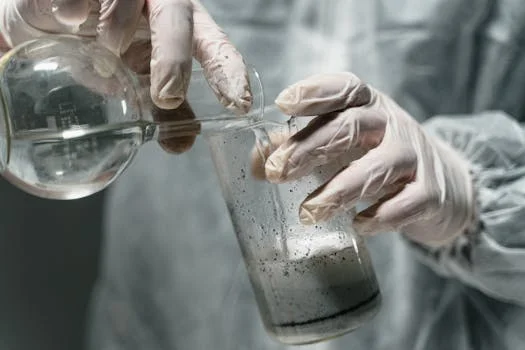
A textile plant in Bangladesh faced repeated compliance failures with effluent turbidity averaging 1,200 NTU (500 mg/L TSS). Reactive and disperse dyes formed stable colloids near -45 mV. Alum at 100 mg/L only reached about 300 NTU—still above the plant’s internal target.
Diagnosis
- Jar tests: Optimal pH 6.5 with 120 mg/L PAC + 1 mg/L cationic polymer.
- Particle size analysis: 80% of particles <50 μm (ideal for DAF).
- Microscopy: Dye aggregates and cellulose fibers confirmed.
Solution
The plant installed a two-stage DAF system (DAF-50) with these parameters:
- Stage 1: pH adjustment to 6.5 + PAC dosing (120 mg/L).
- Stage 2: Cationic polymer (1 mg/L) + DAF with 20% recycle ratio.
- Flow diagram: Influent → pH adjustment → rapid mix → DAF Stage 1 → DAF Stage 2 → effluent.
Results
- Turbidity: 1,200 NTU → 25 NTU (98% removal).
- TSS: 500 mg/L → 30 mg/L.
- Chemical cost: $0.45/m³.
- Energy use: 0.3 kWh/m³.
- ROI: 18 months (avoided fines + reduced sludge disposal costs).
Lessons Learned
- pH control (6.0–7.0) is critical for PAC performance.
- Cationic polymers outperform anionic for dye removal.
- Two-stage DAF improves removal efficiency by 15–20% compared to single-stage.
Proactive Monitoring: Preventing Spikes Before Discharge
Online meters and dose feedback stop NTU excursions cheaper than emergency trucking or overtime jar tests.
Online Turbidity Sensors
Nephelometric sensors covering 0–1,000 NTU fit most effluent duties; backscatter units at 1,000–10,000 NTU suit raw high-solids lines. Calibrate weekly for reuse water and monthly for industrial effluent with formazin standards. Sensor cost usually runs $2,000–$10,000 each.
Automated Chemical Dosing
Feedback loops raise or cut coagulant as turbidity moves. A food plant may program its PLC-controlled dosing system to add 20% more PAC when turbidity exceeds 100 NTU.
- Chemical savings: 15–30% vs. fixed dosing.
- Compliance: Reduces NTU spikes by 50–70%.
- Sludge reduction: Minimizes overdosing.
SCADA Integration
SCADA trends and alarms catch short spikes that grab samples miss. Useful setpoints include turbidity above 50 NTU for 15 minutes (warning) and above 100 NTU for 5 minutes (critical). Dashboards should show a 24-hour NTU trend, timestamped spikes with cause notes, and coagulant use versus turbidity. For small-plant budgeting, see our cost guide for small plants.
Predictive Maintenance
Turbidity drift schedules cleaning before failure. Clean DAF skimmers when removal drops by 10%. Schedule MBR chemical cleans when permeate turbidity exceeds 0.5 NTU. Adjust sludge withdrawal when SVI exceeds 150 mL/g. Plants that follow these triggers often cut chemical use by about 30% and stretch equipment life 20–40%.
Who This Is For and Next Step
This guide is for plant engineers, EPC teams, and procurement leads chasing recurring NTU or TSS permit risk on industrial or municipal lines. Look elsewhere if the only issue is drinking-water filter effluent under Surface Water Treatment Rule limits, which use a different compliance frame. If you need a sized train—from lamella clarification to DAF or MBR—send influent NTU, TSS, and permit limits through our request a quote form with a grab-sample summary.
Frequently Asked Questions
What is the difference between turbidity and total suspended solids (TSS)?
Turbidity measures light scattering in NTU; TSS measures particle mass in mg/L. Clay often tracks near 1 NTU ≈ 1–2 mg/L TSS, algae near 0.5 mg/L, and metal oxides near 1.5 mg/L. TSS is the mass standard for many permits, while turbidity gives faster online control once you build a site-specific correlation.
How do I choose between DAF and MBR for elevated effluent NTU?
Choose DAF for FOG, emulsions, and colloids when 90–98% removal at about $0.50–$1.50/m³ is enough. Choose MBR when you need near-reuse quality near 99% removal at $1.00–$3.00/m³ and can fund membrane cleaning. DAF usually fits influent below about 2,000 NTU; MBR can take stronger organics up to about 5,000 NTU with more footprint and O&M.
What are the most common mistakes in turbidity treatment?
Overdosing coagulants can raise sludge volume 30–50% and chemical cost; confirm with jar tests. Skipping pH control can cut coagulation efficiency 40–60%, and alum still needs pH 6.0–7.5. Skipping particle size or zeta work often adds 20–30% chemical cost. Weak rapid mix below about 200 rpm can cut floc formation roughly in half.
Can elevated effluent turbidity affect downstream disinfection?
Yes. According to U.S. EPA disinfection guidance, turbidity and TSS can render UV ineffective by lowering transmittance and shielding microbes, and about 50% UVT has historically been a practical minimum for conventional UV. Field practice still aims near <2–5 NTU before UV or chlorine. Chlorine demand commonly rises about 2–3 mg/L per 10 NTU on many industrial streams.
How often should I calibrate my turbidity sensor?
Calibrate weekly for critical reuse water and monthly for industrial effluent using formazin standards from 0–1,000 NTU. Clean probes with 10% HCl or an ultrasonic bath every 1–3 months. Drift above 10% usually means fouling or a failed calibration, not a true process step change.