What an Industrial pH Sensor Supplier Actually Sells
An industrial pH sensor supplier provides online 4–20 mA or Modbus probes rated for 0–14 pH, process temperatures to +70°C, and pressures to 6 bar, with IP68 housings for submerged installation. In 2026, prices range from $70 for lab-grade handheld meters to $4,500+ for PTFE-junction, self-cleaning in-line probes with integrated Pt100 temperature compensation used in food, chemical, and metal-finishing wastewater (per the 2026 ORP sensor pricing guide and 2026 IoT sensor cost benchmark).
Buyers encounter four product tiers, and the price jumps an order of magnitude between them. A lab bench meter ($70–$400) and a portable handheld ($200–$600) are grab-sample tools — useful for spot checks, useless for closed-loop dosing. The two industrial classes are submersion probes (a threaded sensor dropped into a tank on a 3–10 m cable) and in-line flow-through probes (sensor installed in a bypass loop with a reference junction flowing back to a reservoir). Combination pH/ORP probes in one housing now outsell separate units in food and metal-finishing plants because they halve the cable run and the mounting hardware.
Distinguish a supplier from a manufacturer before you issue a PO. Many branded pH sensor suppliers assemble third-party sensor heads into their own housings, preamplifiers, and cable glands. That is fine, but ask for the OEM certificate for the bare glass electrode — if the glass cartridge is made by one firm and the housing by another, the warranty usually lives with the electrode maker, and the calibration history must follow that serial number.
Matching the Sensor Class to Your Wastewater Matrix
Probe selection in wastewater is driven by the effluent matrix, not by the brand on the housing. A pH probe that survives a chemical plant's hot caustic stream will foul in 48 hours in a dairy plant's high-FOG waste, and vice versa. Map the matrix first, then shortlist the probe class.
| Wastewater matrix | Key stressor | Required junction / body | Maintenance interval | Compatible treatment context |
|---|---|---|---|---|
| Food, dairy, slaughterhouse (COD 5,000–20,000 mg/L, FOG 500–3,000 mg/L) | Grease fouling, protein film | PTFE junction + ultrasonic self-cleaning head | Clean every 14–30 days; replace 9–12 months | DAF system upstream |
| Metal-finishing, pickling (pH 1–3, high chloride, occasional HF) | Chemical attack, glass etching | Double-junction reference (KCl or gel), Ryton/PVDF body — never glass in HF streams | Refill electrolyte monthly; probe life 6–9 months | Scrubber recirculation, rinse-water recovery |
| Chemical, petrochemical (60–95°C, organic solvents) | Heat + solvent ingress | Refillable reference, PTFE diaphragm, KROHNE OPTISENS PH 8300 class (0–14 pH, +70°C) | Calibrate weekly; replace 6–12 months | Equalization tank, neutralization skid |
| Municipal, packaged plant (variable COD, surfactant) | Submersion, biofilm | Standard glass body, PTFE diaphragm, integrated Pt100, IP68 to 10 m | Calibrate monthly; replace 12–18 months | WSZ package sewage treatment plant, MBR wastewater treatment system |
IP rating is non-negotiable in open-tank mounting. IP67 covers splash-proof panel-mount enclosures only; IP68 is the rating for continuous submersion to 10 m and is the minimum a municipal equalization tank requires. A food-plant DAF overflow or MBR mixed-liquor channel both need IP68 with a sealed cable gland rated for the same depth.
Supplier Comparison: Specifications and 2026 Price Bands

The following matrix provides specific technical benchmarks for industrial RFPs. Pricing is a 2026 market estimate and varies with cable length, housing material, and order quantity — request a written quote before final selection.
| Supplier / model | Probe type | pH range | Max temp | Junction | Output | Indicative 2026 price (USD) |
|---|---|---|---|---|---|---|
| KROHNE OPTISENS PH 8300 | In-line, glass | 0–14 | +70°C | PTFE ring diaphragm | Analog, optional Pt100 | $1,800–$2,400 |
| Endress+Hauser Memosens CPS31 / CPS76 | In-line or submersion | 0–14 | +80°C (CPS76) | PTFE, salt ring | Memosens digital (Modbus on head) | $900–$1,600 |
| Hach (formerly GLI) 8362 sc differential | In-line differential | 0–14 | +70°C | Patented differential reference | sc digital (Hach SC controller) | $2,200–$3,100 |
| Chinese OEM tier (Rika, Lazzaro, Apera-class) | Analog submersion or in-line | 0–14 | +60–80°C | PTFE or ceramic | 4–20 mA or Modbus | $180–$600 analog, $400–$900 digital |
The KROHNE OPTISENS PH 8300 sets the durability benchmark for hot, dirty industrial streams, while Endress+Hauser's Memosens platform dominates where digital hot-swap calibration matters — Memosens heads store calibration data on the sensor itself, so a probe can be bench-calibrated and plugged in wet without a process interruption. Hach's differential reference uses a paired measuring-and-reference cell to extend service life 2–3× in plating baths, which is why wastewater operators with aggressive chemistry pay the premium. The Chinese OEM tier has closed most of the build-quality gap; verify CE, RoHS, and ISO 9001 documentation and request a sample probe for a 30-day trial before bulk ordering.
Integration with Chemical Dosing, PLC, and SCADA
Online pH sensors require compatible communication protocols to integrate with plant-wide control systems. Most procurement engineers get blindsided here: they spec a beautiful probe, then discover it outputs 4–20 mA when their PLC only has analog inputs left, or it uses Memosens when their SCADA is Modbus. Specify the output signal before you specify the brand.
Four outputs cover 95% of wastewater installations. 4–20 mA analog feeds any legacy PLC and is the lowest-cost option but drifts after 10–15 m of cable without a preamplifier. Modbus RTU over RS-485 or Modbus TCP over Ethernet is the standard for new SCADA builds and holds signal integrity past 100 m. HART overlays a digital signal on the 4–20 mA loop for remote calibration diagnostics. Memosens is Endress+Hauser's proprietary digital head — it works with any vendor's transmitter that speaks Memosens, but is not a Modbus drop.
Pair the pH probe with a PLC-controlled chemical dosing skid to form a closed neutralization loop: the sensor reads pH, the PLC applies a PID algorithm, and the dosing pump strokes acid or caustic until setpoint is reached. Response time for acid/caustic neutralization is 4–8 seconds in a well-mixed tank. For an MBR wastewater treatment system or SBR, log pH every 1–5 seconds into SCADA; a 12-month data historian retention is the standard demanded by both EPA and EU compliance auditors reviewing discharge permits.
Total Cost of Ownership: Sensor vs. Lab Handheld Over 12 Months
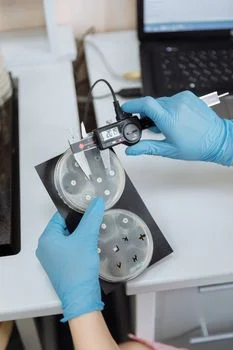
The total cost of ownership for an online industrial pH sensor includes labor savings and risk mitigation. Run both columns for twelve months before you let finance reject the capital purchase.
| Cost line | Online industrial sensor | Lab handheld meter |
|---|---|---|
| CAPEX (probe + transmitter + mounting) | $1,200–$3,000 | $70–$400 |
| Calibration frequency | Monthly (per EPA Method 150.1) | Before every grab sample |
| Operator labor (15 min/sample, 3 shifts, 365 days) | ~10 hours/year for cal checks | 274 hours/year ≈ $6,850 at $25/h loaded |
| Buffer solution + consumables | $120–$300/year | $400–$700/year (more frequent cal) |
| Probe replacement | $400–$900 every 9–18 months | n/a (handheld lasts 5+ years) |
| 12-month compliance risk | Continuous data trail, no gaps | Grab-sample gaps → $10,000–$50,000/day EPA/EU fines documented in 2024–2025 enforcement actions |
The handheld wins on CAPEX. The online sensor wins on labor, consumables, and compliance exposure — and the compliance line is what closes a capital request. Frame the proposal to management as: "$1,500 hardware avoids $50,000/day in potential fines and recovers $6,800 of operator time." That is the language a CFO signs off on.
Frequently Asked Questions
How often should an industrial pH sensor be calibrated in wastewater? Monthly is the baseline for most industrial effluent, per EPA Method 150.1 guidance. Calibrate immediately after any chemical shock (slug load of acid, caustic cleaning cycle, or chlorination event) and after the probe has been manually cleaned.
What IP rating do I need for a pH probe in an open equalization tank? IP68, rated for continuous submersion to at least 10 m. IP67 is splash-proof only and will fail in any open-top tank within months.
Can one pH sensor control both acid and caustic dosing? Yes, with a bi-directional dosing skid and a properly tuned PID loop in the PLC. The sensor reads pH; the controller decides direction (acid below setpoint, caustic above) and modulates pump stroke.
What is the typical lifespan of an industrial pH probe in wastewater? 6–18 months depending on matrix. PTFE-junction probes with self-cleaning heads in food-plant DAF feed last 12–18 months; ceramic-junction probes in the same service foul in 2–3 months. Differential-reference probes (Hach 8362 sc class) extend to 18–24 months in plating rinses.
Do I need a separate ORP sensor or can a pH/ORP combination probe work? Combination probes save one cable run, one mounting port, and roughly $400–$800 in hardware — but expect ORP accuracy to drop by ~10 mV versus a dedicated ORP sensor. For closed-loop pH/ORP-driven coagulant dosing on a