What Is the Philippine Clean Water Act (RA 9275)?
Republic Act No. 9275, the Philippine Clean Water Act of 2004, is the foundational law for wastewater discharge from industrial, domestic, and agricultural sources. DENR, acting through EMB, is the national water-quality authority. Every commercial, industrial, and agricultural enterprise that generates wastewater must secure an industrial waste discharge permit Philippines regulators issue, and must meet applicable effluent limits before release. A documented 31% of all illnesses in the Philippines are attributed to polluted water sources, which is why the Act requires continuous monitoring and reporting, not one-time compliance. DAO 2016-08 sets class-based General Effluent Standards: Class B receiving waters allow BOD ≤30 mg/L and COD ≤60 mg/L; Class C allows BOD ≤50 mg/L and COD ≤100 mg/L, with TSS ≤85 mg/L (Class B) or ≤100 mg/L (Class C). When the receiving class is uncertain, many plants we size still design to BOD ≤30 mg/L, COD ≤100 mg/L, TSS ≤30 mg/L, pH 6.0–9.0, and FOG ≤15 mg/L at the outfall.
The Act covers direct industrial outfalls and non-point sources such as fertilizer and pesticide runoff. It also requires a National Water Quality Status Report every five years so the EMB can track trends, recalibrate sector standards, and flag emerging contaminants. For the permit workflow itself, our step-by-step guide to obtaining a wastewater discharge permit in the Philippines walks through the documents and EMB regional-office submissions.
Key Agencies and Regulatory Framework
The DENR-EMB is the lead regulator and issues Environmental Compliance Certificates (ECCs), Wastewater Discharge Permits, and enforces national effluent standards under DAO 2016-08. Local Government Units (LGUs) derive authority from the Local Government Code to run local sanitation programs and ordinances, which may impose stricter limits than national law. The Department of Health (DOH) sets additional guidelines for sewage collection and disposal at healthcare and food-handling facilities. In practice, a discharger must satisfy the strictest applicable standard among national, local, and watershed rules.
The Laguna Lake Development Authority (LLDA) governs discharges into Laguna de Bay and its tributaries, applying its own effluent table for watershed protection. In Metro Manila, the Metropolitan Waterworks and Sewerage System (MWSS) and its concessionaires, Maynilad and Manila Water, enforce pre-treatment rules on any facility discharging into the centralized sewer, typically BOD ≤100 mg/L at the sewer connection. Identifying which agency has jurisdiction over your outfall is the first compliance decision, before any treatment train is selected. For a national equipment and cost view of industrial wastewater in the philippines, use the country engineering guide alongside the regional notes below.
Industrial and Municipal Effluent Standards
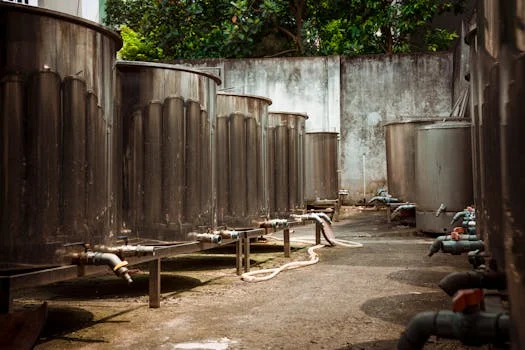
DENR Administrative Order 2016-08 sets General Effluent Standards by receiving-water class for all Philippine point-source dischargers, with sector-specific tables layered on for high-impact industries such as food processing, textiles, and metal finishing. Earlier design briefs often quote a single “general” package; the class tables above are the binding values. The summary below keeps the common sizing targets many plants still use, alongside a food-processing comparison column.
| Parameter | General Effluent Standard | Food Processing (Example) |
|---|---|---|
| Biochemical Oxygen Demand (BOD) | ≤ 30 mg/L | ≤ 50 mg/L |
| Chemical Oxygen Demand (COD) | ≤ 100 mg/L | ≤ 200 mg/L |
| Total Suspended Solids (TSS) | ≤ 30 mg/L | ≤ 50 mg/L |
| pH Level | 6.0 - 9.0 | 6.0 - 9.0 |
| Oil & Grease (FOG) | ≤ 15 mg/L | ≤ 10 mg/L |
Facilities discharging to a municipal sewer must pre-treat to septic-tank effluent quality (typically BOD ≤100 mg/L) so they do not damage downstream biological processes. Hitting the 30 mg/L BOD and TSS design targets usually requires a biological step; an A/O (anoxic/oxic) configuration such as a compact underground sewage treatment system is engineered for sustained BOD removal above 85% at 20–30 °C. Heavy metals are strictly controlled for plating and mining sites, often below 1.0 mg/L per parameter, and all sampling must be run by a DENR-accredited laboratory for the results to be accepted in a Discharge Monitoring Report.
For sector-by-sector standards including the newer DAO 2021-19 revisions, the comparison piece Philippines Wastewater Discharge Standards 2026: DAO 2016-08 vs DAO 2021-19 Tables lays out the parameter deltas we use during design reviews.
How to Achieve Compliance: Step-by-Step Process
Compliance is a four-step loop: audit, permit, install, monitor. Skipping the audit is the single most common reason plants we audit end up with rejected DMRs and permit revisions.
- Conduct a Wastewater Audit: Characterize effluent by measuring flow rate (m³/d), pH, BOD, COD, TSS, FOG, and any sector-specific metals. Capture peak-production conditions, not just average shifts, because EMB reviewers will size your industrial waste discharge permit against the highest expected load.
- Apply for a Wastewater Discharge Permit: Submit the application to your DENR-EMB Regional Office with the audit results, engineering plans for the proposed treatment system, a completed Report of Waste Discharge (RWD), and proof of land ownership or notarized landowner consent. Our permit application walkthrough covers the document set in detail.
- Install an Approved Treatment System: Match the technology to the waste profile. High-FOG streams need a high-efficiency DAF system capable of over 90% oil and grease reduction as a primary step before biological polishing. For broader regional context on equipment selection, the Luzon-focused industrial wastewater treatment guide for Luzon and the Visayas counterpart industrial wastewater treatment in Visayas show typical train configurations by sector.
- Implement Monitoring and Reporting: Run monthly sampling through a DENR-accredited laboratory and file Discharge Monitoring Reports (DMRs) with the regional EMB. Keep a dated logbook of chemical dosing, maintenance, and any system upsets; inspectors routinely cross-check the logbook against DMR values.
Penalties for Non-Compliance
Section 28 of RA 9275 sets administrative fines of not less than ₱10,000 and not more than ₱200,000 per day of violation. Earlier briefs often cite up to ₱100,000 per day; that figure sits inside the statutory range but is not the legal ceiling. The DENR-EMB may suspend or revoke the facility's ECC and cancel business permits, which effectively halts operations until a corrective-action plan is accepted. Repeated or gross violations carry criminal liability, including imprisonment for responsible officers. The financial exposure adds up quickly: a 60-day exceedance of BOD alone can exceed ₱6 million in fines before cleanup and rehabilitation costs under the polluter-pays principle are counted.
EMB inspections are both scheduled and unannounced, often triggered by community complaints or DMR self-reporting that shows breaches. Class-action suits from downstream communities remain a real legal threat, and courts have ordered operators to fund river or coastal cleanup in addition to paying fines. Compliant treatment is cheaper than the risk-adjusted cost of non-compliance.
Recommended Treatment Technologies by Sector
The right train depends on flow rate, pollutant profile, and discharge point. Three sector patterns cover most Philippine permit applications.
Food Processing & Manufacturing: Wastewater is typically high in FOG, TSS, and biodegradable organics. A Dissolved Air Flotation (DAF) unit is the standard primary step, removing 92–97% of suspended solids and free oils. An SBR or MBR downstream polishes residual BOD and ammonia to the 30 mg/L BOD and 30 mg/L TSS design targets.
Hospitals and Healthcare Facilities: Medical streams must address pathogens and chemical residues. Ozone-based advanced oxidation achieves required pathogen kill rates without chlorinated by-products, and on-site autoclaving handles specific liquid wastes before they join the main wastewater stream. Always confirm DOH healthcare-waste guidelines alongside DAO 2016-08 effluent limits.
Residential Complexes & Commercial Buildings: For domestic sewage, a packaged biological plant is the most efficient choice. An underground A/O system reliably drops BOD below 30 mg/L and TSS below 30 mg/L at flows of 5–500 m³/d, and extended-aeration activated sludge handles larger mixed-use developments up to several thousand m³/d.
Who This Is For and Next Step
This guide fits plant engineers, EPC contractors, and procurement managers responsible for Philippine facilities that must meet DAO 2016-08 class-based effluent limits and hold a current industrial waste discharge permit. If your wastewater is purely domestic and below 30 m³/d, a packaged A/O or SBR plant is usually enough. If you handle heavy metals, high FOG, or flows above 500 m³/d, plan on a multi-stage train with DAF or MBR and a formal pre-treatment review with EMB before procurement.
Send your influent profile and target flow to our engineering desk for a sizing and budget review via the request-quote form.
Frequently Asked Questions
What is the wastewater law in the Philippines?
Republic Act 9275, the Philippine Clean Water Act of 2004, is the governing statute for wastewater treatment and discharge, enforced by the DENR-EMB under DAO 2016-08 and DAO 2021-19. It applies to industrial, domestic, and agricultural point-source outfalls nationwide. Facilities must hold a valid discharge permit and meet the effluent limits that match the receiving-water class.
Is a sewage treatment plant required in the Philippines?
Yes. Any establishment that generates and discharges wastewater must install adequate on-site treatment or connect to an approved centralized sewerage facility, and must hold a valid Wastewater Discharge Permit before release begins. Untreated discharge into a water body is a prohibited act under RA 9275 and can trigger daily fines plus a cease-and-desist order.
What are the effluent standards for industrial discharge?
Under DAO 2016-08, limits depend on receiving-water class. Class B allows BOD ≤30 mg/L and COD ≤60 mg/L; Class C allows BOD ≤50 mg/L and COD ≤100 mg/L, with TSS ≤85–100 mg/L by class. Many design packages still target BOD ≤30 mg/L, COD ≤100 mg/L, TSS ≤30 mg/L, pH 6.0–9.0, and oil and grease ≤15 mg/L when local rules or uncertain classification demand a tighter train.
Who enforces wastewater regulations in the Philippines?
The DENR, through its Environmental Management Bureau (EMB), is the primary national enforcement body, supported by the LLDA for the Laguna de Bay watershed and by LGUs that can layer stricter local ordinances on top of national rules. Always confirm which office owns your outfall before you buy equipment.
How often must wastewater be tested?
Monthly sampling is mandatory, with analyses run by a DENR-accredited laboratory and Discharge Monitoring Reports filed with the regional EMB office. Additional self-monitoring is required after any process change or permit renewal. Keep dosing and upset logs so inspectors can cross-check DMR values on site.