A wastewater treatment plant cost in Brazil runs R$60–R$650 per inhabitant for municipal works (IADB 2024) and R$5M to several billion reais for industrial projects. Municipal OPEX lands at R$0.20–R$0.80 per m³, while industrial service runs R$1.50–R$5.00 per m³.
What Drives Wastewater Treatment Plant Cost in Brazil?
Brazilian plant costs split into civil works (40–60% of CAPEX), process equipment, and long-term energy, chemicals, and sludge hauling. Municipal plants budget R$60–R$650 per inhabitant; industrial plants R$5M upward, with tertiary stages adding 25–40%. Regulation CONAMA 430 and state rules like CETESB set the treatment floor.
Three levers dominate any estimate. Process selection — UASB hybrids, MBR, DAF, RO — sets the equipment envelope; effluent targets set the number of stages; location sets logistics, labor, and land. The sections below price each lever for both municipal and industrial buyers.
Economic conditions in 2025 layered complexity onto these budgets. Central Bank monetary policy moved financing costs, so CAPEX and OPEX now carry equal weight in tender scoring. Geography sets the spread: Amazon-region projects pay far more to move heavy machinery, while São Paulo projects pay more for land but less for chemicals and spare parts. Water scarcity in the Northeast pushes reuse value up, while Southeast industrial hubs benefit from denser supplier networks.
Wastewater Treatment CAPEX Brazil 2025: Why Budgets Rose 15–20%
Regulation pulled the market first. PLANSAB, the National Water and Sanitation Plan, frames universal access, and the Legal Framework for Sanitation (Law 14.026/2020, the Novo Marco do Saneamento) set the binding goals. PLANSAB-linked estimates put the investment gap above R$500 billion, and Instituto Trata Brasil (2025) sized the remaining need at R$454.1 billion.
Private operators changed the buying culture. Aegea and Iguá Saneamento professionalized procurement, placing a premium on long-term durability over the lowest initial bid. Equipment prices rose 15–20% since 2020 (ABES 2024 data), so 2025 tenders priced that inflation in.
Industrial growth is the second driver, led by pulp and paper and food processing. Suzano's R$22.2B Cerrado Project in Ribas do Rio Pardo, Mato Grosso do Sul — started up in July 2024 with 2.55 million tonnes per year of pulp capacity (Suzano, 2024) — set the benchmark for industrial effluent CAPEX. CETESB rules in São Paulo often tighten COD and nitrogen limits further, and tertiary stages like Reverse Osmosis or advanced oxidation add 25–40% to project cost.
Inflation and supply chains pushed the civil share higher. Civil works already account for 40–60% of plant CAPEX, and metropolitan labor and concrete prices climbed through 2024. "Custo Brasil" adds import taxes on specialized sensors and high-efficiency pumps, lifting the wastewater treatment plant cost in Brazil above international benchmarks. Many developers now choose modular or containerized trains to dodge on-site construction volatility.
Energy volatility shapes OPEX more than any other line. Electricity prices swing with hydrological conditions and the "bandeira tarifária" tariff-flag mechanism, and aeration is the hungriest load in aerobic plants. New designs recover biogas from UASB anaerobic reactors to generate their own power. Gas scrubbing and generator sets raise initial CAPEX, yet they cut the 10-year total cost of ownership hard.
Municipal Wastewater Treatment CAPEX OPEX Brazil: R$60–R$650 per Inhabitant
Municipal and industrial plants diverge at the influent. Municipal systems chase large-scale BOD removal and pathogen reduction for public health, prioritizing low OPEX and long-term scalability, often with land-intensive processes where space permits. Industrial systems handle complex, high-concentration pollutants tailored to production lines, prioritizing removal efficiency and footprint minimization where land costs bite. That divergence — not any single technology — explains most of the cost spread.
Municipal budgets anchor to the per-inhabitant band. According to IADB data, municipal CAPEX runs R$60–R$650 per inhabitant, and a plant serving 60,000 people lands near US$7 million (roughly R$35M–R$40M) depending on technology. Municipal OPEX benchmarks sit at R$0.20–R$0.80 per m³, with energy and sludge hauling leading. UASB reactors remain the staple for tropical climates, and "UASB + post-treatment" trains add roughly 30% CAPEX to clear nutrient limits under CONAMA 430; stabilization ponds anchor the low end of the band where land is cheap.
Sludge is the hidden cost line in most municipal projects. Landfill tipping fees keep rising, so plants invest in dewatering and thermal drying to cut hauled volume. A high-performance filter press or centrifuge can represent 15% of the equipment budget at a mid-sized plant while cutting hauling costs by up to 70%. Municipal operators increasingly chase sludge-to-energy and agricultural reuse, which adds heavy-metal and pathogen monitoring to the OPEX ledger.
Odor control carries real weight in licensing. Biofilters or chemical scrubbers add 5–10% to CAPEX, often a prerequisite for environmental licenses from IBAMA or state agencies. Trickling filters and activated sludge post-treatment round out UASB trains where nutrient limits bind. ESG-linked financing from BNDES rewards the plants that plan these steps early.
Industrial Wastewater Treatment Cost per m³ Brazil: R$1.50–R$5.00
Industrial effluent costs more per cubic meter, always. For industrial wastewater treatment cost per m3 Brazil projects typically budget R$1.50–R$5.00, against the municipal R$0.20–R$0.80 band, because industrial streams carry complex, high-concentration pollutants. Projects span from R$5M for a specialized DAF system at a food-processing plant to several billion reais for integrated pulp mill effluent systems. Robust pretreatment — such as DAF systems for industrial pretreatment and FOG removal — protects biology from fats, oils, and greases; skipping it invites bulking, membrane fouling, and downtime.
Reuse economics now drive industrial technology choice. Beverage producers such as Ambev and Heineken adopt Membrane Bioreactors to polish effluent for cooling towers and floor washing. In the water-stressed PCJ Basin (Piracicaba, Capivari, and Jundiaí), rising withdrawal fees make reuse a financial necessity rather than an ESG gesture. Phosphorus recovery from sludge or caustic soda recovery from textile effluent offsets OPEX and strengthens BNDES-linked ESG financing cases.
| Feature | Municipal Wastewater Treatment | Industrial Wastewater Treatment |
|---|---|---|
| Primary Goal | BOD/TSS removal & Pathogen control | COD removal & Specific toxin neutralization |
| CAPEX Benchmark | R$60–R$650 per inhabitant | R$5M to R$25B (project-specific) |
| OPEX Benchmark | R$0.20–R$0.80 per m³ | R$1.50–R$5.00 per m³ |
| Compliance Standard | CONAMA 430 & Health Ministry Ordinances | CONAMA 430 & State-specific (e.g., CETESB) |
| Common Technology | UASB, Activated Sludge, Stabilization Ponds | DAF, MBR, RO, Chemical Precipitation |
| Water Reuse Potential | Moderate (Irrigation, Urban cleaning) | High (Process water, Cooling towers) |
| Sludge Characteristics | High organic content, potential pathogens | Variable; may contain heavy metals/chemicals |
Reading the table, two lines deserve extra weight. Compliance drives the industrial column — state rules stacked on CONAMA 430 set the treatment floor that sizes the train. Water reuse potential drives payback, since high-value reuse streams (process water, cooling towers) offset the R$1.50–R$5.00 per m³ service cost fastest.
MBR vs DAF System Cost Brazil: Choosing by Duty
DAF and MBR answer different questions, so cost comparison starts from the duty. DAF earns its place as pretreatment, stripping FOG and suspended solids ahead of biology at modest CAPEX, with chemicals and sludge handling as the main OPEX. MBR carries higher CAPEX and energy load but delivers reuse-grade effluent in a compact footprint. Most food-processing plants we quote run both in series — DAF protecting the MBR membranes, because membrane life depends on it.
The selector rule is short. If influent carries FOG above biological tolerance or TSS spikes from production line changes, DAF comes first regardless of budget. If the target is reuse-grade water for cooling towers or process loops — common in the PCJ Basin — MBR is the core, with RO as an optional polish. Budget-constrained discharge-only plants can stop at DAF plus clarification.
Cross-market benchmarks bracket the same decision. The Tokyo Wastewater Treatment Plant Cost 2026: CAPEX, OPEX & Tech-Specific Breakdown for Industrial Buyers guide prices these technologies in a high-wage market. The Al Khobar Wastewater Treatment Plant Cost 2026: SAR CapEx, OPEX & Tech-Specific Breakdown for Industrial Buyers overview shows how cheap energy shifts the MBR-vs-DAF math.
Equipment That Moves the Numbers in Brazil
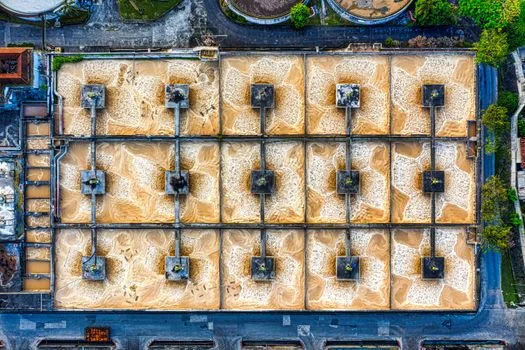
Four equipment choices swing Brazilian project economics hardest. MBR systems for compact, high-efficiency wastewater treatment suit urban sites where land is expensive and industrial sites needing reuse-quality effluent, with TSS and BOD performance beyond CONAMA 430 requirements. Specifications, capacity ranges, and technical data sheets detail how these units minimize footprint. They cost more than conventional trains and repay it in footprint and effluent value.
Dewatering comes second. As landfill costs rise, sludge dewatering solutions for municipal and industrial plants with high cake dryness cut the mass and volume of sludge to be transported — the budget line municipal operators control best after energy. Specifications and capacity data help match press size to flow rate. Sizing the press to your sludge class is the biggest single lever on hauling spend.
Aeration and dosing close the OPEX loop. High-efficiency diffusers and blowers cut energy consumption by up to 30% compared with traditional surface aerators, the key lever on municipal activated-sludge OPEX. Automated dosing units stop the waste of expensive coagulation and flocculation chemicals, a major component of the industrial cost per m³.
Buyers benchmarking international pricing can also compare the Tokyo Wastewater Treatment Plant Cost 2026: CAPEX, OPEX and Technology Breakdown before locking a budget envelope. Next step: send your flow rate, pollutant parameters, and target discharge standard through our request-a-quote channel for a CAPEX and OPEX breakdown tailored to CONAMA 430 and your state's limits. Municipal consortia and industrial EPC teams both receive itemized budgets they can defend in tender.
Frequently Asked Questions
What does a CONAMA 430 compliant treatment plant cost?
A CONAMA 430 compliant plant typically costs R$60–R$650 per inhabitant for municipal service, or R$5M upward for industrial duty, before tertiary stages. CETESB-style state limits on COD and nitrogen add Reverse Osmosis or advanced oxidation stages, which raise project cost by 25–40%. Civil works at 40–60% of CAPEX dominate the municipal end of that range.
How much is municipal OPEX per cubic meter in Brazil?
Municipal OPEX in Brazil runs R$0.20–R$0.80 per m³, with aeration energy and sludge hauling as the two largest lines. Tariff-flag electricity volatility can move the energy line year to year. UASB-based designs with biogas recovery hold OPEX at the low end of the band.
Why does industrial treatment cost more per m³ than municipal?
Industrial treatment costs R$1.50–R$5.00 per m³ — three to twenty-five times the municipal band — because the streams are concentrated and process-specific. Pretreatment for FOG, toxins, and heavy metals adds stages, chemicals, and hazardous-class sludge handling. Reuse-grade targets push the train into MBR or RO, raising both CAPEX and energy.
Is MBR worth the higher cost in Brazil?
MBR pays where land is expensive or reuse is the goal. It delivers reuse-grade effluent in a compact footprint, which matters in São Paulo industrial zones and water-stressed basins like the PCJ. For discharge-only compliance at a land-rich site, UASB plus post-treatment at roughly 30% lower CAPEX usually wins the tender.
Why are Brazilian plant budgets rising toward 2033?
Equipment prices rose 15–20% since 2020, and civil works inflation adds pressure. Tighter state discharge limits push more plants into tertiary treatment, adding 25–40% per project.
Further Reading
Explore these in-depth articles on related wastewater treatment topics to further your understanding of the Brazilian market:
- hospital wastewater treatment cost benchmarks in Brazil — Learn about the specific requirements for treating infectious effluents and pharmaceutical residues.
- local supplier options for wastewater treatment projects in Porto Alegre — A regional deep-dive into the logistics and supplier landscape in Southern Brazil.
- The Impact of the New Sanitation Framework on Industrial Reuse — A guide on how the 2020 law change is creating new opportunities for private-public partnerships in water reuse.
- Energy Recovery from UASB Reactors — Technical specifications for capturing methane and reducing the carbon footprint of municipal treatment plants.