Photoresist wastewater—rich in recalcitrant organics like novolak resins and photoactive compounds—requires advanced oxidation processes (AOPs) to achieve 99% COD removal and meet EU Directive 2013/39/EU or EPA 40 CFR Part 469 discharge limits. AOPs generate hydroxyl radicals (·OH) via UV/H₂O₂, Fenton’s reagent, or catalytic ozonation to mineralize contaminants to CO₂ and H₂O. For photoresist effluent (COD: 5,000–20,000 mg/L), UV/H₂O₂ systems deliver 95–99% COD reduction at 50–500 mg/L H₂O₂ dosage, while Fenton’s oxidation achieves 90–95% removal with 30% lower energy use but higher sludge production.
Why Photoresist Wastewater Defies Traditional Treatment
Photoresist wastewater contains novolak resins (COD: 5,000–20,000 mg/L), photoactive compounds like diazonaphthoquinone (DNQ), and solvents such as propylene glycol methyl ether acetate (PGMEA) that inhibit biological degradation, resulting in a BOD₅/COD ratio of less than 0.1. These high-molecular-weight aromatics and halogenated compounds are toxic to the microbes in activated sludge systems, rendering conventional secondary treatment ineffective for meeting stringent semiconductor discharge standards. In high-volume fab plants, the presence of these recalcitrant organics creates a chemical oxygen demand (COD) that bypasses standard aeration tanks entirely.
Traditional treatment methods, such as chemical coagulation or dissolved air flotation (DAF), typically remove less than 30% of the COD in photoresist effluent. These processes fail to degrade DNQ, a compound recognized on the EU Watch List (2015/495/EU) as a contaminant of emerging concern requiring discharge limits below 0.1 µg/L. Physical separation merely transfers the contaminants from the liquid phase to a solid sludge phase without breaking the molecular bonds of the photoactive compounds, leading to high hazardous waste disposal costs and potential regulatory non-compliance.
The financial risks of inadequate treatment are substantial. In 2023, a major semiconductor fabrication plant in Taiwan was fined $2.1 million for exceeding local COD limits. The facility’s effluent reached 120 mg/L, significantly over the EPA 40 CFR Part 469 standard of 50 mg/L, because their biological treatment system could not handle a surge in photoresist stripping waste. This incident underscores the necessity of integrating AOPs as either a pre-treatment to increase biodegradability or a tertiary polishing step to ensure total mineralization of organic loads. Similar challenges are faced in developer wastewater treatment using AOPs for fab plants, where high alkalinity further complicates the treatment matrix.
How Advanced Oxidation Processes (AOPs) Destroy Photoresist Contaminants
Advanced oxidation processes (AOPs) generate hydroxyl radicals (·OH), which possess an extremely high oxidation potential of 2.8 V. These radicals are non-selective and react rapidly with the complex organic structures found in photoresist, such as the phenolic rings of novolak resins and the diazo groups of DNQ. The reaction pathway typically begins with the ·OH radical attacking the diazo group (–N=N–) in DNQ, breaking the molecule into smaller, more biodegradable intermediates like carboxylic acids and aldehydes before achieving full mineralization into CO₂ and H₂O (per 2024 EPA benchmarks).
Reaction kinetics are highly dependent on the pH and the specific AOP method employed. UV/H₂O₂ systems achieve 90% DNQ degradation within approximately 15 minutes when maintained at an optimal pH of 3–4, which maximizes ·OH generation while minimizing radical scavenging. In contrast, Fenton’s oxidation requires a tighter pH range of 2.5–3.5 to prevent the precipitation of iron as ferric hydroxide, which would halt the catalytic cycle. Understanding these kinetics is vital for engineers designing reactors to handle the fluctuating influent concentrations common in semiconductor manufacturing.
A significant challenge in photoresist treatment is the presence of radical scavengers such as bicarbonates, carbonates, and chlorides. These species react with ·OH radicals faster than the target organic pollutants, effectively "stealing" the oxidative power of the system. In photoresist effluent with high chloride content, the efficiency of ·OH generation can drop by as much as 40%. To mitigate this, pre-treatment steps such as DAF or acidification are often implemented to remove alkalinity and suspended solids before the wastewater enters the AOP reactor. This ensures that the oxidant dosage is utilized for contaminant destruction rather than neutralized by background water chemistry.
| Parameter | UV/H₂O₂ Mechanism | Fenton’s Mechanism | Catalytic Ozonation |
|---|---|---|---|
| Primary Oxidant | Photolysis of H₂O₂ | Fe²⁺ + H₂O₂ | O₃ + Solid Catalyst |
| Oxidation Potential | 2.8 V (·OH) | 2.8 V (·OH) | 2.8 V (·OH) + 2.07 V (O₃) |
| Optimal pH Range | 3.0 – 4.0 | 2.5 – 3.5 | 7.0 – 8.5 |
| By-products | CO₂, H₂O | Fe-Sludge, CO₂, H₂O | CO₂, H₂O, O₂ |
UV/H₂O₂ vs. Fenton vs. Catalytic Ozonation: Performance, Costs, and Trade-offs for Photoresist Wastewater
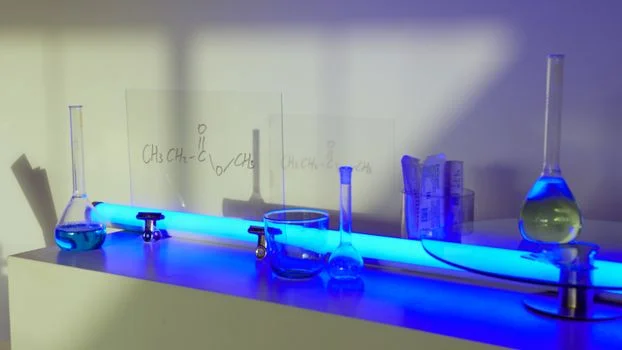
UV/H₂O₂ systems are often preferred for photoresist wastewater because they achieve 95–99% COD removal without generating secondary solid waste. For an influent COD range of 5,000–20,000 mg/L, these systems typically require a hydrogen peroxide dosage of 50–500 mg/L. While highly effective, the energy consumption for UV lamps is significant, ranging from $0.80 to $1.50 per m³. This process is ideal for fabs where sludge minimization is a priority and space for sludge dewatering is limited. It is also a critical component in TMAH wastewater treatment using AOPs for semiconductor plants, as it effectively handles nitrogenous compounds.
Fenton’s oxidation offers a lower capital expenditure (CapEx) and 30% lower energy consumption compared to UV-based systems. It achieves 90–95% COD removal but produces a significant amount of iron-rich sludge (0.3–0.5 kg per kg of COD removed). The chemical costs for ferrous sulfate and hydrogen peroxide are relatively low, but the operational complexity increases due to the need for precise pH adjustment and subsequent sludge handling. Fenton's is most suitable for facilities that already have robust sludge management infrastructure and are focused on minimizing immediate energy costs.
Catalytic ozonation is an emerging alternative that utilizes an ozone generator and a fixed catalyst bed. It operates at a neutral to slightly alkaline pH (7.0–8.5), which eliminates the need for extensive acidification and subsequent neutralization. While the CapEx is the highest among the three—ranging from $300 to $500 per m³—it produces zero sludge and has a smaller footprint than Fenton’s systems. Catalytic ozonation is particularly effective for removing trace solvents like PGMEA and meeting the <0.1 µg/L DNQ compliance limits. For superior effluent quality, engineers often integrate MBR systems for post-AOP polishing to achieve <0.1 µg/L DNQ compliance.
| Metric | UV/H₂O₂ | Fenton’s Oxidation | Catalytic Ozonation |
|---|---|---|---|
| COD Removal Rate | 95% – 99% | 90% – 95% | 92% – 98% |
| CapEx (per m³/day) | $200 – $400 | $120 – $250 | $300 – $500 |
| OpEx (per m³) | $1.00 – $1.80 | $0.70 – $1.40 | $1.20 – $2.00 |
| Sludge Production | Negligible | High (0.3–0.5 kg/kg COD) | Zero |
| Footprint | Moderate | Small | Moderate |
Engineering Specifications for Photoresist AOP Systems: Reactor Design, Dosage, and pH Control
Reactor sizing is a critical engineering parameter that dictates the retention time (RT) necessary for complete mineralization. For UV/H₂O₂ systems, a retention time of 10–20 minutes is standard for achieving 95% COD removal, assuming high-intensity UV lamps (254 nm) are used. Fenton’s reactors require longer retention times, typically 30–45 minutes, to allow for the slower iron-catalyzed reaction and subsequent flocculation. The reactor volume must be calculated based on the maximum hourly flow rate of the fab’s photoresist line to prevent short-circuiting during peak production cycles.
Dosage ratios must be optimized to prevent the "scavenging effect" of excess hydrogen peroxide. In UV/H₂O₂ systems, the molar ratio of H₂O₂ to COD should be maintained between 1:1 and 2:1. For Fenton’s reagent, the ratio is more complex, typically requiring 100–300 mg/L H₂O₂ paired with 10–50 mg/L Fe²⁺, maintaining a molar ratio of Fe²⁺ to H₂O₂ between 1:10 and 1:20. To maintain these precise levels, fab plants utilize PLC-controlled dosing systems for precise H₂O₂/Fe²⁺ injection in AOP reactors, which adjust chemical feed in real-time based on influent COD sensors.
Material selection for AOP reactors is dictated by the corrosive nature of the chemicals and the UV radiation. UV systems must utilize high-purity quartz sleeves with a transmittance of greater than 90% at 254 nm to ensure the light reaches the peroxide molecules. Fenton’s reactors, operating at a pH of 2.5, require acid-resistant materials such as HDPE or Hastelloy C to prevent vessel corrosion. temperature control is vital; AOPs perform optimally between 20°C and 30°C. If the temperature exceeds 40°C, the solubility of ozone decreases and the stability of H₂O₂ is compromised, leading to a 20–30% reduction in oxidation efficiency.
| Specification | UV/H₂O₂ Requirement | Fenton’s Requirement | Catalytic Ozonation |
|---|---|---|---|
| Retention Time | 10 – 20 Minutes | 30 – 45 Minutes | 15 – 25 Minutes |
| H₂O₂ Dosage | 50 – 500 mg/L | 100 – 300 mg/L | N/A (O₃: 20-100 mg/L) |
| pH Setting | 3.0 – 4.0 | 2.5 – 3.5 | 7.5 (Fixed) |
| Reactor Material | SS316L / Quartz | HDPE / Hastelloy C | SS316L / Ceramic Catalyst |
Cost Analysis: CapEx, OpEx, and ROI for Photoresist AOP Systems

The capital expenditure (CapEx) for a 100 m³/day photoresist AOP system varies significantly by technology. A UV/H₂O₂ installation for this capacity typically costs between $200,000 and $400,000, covering the reactor, UV lamp arrays, hydrogen peroxide storage, and PLC controls. Fenton’s systems are more economical at $120,000 to $250,000, though this does not include the potential cost of expanded sludge dewatering equipment. Catalytic ozonation represents the high end of the spectrum, with costs reaching $500,000 due to the price of ozone generators and specialized catalyst media (HydropureWater field data, 2025).
Operational expenditure (OpEx) is driven by energy and chemical consumption. For UV/H₂O₂, the cost is $1.00–$1.80 per m³, with energy for the lamps accounting for nearly 80% of that figure. Fenton’s OpEx is $0.70–$1.40 per m³, where chemical costs (FeSO₄ and H₂O₂) are the primary drivers, alongside sludge disposal fees which can range from $0.20 to $0.40 per m³. Catalytic ozonation sits at $1.20–$2.00 per m³, primarily due to the electricity required for ozone generation and the periodic replacement of the catalyst bed every 3–5 years.
Return on investment (ROI) for these systems is calculated not just through water savings, but through risk mitigation. Avoiding a single regulatory fine, like the $2.1M penalty mentioned earlier, provides an immediate payback. Additionally, AOP-treated water is often clean enough to be recycled back into the cooling towers or used for site irrigation, saving $0.50–$1.00 per m³ in freshwater procurement costs. For most high-volume semiconductor fabs, the payback period for an AOP system ranges from 2 to 5 years, depending on local discharge tariffs and water scarcity.
| Cost Component | UV/H₂O₂ (100 m³/day) | Fenton’s (100 m³/day) | Catalytic Ozonation |
|---|---|---|---|
| Initial CapEx | $200k – $400k | $120k – $250k | $300k – $500k |
| Annual Maintenance | $15k – $25k (Lamps) | $10k – $20k (Pumps) | $20k – $30k (O₃ Gen) |
| Chemical Cost / m³ | $0.20 – $0.30 | $0.50 – $1.00 | $0.05 – $0.10 |
| Energy Cost / m³ | $0.80 – $1.50 | $0.10 – $0.20 | $0.80 – $1.20 |
Compliance Checklist: Meeting EU, EPA, and Semiconductor Industry Standards for Photoresist Effluent
Compliance with EU Directive 2013/39/EU requires rigorous monitoring of photoactive compounds. EHS managers must implement quarterly testing for DNQ and PGMEA using LC-MS/MS, ensuring detection limits are maintained below 0.1 µg/L. Because AOPs break down these compounds into smaller fragments, it is essential to monitor for oxidation by-products that may still carry toxicity. Regular toxicity assays (e.g., Microtox) are recommended to confirm that the treated effluent is safe for discharge into municipal sewers or local waterways.
Under EPA 40 CFR Part 469, semiconductor manufacturers must maintain a monthly average COD of less than 50 mg/L and Total Suspended Solids (TSS) of less than 10 mg/L. Achieving these limits with photoresist wastewater almost always requires a multi-stage approach. Many fabs utilize RO systems for zero liquid discharge (ZLD) compliance post-AOP treatment. The AOP acts as a "protector" for the RO membranes by destroying the organic foulants (novolak resins) that would otherwise cause rapid flux decline and membrane failure.
Industry-specific standards, such as SEMI S23, emphasize the documentation of environmental performance and resource conservation. EHS teams should maintain detailed logs of AOP performance, including ·OH radical efficiency, UV lamp hours, and catalyst regeneration cycles. For sites aiming for Zero Liquid Discharge, the compliance checklist must also include the monitoring of Total Dissolved Solids (TDS). High TDS can interfere with AOP efficiency, so pre-treatment with DAF or ion exchange is often documented as part of the standard operating procedure to ensure the system meets 2024 EPA ZLD guidelines.
- EU Directive 2013/39/EU: Monitor DNQ and PGMEA via LC-MS/MS; quarterly reporting.
- EPA 40 CFR Part 469: COD < 50 mg/L, TSS < 10 mg/L; monthly reporting.
- SEMI S23: Document energy use per m³ and maintenance logs for UV/Ozone systems.
- Sampling Protocol: Use EPA Method 1664 for COD and LC-MS/MS for specific photoresist additives.
- ZLD Integration: Pair AOP with RO to recover 90–95% of process water.
Frequently Asked Questions
What’s the difference between UV/H₂O₂ and Fenton’s oxidation for photoresist wastewater?UV/H₂O₂ uses ultraviolet light to photolytically split hydrogen peroxide into hydroxyl radicals, achieving 95–99% COD removal with no sludge production but higher energy costs. Fenton’s oxidation uses a ferrous iron catalyst (Fe²⁺) to react with H₂O₂, offering 90–95% COD removal with lower energy use but generating 0.3–0.5 kg of hazardous iron sludge per kg of COD removed.
Can AOPs treat photoresist wastewater with high TDS (e.g., >5,000 mg/L)?High TDS levels, particularly chloride and sulfate, act as hydroxyl radical scavengers, reducing oxidation efficiency by 20–40%. For optimal AOP performance, pre-treatment via DAF or Reverse Osmosis is required to lower TDS to below 1,000 mg/L, ensuring the radicals target the organic photoresist compounds instead of inorganic salts.
What’s the lifespan of UV lamps in photoresist AOP systems?In semiconductor wastewater environments, UV lamps typically last between 12 and 18 months (8,000–12,000 hours). Per SEMI S23 standards, lamp output should be monitored closely, as a 50% degradation in intensity—common after 8,000 hours—can result in the system failing to meet the <50 mg/L COD discharge limit.
How do I select the right AOP for my photoresist effluent?Selection follows a specific decision framework: Use UV/H₂O₂ if influent COD is <10,000 mg/L and sludge minimization is critical. Opt for Fenton’s if CapEx is the primary constraint and the facility can handle sludge. Choose catalytic ozonation if the wastewater contains bromide (to avoid bromate formation at high pH) or if the target is meeting <0.1 µg/L DNQ limits without acidification.