Common Symptoms and Immediate Impacts
Excessive vibration exceeding 7 mm/s RMS in a rotary drum screen typically signals advanced bearing degradation or structural misalignment that necessitates immediate intervention to prevent catastrophic mechanical failure. In industrial wastewater pretreatment environments, ignoring these early warning signs leads to a predictable progression: intermittent harmonic noise evolves into consistent vibration, eventually resulting in cracked frame welds or sheared drive shafts. Monitoring these symptoms is not merely about maintenance; it is about preventing the 30–60% flow reduction that occurs when hydraulic performance is compromised by operational inefficiencies.
A drum screen experiences blinding or clogging, the impact on the downstream processes is immediate. Field data indicates that a blinded screen increases head loss significantly, often forcing bypass events that violate discharge permits. Motor load spikes are a critical metric; any drive motor consistently operating at >90% of its rated load is likely fighting mechanical resistance from a misaligned drum or excessive solids accumulation in the seal area. (HydropureWater field data, 2025).
Uneven wear patterns on the screen surface or the internal flights often suggest a feed distribution issue. If solids are concentrated on the center 20% of the drum rather than distributed across the width, the localized wear rate increases by a factor of three. This leads to premature screen replacement and uneven stress on the support rollers. Recognizing these symptoms—vibration, flow reduction, motor overload, and uneven wear—allows maintenance teams to move from reactive "firefighting" to a data-driven troubleshooting approach that restores 90% uptime within 48 hours.
Step-by-Step Troubleshooting Framework
A systematic diagnostic framework for drum screens begins with quantifying the deviation from OEM specifications, such as checking if mounting bolt torque falls below the required 450–550 Nm range for M24 bolts. This logical progression ensures that technicians do not waste time on complex control issues when the root cause is basic mechanical instability. Utilizing field-tested fixes for mechanical bar screen issues provides a baseline for comparing rotary drum performance against other common pretreatment technologies.
- Symptom: Excessive Vibration – Measure the vibration velocity at the bearing housings. If levels exceed 7 mm/s RMS, immediately inspect the base mounting bolts. Ensure they are torqued to 450–550 Nm. If vibration persists, check for grout voids under the baseplate using a "tap test" or ultrasonic meter.
- Symptom: Screen Blinding/Clogging – Inspect the internal and external spray nozzles. Field audits show that 68% of clogging issues are traced back to blocked nozzles or insufficient spray pressure. Verify that the spray bar delivers at least 3–4 bar of pressure consistently.
- Symptom: Drive Chain Slippage – Measure the chain tension. The ideal deflection should be approximately 1% of the total span length. Excessive slack causes sprocket wear, while over-tensioning leads to premature bearing failure.
- Symptom: Overheating Components – Use thermal imaging to scan bearing housings and motor casings. Any temperature reading above 85°C indicates imminent failure due to lubrication breakdown or internal friction.
- Symptom: Frequent Motor Trips – Review the PLC alarm logs for "over-torque" or "current spike" events. These frequently correlate with feed surge issues or large inorganic debris (rocks, metal scrap) wedged in the drum seal.
By following this step-list, operators can isolate the root cause within minutes. For instance, if the PLC logs show torque spikes every two hours, the issue is likely a cyclical surge in the influent pump station rather than a mechanical defect in the screen itself. This level of diagnostic depth is essential for justifying repair budgets to management.
Mechanical Alignment and Vibration Control

Laser alignment tolerances for drum shafts must be maintained within <0.05 mm/m to prevent resonant frequencies from compromising the structural integrity of the frame. Misalignment is the primary driver of premature bearing failure in rotary screens, as even a 1 mm deviation can increase the radial load on bearings by 25%. Proper leveling of the base is equally critical; the equipment must be within ±1.5 mm over a 3-meter span to ensure the drum rotates on a true horizontal axis.
Grout integrity plays a significant role in vibration dampening. Voids under the baseplate, often caused by poor initial installation or chemical erosion, can increase vibration levels by 40–70%. During troubleshooting, if vibration cannot be resolved through alignment, the baseplate must be inspected for hollow spots. For drums with a diameter greater than 1.5 meters, dynamic balancing is required to meet ISO 1940 G6.3 standards, ensuring that the centrifugal forces generated during rotation do not fatigue the support structure.
| Parameter | Acceptable Threshold | Critical Action Level |
|---|---|---|
| Vibration Velocity (RMS) | <3.5 mm/s | >7.0 mm/s (Inspect Immediately) |
| Shaft Alignment Tolerance | <0.05 mm/m | >0.15 mm/m (Re-align) |
| Base Leveling (per 3m) | ±1.5 mm | >3.0 mm (Grout/Shim) |
| Motor Load Percentage | 60–75% | >90% (Check for Obstructions) |
| Bearing Temperature | <65°C | >85°C (Replace Lubricant/Bearing) |
Feed Optimization to Prevent Impact Damage
Optimizing feed distribution to cover at least 70% of the screen width reduces localized impact velocity and prevents the uneven wear patterns that shorten screen life by 30-40%. Many industrial systems suffer from "center-loading," where the influent pipe dumps the entire hydraulic load into the middle of the drum. This creates a high-velocity zone that can physically deform the wedge wire or mesh over time. Installing a continuous-duty rotary mechanical bar screen with self-cleaning discharge at the headworks can mitigate the heavy solids load, but the drum screen itself requires specific feed geometry to thrive.
To fix impact-related wear, maintenance engineers should extend the feed chute and install a deflector plate. This plate breaks the kinetic energy of the incoming water and spreads it across the drum surface. For high-flow applications (exceeding 50 m³/h), a flow splitter box is recommended to ensure both sides of the drum are utilized equally. Widening the feed ring is another proven strategy; (HydropureWater field data) suggests this can reduce direct impact velocity by 30–40%, effectively doubling the lifespan of the screen media.
Surge dampening is the final piece of the feed optimization puzzle. If the system is fed by high-capacity submersible pumps, the "hammer" effect of the pump starting can stress the drum's structural ribs. Implementing an inline holding tank or using PLC-controlled inflow staging can smooth out these hydraulic peaks, ensuring the screen operates within its design envelope consistently.
Drive System and Control Logic Tuning
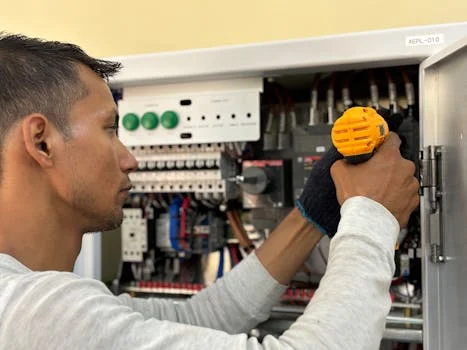
Integrating specific PLC ramp timings, such as a 5-second soft-start and a 30-second ramp-down, reduces the instantaneous torque load on drive chains by up to 60%. Most drum screens fail during the start/stop cycle due to the massive inertia of a fully loaded drum. By programming a 5-second ramp-up via a Variable Frequency Drive (VFD), the motor builds torque gradually, preventing chain "slap" and sprocket chipping. The 30-second ramp-down is even more critical, as it allows the drum to come to a controlled rest, minimizing the inertial shock on the gearbox teeth.
Control logic should also include a mandatory spray system interlock. The PLC should be programmed to delay the drum's rotation until the spray water pressure has reached at least 2 bar. This prevents "dry running," where captured solids are smeared into the screen mesh rather than being washed away, a leading cause of premature blinding. VFD settings should be optimized for a 30 Hz base operation for standard flows, with a programmed "cleaning boost" to 50 Hz for 2 minutes every 2 hours to clear stubborn debris.
Duty cycle optimization is a powerful tool for wear reduction. Instead of constant rotation, which wears out seals and bearings unnecessarily, implement a "20 minutes on / 10 minutes off" cycle if the influent flow allows. Field studies indicate that this duty cycle can reduce mechanical wear by up to 50% without compromising effluent quality. These control strategies are as vital to system health as industrial sand filter troubleshooting with downtime reduction data, as both rely on precise timing and pressure management.
Wear Component Inspection and Replacement Schedule
Predictive maintenance schedules for rotary screens center on bearing life cycles, which typically range between 18,000 and 25,000 operating hours depending on lubrication consistency. Using a high-quality ISO VG 220 grease is non-negotiable for industrial wastewater applications where moisture and fine grit are prevalent. Bearings should be greased every 500 operating hours, or as specified by the auto-lubrication system, to flush out contaminants that cause abrasive wear.
Seals are the most vulnerable wear component. In environments with high Total Suspended Solids (TSS >500 mg/L), seals should be inspected monthly and replaced every 12 months or 5,000 operating hours. A failing seal allows grit to enter the bearing housing or the drive assembly, leading to a cascade of mechanical failures. Screen panels themselves typically last 3–5 years, but if the TSS load is consistently high or contains abrasive sand, this lifespan can be reduced by 30%. Monthly inspections for chain elongation are also required; once a chain has stretched beyond 3% of its original length, it must be replaced to prevent sprocket damage.
| Component | Inspection Interval | Expected Lifespan | Maintenance Action |
|---|---|---|---|
| Main Bearings | Weekly (Aural/Thermal) | 18,000–25,000 Hours | ISO VG 220 Grease every 500 hrs |
| Drum Seals | Monthly | 12 Months / 5,000 Hours | Check for leakage/grit ingress |
| Screen Panels | Quarterly | 3–5 Years | Inspect for wire deformation |
| Drive Chain | Monthly | 10,000 Hours | Replace if elongation >3% |
| Spray Nozzles | Daily (Visual) | 2 Years | Acid soak if scale accumulates |
Frequently Asked Questions

What causes a rotary drum screen to vibrate excessively?Excessive vibration is usually caused by shaft misalignment (>0.05 mm/m), loose base mounting bolts (torque <450 Nm), or internal drum imbalance due to heavy solids accumulation. In rare cases, grout voids under the baseplate can cause harmonic resonance.
How do you align a rotary drum screen shaft?Use a laser alignment tool to measure the coupling between the motor/gearbox and the drum shaft. Adjust the motor shims until the vertical and horizontal angularity is within 0.05 mm/m. Ensure the drum is leveled to ±1.5 mm across its entire length.
Why is my drum screen clogging frequently?Clogging is typically caused by insufficient spray bar pressure (needs >3 bar) or blocked nozzles. It can also occur if the grease/oil concentration in the wastewater is high, requiring the addition of a hot water wash or chemical cleaning step to the spray cycle.
What is the ideal ramp-up time for a rotary drum screen motor?