Hollow fiber MBR working principle combines suspended-growth biology with immersed ultrafiltration. PVDF fibers (outer diameter 1.2–2.0 mm, pore size 0.05–0.4 μm) sit in a bioreactor at 8,000–12,000 mg/L MLSS. Aeration scours the fiber surface while a vacuum draws permeate at 15–30 LMH, routinely delivering 99.9% TSS removal and effluent COD <50 mg/L without a secondary clarifier.
Hollow Fiber MBR Working Principle in Four Process Steps
Immersed hollow-fiber trains draw permeate through straw-like PVDF walls at 0.1–0.5 bar TMP while coarse-bubble aeration at 0.5–1.0 m³/m²/h scours the fiber exterior. Industrial net flux is typically 15–30 LMH at 8,000–12,000 mg/L MLSS, yielding <1 mg/L TSS and <1 NTU when screening and CIP stay on design.
Step 1: Biological degradation. Mixed liquor is held at 8,000–12,000 mg/L MLSS so biomass can oxidize BOD/COD and support nitrifiers that wash out of low-SRT clarifier plants. According to EPA 2024 benchmarks cited in the source material, COD removal of 92–97% is common for influent COD from 50 to 500 mg/L. Most plants we size for food or pharma wastewater run toward the lower MLSS end until peak-load data prove otherwise.
Step 2: Membrane filtration. Permeate is pulled through 0.05–0.4 μm pores into the fiber lumen. Design TMP stays at 0.1–0.5 bar. The physical cut-off removes TSS and most bacteria, so sand filtration is usually unnecessary before reuse.
Step 3: Aeration scouring. Coarse bubbles at 0.5–1.0 m³/m²/h shake flexible fibers and limit cake buildup. Specific energy for hollow fiber trains is typically 0.3–0.6 kWh/m³—about 20–30% below many flat-sheet layouts that need more air per square meter.
Step 4: Backwash and recovery cleaning. Filtration pauses every 10–30 minutes for a 30–60 second backwash. Permeate, sometimes dosed with 200–500 ppm sodium hypochlorite, is reversed through the lumen. Every 3–6 months, citric acid or NaOH recovery cleaning removes scale or organic foulants that daily cycles cannot clear.
What does an MBR process flow look like?
An MBR process flow routes screened wastewater into an aerobic or A/A/O bioreactor, then through immersed hollow fiber modules to a permeate tank, with waste sludge withdrawn under SRT control. Fine screening at 1 mm sits upstream, and optional DAF or equalization is added when oil, grease, or load swings threaten flux. Unlike CAS, no secondary clarifier sits between biology and solids separation.
| Engineering Parameter | Standard Range (Industrial) | Unit |
|---|---|---|
| Pore Size | 0.05 – 0.4 | μm |
| MLSS Concentration | 8,000 – 12,000 | mg/L |
| Design Flux (Net) | 15 – 30 | LMH (L/m²/h) |
| Transmembrane Pressure (TMP) | 0.1 – 0.5 | bar |
| Aeration Scour Rate | 0.5 – 1.0 | m³/m²/h |
| Specific Energy Consumption | 0.3 – 0.6 | kWh/m³ |
| Fiber Outer Diameter | 1.2 – 2.0 | mm |
Why Industrial Plants Switch from Clarifiers to Hollow Fiber MBR
Industrial facilities adopt hollow fiber MBR to raise treatment capacity inside existing tanks while meeting tighter TSS and COD permits. A food plant in Shandong avoided a $2 million expansion by retrofitting existing tanks. It installed HydropureWater’s integrated MBR system with PVDF hollow fiber membranes, cutting footprint by about 60% and holding effluent COD below 50 mg/L. Gravity clarifiers struggle when high-strength organics drive sludge bulking and unstable TSS.
Permit drivers include China GB 18918-2002 Class 1A (TSS <10 mg/L, COD <50 mg/L), EU Directive 91/271/EEC, and pathogen limits referenced under EPA 40 CFR Part 503. Conventional effluent TSS often swings between 50 and 100 mg/L, so sand filters or UV become add-ons for reuse. Hollow fiber permeate typically stays <1 mg/L TSS and <1 NTU, which supports water reuse applications for MBR effluent such as cooling makeup and process rinse water.
Eliminating the secondary clarifier also lets operators run 8,000–12,000 mg/L MLSS instead of the 3,000–5,000 mg/L ceiling common in CAS. Higher biomass shrinks reactor volume and helps on complex streams, including some MBR applications for heavy metal wastewater after proper upstream metals removal. Packing density reaches 500–1,500 m²/m³—about 3–5× flat-sheet modules—so indoor retrofits stay compact.
Hollow Fiber vs. Flat Sheet MBR: Comparison Matrix for Industrial Use

Membrane geometry shapes 10-year total cost of ownership even when both formats meet the same turbidity target. Hollow fiber bundles pot thousands of flexible strands in epoxy and maximize area per tank volume. Flat sheets use rigid panels that resist ragging better but need more space and often more scour air.
| Parameter | Hollow Fiber MBR | Flat Sheet MBR | Notes |
|---|---|---|---|
| Packing Density | 500 – 1,500 m²/m³ | 100 – 300 m²/m³ | HF is 3-5x more compact |
| Flux Rate (Industrial) | 15 – 30 LMH | 10 – 25 LMH | HF typically handles higher flux |
| Energy Consumption | 0.3 – 0.6 kWh/m³ | 0.5 – 0.8 kWh/m³ | HF is 20-30% more efficient |
| CAPEX | $1,200 – $2,000/m³/d | $1,500 – $2,500/m³/d | HF has lower initial cost |
| OPEX | $0.20 – $0.40/m³ | $0.30 – $0.50/m³ | HF saves on energy/chemicals |
| Membrane Lifespan | 5 – 8 Years | 7 – 10 Years | FS is more mechanically robust |
| Cleaning Requirement | Frequent Backwash | Chemical Soak Only | HF requires automated backwash |
Selection checklist for membrane geometry:
- Choose hollow fiber when footprint, CAPEX, or energy dominate, wastewater is screened to <1 mm, and oil/grease stays moderate.
- Choose flat sheet when rags, hair, fibrous solids, viscous sludge, or oil/grease >500 mg/L are hard to remove upstream.
- Prefer flat sheet if the site cannot support automated backwash discipline and prefers soak-only cleaning.
How to Specify a Hollow Fiber MBR for Industrial Wastewater
Successful hollow fiber designs start from influent chemistry, peak flux, and cleaning chemistry—not brochure flux claims. The same discipline applies when the MBR sits inside a larger full integrated wastewater treatment plant design. Treat the immersed barrier as the plant’s ultrafiltration step; standalone polishing trains often use a separate Ultrafiltration (UF) Water Treatment System with similar pore ratings.
1. Define influent risks. If oil and grease exceed 500 mg/L, specify DAF pre-treatment for high-oil/grease wastewater before biology. Influent COD >2,000 mg/L often needs anaerobic/aerobic staging so organic fouling does not collapse flux within weeks.
2. Size net flux conservatively. Use Flux (LMH) = Daily flow (m³/day) / (Membrane area (m²) × 24 h) and target 15–25 LMH net for industrial wastewater. Designs that lock in 30+ LMH as normal operation usually repay the CAPEX cut with CIP chemicals and downtime.
3. Lock membrane polymer and warranty. PVDF remains the industrial default for 5–8 year service life and chemical tolerance, while PES can show higher clean-water flux but foul faster on many industrial matrices. Avoid PP when mixed liquor exceeds about 40°C.
| Selection Criteria | Requirement / Target | Risk Mitigation |
|---|---|---|
| Pre-treatment | 1 mm Fine Screen | Prevents fiber breakage/ragging |
| Peak Flux Ratio | < 1.2x Average Flux | Prevents pore clogging during surges |
| Membrane Warranty | Minimum 5 Years | Ensures vendor accountability for integrity |
| Fiber Breakage Rate | < 0.1% per year | Maintains effluent turbidity <1 NTU |
4. Build the ROI case on avoided units. Against $1,200–$2,000/m³/d CAPEX, credit deleted sand filters, lower sludge haul from long SRT, and reclaimed-water value. Compared with CAS plus tertiary treatment, many industrial projects show payback in 18–30 months when reuse credits are real.
Selection checklist (4–7 items):
- Confirm 1 mm fine screening upstream of the membranes.
- Map oil/grease load and peak-to-average flow ratio.
- Set net flux at 15–25 LMH for industrial duty.
- Require PVDF (or justified equal) with at least a 5-year warranty.
- Define a TMP alarm at 0.5 bar and written CIP recipes for NaOCl and citric acid.
- Assign sludge wasting setpoints that hold 8,000–12,000 mg/L MLSS.
How do you clean a hollow fiber MBR system?
Cleaning a hollow fiber MBR uses short permeate backwashes every 10–30 minutes, plus periodic chemical maintenance and recovery soaks. Maintenance doses often use 200–500 ppm sodium hypochlorite in the backwash line. Recovery cleaning every 3–6 months deploys citric acid for inorganic scale or NaOH for organic foulants, with soak times commonly 2–4 hours when TMP stays elevated after online cycles.
Vendor-specific sequences (including Koch-style hollow fiber recipes) still follow the same physics: keep fibers moving with scour air, reverse flow before cake densifies, and match chemistry to the foulant. Skip acid on pure organic fouling, and skip strong oxidant on carbonate-dominated scale.
Hollow Fiber MBR Troubleshooting: Five Failures and Fixes
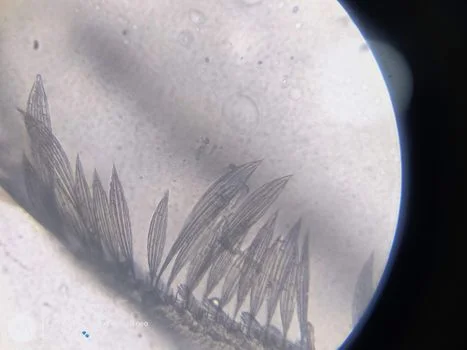
MBR downtime usually traces to fouling chemistry or mechanical stress, not a “lazy” clarifier blanket. Operators should treat TMP as the primary health signal and act before net flux falls below about 10 LMH.
Problem 1: Flux decline (<10 LMH). Causes include organic/inorganic fouling or MLSS >15,000 mg/L. Raise scour air toward 1.0 m³/m²/h, waste sludge to restore design MLSS, then CIP with NaOH for organic cakes.
Problem 2: Fiber breakage. Hair and rags that bypass screens wrap bundles and snap fibers. Install 1 mm fine screening to prevent fiber breakage, inspect potting yearly, and isolate modules if breakage exceeds about 1%.
Problem 3: Irreversible fouling. EPS or calcium carbonate lodged in pores survives normal backwash. Use citric acid near pH 2 for scale; dose 5–10 mg/L PAC or coagulant in the bioreactor to bind sticky polymers before they reach the membrane.
Problem 4: TMP >0.5 bar. A dense cake often remains after standard backwash. Increase backwash to every 10 minutes for 30 seconds; if TMP stays high, soak offline in 500 ppm sodium hypochlorite for 2–4 hours.
Problem 5: Permeate turbidity >1 NTU. Turbidity means a breached barrier. Apply a bubble-point check (ASTM D6908) with low-pressure air on the permeate side while submerged, then plug or replace leaking fibers immediately.
Who This Is For / Next Step
This guide is for plant engineers and EPC teams comparing hollow fiber versus flat sheet MBR on footprint, energy, and cleaning labor. Look elsewhere if you only need primary clarification or sludge thickening equipment without a membrane barrier. If your duty stream, peak flow, and oil/grease numbers are ready, request a sized proposal through our hollow fiber MBR inquiry form with influent COD, TSS, and required reuse quality.
Frequently Asked Questions
What is the lifespan of a hollow fiber MBR membrane?
PVDF hollow fiber membranes typically last 5–8 years in industrial service when screening, oil control, and CIP stay inside design limits. Lifespan shortens when free oils coat fibers, when pH swings below 2 or above 12, or when debris bypasses the 1 mm screen. Flat-sheet modules often reach 7–10 years because panels tolerate ragging better. They trade packing density and usually need more scour energy.
How much energy does a hollow fiber MBR system consume?
Specific energy commonly falls between 0.3 and 0.6 kWh per cubic meter of permeate under industrial flux and MLSS setpoints. Membrane scour blowers often account for 60–70% of that total, so diffuser layout and air cycling matter more than pump trim alone. Variable-frequency drives on blowers can cut roughly 15% during sustained low-flow periods when TMP remains stable.
Can hollow fiber MBR treat high-salinity wastewater?
Saline wastewater is treatable in hollow fiber MBR service, but sustainable flux often drops 30–50% when salinity exceeds about 10,000 mg/L as NaCl. Higher viscosity and poorer oxygen transfer force lower design LMH and salt-tolerant biomass selection. Confirm alpha-factor impacts on aeration power before locking blower sizing, and plan more frequent TMP reviews during the first months of operation.
What pre-treatment is mandatory for hollow fiber MBR?
A 1 mm fine screen is mandatory to limit ragging and fiber breakage on hollow fiber bundles. Free oils or fats above about 50 mg/L need DAF or an oil-water separator so the membrane surface does not blind. High peak-to-average flow ratios still need equalization even when screens and DAF are correctly sized, because flux spikes above 1.2× average accelerate pore plugging.
How often should hollow fiber MBR membranes be chemically cleaned?
Low-strength maintenance cleaning usually runs daily to weekly through the backwash line, while full recovery soaks are typically scheduled every 3–6 months. Exact intervals track organic loading, oil breakthrough, and how fast TMP climbs between CIP events. If TMP returns to baseline slowly after maintenance cleans, shorten the recovery interval rather than raising continuous flux to chase production.