Secondary treatment biologically removes 85–95 % of BOD and 85–90 % of TSS, producing effluent suitable for non‑sensitive discharge. Tertiary treatment further polishes water to <5 mg/L BOD and <1 mg/L TSS, removing nutrients and pathogens to meet strict reuse or environmental standards. The better option depends on your discharge limits and water reuse goals.
What Is Secondary Treatment and How Does It Work?
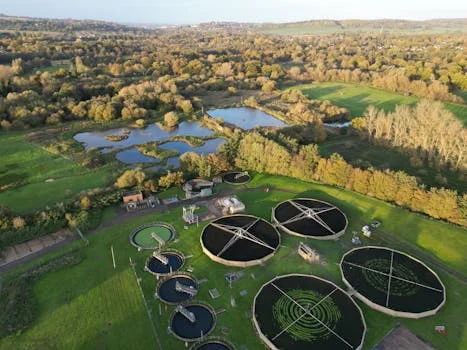
Secondary treatment achieves 85–95 % removal of Biochemical Oxygen Demand (BOD) and 85–90 % reduction of Total Suspended Solids (TSS) using microbial processes. The stage relies on aerobic or anaerobic microorganisms that metabolize organic matter, converting dissolved and colloidal pollutants into carbon dioxide, water, and cell mass. Common configurations include:
- Activated sludge: Suspended‑growth reactors where mixed liquor is aerated and settled in secondary clarifiers. Modern plants often operate at Sludge Retention Times (SRT) of 10–20 days to enhance nitrification, and can be upgraded with anoxic zones for partial denitrification.
- Membrane bioreactor (MBR): Combines activated sludge with micro‑filtration membranes for higher biomass concentration and compact footprint. MLSS can be maintained at 8–15 g/L, doubling the volumetric loading compared to conventional activated sludge.
- Trickling filters and bio‑towers: Fixed‑film systems where wastewater flows over media colonised by bio‑films. High‑rate plastic media achieve specific surface areas of 90–120 m²/m³, allowing BOD loadings up to 2 kg/m³·d.
- Oxidation ditches: Large, looped aerobic basins that provide long hydraulic retention times (18–36 h) and simultaneous nitrification–denitrification when operated in alternating aerobic/anoxic modes.
Performance data from EPA and EU guidelines show typical effluent concentrations of 20 mg/L BOD and 30 mg/L TSS after secondary treatment—sufficient for most municipal discharge permits but often inadequate for sensitive ecosystems or reuse applications. Secondary treatment's limitations highlight the need for further polishing in certain cases. For a deeper dive into advanced biological options, you can compare MBR and SBR systems for advanced biological treatment. In colder climates, operators often raise dissolved-oxygen set-points to 2.5–3 mg/L to offset reduced microbial activity at 10–12 °C, which can otherwise double effluent BOD.
What Is Tertiary Treatment and What Does It Remove?
Tertiary treatment lowers residual BOD to below 5 mg/L, nitrogen to ≤10 mg/L, and phosphorus to ≤1 mg/L while achieving up to 99 % pathogen removal. This stage targets pollutants that remain after secondary polishing, including nutrients, fine suspended solids, emerging contaminants, and microorganisms. Key technologies are:
- Filtration: Sand filters, cartridge filters, and high‑pressure membrane filtration (ultrafiltration or nanofiltration) to capture particles <0.5 µm. Dual‑media anthracite-sand filters operated at 5–10 m/h can reliably produce effluent TSS <2 mg/L without chemical addition.
- Nutrient removal: Biological denitrification, anammox, or chemical precipitation (e.g., alum, ferric chloride) to meet strict nitrogen and phosphorus limits. The anammox process converts NH₄-N and NO₂-N directly to N₂ with 60 % less aeration energy compared to conventional nitrification–denitrification.
- Disinfection: Ultraviolet (UV) irradiation, ozone, or chlorine dioxide; an on‑site ClO₂ generator for reliable tertiary disinfection is common in industrial settings. UV dose requirements for 4-log virus removal are 80–120 mJ/cm² depending on water quality.
- Advanced oxidation processes (AOPs): UV/H₂O₂ or ozone/H₂O₂ to degrade pharmaceuticals, micro‑plastics, and other emerging contaminants. AOPs can achieve >90 % removal of recalcitrant APIs such as carbamazepine when operated at 1–2 g/L H₂O₂ and UV fluence >1 kJ/m².
Typical tertiary effluent specifications are BOD <5 mg/L, TSS <1 mg/L, total nitrogen ≤10 mg/L, total phosphorus ≤1 mg/L, and >99 % pathogen inactivation. These levels satisfy the EU Urban Waste Water Directive 91/271/EEC, EPA National Pollutant Discharge Elimination System (NPDES) high‑purity limits, and many water‑reuse codes. Tertiary treatment enables further water reuse applications, such as reverse-osmosis to reduce total dissolved solids to <100 mg/L for boiler feed or indirect potable reuse.
Head-to-Head: Secondary vs Tertiary Treatment Comparison
The key differences between secondary and tertiary stages lie in effluent quality, nutrient removal, footprint, operational cost, and regulatory compliance. This comparison is crucial for determining the most suitable treatment level for specific applications.
| Parameter | Secondary Treatment | Tertiary Treatment |
|---|---|---|
| BOD (mg/L) | 15–20 (typical) | <5 |
| TSS (mg/L) | 30–50 (typical) | <1 |
| Ammonia‑N Removal | 10–30 % | >90 % (denitrification or anammox) |
| Phosphorus Removal | 15–25 % | >90 % (chemical precipitation or EBPR) |
| Pathogen Removal | ~70 % (settling & oxidation) | 99 %+ (UV, ozone, ClO₂) |
| Typical Footprint (m² per m³/d) | 20–40 | 10–20 (compact MBR or membrane‑based) |
| CAPEX Increase | Baseline | +40 % to +70 % (membranes, chemicals, disinfection) |
| OPEX Increase | Baseline | +30 % to +50 % (energy, chemicals, sludge handling) |
| Regulatory Fit | Meets basic EPA, WHO, and many municipal limits | Required for EU Urban Waste Water Directive 91/271/EEC, strict reuse codes, and high‑purity industrial permits |
For a regulatory perspective, see the 2025 EU industrial effluent limits and compliance technologies, which outline when tertiary polishing becomes a legal necessity. Some U.S. states have adopted numeric nutrient criteria (NNC) that cap TN at 3–4 mg/L and TP at 0.1–0.2 mg/L for discharge into nutrient-impaired watersheds—levels that require tertiary treatment.
When Is Tertiary Treatment Necessary?
Tertiary polishing is mandatory when local regulations or reuse objectives demand effluent quality beyond secondary treatment's capabilities. Typical trigger points include:
- Discharge to lakes, rivers, or coastal zones designated as “high ecological value” under EU Water Framework Directive or U.S. EPA Section 404(b) guidelines. For these waterbodies, effluent TP must often be <0.1 mg/L to prevent eutrophication.
- Industrial water‑reuse schemes such as irrigation, cooling‑tower makeup, or boiler feedwater, where BOD <5 mg/L and TSS <1 mg/L are stipulated. Cooling towers further require Legionella control, usually achieved via thermal shock or ClO₂ dosing at 0.3–0.5 mg/L residual.
- Sector‑specific standards for food‑processing, pharmaceuticals, and hospitals that require pathogen‑free effluent. FDA’s Food Safety Modernization Act (FSMA) mandates zero detectable fecal coliform per 100 mL for produce irrigation water.
- Contracts with municipal sewer systems that impose pre‑treatment limits tighter than generic municipal standards. Many Publicly Owned Treatment Works (POTWs) in California now impose TN and TP limits of 10 mg/L and 0.5 mg/L respectively for industrial dischargers.
Saudi Arabia’s 2025 industrial discharge limits (TSS ≤ 10 mg/L, COD ≤ 60 mg/L) can only be consistently achieved with a tertiary polishing step after secondary treatment. Similar trends are seen in Singapore, where NEWater reuse standards require UF-RO effluent with TOC <0.5 mg/L and conductivity <100 µS/cm.
How to Choose: A Decision Framework for Your Facility
A systematic decision framework matches plant requirements with the appropriate treatment level while controlling CAPEX and OPEX. The following steps guide the selection process:
- Step 1 – Verify discharge limits. List the most stringent parameters (BOD, TSS, NH₃‑N, TP). If any limit is below 10 mg/L, tertiary treatment is likely required. Use statistical percentiles (e.g., 95-percentile) rather than average values to ensure permit compliance during peak loads.
- Step 2 – Assess reuse potential. On‑site reuse for irrigation, cooling towers, or process water typically demands <5 mg/L BOD and pathogen‑free water. Conduct a water-balance audit to quantify potential savings.
- Step 3 – Estimate budget impact. Tertiary adds roughly 40–70 % to capital cost. Use a cost‑performance matrix to compare ROI against water‑saving benefits. Include avoided sewer surcharges and potential carbon credits for nutrient removal.
- Step 4 – Evaluate sludge and chemical handling. Secondary processes generate larger biomass volumes; tertiary units (e.g., membrane‑based) reduce sludge but introduce chemical residuals that must be managed.
- Step 5 – Choose technology package. For compact high‑purity needs, an integrated MBR system for high‑efficiency tertiary polishing is often optimal. Pair it with an on‑site ClO₂ generator for reliable tertiary disinfection when pathogen removal is critical.
This framework aligns technical performance with regulatory risk and total cost of ownership, enabling a data‑driven investment decision. Pilot testing at 0.5–1 % of full flow for 3–6 months is recommended to validate design assumptions under seasonal variability.
Frequently Asked Questions
Concise answers to common queries about secondary and tertiary wastewater treatment are provided below.
- What is the main difference between secondary and tertiary treatment? Secondary focuses on biological degradation of organic matter (BOD/TSS), while tertiary adds advanced steps to remove nutrients, pathogens, and emerging contaminants.
- Is tertiary treatment always necessary? No. It is required only when discharge limits, reuse goals, or ecosystem protection standards exceed secondary treatment's capabilities.
- Can secondary treatment alone meet industrial discharge standards? In many cases, yes—for general municipal permits. However, sectors with strict nutrient or pathogen limits often need tertiary polishing.
- What is the cost difference between secondary and tertiary systems? Capital expenses rise by 40–70 % and operating expenses by 30–50 % when adding tertiary processes.
- Which industries typically require tertiary wastewater treatment? Industries such as food & beverage, pharmaceuticals, hospitals, and high‑tech manufacturing usually adopt tertiary treatment. For a sector‑specific case study, see tertiary treatment solutions for healthcare facilities.