Why Semiconductor Wastewater Treatment Demands Specialized Solutions
Semiconductor manufacturing generates high wastewater volumes, with 2024 SEMI standards indicating a range of 2–10 m³ of wastewater per 300mm wafer produced. This effluent is not merely voluminous but highly complex, containing a cocktail of tetramethylammonium hydroxide (TMAH), isopropyl alcohol (IPA), fluoride, and heavy metals such as copper, nickel, and chromium. Fab managers often face frustration when standard municipal treatment systems fail to neutralize these specific compounds, leading to permit violations, exorbitant surcharges, and potential production shutdowns. As discharge limits tighten globally, the financial risk of non-compliance has become a primary operational threat.
Regulatory standards, specifically EPA 40 CFR Part 469 in the United States, strictly limit semiconductor manufacturing effluent, often requiring TMAH levels to be reduced to <1 mg/L and fluoride to <10 mg/L before discharge. In Europe, the Industrial Emissions Directive 2010/75/EU imposes similar constraints, focusing on the Best Available Techniques (BAT) for resource recovery. Beyond compliance, the drive for water reuse is fueled by the industry’s vulnerability to water scarcity. A 2023 case study of a 300mm fab in Taiwan demonstrated that implementing a Zero-Liquid Discharge (ZLD) system reduced wastewater disposal costs by 40% while insulating the facility against regional droughts (Gradiant data, 2023).
The operational risks of untreated discharge extend to groundwater contamination and irreversible damage to local biological treatment plants. TMAH, for instance, is highly toxic to the nitrifying bacteria used in municipal wastewater plants; a sudden slug of TMAH can "kill" a biological reactor, leading to immediate legal action against the fab. Consequently, modern semiconductor wastewater treatment solutions must transition from simple disposal to integrated resource recovery systems that stabilize the fab’s environmental footprint and bottom line.
Contaminant Profile: What’s in Semiconductor Wastewater and Why It Matters
Tetramethylammonium hydroxide (TMAH) remains one of the most challenging contaminants in semiconductor effluent due to its high toxicity to aquatic life at concentrations exceeding 1 mg/L (EPA 2024). Used primarily in photoresist development, TMAH presents a dual challenge: it is highly alkaline and resistant to conventional biological degradation unless specifically acclimated. In many fabs, influent TMAH concentrations range from 50 to 500 mg/L, requiring specialized advanced oxidation or targeted membrane processes to meet the <1 mg/L discharge threshold.
Isopropyl alcohol (IPA) is the primary organic solvent used for wafer cleaning and drying, typically appearing in concentrations between 100 and 1,000 mg/L. Because IPA is highly flammable and contributes significantly to Chemical Oxygen Demand (COD), it is a prime candidate for recovery. Technologies like Macro Porous Polymer Sorption (MPPS) have set industry benchmarks by achieving 95%+ IPA recovery, turning a waste stream into a reusable solvent. Heavy metals, including Cu, Ni, and Cr, result from etching and plating processes. These are regulated to levels as low as 0.1 mg/L under EPA 40 CFR Part 469, necessitating multi-stage removal processes such as chemical precipitation followed by electrocoagulation for heavy metal removal in semiconductor wastewater.
Fluoride management is equally critical, as hydrofluoric acid (HF) etching produces influent concentrations of 50–200 mg/L. To reach the required <10 mg/L effluent limit, fabs typically employ lime (calcium hydroxide) precipitation to form calcium fluoride (CaF2) sludge, followed by polishing via activated alumina or ion exchange. The table below summarizes typical influent profiles and the required reduction efficiencies for modern fabs.
| Contaminant | Typical Influent (mg/L) | Effluent Limit (mg/L) | Primary Removal Mechanism | Required Efficiency |
|---|---|---|---|---|
| TMAH | 50 – 500 | <1.0 | AOP / Specialized MBR | 99.8% – 99.9% |
| IPA | 100 – 1,000 | <20 | MPPS / Biological Treatment | 95% – 98% |
| Fluoride | 50 – 200 | <10.0 | Lime Precipitation / Adsorption | 90% – 95% |
| Heavy Metals (Cu, Ni) | 1 – 50 | <0.1 | Precipitation / Ion Exchange | 99% – 99.9% |
| Total Suspended Solids | 200 – 500 | <10 | DAF / Ultrafiltration | 95% – 98% |
Semiconductor Wastewater Treatment Technologies: How They Work and What They Remove
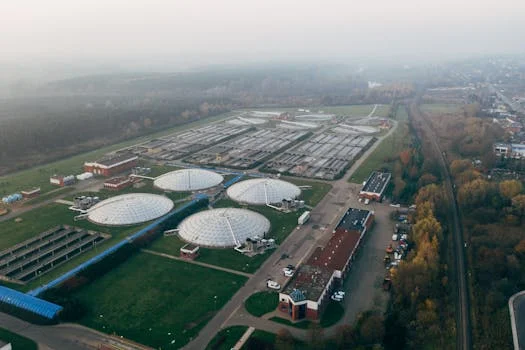
Dissolved Air Flotation (DAF) systems achieve 92–97% removal of total suspended solids (TSS) in semiconductor pre-treatment by utilizing micro-bubbles to buoy hydrophobic particles to the surface. A high-efficiency DAF system for semiconductor wastewater pre-treatment is particularly effective for removing Fats, Oils, and Grease (FOG) and suspended solids before the water reaches sensitive membrane stages. By operating with bubble sizes between 20–50 microns, DAF ensures that the downstream biological or membrane units are protected from fouling, significantly extending the lifecycle of more expensive components.
For organic removal and water reuse, the Membrane Bioreactor (MBR) has become a standard. A compact MBR system for semiconductor water reuse combines biological degradation with ultrafiltration (typically 0.1 μm pore size). MBRs are highly effective at treating TMAH and IPA, provided the biomass is properly seeded. They offer a significantly smaller footprint (up to 60% reduction) compared to conventional activated sludge systems and operate at energy consumption rates of 0.5–1.2 kWh/m³. The resulting permeate is often clear enough for direct feed into Reverse Osmosis (RO) systems.
Advanced polishing and ultrapure water (UPW) loops rely on an ultrapure RO system for semiconductor process water. These systems achieve 95–99% salt rejection and are essential for ZLD configurations. However, RO membranes are susceptible to fouling from trace organics; therefore, they are almost always preceded by AOP (Advanced Oxidation Processes) or MPPS. AOP uses UV/H₂O₂ or ozone to break down refractory organics like TMAH into simpler nitrogen compounds, while MPPS (Macro Porous Polymer Sorption) focuses on solvent recovery, capturing IPA through an adsorption-desorption cycle that is more energy-efficient than traditional distillation. For a deeper look at membrane performance, see how industrial RO systems achieve 99.5% contaminant removal.
| Technology | Target Contaminants | Removal Rate | Energy Use (kWh/m³) | Key Advantage |
|---|---|---|---|---|
| DAF | TSS, FOG, Metals | 90% – 97% | 0.1 – 0.3 | Excellent pre-treatment; low OPEX |
| MBR | COD, TMAH, IPA | 99%+ | 0.5 – 1.2 | High-quality effluent; small footprint |
| RO | TDS, Boron, Silica | 95% – 99% | 0.8 – 1.5 | Essential for water reuse/UPW |
| AOP (UV/H₂O₂) | TMAH, Refractory Organics | 99.9% | 1.5 – 3.0 | Complete mineralization of toxins |
| ZLD (Evap/Cryst) | All dissolved solids | 98%+ Recovery | 10.0 – 25.0 | Eliminates liquid discharge entirely |
Choosing the Right System: A Decision Framework for Semiconductor Fabs
Selecting a semiconductor wastewater system requires a multi-stage characterization of the waste stream, beginning with a mass balance of tetramethylammonium hydroxide (TMAH) and isopropyl alcohol (IPA) loads. Engineers should follow a structured decision framework to ensure the chosen technology balances CAPEX with long-term operational stability. The first step is Characterization: use ICP-MS for trace metal analysis and GC-MS for solvent identification. This data determines whether the primary goal is compliance-only discharge or high-value resource recovery.
The second step involves Goal Definition. If the fab is located in a region with high water costs or strict ZLD mandates, the framework shifts toward RO and evaporation. Conversely, if the fab has a high IPA load (>500 mg/L), a solvent recovery system like MPPS should be prioritized to offset OPEX. Step three is Technology Matching: for high-TSS streams, DAF is mandatory. For high-TMAH streams, an AOP unit must be integrated before any biological or membrane stage to prevent toxicity-induced system failure. The following decision matrix provides a starting point for technology selection based on contaminant profile.
| If your primary challenge is... | And your fab size is... | The recommended framework is... |
|---|---|---|
| High Fluoride (>100 mg/L) | Any | Two-stage Lime Precipitation + Polishing Adsorption |
| High IPA (>500 mg/L) | Large (>1000 m³/day) | MPPS (Recovery) + MBR (Polishing) |
| Strict TMAH Limits (<0.5 mg/L) | Any | AOP (Ozone/UV) + RO Polishing |
| Water Scarcity / High Disposal Cost | Medium-Large | MBR + RO + ZLD (Evaporator) |
| High Heavy Metal Load | Small-Medium | Electrocoagulation + DAF + Ion Exchange |
Finally, consider Scalability and Footprint. MBR systems are ideal for urban fabs where land is at a premium, as they eliminate the need for secondary clarifiers. For fabs planning future expansions, modular RO and DAF units allow for "pay-as-you-grow" capacity increases without over-investing in initial CAPEX.