Calgary’s Wastewater Treatment Landscape: Why Costs Are Rising in 2025
Wastewater treatment plant costs in Calgary in 2025 range from $750 million for municipal upgrades, such as the Bonnybrook Plant D expansion, to $250,000–$2 million for industrial and commercial systems. The City of Calgary’s expansion, funded through off-site levies and regional rates, is designed to serve 1.4 million people by 2026—up from 950,000 today. For private projects, package plants like MBR or DAF systems achieve 92–97% TSS removal at a cost of $1,200–$3,500 per m³/day of capacity, while custom systems for food processing or healthcare facilities can cost $5,000–$8,000 per m³/day. Regulatory requirements, including TSS below 18 mg/L, TP below 0.9 mg/L, and a new total nitrogen limit of 15 mg/L, are increasing capital and operational expenses.
Rising wastewater treatment costs in Calgary are driven by rapid population growth, stricter environmental regulations for the Bow River watershed, and the shift to a regional service model. The city’s primary infrastructure includes three major facilities: the Bonnybrook Wastewater Treatment Plant (WWTP) with a capacity of 1,258,000 equivalent population (EP), Fish Creek (176,000 EP), and Pine Creek (275,000 EP). With the regional population expected to reach 1.4 million by 2026, the city must expand capacity while meeting a new Total Nitrogen (TN) limit of 15 mg/L for the Bonnybrook Plant D expansion.
Historically, wastewater treatment costs in Calgary have increased with technological demands. In 1954, primary treatment expansions were significantly less expensive per EP than today’s systems, which require Biological Nutrient Removal (BNR) and UV disinfection. Current financing relies on off-site levies—where new developments pay a fixed fee per unit—and regional rates regulated by the Alberta Utilities Commission (AUC). Regional customers such as Airdrie and Cochrane pay volumetric fees to access Calgary’s infrastructure. Provincial grants, like the $12.9 million allocated to Wetaskiwin, reflect ongoing reliance on higher-level government funding for regional upgrades.
| Facility | Installed Capacity (EP) | 2025 Regulatory Focus | Primary Funding Source |
|---|---|---|---|
| Bonnybrook | 1,258,000 | TN < 15 mg/L, TSS < 18 mg/L | Off-site Levies & Regional Rates |
| Fish Creek | 176,000 | TP < 0.9 mg/L | Provincial Grants & Municipal Budget |
| Pine Creek | 275,000 | Secondary Treatment Optimization | Utility User Fees |
| Airdrie Tie-in | Catchment Area | Regional Connectivity | AUC Regulated Rates |
Municipal Wastewater Treatment Costs in Calgary: Bonnybrook, Fish Creek, and Beyond
The Bonnybrook Plant D expansion dominates municipal wastewater treatment costs, with a total projected cost of $750 million upon completion in 2026. As of late 2024, approximately $490 million has been spent. The project budget includes $120 million for Biological Nutrient Removal (BNR) facilities, $80 million for UV disinfection systems, and $65 million for secondary clarifiers. These expenditures support compliance with effluent limits of TSS below 18 mg/L and TP below 0.9 mg/L, based on City of Calgary engineering data from 2024.
Smaller municipal plants such as Fish Creek require $50–80 million in upgrades to meet Bow River phosphorus standards. Benchmarking against recent Alberta projects, including the $12.9 million grant to Wetaskiwin’s regional plant, indicates that regional upgrades cost $30–50 per capita for basic secondary treatment and rise to $200–300 per EP when BNR systems are needed. Operating expenses (OPEX) for Calgary facilities currently range from $0.85 to $1.10 per m³, allocated as follows: $0.40/m³ for energy, $0.25/m³ for chemical dosing to remove phosphorus, and $0.20–$0.45/m³ for labor and maintenance.
Regional connectivity also contributes to capital costs. Extending pipelines to connect Airdrie or Cochrane to Calgary’s system costs about $1.2 million per kilometer for a 12-inch force main, based on Alberta Infrastructure 2024 benchmarks. These costs are typically recovered through AUC-regulated regional rates, ensuring non-Calgary users contribute proportionally to the operation of the central Bonnybrook facility.
| Project Phase / Type | Estimated Cost | Engineering Specification | Cost Driver |
|---|---|---|---|
| Bonnybrook Plant D Total | $750,000,000 | 1.4M EP Capacity | Nutrient Removal (TN/TP) |
| BNR Infrastructure | $120,000,000 | 3-Stage Phased Anaerobic | Regulatory Nitrogen Limits |
| UV Disinfection | $80,000,000 | High-Intensity Low-Pressure | Pathogen Kill Rates |
| Force Main Extensions | $1.2M / km | 12-inch Ductile Iron | Distance to Catchment |
Industrial Wastewater Treatment Costs in Calgary: Food Processing, Petrochemicals, and More
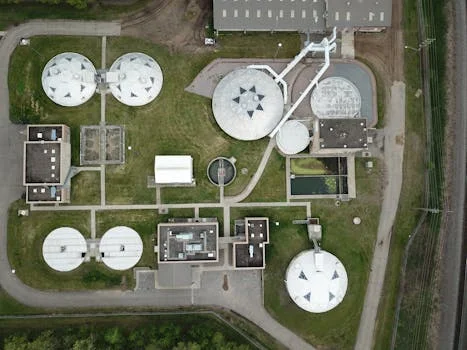
Industrial wastewater treatment costs in Calgary depend on the difference between raw effluent quality and the limits set by the City of Calgary Sewer Use Bylaw. For food processing facilities, CAPEX ranges from $1,500 to $3,500 per m³/day of capacity. High-strength wastewater from meat processing or dairies often requires DAF systems for industrial pre-treatment to remove fats, oils, grease (FOG), and total suspended solids (TSS) before discharge to the municipal sewer. A standard DAF unit handling 4–300 m³/h costs $80,000–$300,000, depending on automation level and material specifications such as SS304 or SS316.
Petrochemical and pharmaceutical facilities face higher costs due to recalcitrant organic compounds and elevated Chemical Oxygen Demand (COD). Custom systems for these industries can cost $5,000–$8,000 per m³/day. Many of these plants use compact MBR systems for high-quality effluent, which achieve 99% TSS removal and reduce COD significantly. Although MBR systems have higher CAPEX ($250,000–$1.2 million for 10–2,000 m³/day), their small footprint (0.5 m²/m³) makes them suitable for facilities with limited space.
Energy use is a major consideration in Alberta, where electricity prices in 2025 range from $0.12 to $0.18/kWh. MBR systems consume 0.8–1.2 kWh/m³, while DAF systems are more efficient at 0.3–0.5 kWh/m³. A Calgary food processor treating 200 m³/day could invest $950,000 in a combined DAF and MBR system to reduce TSS from 2,500 mg/L to under 12 mg/L, potentially saving over $120,000 annually in municipal over-strength surcharges (HydropureWater field data, 2025).
| Technology Type | CAPEX Range | Energy Use (kWh/m³) | TSS Removal Rate |
|---|---|---|---|
| DAF (Dissolved Air Flotation) | $80K – $300K | 0.3 – 0.5 | 85% – 95% (with coagulants) |
| MBR (Membrane Bioreactor) | $250K – $1.2M | 0.8 – 1.2 | 98% – 99.9% |
| Extended Aeration | $150K – $800K | 0.5 – 0.7 | 90% – 95% |
| SBR (Sequencing Batch Reactor) | $100K – $600K | 0.6 – 0.9 | 92% – 96% |
Commercial and Institutional Wastewater Treatment Costs: Hospitals, Hotels, and Campuses
Commercial and institutional projects in Calgary, including private hospitals, hotels, and remote campuses, often use decentralized treatment when municipal connections are too expensive. For these applications, WSZ series package plants for commercial use are standard, costing $25,000–$150,000 for flows of 1–80 m³/h. These systems are typically installed underground to reduce noise and maintain aesthetics, which is important in hospitality and healthcare settings.
Hospital wastewater requires specialized treatment due to pathogens and pharmaceutical residues. The compact medical wastewater system, priced at $50,000–$120,000 for 5–50 m³/day, uses ozone or high-dose UV disinfection to achieve a 99.99% pathogen kill rate, meeting Alberta Health Services standards such as fecal coliform below 200 MPN/100mL. For hotels and campuses, the choice is typically between extended aeration and MBR. Extended aeration is less expensive ($40,000–$200,000), but MBR is preferred for water reuse in irrigation, which reduces utility costs.
Commercial systems must also meet regulatory requirements from Alberta Environment and Protected Areas (AEPA), with approval costs of $10,000–$50,000 for engineering and filing. Calgary’s Sewer Use Bylaw imposes surcharges for any commercial discharge exceeding 350 mg/L TSS. A case study of a Calgary hotel treating 100 m³/day showed that a $120,000 investment in a WSZ package plant paid for itself in four years by avoiding surcharges and reducing water use through greywater recycling.
ROI Calculator: Should You Tie Into Calgary’s System or Build Your Own?
Choosing between a regional tie-in and on-site treatment requires a net present value (NPV) analysis. Tie-in costs include AUC-regulated rates ($0.80–$1.50/m³), off-site levies ($20,000–$50,000 per unit), and pipeline extensions at