Wrocław’s industrial wastewater treatment in 2025 demands compliance with EU Directive 91/271/EEC and Poland’s Water Law Act, with local discharge limits for COD (125 mg/L), BOD (25 mg/L), and TSS (35 mg/L). For food processing plants, Wrocław-optimized DAF systems for high-FOG industrial wastewater achieve 92–97% FOG removal, while MBR systems for pharmaceutical and textile reuse in Wrocław deliver near-reuse-quality effluent (<1 μm filtration) for pharmaceutical facilities. Costs range from PLN 2.5M for a 50 m³/h DAF system to PLN 12M for a 200 m³/h MBR plant, with ROI driven by sludge disposal savings (PLN 800–1,200/ton) and biogas revenue (PLN 0.45/kWh).
Wrocław’s Industrial Wastewater Challenge: Compliance, Costs, and Capacity
Wrocław’s industrial zones, including Nowa Wieś, Psie Pole, and Muchobór, generate approximately 45,000 m³/day of high-strength wastewater with Chemical Oxygen Demand (COD) often exceeding 2,000 mg/L. This volume places significant pressure on the municipal infrastructure, as the Janówek Wastewater Treatment Plant (WWTP) operates with a total capacity of 140,000 m³/day (per MPWiK data). Industrial plant managers face a twofold challenge: the municipal system requires rigorous pre-treatment for any industrial effluent, and the costs of non-compliance are escalating under the Polish Environmental Protection Law.
The industrial makeup of the Lower Silesian capital is dominated by food processing (38%), chemical manufacturing (22%), and pharmaceutical production (15%). These sectors produce effluent with drastically different profiles. A 2024 audit of a meat processing facility in Wrocław revealed Fats, Oils, and Grease (FOG) levels at 1,200 mg/L, which is four times the EU-recommended limit of 300 mg/L for sewer discharge. Such discrepancies lead to administrative fines ranging from PLN 50,000 to 500,000 per violation, depending on the severity and frequency of the breach.
Economic drivers are shifting toward on-site treatment. Sludge disposal costs in Wrocław have risen to PLN 800–1,200/ton in 2025, primarily due to stricter landfilling regulations and increased transport fuel costs. Implementing sludge dewatering solutions to cut Wrocław disposal costs by 70% is no longer an optional environmental upgrade but a financial necessity. The integration of biogas recovery in large-scale anaerobic systems offers a revenue stream of approximately PLN 0.45/kWh, partially offsetting the high energy demands of industrial pumping and aeration.
Wrocław’s Regulatory Landscape: EU Directives, Polish Law, and Local Limits
EU Directive 91/271/EEC mandates secondary treatment for all industrial discharges exceeding a population equivalent (PE) of 2,000, a threshold that most medium-to-large Wrocław facilities surpass. This European framework is transposed into local action via Poland’s Water Law Act, which received a critical update in 2023. The update introduced more stringent limits for nutrient discharge, particularly nitrogen (10 mg/L) and phosphorus (1 mg/L), to protect the Odra River basin from eutrophication. For facilities in Wrocław, these standards are enforced by the Voivodeship Inspectorate for Environmental Protection (WIOŚ).
Local discharge limits for Wrocław specify that industrial effluent entering the municipal sewer must be pre-treated to prevent damage to biological processes at the Janówek facility. While municipal limits are the baseline, sector-specific requirements add layers of complexity. Pharmaceutical plants must monitor heavy metals such as Chromium (< 0.5 mg/L) and Lead (< 0.1 mg/L), while textile manufacturers face strict color standards (< 50 Pt-Co units). Navigating the permit process for new discharges typically takes 6 to 12 months and requires an Environmental Impact Assessment (EIA) for any flow exceeding 10 m³/h.
| Parameter | Wrocław Local Limit (2025) | EU Directive 91/271/EEC | Typical Raw Industrial Effluent |
|---|---|---|---|
| COD (mg/L) | 125 | 125 | 1,500 – 5,000 |
| BOD5 (mg/L) | 25 | 25 | 800 – 2,500 |
| TSS (mg/L) | 35 | 35 | 500 – 2,000 |
| FOG (mg/L) | 300 (Pre-treatment) | N/A (Sector specific) | 500 – 1,500 |
| Total Nitrogen (mg/L) | 10 | 15 | 50 – 150 |
| Total Phosphorus (mg/L) | 1 | 2 | 10 – 30 |
Compliance involves regular reporting through the BDO (Database on Products and Packaging and Waste Management) system. Failure to accurately track sludge volumes or chemical usage can lead to immediate audits. Many facilities are adopting chlorine dioxide disinfection for Wrocław’s industrial effluent to manage microbial loads and prevent biofouling in discharge pipelines.
Treatment Process Deep Dive: DAF, MBR, and Sludge Dewatering for Wrocław’s Industries
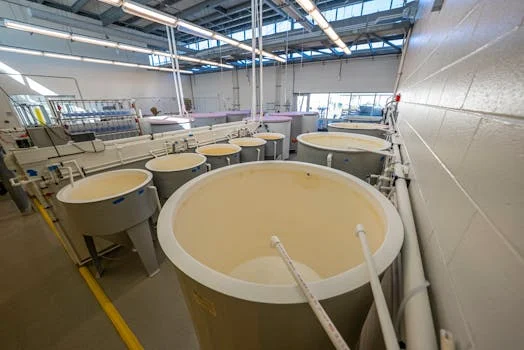
Dissolved Air Flotation (DAF) technology utilizing 30–50 μm micro-bubbles achieves 92–97% removal of Total Suspended Solids (TSS) and 85–95% of FOG in meat and dairy processing. The DAF equipment is engineered to handle flows from 4 to 300 m³/h, utilizing PLC-controlled chemical dosing to optimize coagulant and flocculant consumption. In Wrocław’s food sector, DAF serves as the primary defense against high organic loads that would otherwise overwhelm biological stages or incur heavy municipal surcharges.
For pharmaceutical and textile facilities requiring high-purity effluent for reuse, Membrane Bioreactor (MBR) systems provide a superior alternative to conventional clarifiers. Using PVDF flat-sheet membranes with a 0.1 μm pore size, MBR units achieve near-total pathogen removal and TSS levels below 1 mg/L. The DF series operates at a flux of 10–20 LMH (liters per square meter per hour), allowing for a 60% smaller footprint compared to traditional activated sludge plants. This is particularly advantageous for facilities in crowded industrial zones like Psie Pole where land availability is limited.
The final stage of any robust industrial system is sludge management. Plate-and-frame filter presses reduce the volume of biological and chemical sludge by up to 80%, producing a dry "cake" with solids content exceeding 30%. This drastic volume reduction is the primary driver for ROI, as it minimizes the number of waste transport trips required. Automatic models now integrate cloth washing and plate shifting, reducing labor requirements by 50% compared to manual legacy systems.
| Technology | Efficiency (TSS Removal) | Energy Use (kWh/m³) | Footprint (m²/m³/h) | Primary Industry |
|---|---|---|---|---|
| DAF | 92% – 97% | 0.2 – 0.4 | 0.5 – 1.5 | Food, Metalworking |
| MBR (DF Series) | > 99% | 0.6 – 1.2 | 0.3 – 0.8 | Pharma, Textile |
| Filter Press | Cake Solids > 30% | 0.1 – 0.3 | 0.2 – 0.5 | All (Sludge) |
When evaluating these technologies, engineers must consider the specific energy-to-removal ratio. While MBR has a higher energy demand (up to 1.2 kWh/m³), the ability to reuse treated water for non-potable process applications (saving PLN 3.50/m³ in freshwater costs) often justifies the operational expense. For more details on localized implementation, consult Poland’s 2025 sludge dewatering equipment guide.
Cost Benchmarks: Industrial Wastewater Treatment in Wrocław (2025 Data)
Capital expenditure (CAPEX) for a 50 m³/h DAF system in Wrocław currently ranges between PLN 2.5M and 4M, depending on the level of automation and material specifications (e.g., SS304 vs. SS316). For larger installations or high-complexity MBR plants (100–200 m³/h), costs can escalate to PLN 8M–15M. These figures include engineering, equipment procurement, and commissioning, but exclude civil works which typically add another 20–30% to the total project budget.
Operational expenditure (OPEX) is dominated by energy and chemical costs. In Wrocław, industrial electricity rates fluctuate, but an average energy cost of PLN 0.50–1.50 per cubic meter of treated water is standard for biological systems. Chemical costs for DAF, including polymers and pH adjusters, range from PLN 0.20 to 0.80/m³. For MBR systems, a significant OPEX component is membrane replacement, which should be amortized at PLN 0.15–0.30/m³ over a 5-to-7-year membrane lifespan.
| System Type | CAPEX (50 m³/h) | OPEX (per m³) | Estimated ROI |
|---|---|---|---|
| DAF Pre-treatment | PLN 2.5M – 3.5M | PLN 0.70 – 1.20 | 2.5 Years |
| Full MBR Plant | PLN 6.0M – 9.0M | PLN 1.50 – 2.50 | 4.0 Years |
| Sludge Dewatering | PLN 1.2M – 2.0M | PLN 0.30 – 0.60 | 2.8 Years |
The Return on Investment (ROI) is primarily accelerated by three factors: sludge disposal savings, biogas revenue, and water reuse. A dairy plant in the Wrocław outskirts recently reported a 65% reduction in disposal costs (saving PLN 450,000 annually) after installing a high-pressure plate-and-frame press. SMEs in Lower Silesia can access EU Cohesion Fund grants covering up to 80% of CAPEX, or low-interest loans (2–4%) from the Polish National Fund for Environmental Protection (NFOŚiGW).
Equipment Selection Framework: Matching Technology to Wrocław’s Industrial Needs
Selecting industrial wastewater equipment for Wrocław facilities requires a five-step engineering audit to ensure long-term compliance and operational stability. The