
Start with the wastewater profile and the final discharge route
Textile wastewater treatment in Nigeria requires a selection process based on contaminant profiles, flow variation, discharge routes, and sludge burdens rather than generic treatment packages. Nigerian baseline research found untreated factory effluent and linked pollutants such as free chlorine and toxic heavy metals to oxygen depletion in receiving waters. A Lagos study used triplicate samples per week over a 6-week period and examined 18 physicochemical parameters. These findings support starting with source control and sampling, then comparing a DAF-led route for suspended and colloidal material with biological treatment for soluble biodegradable load, followed by clarification and verified sludge handling.
Factory-specific production and flow data, wastewater analysis, and discharge requirements form the necessary foundation for any treatment design. Cogent Engineering’s Lagos study used triplicate samples per week over a 6-week period to assess textile-industry waste load and volume. It analysed 18 physicochemical parameters, including pH, colour, turbidity, suspended and dissolved solids, conductivity, dissolved oxygen, BOD, COD, chloride, nitrate, phosphate, some heavy metals, and odour. This documented pattern for a site assessment serves as a guide rather than a substitute for sampling the factory under its own operating conditions.
Ask the factory for the production schedule, measured influent flow, and the origin of each waste stream. Segregate sizing agents, dyes, bleaching chemicals, acids, alkalis, oils, and wash water where possible: mixing these streams can change both treatment demand and the chemicals required. Request laboratory results for raw wastewater from an accredited analyst, together with sampling points, dates, and operating conditions. Ask the authority responsible for the selected discharge route for the applicable Nigeria wastewater discharge criteria, or for reuse criteria if treated water will return to production.
Do not define the equipment duty until three inputs are connected: the untreated wastewater profile, the peak and production-related flow, and the legally or operationally required final effluent quality. A textile wastewater DAF pretreatment system may be relevant after testing, but its suitability depends on the solids, oil, grease, and colloidal characteristics of the actual effluent.
Match the dominant contaminant problem to the treatment route
Treatment routes must be chosen based on the dominant contaminant problem rather than the broad label of "textile wastewater." A Nigerian study reported that wastewater from the studied textile factories was untreated and that high pollutant loads were discharged daily. It specifically linked free chlorine and toxic heavy metals to rapid dissolved-oxygen depletion, described as oxygen sag, in receiving water. Untreated discharge therefore carries an environmental burden beyond simply meeting an equipment throughput target.
| Discharge route or influent problem | Governing rule or process option | What data settles it |
|---|---|---|
| High suspended solids, turbidity, oil, grease or colloidal material | Evaluate a dissolved air flotation system for physical separation; include pH adjustment and coagulation where testing shows they are required. | Representative TSS, turbidity, oil and grease results, along with particle characteristics and the measured influent flow. |
| Biodegradable soluble load requiring COD and BOD reduction | Evaluate biological treatment separately, or as the downstream stage after physical separation. | Influent and treated COD, BOD, dissolved oxygen, temperature and the biodegradable fraction reported by the laboratory. |
| Free chlorine, heavy metals or other contaminants that may inhibit biology | Investigate source control and contaminant-specific pretreatment before relying on biological treatment. | Source-by-source inventory, heavy-metal results, chlorine measurement and an assessment of the proposed pretreatment’s effect on biodegradability. |
| Final discharge to a receiving environment or sewer authority | Use the route-specific consent, permit or reuse requirement as the acceptance basis. | Written criteria from the relevant authority, including the receiving point, required parameters and applicable test methods. |
DAF-led and biological-led routes are not interchangeable, requiring a clear sequence based on the specific wastewater characteristics. If suspended and colloidal material dominates but the biodegradable load remains substantial, the defensible sequence is separation followed by biological treatment. If the wastewater is predominantly soluble and biodegradable, biological treatment may be central, with clarification still requiring evaluation. If toxic metals or residual free chlorine threaten biological activity, treatment cannot be selected from BOD and COD alone.
Keep source control separate from end-of-pipe treatment. Segregation, chemical inventory, production recovery, and reduction of wash-water losses can alter the wastewater to be treated. Evaluate a biological option such as an MBR biological treatment system against the measured wastewater and required effluent quality, rather than treating membrane selection as a substitute for source characterization.
Build the treatment train around separation, biology and sludge handling
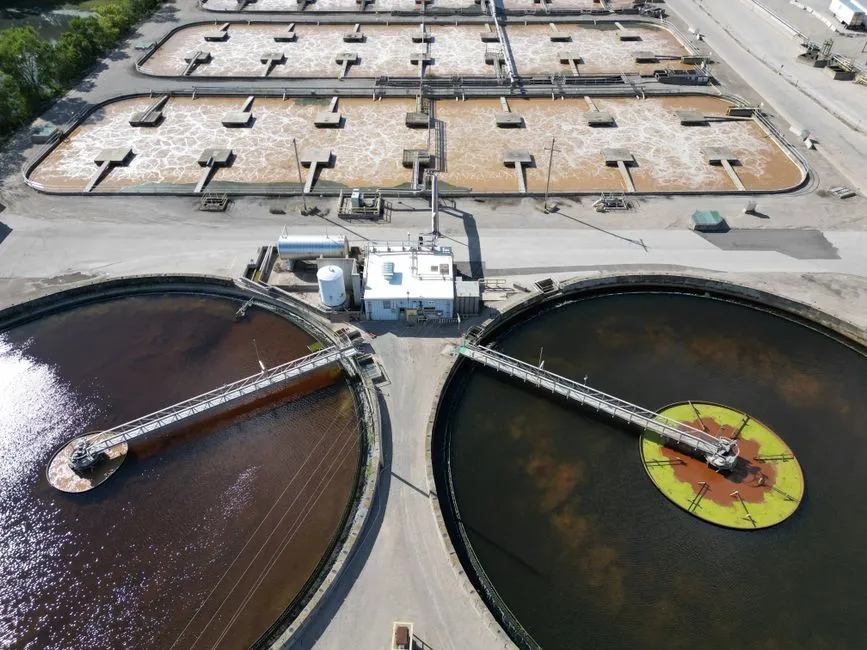
A defensible treatment train makes the physical, biological, and residual-management duties explicit. The 18-parameter assessment in the Lagos study included BOD, COD, dissolved oxygen, and suspended solids. That combination supports separating solids removal from biological treatment and prevents one unit from being credited with performance that belongs to another stage.
- Source segregation: identify where sizing agents, dyes, bleaching chemicals, acids, alkalis, oils, and wash water enter the drains.
- Equalisation and conditioning: assess flow variation and the need for pH adjustment before separation or biological treatment.
- Physical separation: evaluate DAF or another solids-removal stage against measured TSS, turbidity, oil, and grease.
- Biological treatment: size the biological stage from influent COD and BOD, with inhibitory contaminants addressed first.
- Clarification: define the solids separation required after biological treatment and before discharge or reuse.
- Sludge handling: include conditioning, collection, transport, dewatering, and the destination for the resulting cake or filtrate.
Effective sludge handling must be included in the preliminary equipment scope because it affects footprint, utilities, labour, disposal cost, and operating risk. A plate and frame filter press can be evaluated for textile sludge separation, but the supplier should define the sludge properties on which its selection is based and how filtrate will return to the treatment process. Also require the textile sludge filter press selection guide to be read against site data rather than used as a stand-alone equipment specification.
Use the textile wastewater equipment selection guide to interrogate the proposed sequence, but retain the Nigerian site’s wastewater analysis, discharge route, and utility constraints as the controlling inputs. The equipment list should state which stage removes each contaminant and where the resulting sludge goes.
Turn the selected route into a supplier-ready quotation
Price a complete treatment train with stated boundaries, not a collection of unit capacities. Require the supplier to provide a process flow diagram, equipment list, hydraulic calculations, chemical and sludge estimates, control philosophy, utility requirements, commissioning plan, and acceptance-test protocol. Each quoted item should identify its design influent, flow basis, duty cycle, treatment objective, and interface with the preceding and following stages.
Assign responsibilities before prices are compared. The factory supplies production schedules, flow records, wastewater-source information, and available footprint. An accredited laboratory supplies representative wastewater and treated-effluent results with documented methods. The relevant authority supplies the discharge or reuse criteria. The treatment supplier supplies equipment performance guarantees, operating documentation, training, and the verification protocol.
| Quote line item | Technical scope to specify | Red flags to check before signing |
|---|---|---|
| Inlet works and pretreatment | Screening, equalisation, pH adjustment, coagulation and DAF where included; state the design flow, influent TSS, turbidity and chemical dosing basis. | A quoted capacity without stated design influent, or omitted pH and coagulation scope that is necessary to achieve the stated separation. |
| Biological treatment and clarification | Define the biological stage, COD and BOD duty, aeration or membrane scope, solids separation, controls and treated-water outlet. | Biological performance promised without specifying COD, BOD, test method, loading basis or the dissolved-oxygen and inhibitory-contaminant conditions. |
| Sludge treatment | State sludge-generation basis, conditioning method, dewatering scope, cake handling, filtrate return and final disposal responsibility. | Sludge excluded from scope, or a filter-press selection based only on chamber volume rather than the supplier’s stated sludge properties. |
| Controls, utilities and operator training | List instruments, electrical requirements, compressed air, power, chemical storage, control narrative, manuals, training and spare-parts commitments. | Controls or utilities omitted, while the equipment list presents the plant as ready for the proposed operating condition. |
| Commissioning and acceptance | Require startup, performance testing, sampling plan, laboratory method, acceptance parameters, correction period and treatment of failures. | Compliance claimed from equipment capacity rather than tested treated effluent against the authority’s applicable criteria. |
| Commercial completeness | Define supply boundaries, installation, civil works, freight, taxes, commissioning, warranty, validation runs and performance obligations. | Unclear exclusions, an unqualified guarantee, or a quote that cannot be compared because capacity, influent duty and acceptance conditions differ. |
Do not treat a quoted capacity as proof of compliance. The supplier must define the design influent, duty cycle, treated-effluent parameters, and test method used to demonstrate performance. If the proposed limit or reuse target is not yet documented, request written confirmation from the relevant authority before accepting the guarantee.
Frequently Asked Questions
How much should textile wastewater treatment in Nigeria cost?
No defensible price can be stated without the factory’s measured flow and wastewater analysis. Request a priced bill of quantities separated into pretreatment, biological treatment, clarification, sludge dewatering, controls, utilities, civil interfaces, commissioning, training, and acceptance testing. Require the supplier to state the design influent and exclusions behind every price; otherwise quotations may not be comparable.
Should a Nigerian textile factory choose DAF or biological treatment?
Choose DAF-led treatment when testing shows that suspended solids, turbidity, oil, grease, or colloidal material is the dominant problem; use biological treatment for soluble biodegradable load. If both problems are material, evaluate separation followed by biological treatment. Ask the laboratory for COD, BOD, TSS, dissolved oxygen, and inhibitory-contaminant results before fixing the train.
Which site data should be collected before selecting industrial wastewater equipment?
Request the production schedule, peak and average influent flow, source-by-source waste inventory, wastewater laboratory results, final discharge route, applicable permit or reuse criteria, available footprint, and utility constraints. The Lagos study’s triplicate weekly sampling over a 6-week period provides a documented sampling pattern, but factory-specific data under representative production conditions should govern equipment selection.
How should a buyer evaluate a treatment supplier and its performance guarantee?
Check whether the supplier provides a process flow diagram, hydraulic calculations, design influent, equipment list, sludge estimate, utility demand, commissioning plan, and acceptance protocol. The guarantee must name the treated-effluent parameters, sampling method, operating condition, and test method. For equipment and scope comparisons, use the textile wastewater equipment selection guide as a structured review aid, not as a substitute for site-specific verification.