Confirm the Industrial Water Duty and Required Permeate
Selecting an industrial reverse osmosis water treatment system in Benin starts with the source water and intended use. RO uses pressure to force feedwater through a semi-permeable membrane, producing purified permeate while retaining dissolved solids and other contaminants in a reject stream. Veolia reports removal of over 99% of contaminants, including dissolved solids, organics, bacteria and pyrogens. A buyer should obtain a full feedwater analysis, define the required permeate quality and flow, select pretreatment, and specify commissioning, acceptance testing and reject-water handling before requesting a quotation.
Establish whether the project is for process-water production, wastewater reuse, boiler feed or another industrial duty. Veolia identifies pharmaceutical and healthcare, food and beverage, seawater desalination, process-water production and wastewater recovery among RO applications. These duties require specific permeate specifications, flow bases and compliance evidence.
Complete the following site-data fields before evaluating an industrial reverse osmosis water treatment system:
- Required permeate flow, operating hours and expected daily consumption.
- Process-water demand and the destination of any discharge or reuse stream.
- Future expansion requirements and the planning horizon.
- Permeate parameters required by the process, including how each will be measured.
- Applicable Benin discharge, reuse, food-safety or other sector-specific requirements.
Do not substitute the phrase “purified water” for a usable specification. State the parameters, acceptance tolerance, test method and responsible laboratory. For a wastewater-reuse project, also identify whether the permeate will enter a process, be reused within the site, or require further treatment before discharge.
Test the Feedwater Before Selecting the RO Train
The feedwater analysis determines membrane protection, pretreatment and whether a stated permeate recovery is credible. Request results for suspended solids, turbidity, hardness, dissolved solids, conductivity, organics, bacteria, pH and temperature. The sampling plan should identify the source, sampling point, sample preservation, date and laboratory, because a single result may not represent normal operating variation.
Match treatment to the identified risk. Suspended solids and colloidal matter point toward solids removal and filter protection; hardness and scaling constituents require a different assessment; organics or bacteria affect biological treatment, membrane fouling and disinfection requirements. Neither multi-media pretreatment for RO protection nor ultrafiltration should be assumed to solve every water-quality problem.
| Discharge route or influent problem | Governing rule or process option | What data settles it |
|---|---|---|
| Process water from a controlled source | Use the feed analysis to select filtration, antiscalant control and the RO configuration; the industrial RO system remains downstream of agreed pretreatment. | Source analysis, permeate specification, required flow, recovery target and future expansion. |
| Wastewater requiring biological treatment before RO | Route the flow through biological treatment and membrane clarification before selecting the final RO train. | COD, BOD, suspended solids, organics, pH, temperature and reuse or discharge destination. |
| Feedwater with suspended solids, turbidity or colloidal material | Evaluate multi-media filtration or ultrafiltration according to the particle-loading risk. | Suspended-solids and turbidity results, filtration duty and required pretreatment performance. |
| Hardness or other scaling constituents | Determine the need for hardness control before finalizing membrane materials and recovery. | Hardness, dissolved solids, conductivity, temperature and the proposed recovery. |
| Uncertain or variable source quality | Use source verification and operating controls rather than accepting a generic feed specification. | Sampling plan, historical operating data, source ownership and minimum and maximum feed conditions. |
Do not transfer figures from another source or jurisdiction into the Benin project. An academic landfill-leachate study in the Rabat-Salé-Kénitra Region reported COD of 3,850 mg/L and average nitrates of 56.6 mg/L. Those values characterize that studied leachate; they are not Beninese site values and cannot select the treatment route without local analysis.
Compare the Treatment Routes That Change the Equipment Choice

Matching the dominant contaminant and process objective to the required pretreatment dictates the treatment route. Use multi-media filtration where the design objective is suspended-solids, turbidity and colloidal-matter removal that protects downstream RO membranes. Use ultrafiltration when its specified separation function is needed for the feed and downstream membrane train; confirm the required outlet quality rather than treating it as a universal pretreatment choice.
Consider low-pressure RO only after the supplier evaluates feedwater quality, treatment objectives and system design. Fluence states that low-pressure membrane technology can reduce pumping energy when feed conditions allow, but not every application is suitable. The design should demonstrate that lower feed pressure can still meet the agreed permeate specification and recovery target.
For wastewater containing a biodegradable organic load, assess biological treatment before RO. The landfill-leachate study identifies aeration and reverse osmosis as monitored stages in its treatment approach. This case supports treating biological removal as a possible train component, but it does not establish that aeration is required for every Benin effluent.
Where biological treatment is selected, compare DAF equipment for solids separation and an integrated MBR wastewater treatment route against the actual treatment objective. Compare discharge, internal reuse and product recovery to identify whether the objective is clarification, biological treatment, membrane separation, water recovery or a combination.
Build a Quotation Scope with Site-Specific Responsibilities
A quotation should separate the complete treatment train from the site’s obligations. Require the supplier to state who performs source sampling and analysis, process design, equipment supply, civil works, electrical installation, mechanical installation, commissioning, training, initial spares and long-term maintenance. Otherwise, a priced equipment package can leave critical interfaces unallocated.
| Quote line item | Technical scope to specify | Red flags to check before signing |
|---|---|---|
| Site data and process design | Source sampling plan, feedwater analysis, permeate specification, flow, operating hours, recovery target and design basis. | The quotation assumes “typical” feedwater or omits the laboratory report used to size the equipment. |
| Pretreatment and RO equipment | Define each vessel, membrane, pump, control, instrument and treatment stage, including connections and materials. | Filtration is listed without a required outlet specification or RO-protection duty. |
| Installation and utilities | State the civil, electrical, drainage, incoming-water, permeate and reject connections; include power supply, footprint and operator-access requirements. | Installation, cabling, foundations or utility connections are excluded but shown as supplier activities elsewhere. |
| Acceptance guarantees | Specify the test feedwater, sample points, operating conditions, permeate parameters, recovery target, energy-consumption basis and test method for each guarantee. | “High-quality permeate” or “low energy use” appears without a measurable acceptance condition. |
| Reject-water handling | Require the reject quantity calculation, disposal assumptions, collection interface and any recycling option. Veolia states that RO contaminants are discharged through a reject stream that may be disposed of or recycled. | The route is unnamed, or the buyer assumes a discharge permission that has not been confirmed. |
| Resilience and operations | Define startup after interruption, source variability, cleaning, membrane replacement, spares and operator training. | No response is given to drought-affected source variation or interrupted power. |
| Post-delivery responsibility | Allocate defect correction, performance remediation, documentation, operator competency and continuing support. | Commissioning ends at shipment, or membrane cleaning and replacement costs are excluded without explanation. |
Include a site-specific resilience condition in the RFQ. Pure Aqua describes Benin’s drought hazard as occurring about once every 5 years. Do not treat that statement as a design flow or operating forecast; ask the supplier to explain how source variation, storage, pretreatment response and recovery assumptions affect the proposed train. Check treatment valves, media and related parts only after the process design establishes what is required.
Define Acceptance, Delivery and After-Sales Checks
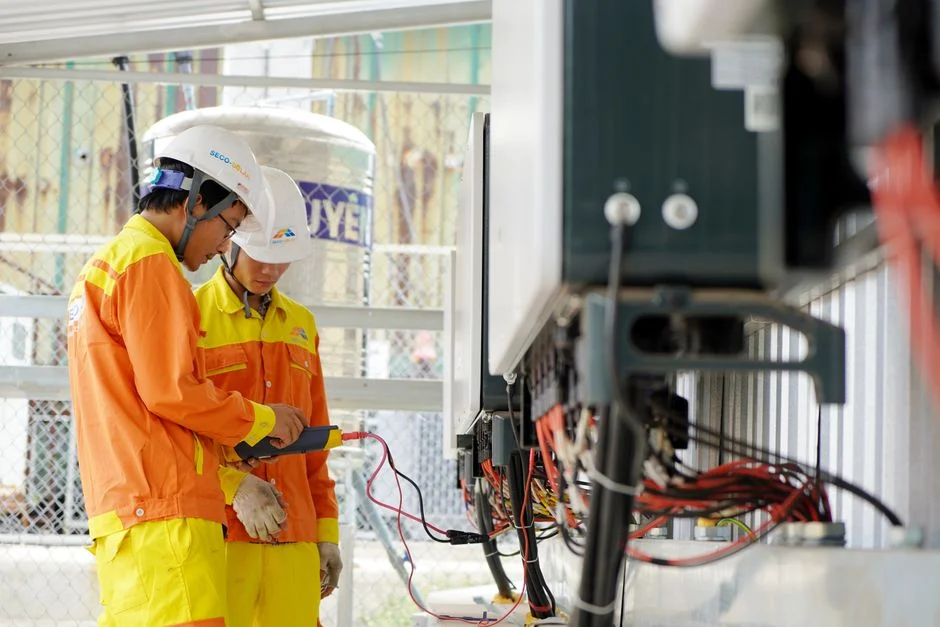
Define acceptance before the order by stating the test feedwater, sample points, operating conditions and measurement methods. Require separate acceptance items for permeate quality, product flow and RO permeate recovery; add energy consumption only if the supplier defines its measurement boundary and test procedure. The reject-water balance should also be documented so the recovery and disposal assumptions can be reconciled.
Confirm the delivery package: equipment dimensions, installation method, electrical supply, controls, inlet and outlet connections, required accessories, operator training, commissioning support and availability of spare membranes and filter elements. Veolia identifies integrated PLC control and self-cleaning as features of modern RO systems, but automatic functions do not replace an agreed operating procedure or operator training.
Make handover conditional on reviewed as-built documentation, operating instructions, test records, installed-equipment schedules, spare-parts lists and clearly assigned warranty and maintenance responsibilities. Require a written method for membrane cleaning, membrane replacement, permeate and reject sampling, alarm response and recovery after power or feed interruption.
Before comparing supplier quotations, use the structure in this industrial RO project selection and RFQ checklist, then adapt it to the Benin site data and the selected treatment train. For industrial effluent and reuse applications, also review industrial effluent treatment selection in Benin for the project-specific decision sequence.
Frequently Asked Questions
What feedwater analysis should the buyer provide before requesting an industrial RO quotation?
Provide suspended solids, turbidity, hardness, dissolved solids, conductivity, organics, bacteria, pH and temperature, together with the sampling method, source, sample date and laboratory. Also provide the required permeate flow, operating hours, permeate specification and recovery target because these inputs determine pretreatment and RO sizing.
When is low-pressure RO suitable for a Benin industrial water project?
Low-pressure RO is suitable only when feedwater characteristics, treatment objectives and system design permit lower feed pressure while maintaining the required water quality. Ask the supplier for a source-specific design basis showing how the selected membranes, pretreatment and operating conditions satisfy that condition; the presence of a low-pressure system in the catalogue is not itself a suitability demonstration.
What should be included in the acceptance test and handover scope?
Require a written test covering the agreed feedwater, sample points, operating conditions, permeate quality, product flow and RO permeate recovery, with an identified method for each measurement. Handover should include commissioning records, as-built documentation, operating instructions, training, spares, warranty responsibilities and procedures for cleaning and membrane replacement.
Which costs and supplier responsibilities must be separated in the RFQ?
Separate equipment, pretreatment, civil works, electrical installation, utility connections, commissioning, training, initial spares and continuing maintenance as distinct line items. Ask each supplier to price the same responsibilities and to disclose exclusions, reject-disposal assumptions, energy and recovery guarantees, delivery scope and post-commissioning support. No project-specific quotation is available in the research, so the buyer must request a price based on the completed site data and stated acceptance basis rather than rely on a generic budget figure.