Set the discharge route before selecting equipment
A hospital wastewater treatment and disinfection system for Congo must be selected based on the discharge route, hospital flow, influent characteristics, available footprint, and required pathogen control. Research cited in S4 found SARS-CoV-2 RNA in 35 of 42 influent samples, 2 of 18 secondary-treated effluent samples, and 0 of 12 tertiary-treated effluent samples. It also reports complete SARS-CoV inactivation after 30 min with more than 10 mg L−1 chlorine, equivalent to 0.4 mg L−1 free residual chlorine. These findings support multi-barrier treatment and validated disinfection, but they do not establish a Congo discharge limit. The project team must obtain the receiving route, permit requirements, flow, water analysis, footprint, utilities, and acceptance criteria before selecting or pricing equipment.
Classify the proposed outlet before comparing equipment. A municipal sewer connection may impose entry conditions set by the sewer authority; surface-water or groundwater discharge requires the responsible environmental authority and receiving-water assessment; onsite reuse requires a signed reuse basis and applicable water-quality criteria. No Congo-specific hospital effluent limit is established in the research available for this guide.
Request the applicable effluent limits, sampling method, monitoring frequency, discharge plan, sewer-entry conditions, and any reuse criteria directly from the project authority. The project engineer should also obtain the receiving-water sensitivity and the authority responsible for approving the final discharge route. This is the basis for the hospital wastewater treatment engineering guide for the West African context, adapted to the Congo site rather than treated as a local permit.
Do not assume that one treatment train applies to every outlet. A documented configuration described by S5 uses mechanical pretreatment followed by disinfection before discharge to the environment or sewer connection under local legislation. The same source notes that hospital wastewater may contain biological agents, pharmaceuticals, chemicals and, in some facilities, radioisotopes; the project waste profile must establish whether specialized containment or pretreatment is required.
Compare treatment and disinfection routes against site conditions
Choose the biological treatment route based on the waste profile and outlet, then add the disinfection barrier required by the governing discharge or reuse criteria. An A/O package is a candidate for a straightforward gravity route; an integrated MBR wastewater treatment system warrants comparison where membrane separation and a smaller treatment footprint are required; a medical wastewater package may suit smaller facilities. These are selection conditions, not a substitute for site data.
DAF should be considered only if representative samples show separated oil, grease or floatable material sufficient to justify that unit. A medical wastewater treatment system with multi-stage filtration and ozone disinfection may be relevant for a smaller clinic or medical facility; its catalogue description reports a footprint as small as 0.5 m². For hospital effluent disinfection, a chlorine dioxide generator for hospital effluent disinfection should be evaluated where on-site generation is appropriate; its catalogue states configurations from 50 g/h to 20,000 g/h.
| Discharge route or influent problem | Governing rule or process option | What data settles it |
|---|---|---|
| Connection to a municipal sewer | Mechanical pretreatment and biological treatment, with disinfection where the sewer authority requires it | Written sewer-entry limits, prohibited discharges, sampling requirements and connection conditions |
| Surface-water or groundwater discharge | Treatment and disinfection train governed by the environmental authority and receiving-water assessment | Permit criteria, discharge point, receiving-water information and signed discharge plan |
| Separated oil, grease or floatable material | Consider DAF or another solids-removal pre-treatment before biological treatment | Representative oil-and-grease and floatables analysis, with waste-source identification |
| Limited footprint or required membrane separation | Compare MBR with the A/O package and a smaller medical wastewater package | Available footprint, treatment objectives, flow profile, solids-removal duty and maintenance access |
S4 supports evaluating treatment and disinfection together: it describes hospital wastewater as a potential source of microbial pathogens and viruses and reports SARS-CoV-2 nucleic-acid signals in untreated, secondary-treated and tertiary-treated samples. Its stated inactivation condition is research context, not a guaranteed design specification for the Congo installation.
Size the system from measured flows and contaminants

Price the plant from documented flow and contaminant data, not hospital bed count alone. Request average daily flow, peak hourly flow, diurnal variation, current and projected bed occupancy, laundry and kitchen flows, and separate infectious-disease ward discharges. A supplier must state which flow governs each unit, how peak flow is handled, and what equalisation and solids-removal equipment are included.
Obtain COD, BOD, suspended solids, pH, oil and grease, temperature, conductivity, salinity where relevant, and microbiological indicators from representative operating samples. Sampling should distinguish ordinary ward wastewater from laundry, kitchen, laboratory and infectious-disease sources where their characteristics differ.
Require every missing analytical value to appear as a documented design assumption. The supplier should then identify how the assumption will be resolved through additional sampling, pilot testing or design review before contract award. For a smaller facility, the medical wastewater treatment system can be compared using the same flow and influent schedule; catalogue capacity cannot substitute for the project data.
Specify disinfection performance and monitoring
Define the disinfection barrier as a measured performance obligation. Ask bidders to identify whether the proposed barrier is chlorine-based, chlorine dioxide, ozone or UV, and to state the dose, contact time, reactor arrangement and monitoring basis for the selected route.
S4 reports complete SARS-CoV inactivation after 30 min of disinfection with more than 10 mg L−1 chlorine, equivalent to 0.4 mg L−1 free residual chlorine. The same study states that WHO and China CDC recommendations could not ensure complete SARS-CoV-2 deactivation. These findings support conservative design and validation, but the quoted condition must not be converted into a universal Congo design value or compliance claim.
Specify analytical or indicator tests, sample points, monitoring frequency, residual or dose instruments, alarm response and the evidence required for acceptance. For chlorine dioxide, require a site-specific explanation of safe generation, gas handling, chemical supply, residual monitoring and operator competence. Keep virus-monitoring studies separate from routine operating controls, and require qualified local verification before using a monitoring result as a discharge decision.
Build a quotation schedule and acceptance checklist
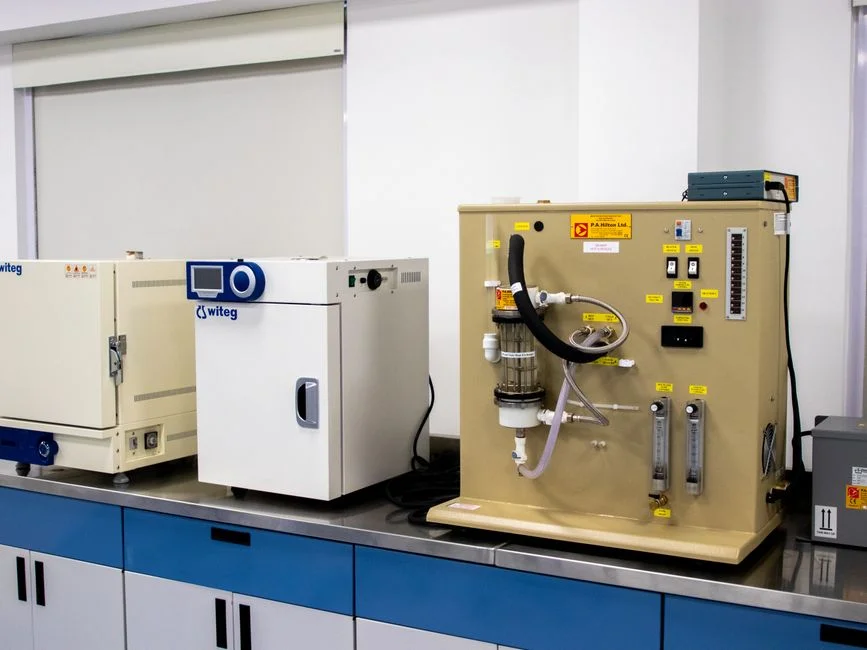
Use one common RFQ schedule so bids can be compared on the same engineering basis. The project engineer should ask the hospital authority to complete the discharge-route and site-data schedule before bidders develop a compliant offer. Include design flow, influent envelope, outlet criteria, treatment stages, disinfection, instrumentation, utilities, footprint, foundations, sludge handling, installation, commissioning, training and warranty.
| Quote line item | Technical scope to specify | Red flags to check before signing |
|---|---|---|
| Process design and treatment train | Design flow, influent limits, outlet criteria, treatment stages, flow equalisation and solids removal | Performance guarantee without an influent basis or omitted peak-flow duty |
| Disinfection system | Barrier type, dose, contact time, reactor, monitoring, alarms and acceptance tests | Generic compliance statement with no dose definition or sample points |
| Sludge and pre-treatment | Removed-solids generation, storage, dewatering or disposal route and operator interface | Sludge route omitted or waste disposal left without responsibility |
| Installation and civil interfaces | Foundations, access, power, drainage, connections, utilities, delivery and local permits | Civil works, power supply or permits unallocated between parties |
| Commissioning and commercial total | Testing, training, acceptance remedy, warranty, freight, duties, taxes, installation and operating-cost estimates | Quotation total does not separate charges, or failed-test remedy is undefined |
| Operations and spares | Operator requirements, maintenance plan, critical spares and local support | No local spare-parts strategy or operator-training scope |
Require bidders to state exclusions for site civil works, power, chemicals, waste disposal, permits, sampling, laboratory analysis and long-term staffing. Require the commercial total to separate equipment, freight, import duties and taxes where known, installation, commissioning, training and annual operating-cost estimates. Make award conditional on approval of the site data, discharge criteria, process guarantees, test methods and remedy for failed acceptance testing. For reference, the 30 m³/day hospital MBR case study can inform the RFQ structure, but its project flow must not be transferred to another hospital.
Frequently Asked Questions
What flow and wastewater data must a Congo hospital provide before selecting a treatment system?
Provide average daily flow, peak hourly flow, diurnal variation, current and projected occupancy, significant ward or ancillary flows, and representative results for COD, BOD, suspended solids, pH, oil and grease, temperature, conductivity, salinity where relevant, and microbiological indicators. Also provide the proposed discharge route, available footprint, power and utilities. Ask bidders to identify the governing flow for each unit and document every missing input.
When should a hospital choose MBR rather than an A/O package treatment plant?
Compare MBR when the required treatment performance, membrane separation or available footprint justifies the additional process and maintenance complexity. Compare the MBR versus package plant comparison for a regional hospital project, but base the decision on the Congo site’s outlet criteria, flow profile, solids loading, footprint and operating resources—not on the technology label alone.
Which disinfection acceptance tests should be included in the supplier quotation?
Require the supplier to specify the disinfection barrier, dose or intensity, contact time, reactor, sample points, monitoring instruments, analytical or indicator tests, acceptance values, test duration, repeat-test procedure and remedy for failure. Keep virus-monitoring claims separate from routine operating evidence and require qualified local verification before using monitoring results for a discharge decision.
What should procurement verify before accepting a performance and lifecycle-cost offer?
Verify that the offer states its design flow, influent envelope, outlet criteria, treatment stages, disinfection basis, utilities, footprint, civil interfaces, sludge route, commissioning tests and warranty. Require separate charges for equipment, freight, import duties and taxes where known, installation, commissioning, training and annual operating costs. A local-parts plan and a defined remedy for failed acceptance testing should also be required before award.