Start with Titusville's pretreatment approval
Petroleum plants near Titusville meet sewer pretreatment limits by first securing approval under the city’s Industrial Pretreatment Program and complying with Chapter 21 requirements. Industrial and commercial kitchen connections must contact the program before site, building, or business-tax approvals are issued. The plant then characterizes each wastewater stream, segregates hydrocarbon-bearing flows, removes free oil with an API separator or CPI, polishes emulsified oil and FOG with DAF, and adds biological or membrane treatment where the permit requires it. The final design must be verified against the current Titusville permit, pollutant limits, monitoring requirements, and slug-control provisions rather than generic petroleum-industry values.
The Titusville Public Works Industrial Pretreatment Program protects the public sewer by preventing hazardous contaminants and grease from entering it, while enforcing EPA, FDEP, and city requirements. According to the City of Titusville’s Industrial Pretreatment Program page, anyone discharging non-domestic wastewater or commercial kitchen wastewater to the Titusville sewer is subject to Chapter 21 restrictions and permit requirements. Industrial pretreatment is therefore a regulatory requirement for a covered discharge, not an optional treatment upgrade.
Before buying equipment, contact the program for the current discharge authorization form, applicable limits, monitoring and reporting schedule, slug-control requirements, and accepted analytical methods. The intake package should include process descriptions, wastewater sources, flow diagrams, available pollutant data, proposed treatment equipment, chemical use, monitoring points, and the responsible compliance contact. The city also states that industrial or commercial kitchen facilities seeking site or building permits and business tax receipts must contact the Pretreatment Program before those approvals are issued.
For the petroleum application, that package is the bridge between compliance and design. It establishes whether the discharge is subject to a non-domestic wastewater permit, what the POTW control mechanism requires, and which measured inputs must drive equipment sizing. The approach is similar to how industrial plants document pretreatment compliance, but Titusville’s Chapter 21 and issued control mechanism remain the controlling references.
| Pre-application item | What the engineer should provide | Decision enabled |
|---|---|---|
| Wastewater sources | Tank-bottom, loading drip, wash-rack, test-water, and drainage streams | Stream segregation and unit selection |
| Flow information | Average flow, peak flow, batch discharges, and equalization needs | Hydraulic and slug-control design |
| Pollutant data | Oil and grease, HEM or the locally specified parameter, TSS, pH, and identified petroleum constituents | Treatment objectives and permit comparison |
| Proposed controls | API, CPI, DAF, biological or MBR polishing, chemical addition, alarms, and sampling points | Control-mechanism and equipment review |
| Monitoring plan | Sampling locations, methods, frequency, flow measurement, reporting, and record retention | Auditable compliance program |
Separate federal rules from site-specific limits
EPA guidance explains the framework for pretreatment obligations, but it does not set the Titusville discharge limit for a particular petroleum plant. EPA’s Local Limits Development Guidance, published as an EPA document in 2015 and listed by EPA on 2021-06-25, states that obligations for indirect dischargers are determined by POTW-issued permits, equivalent control mechanisms, or regulatory requirements. The guidance expressly says it is not a regulation and that a permit or regulation controls in case of conflict.
EPA identifies three distinct layers: prohibited discharges, categorical standards, and local limits. A petroleum operation must therefore establish which layers apply without treating one as a substitute for another. Chapter 21 and the issued Titusville POTW control mechanism are the local references. Federal guidance remains useful for understanding why the POTW develops limits and how analytical and flow data are evaluated.
Do not adopt a commercial article’s typical values as local requirements. The supplied petroleum bulk-plant article, published by HydropureWater in 2026, describes typical 2026 permit ceilings of 100–200 mg/L HEM and approximately 250 mg/L TSS, but it also directs engineers to verify site-specific design values against current permits and influent testing. Those figures are examples, not evidence of Titusville’s limits.
Before final sizing, confirm the permit concentration limit, mass-loading limit, monitoring frequency, sample type, analytical method, reporting form, discharge prohibitions, and slug-discharge requirements. The approval package should map each requirement to a treatment objective, responsible operator, monitoring point, and record. That mapping is stronger than a general statement that the plant will “meet pretreatment limits.”
| Authority or information source | Role in the engineering basis | Action for the petroleum plant |
|---|---|---|
| Titusville Chapter 21 | Local pretreatment code restrictions and permit framework | Confirm the current applicable provisions |
| Issued POTW control mechanism | Site-specific limits, monitoring, reporting, and controls | Use as the controlling design and compliance document |
| EPA Local Limits Development Guidance | Technical framework for developing local limits | Use to understand the POTW basis, not as a permit |
| Applicable categorical standards | Technology-based requirements where applicable to the facility | Ask the control authority whether the operation is covered |
| Representative wastewater data | Site-specific contaminant loads and treatment performance | Collect before final equipment selection |
Map every petroleum wastewater stream

Petroleum wastewater treatment cannot be sized from a single sample or a generic plant profile. Evaluate tank-bottom water, API or coalescer dumps, truck and rail loading drip, vehicle wash-rack wastewater, hydrostatic-test water, and stormwater that contacts product-handling areas. The HydroPureWater petroleum bulk-plant guide, published in 2026, identifies these as the principal streams for a bulk plant; a refinery or storage terminal may have a different stream mix and must document its own.
Separate free oil, emulsified oil, and dissolved contaminants because the removal mechanisms differ. Gravity separation addresses free oil. Flotation addresses emulsified oil and floatable FOG. Biological or other advanced treatment may be required for dissolved organics, ammonia, sulfide, or other pollutants that physical treatment does not remove. A wash-rack stream containing detergents and a coalescer dump are not equivalent design loads merely because both enter the same sewer.
Collect representative samples before final sizing and document peak flow, average flow, slug conditions, oil loading, suspended solids, pH, and any petroleum constituents regulated by the current control mechanism. Include operating scenarios: tank drops, coalescer dumps, loading-area washdowns, and batch discharges. EPA’s Local Limits Development Guidance emphasizes review of analytical results and collection of flow data; it also identifies hauled waste among the industrial or commercial discharge sources evaluated during local-limits development. Confirm the authorization status of any hauled-waste proposal.
Do not use a daily average as the governing hydraulic event. A coalescer dump or tank drop can create a short, high-load discharge even when the daily mean is modest. The 2026 bulk-plant guide warns that a DAF alone can be overwhelmed by a free-oil slug because the oil blankets the bubble surface. Upstream separation, equalization, and controlled discharge are part of the basis of design, not operating add-ons.
| Stream or event | Primary characteristic to verify | Design implication |
|---|---|---|
| Tank-bottom water | Free oil, bottom solids, batch volume | Primary separator and controlled retention |
| API or coalescer dump | Free-oil slug and drain timing | Hydraulic peak, equalization, and slug controls |
| Truck or rail loading drip | Free-oil contribution and collection frequency | Segregation and primary oil removal |
| Vehicle wash-rack | Emulsified oil, detergents, suspended solids | DAF or equivalent flotation stage |
| Hydrostatic-test water | Product type, pH, and discharge volume | Characterization and disposal or treatment route |
| Product-area stormwater | Contact with product, oil loading, and runoff peak | Segregation and permit-based stormwater controls |
The DAF versus clarifier selection guide provides a useful secondary discussion of flotation duty, but the final selection must use petroleum wastewater and the Titusville control mechanism.
Build the treatment train in the right order
The defensible petroleum pretreatment sequence begins with source segregation, then free-oil removal, flotation polishing, justified advanced treatment where required, and controlled discharge. Keep hydrocarbon-contaminated streams separate from cleaner flows. Route product-area drainage to the approved treatment route rather than allowing it to dilute the strength of a mixed stream or create an unauthorized discharge path.
Use an API gravity separator or CPI as the primary free-oil stage. Follow with DAF for emulsified oil, FOG, colloidal solids, and remaining suspended material. The treatment sequence should reflect the stream characteristics established during characterization rather than treating every petroleum discharge as one homogeneous wastewater. For a DAF proposal, evaluate the DAF system for petroleum wastewater pretreatment against the measured hydraulic and contaminant loads.
HydropureWater’s 2026 petroleum-plant guide states that its DAF systems span 4–300 m³/h across 13 models and are designed for industrial removal of suspended solids, FOG, oil and grease, and colloidal matter. That range is a catalog capability, not proof that a particular unit is correctly sized. The selected model must match the plant’s peak flow, oil load, emulsion characteristics, treatment objective, and available footprint.
Where verified permit requirements include dissolved organics, ammonia, sulfide, or other pollutants that physical treatment cannot meet, add biological polishing or another justified process step. Consider an MBR membrane bioreactor for advanced wastewater polishing where membrane separation is required for solids containment or polishing. The supplied 2026 petroleum-plant article describes near-reuse-quality effluent below 1 μm and a footprint about 60% smaller than conventional systems. Verify those claims against the proposed duty, test conditions, and site constraints during vendor review.
Include equalization and controlled chemical addition where flow or pH swings could overload the train. The 2026 bulk-plant guide identifies automatic dosing for coagulants, flocculants, pH adjusters, and specialty chemicals, but the selected chemical and dose must be established through site wastewater testing and vendor process review. A further comparison of biological and physical treatment stages is available in the industrial COD treatment train comparison.
- Segregate contaminated and comparatively clean drainage.
- Remove free oil with an API separator or CPI.
- Polish emulsified oil, FOG, and suspended material with DAF or a justified alternative.
- Add biological or membrane treatment only for verified treatment objectives.
- Provide equalization, chemical control, alarms, and a controlled sewer connection.
- Verify the final proposal against current influent data and permit conditions.
| Stage | Primary duty | Sizing evidence required |
|---|---|---|
| Source segregation | Prevent unnecessary contaminant loading and separate approvals | Source map, drainage areas, and discharge routing |
| API or CPI | Primary free-oil removal | Peak flow, oil load, and manufacturer oil-removal duty |
| DAF | Emulsified oil, FOG, colloidal solids, and TSS polishing | Representative emulsion and solids testing plus hydraulic peak |
| Biological or MBR stage | Removal of dissolved or biodegradable pollutants where required | Permit objective, influent characterization, and treatment analysis |
| Equalization and controls | Limit slug and pH impacts | Batch-volume record, control narrative, alarms, and interlocks |
Prove compliance at the discharge point
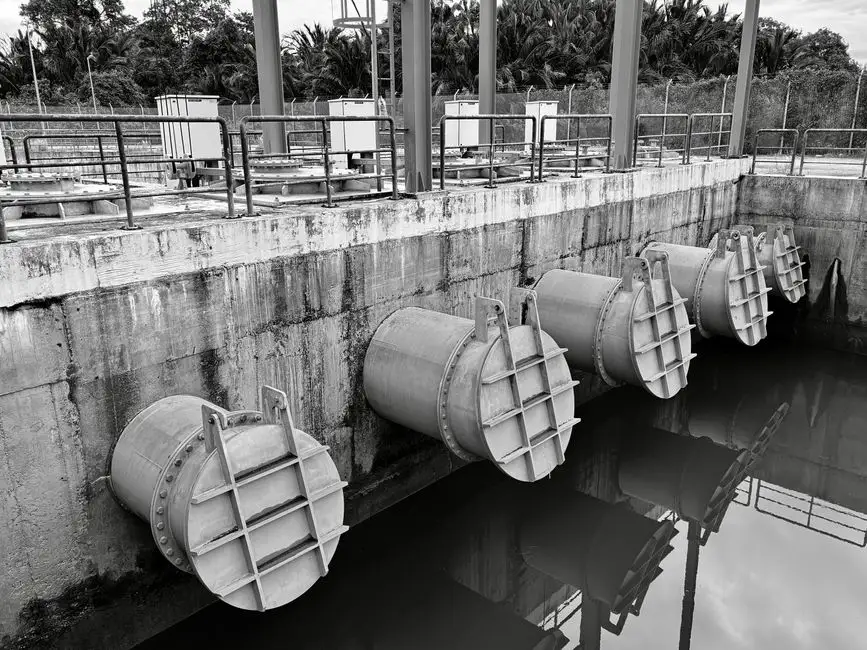
Compliance monitoring must follow the current Titusville control mechanism rather than a generic schedule borrowed from another jurisdiction. Confirm the required parameters, sample type, frequency, analytical method, reporting form, and any accelerated-monitoring or slug-discharge provisions. The monitoring point should represent the permitted discharge after the complete treatment train.
Make the sample location accessible, flow measurement defensible, and chain of custody documented. Identify whether the permit requires a grab, composite, or flow-proportional sample; establish the compositing period and flow record; and use analytical methods accepted by the Titusville control authority. Retain calibration logs so a concentration result can be evaluated as a mass loading when required.
The supplied 2026 bulk-plant article gives daily visual free-oil checks, weekly TSS grabs, and monthly HEM composites as an example of a petroleum-plant monitoring program. It also refers to flow-proportional composite sampling where specified. These are examples to verify, not Titusville requirements. The control mechanism controls.
Maintain an auditable file: operating records, flow-meter calibrations, laboratory reports, chain-of-custody forms, chemical-use records, equipment maintenance, BMP inspections, operator training, slug-response records, and corrective actions. EPA’s Local Limits Development Guidance emphasizes evaluation of analytical results and collection of flow data, supporting trend analysis rather than reliance on isolated concentration readings. A rising load at stable concentration may indicate increased plant loading or dilution changes that require investigation.
Connect the operating plan to slug control. Define what constitutes a slug, how it will be contained, when the discharge connection will be stopped, and how the plant will communicate with the control authority. The plan should address the actual petroleum events identified in the wastewater mapping, such as coalescer dumps, tank transitions, and batch discharges. Training records should show that operators understand those actions.
Choose equipment without relying on generic claims
The best-fit petroleum treatment system is the one that demonstrates the required oil-removal duty under conditions representative of the plant’s wastewater. Compare alternatives by free-oil handling, emulsion performance, peak hydraulic capacity, footprint, controls, maintainability, and compatibility with the existing treatment train. For a bulk plant, loading drip and tank-bottom streams may make upstream oil separation decisive; for a refinery, dissolved and biodegradable contaminants may make biological polishing central.
Require the supplier to define test conditions, demonstrate performance with representative wastewater, confirm electrical and site requirements, and provide complete operating, control, and maintenance documentation. A catalog capacity range does not establish treatment performance or compliance suitability. Ask how the proposed equipment responds to the measured free-oil slug, emulsified-oil load, pH range, and batch discharge.
Request written confirmation of sampling provisions, alarm interlocks, chemical-control strategy, available process data, and slug-control functions. Also make operator training, spare-parts availability, service capability, and delivery schedule part of the compliance-risk review. These are operating commitments, not procurement details. The DAF versus clarifier selection guide provides a broader framework for comparing flotation equipment.
| Procurement criterion | Supplier response required | Engineering reason |
|---|---|---|
| Petroleum wastewater performance | Defined conditions and representative-wastewater evidence | Prevents unsupported performance claims |
| Hydraulic fit | Peak-flow and batch-load review | Addresses slug and peak conditions |
| Treatment fit | Stage-by-stage mass-balance and objective | Confirms the train can meet permit conditions |
| Controls and monitoring | Alarms, interlocks, data outputs, and sampling provisions | Supports operations and compliance records |
| Site readiness | Electrical, footprint, utilities, and installation assumptions | Reduces installation and schedule risk |
| Lifecycle support | Training, maintenance, spares, and local service commitment | Reduces long-term operating risk |
Frequently Asked Questions
How should a petroleum plant near Titusville size a DAF system for pretreatment?
Size the DAF from representative wastewater testing, the measured peak hydraulic condition, and the permit-derived treatment objective—not from a catalog range. The calculation must include emulsion and solids loading, upstream free-oil removal, and expected batch discharges. Confirm the final capacity with the manufacturer against current influent data and the Titusville control mechanism.
What information should an equipment supplier receive before quoting DAF or MBR equipment?
Provide wastewater sources, flow records, representative analytical results, the current control mechanism, proposed treatment objectives, site constraints, and chemical requirements. Require the supplier to state its test conditions, identify treatment assumptions, and define how the proposed unit handles the site’s peak and slug conditions.
How much does industrial pretreatment equipment cost for a petroleum plant near Titusville?
The supplied research does not provide a Titusville equipment quotation, so a defensible price cannot be stated. Request a scope-based quote that separates equipment, foundations and piping, electrical and controls, chemical storage, installation, training, commissioning, and permit-related monitoring. Provide the same design basis to each bidder so prices remain comparable.
Can a petroleum plant begin sewer-discharge design before receiving Titusville pretreatment approval?
Begin preliminary characterization and develop alternative treatment concepts, but do not use an assumed permit limit as the final design basis. Contact the Industrial Pretreatment Program for current limits and authorization requirements, then reconcile the design with Chapter 21 and the issued POTW control mechanism before approving equipment or discharge routing.
What are the biggest compliance risks when monitoring petroleum wastewater before discharge?
The main risks are an unrepresentative sample, an incorrect sample type or frequency, unreliable flow data, an unverified analytical method, and inadequate slug-control records. Reduce those risks by using accessible monitoring points, calibrated flow measurement, documented chain of custody, accepted methods, trend review, operator training, and a written corrective-action process tied to the current control mechanism.