Start with the factory wastewater, not the equipment catalogue
A factory in Paris needs an industrial ETP or DAF system based on its actual wastewater, not a standard package. DAF is usually most relevant when the effluent contains suspended solids, FOG, oil and grease, or colloidal material that must be removed before biological treatment. In a refinery ETP, for example, DAF can protect downstream biological reactors from emulsified oil. A complete ETP may also require primary treatment, aerobic or anaerobic biological treatment, and tertiary treatment. Selection should use representative wastewater tests, average and peak flow, discharge or reuse targets, chemical demand and sludge-handling needs.
Start by assembling a wastewater evidence file. Request samples during normal production, cleaning, wash-down and shutdown conditions, rather than relying on one laboratory bottle. The analysis should cover flow, suspended solids, FOG, oil and grease, pH and the contaminants relevant to the factory sector. A sampling plan should also identify whether streams are segregated or combined; dilution at the inlet can conceal the treatment duty created by a concentrated wash stream.
Record average flow, peak flow, operating hours and the production schedule. A daily average may conceal the hydraulic load experienced during a batch discharge. The industrial wastewater treatment sizing guide provides a framework for separating flow and loading questions during equipment review.
| Evidence item | What the factory should provide | Selection question it answers |
|---|---|---|
| Representative analyses | Suspended solids, FOG, oil and grease, pH and sector-specific contaminants across operating conditions | Which pollutants must be removed, and which process barriers are required? |
| Flow records | Average flow, peak flow, operating hours, batch discharges and wash-water surges | What hydraulic and operating duty must the train handle? |
| Water destination | Discharge, production reuse, cooling or cleaning use, or discharge to an industrial-wastewater sewer | What final-water specification and treatment intensity apply? |
| Variable streams | Emulsified oil, solvents, high-pH cleaning chemicals and variable wash water | Is biological treatment protected by adequate pretreatment? |
Define the final-water objective before selecting equipment. A sewer-discharge design must be tied to the current permit and receiving-authority requirements; a reuse project needs the process constraints of its intended service. Also identify potentially inhibitory streams. Quora’s refinery ETP discussion states that emulsified oil can interfere with oxygen transfer and damage the microbial colony in downstream biological reactors (OpenBlueprint, July 15). That is a reason to investigate pretreatment, not a basis for assuming that every factory has the same oil problem.
Choose the treatment train that matches the pollutants
Primary physical and chemical treatment, biological treatment and flotation have different roles. Quora describes primary treatment as the use of physical methods for settleable material, followed by chemical treatment for pH control and flocculation; biological treatment can then address biodegradable organic load under aerobic or anaerobic conditions (OpenBlueprint, July 15). Tertiary treatment is a separate final-cleaning stage rather than an automatic part of the flotation stage.
Use DAF when the objective is to remove suspended solids, FOG, oil and grease, or colloidal material. The supplied product catalogue covers 13 standard industrial DAF system models with capacities from 4 to 300 m³/h. That range is a catalogue selection envelope, not proof that any model is suitable for a Paris factory; the bidder must demonstrate how its selected model meets the project’s flow, loading and treatment objectives.
In a refinery ETP, DAF has a defined placement: it can follow an API separator and precede biological reactors. The API separator removes free oil and heavy sediment; DAF then captures remaining emulsified oil and fine solids before they reach the biological stage (OpenBlueprint, July 15). This sequence protects downstream biology, but it does not replace the need to test the factory’s own wastewater.
Where a factory requires compact biological treatment or reuse, an MBR configuration may be relevant. The supplied catalogue describes an MBR configuration combining activated sludge with submerged PVDF membrane filtration, available from 10 to 2,000 m³/day, with filtration below 1 μm. The integrated MBR treatment system should be assessed against the required reuse specification, wastewater characteristics and operating conditions.
Disinfection is a separate decision. The supplied catalogue lists a chlorine dioxide generator range from 50 g/h to 20,000 g/h for microbial control in industrial wastewater applications; the relevant chlorine dioxide generator configuration must be selected against the validated treatment objective rather than added automatically.
| Treatment route | Primary role | Decision condition | Main engineering check |
|---|---|---|---|
| Physical and chemical pretreatment | Remove settleable material and support pH or flocculation control | Suspended material or chemical conditioning must be managed before the next stage | Separation duty, chemical demand and resulting sludge |
| DAF | Remove suspended solids, FOG, oil and grease, and colloidal matter | Floatable pollutants are present or downstream biological treatment needs protection | Peak flow, contaminant loading, coagulation, froth removal and sludge handling |
| Biological treatment | Remove biodegradable organic load | Organic load is biodegradable and the effluent has been made biologically compatible | Inhibitors, aeration or gas demand, sludge production and final-water quality |
| MBR | Combine activated sludge with membrane filtration | Compact biological treatment and a stringent solids-separation or reuse objective require evaluation | Filtration claim, design flow, membrane fouling, controls and maintenance |
| Tertiary treatment or disinfection | Provide final water-quality control | The discharge or reuse specification requires additional treatment | Validated final-water target and independent performance test |
The practical sequence is therefore: establish the pollutants; identify inhibitory streams; protect biological treatment; establish the biological stage where organic load requires it; then define tertiary treatment, reuse treatment and disinfection. DAF alone is credible only when the required final result and complete contaminant removal can be demonstrated without an additional biological or polishing stage.
Understand how DAF performs inside an industrial ETP
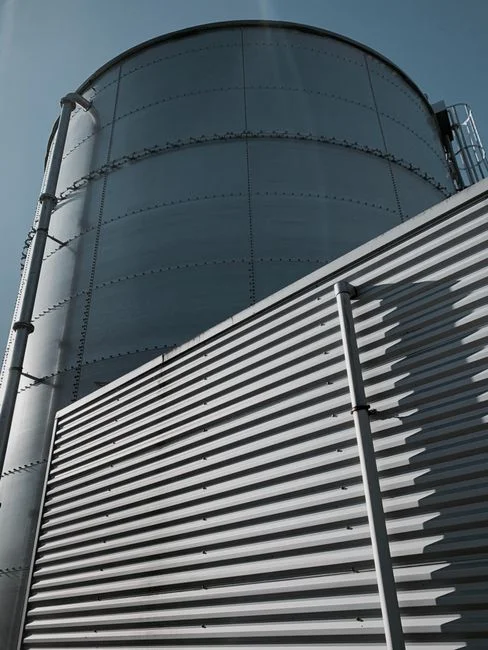
DAF separates suspended and oily material by attaching small air bubbles to particles so they rise to the surface. A portion of clarified effluent is pressurized and saturated with air before returning to the flotation tank; the pressure drop creates microbubbles that attach to suspended solids and tiny oil droplets (OpenBlueprint, July 15). The same source reports typical DAF microbubble diameters of 10–100 microns.
Inside the tank, the floated material forms froth and sludge. A mechanical skimmer removes this layer and transfers it to a sludge holding area, while clarified water leaves below an overflow weir (OpenBlueprint, July 15). This explains why the flotation tank, recycle circuit, pressurisation system, skimmer and sludge route must be evaluated together; a nominal flow figure alone does not describe performance.
Coagulation and flocculation may be needed to destabilize emulsions before flotation. The refinery example describes chemical coagulants being used to break the stability of emulsified oil before DAF removes the released oil and fine solids (OpenBlueprint, July 15). Chemical selection should therefore follow jar or pilot testing with the factory’s samples. A generic dosing rate is not defensible when the emulsion chemistry, pH, oil content and solids vary by production condition.
Controls determine how consistently the process is maintained. An automatic chemical dosing skid can meter coagulants, flocculants, pH adjusters and specialty chemicals from a pre-wired, factory-tested skid, according to the supplied product catalogue. The tender should still identify the chemical, dose-control signal, storage arrangement, duty sequence, fail-safe response and operator interface.
Use the DAF system specifications and selection criteria to question solids-loading data, hydraulic loading, recycle flow, air supply, materials, controls, tank access and test methods. Any performance claim should be linked to a stated influent condition and acceptance method. A guarantee expressed without the required influent quality is not useful for comparison.
DAF has one primary role in this treatment train: it removes material that can be floated or destabilized for flotation. It does not, by itself, establish biological compatibility, final reuse quality, disinfection performance or compliant sludge handling. Those functions need separate process and equipment definitions.
Size the system around loads as well as flow
Hydraulic capacity and contaminant load are separate sizing questions. A unit can handle the selected flow rate while remaining undersized for suspended solids, FOG, oil and grease, or colloidal solids. The design basis must state the wastewater characteristics, pollutant concentrations, treatment objective and operating envelope; a peak flow without a loading basis is incomplete.
Ask bidders to identify the selected DAF model and explain how it corresponds to the catalogue range of 4–300 m³/h across 13 standard models. They should also state average flow, peak flow, operating hours, equalisation assumptions, recycle arrangement and performance criteria. These are the inputs used in the 2026 DAF selection and cost framework.
Where clarification is used, the supplied catalogue lists surface loading rates of 20–40 m/h for the lamella clarifier and states that chemical consumption can be up to 30% lower. Those are catalogue figures, not guaranteed project outcomes. Require the bidder to reconcile them with the actual wastewater, tank geometry, duty and design basis. The relevant high-efficiency sedimentation tank should be assessed as a treatment component, not treated as a substitute for checking the complete ETP.
| Sizing input | Minimum information to request | Why it affects selection |
|---|---|---|
| Hydraulic duty | Average flow, peak flow, operating hours, batch sequence and equalisation | Sets vessel volume, pumping, recycle and treatment time |
| Pollutant duty | Suspended solids, FOG, oil and grease, colloids and relevant sector contaminants | Determines whether flow capacity alone is adequate |
| Treatment objective | Discharge, reuse, cooling, cleaning or sewer-discharge specification | Defines the required treatment train and final tests |
| Chemicals | Proposed chemicals, test basis, expected consumption, storage and safety requirements | Connects coagulation and flocculation to operating cost and sludge |
| Sludge | Expected generation, characteristics, thickening, storage, conveying and disposal route | Prevents the flotation stage from becoming an unresolved handling duty |
| Installation and operation | Footprint, utilities, access, odour control, drains, maintenance and spares | Determines deliverability and whole-life operating requirements |
Include downstream sludge generation, chemical inventory, operator access, odour control and maintenance access in the sizing discussion. The sludge route is especially important for sticky, fibrous or oily residues; a supplier should identify the assumed sludge characteristics and the interface with any conveying system. A commercial France-focused sludge-conveying post from Dynemix India, published August 27, identifies dewatered and sticky sludge, fibrous residuals and enclosed transfer as application requirements, but it does not provide a Paris design standard or a verified project duty.
Do not compare bids on treatment capacity alone. Compare the stated design basis, treatment objective, test protocol, guarantees, drawings, utilities and complete scope. A bid that omits equalisation, chemical preparation, sludge handling, controls, installation or commissioning may appear less expensive while transferring a major cost or risk to the factory.
Build a Paris-ready procurement and compliance brief

A Paris procurement brief should separate verified technical evidence from items that require local confirmation. The supplied research does not establish a Paris discharge limit or a verified French approval pathway. The factory must confirm its current permit, sewer agreement, sector-specific rules and receiving authority before fixing the final-water specification or ordering equipment.
Place the following in the tender package: representative wastewater analyses; flow records and production schedules; process drawings; utility requirements; installation constraints; reuse or discharge objectives; and the required final-water specification. Also identify prohibited or controlled substances, sampling locations and the process stages that require isolation. These inputs give bidders a common basis for treatment selection.
Require each bidder to identify the treatment train, design flow, pollutant-loading basis, equipment materials, controls, chemical dosing, sludge handling, utilities, spare parts, commissioning tests and training. A bidder should also state which assumptions it has made. This is more useful than a generic “complete ETP” label because it makes omissions visible.
For any proposal with biological treatment, ask how the system protects the reactors from emulsified oil and fine solids. In refinery ETP applications, that is the specific protective role described for DAF by OpenBlueprint (July 15). The question must be adapted to the factory’s actual analyses rather than copied as a refinery assumption.
| Bid item | What to request | Evaluation check |
|---|---|---|
| Design basis | Flow, loading, operating hours, wastewater analyses and treatment objective | Does the proposal address the factory’s documented duty and worst operating condition? |
| Process scope | Train diagram, equipment list, chemicals, controls and sludge route | Are pretreatment, biological treatment, reuse and final-water stages complete? |
| Performance | Acceptance tests, guarantee conditions and sampling method | Are guarantees tied to defined influent and final-water parameters? |
| Installation | Layout, utilities, structural and electrical interfaces, access and drainage | Can the system be installed and safely maintained at the Paris site? |
| Service | Local or authorised service plan, start-up support, training and long-term spares | Is responsibility for commissioning and support clearly assigned? |
| Compliance | Permit and sewer assumptions, documents required, regulatory interfaces | Has the buyer confirmed local requirements rather than relying on a generic claim? |
Evaluate service and commissioning risk separately from the equipment price. Request a named local or authorised service route, start-up attendance, response arrangements, spare-part availability, training scope and a clear responsibility matrix. The factory should also ask how performance changes when chemical supply, sludge removal or equalisation is interrupted. These answers reveal whether the proposed train can be operated as designed.
The final compliance check is procedural: obtain the current permit and sewer agreement, confirm which authority receives the application, establish the required sampling and reporting, and verify the applicable sector-specific obligations with qualified local support. The DAF decision should not proceed on an unverified generic “Paris limit.”
Frequently Asked Questions
How much should a factory in Paris budget for an industrial ETP or DAF system?
No verified Paris price is available in the supplied research, so a responsible budget must be built from quotations rather than an assumed unit rate. Request itemised pricing for screening or primary treatment, the selected DAF or biological equipment, chemical dosing and storage, controls, sludge handling, utilities, installation, commissioning and service. Ask each supplier to state the design flow, pollutant-loading basis and treatment objective behind its price so that bids use comparable scopes.
Which wastewater characteristics determine whether a DAF system is needed?
DAF should be considered where the treatment objective includes suspended solids, FOG, oil and grease, or colloidal matter. Representative samples should establish suspended-solids concentration, FOG, oil and grease, pH and the relevant sector contaminants. The presence of emulsified oil also raises a pretreatment question for any downstream biological reactor; the refinery example reviewed by OpenBlueprint (July 15) describes that risk directly.
What documents should a factory request before comparing ETP suppliers?
Provide representative wastewater analyses, average and peak flow records, operating schedules, process drawings, utility requirements, installation constraints, reuse or discharge objectives and the required final-water specification. Require bids to return the proposed train, design basis, equipment list, controls, chemical dosing, sludge handling, utilities, spare parts, commissioning tests and training. The DAF selection guide can support this evidence check, but the factory must supply the project data.
Should a Paris factory choose DAF alone or combine it with biological treatment?
Choose DAF alone only if the wastewater analyses and acceptance tests show that it can meet the complete treatment objective. If the effluent contains biodegradable organic load, biological treatment is generally required after suitable physical or chemical pretreatment. Where emulsified oil or fine solids could interfere with biology, DAF can serve as the protective pretreatment stage, as described for refinery ETP applications by OpenBlueprint (July 15).
What compliance information should be verified before ordering equipment?
Verify the current permit, sewer agreement, sector-specific rules, receiving-authority requirements and the required final-water specification. The supplied research contains no verified Paris numeric discharge limit or complete French approval pathway, so those items must be confirmed locally before a final specification is issued. In the tender, ask bidders which permit conditions their guarantees assume and which documents remain the factory’s responsibility.