
Why Guayaquil's Megaprojects Don't Answer This Question
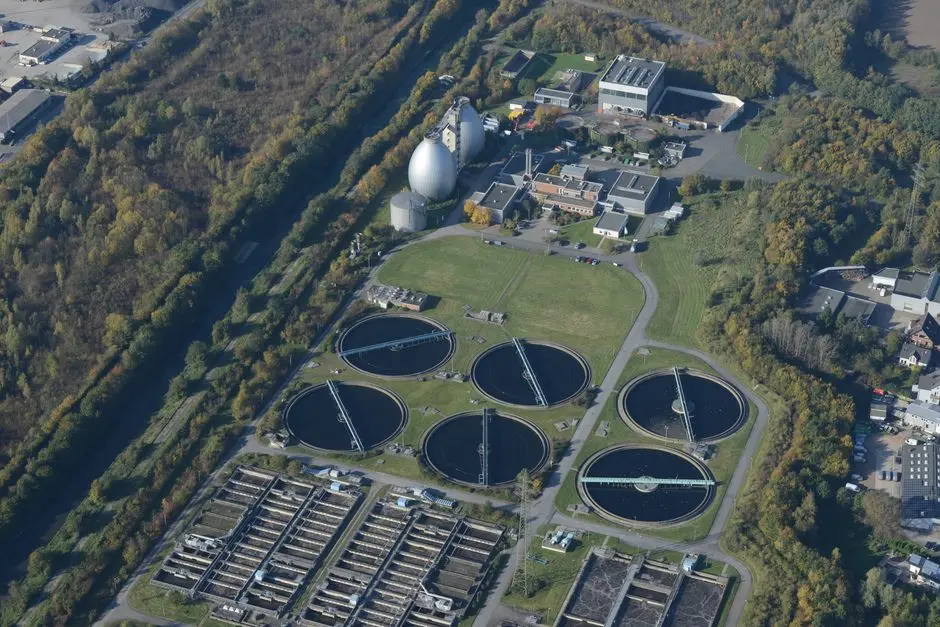
The two flagship facilities that dominate any internet search on Guayaquil sanitation — Los Merinos and Las Esclusas — are designed to treat 100% of the domestic wastewater collected in the southern and northeastern basins, a project that will benefit over 2.6 million people and lift coverage to nearly 100% under the World Bank program (blogs.worldbank.org, "Becoming a leader in Latin America's wastewater treatment").
That scope is two to three orders of magnitude larger than a private residential urbanización of a few hundred to a few thousand homes, so the megaproject coverage does not translate into a procurement roadmap a developer can use. Las Esclusas is a multi-year civil works project — three years of construction, three months of commissioning, and six months of assisted operation, per EMAPAG general manager José Luis Santos (waterworld.com, "Redefining Ecuador's Wastewater Treatment") — and is not a comparable product line. A separate 30,000-house-connection and 41 km main-sewer rehabilitation in La Chala is financed under the EIB program, and because that program is the city's route to 100% sewer coverage, most housing developments in the southern basin are expected to discharge to the EMAPAG interceptor rather than operate as fully off-grid sites (eib.org, "Wastewater Treatment Project in Guayaquil"). Cogeneration framing at Las Esclusas — three 540 kWh units plus a 740 kWh line, estimated to meet 35–40% of onsite power — is not economically meaningful at packaged-plant scale, so a developer should evaluate small units on hydraulic and effluent quality grounds, not on energy-recovery claims.
Packaged STP Technologies That Fit a Guayaquil Urbanización
Buried A/O contact-oxidation units (1–80 m³/h), containerized MBR packages, and SBR packages are the three process families realistic for a tropical coastal housing site. Buried A/O units combine biological treatment, sedimentation, and disinfection in a single buried skid, run fully automated with no on-site operator, and can be landscaped over — which is why a buried A/O packaged sewage treatment plant is the default for residential deployments. A containerized MBR packaged plant integrates a submerged PVDF flat-sheet membrane module with activated sludge to produce near-reuse effluent at a smaller footprint than conventional activated sludge, at a higher membrane-replacement cost. SBR packages are an alternative for variable-load residential developments, but they require equalization volume and timer-driven cycle control, which adds operational complexity relative to continuous-flow A/O units.
Discharge destination drives technology choice. If the development will connect to the EMAPAG interceptor, secondary biological treatment with disinfection is usually sufficient. If the development discharges to the Estero Salado or a local estuary, an MBR with tertiary filtration or UV disinfection is the safer specification, because receiving-water sensitivity there is much higher than in the open Guayas River. The World Bank's Guayaquil receiving-water model showed that, given the high flows and tide dynamics in the Guayas River system, primary treatment levels would be sufficient to comply with water quality standards for that open-river discharge (blogs.worldbank.org, "Three ways to improve wastewater management in Guayaquil, Ecuador"). This applies to the open Guayas and Daule rivers, not to enclosed esteros; readers should not generalize it to small receiving bodies.
| Process | Typical flow range | Footprint | Effluent quality | Operator skill | Best fit on the coast |
|---|---|---|---|---|---|
| Buried A/O (WSZ-class) | 1–80 m³/h | Small, landscaped over | Secondary, disinfected | Low (automated) | EMAPAG interceptor discharge |
| Containerized MBR | 1–50 m³/h | ~60% of CAS, container-based | Near-reuse, low TSS | Moderate (membrane care) | Estero Salado, reuse for irrigation |
| SBR package | 5–100 m³/h | Moderate, needs equalization | Secondary, batch-discharged | Moderate (timer logic) | Variable-load residential only |
Sizing the Unit to the Development's Real Hydraulic Load
Guayaquil generates about 280,000 m³/day of wastewater in the dry season and 350,000 m³/day in the wet season — a roughly 25% uplift caused by infiltration into the 3,950 km collector network (waterworld.com, "Redefining Ecuador's Wastewater Treatment"). A private development on a separate sewer will see a smaller but still meaningful wet-season factor, and that factor must be built into the design flow rather than averaged out. The standard packaged-plant sizing inputs are: number of dwelling units × residents per unit × per-capita sewage contribution × a peaking factor for morning and evening peaks. The per-capita contribution figure and the local norm applicable to a residential urbanización in coastal Ecuador should be confirmed with the project hydraulic engineer. Always size the biological stage to average dry-weather flow and the hydraulic stage (pumps, piping, sedimentation) to peak wet-weather flow; this separation is the most common reason packaged plants overflow during Guayaquil's rainy season. For an MBR, the membrane rack area is governed by average flow and flux rate, while the WSZ-class A/O skid is more forgiving of hydraulic surges, which is one reason it remains the default for residential deployments. A packaged MBR STP sizing for hospitality guide covers similar logic for a different climate, and the same hydraulic-separation principle applies here.
| Sizing input | What it controls | Guayaquil-specific note |
|---|---|---|
| Average dry-weather flow | Biological stage capacity | Drives reactor volume and MLSS |
| Peak wet-weather flow | Hydraulic stage (pumps, piping, sedimentation) | ~25% uplift seen at city scale; site-specific |
| Per-capita sewage contribution | Both stages | Confirm against local norm; not supplied here |
| Peaking factor | Equalization, pump selection | Morning/evening peaks in residential blocks |
Site and Soil Conditions That Drive Foundation Design
The Las Esclusas WWTP site in southern Guayaquil sits on a mixture of clay and sand that, according to EMAPAG's Santos, "in addition to generating settling problems generates liquefaction problems, for which a vibro-substitution method with tamping has been proposed" (waterworld.com, "Redefining Ecuador's Wastewater Treatment"). That statement is from a megaproject, but the same soil description applies across southern Guayaquil and is the precedent a developer should at minimum raise with their geotechnical consultant. Buried packaged plants in coastal Guayaquil must be designed against buoyancy from a high water table and against differential settlement; a simple reinforced slab is rarely enough on these soils. If the development is in the Estero Salado catchment, expect a shallow, saline water table and aggressive soil chemistry — specify coatings and concrete grades accordingly. If buried installation is not feasible, a skid-mounted or trailer-mounted packaged unit on a raised, ventilated pad is a credible alternative for sites with very poor soils, at the cost of losing the landscaping benefit. Comparable tropical-coastal cases such as the packaged STP for Kinshasa housing developments guide deal with similar foundation constraints, and the same logic of confirming soil assumptions with a local geotechnical report applies.
Discharge Path, EMAPAG Coordination, and Reuse Options
Most southern Guayaquil housing will be expected to connect to the EMAPAG interceptor being expanded under the EIB program (eib.org, "Wastewater Treatment Project in Guayaquil"); confirm the connection point and any pretreatment requirements with EMAPAG before specifying the plant. If the development will reuse treated water for landscape irrigation, toilet flushing, or car washing inside the urbanización, MBR effluent polished through a UV disinfection stage is the standard hygienic-quality target — a chlorine residual is unnecessary if a UV stage is in place, and a chlorine dioxide generator is a common alternative where a residual is required downstream. Treated effluent should never be discharged to a rainwater drain or to the Estero Salado without tertiary filtration; the open Guayas River has higher assimilative capacity, but most residential plots are not adjacent to it. Sludge handling still applies at packaged scale: budget for periodic withdrawal by a licensed hauler, or, for developments over a few hundred homes, an on-site sludge dewatering filter press to reduce hauling volume. Where reuse targets go beyond irrigation — for instance boiler make-up or process water — the RO for wastewater reuse guide lays out the additional polishing train required.
Pre-Purchase Checklist for Any Packaged STP Supplier
Use this list to compare vendor quotes on a like-for-like basis and to force site-specific risks into the specification before signing.
- Ask for guaranteed influent/effluent parameters (BOD, COD, TSS, NH₃-N, fecal coliforms) at the design flow, with a third-party test certificate.
- Ask whether the quoted unit is rated for Guayaquil ambient conditions (temperature, humidity) and for the wet-season peaking factor documented above.
- Ask for foundation and buoyancy design assumptions, and confirm them against the project's geotechnical report — do not accept "standard foundation" without seeing the calculation.
- Ask for an itemized spare-parts list and a recommended membrane-replacement schedule (if MBR), expressed in years and unit cost, so lifecycle cost is visible up front.
- Ask for a references list of at least two operating residential packaged plants in coastal Ecuador or northern Peru with comparable climate and soil — not inland temperate-climate references.
Frequently Asked Questions
What hydraulic load should I size a packaged STP for in a Guayaquil housing development of 200 homes?
Size the biological stage to average dry-weather flow and the hydraulic stage to peak wet-weather flow. The 25% wet-season uplift documented at city scale (waterworld.com, "Redefining Ecuador's Wastewater Treatment") is a starting reference, but the per-capita contribution, occupancy rate, and peaking factor for a specific urbanización must come from the project hydraulic engineer and the local norm; ask the supplier to show both the ADWF and PWWF numbers on the quote.
Do I need EMAPAG approval before installing a private packaged sewage plant in Guayaquil?
Yes. The EIB-financed program is building toward 100% sewer coverage in the southern basin (eib.org, "Wastewater Treatment Project in Guayaquil"), and EMAPAG is the controlling utility. Confirm the discharge point, any pretreatment requirements, and whether the private plant can be the development's compliance point or whether EMAPAG requires a direct connection to the interceptor before specifying equipment.
A/O packaged unit vs MBR for a residential project in coastal Ecuador — which is more economical over 10 years?
For an EMAPAG interceptor discharge, a buried A/O unit is usually the lower lifecycle cost because it avoids membrane replacement. For an Estero Salado discharge or an on-site reuse target, an MBR's smaller footprint and higher effluent quality usually offset the membrane-replacement cost over a 10-year horizon. Ask each vendor for a 10-year lifecycle cost breakdown, with membrane-replacement frequency and unit cost as separate line items, so the comparison is direct.
How long does delivery and commissioning typically take for a buried packaged STP in Ecuador?
Delivery, site preparation, installation, and commissioning for a buried packaged unit are typically a matter of weeks to a few months. Treat any vendor figure as indicative and ask for a contractual delivery and commissioning schedule with liquidated-delay terms.
What soil preparation is required for a buried sewage plant in southern Guayaquil?
Southern Guayaquil soils are a clay-sand mix with documented settling and liquefaction problems, and the Las Esclusas precedent is vibro-substitution with tamping (waterworld.com, "Redefining Ecuador's Wastewater Treatment"). For