
Why the City of Kokomo Runs an Industrial Pretreatment Program
The City of Kokomo's NPDES permit for its publicly owned treatment works (POTW) requires the City to maintain a Pretreatment Program under Section 402(b)(8) of the Clean Water Act and 40 CFR 403, and the Pretreatment Team is empowered to inspect, monitor, and compel corrective action at any Significant Industrial User (SIU) whose discharge threatens the plant, its workers, the collection system, or downstream water quality (City of Kokomo, November 2011).
As of November 2011, six industries were on the SIU list: Kokomo Transmission Plant (KTP), Indiana Transmission Plant (ITP), Delphi, General Motors, Haynes International, and Park 100, with five additional groundwater remediation sites — including the former Continental Steel site — also tracked by the team (City of Kokomo, November 2011). Categorical pretreatment standards under 40 CFR apply on top of any local limit, and for the Kokomo service area the most relevant categories are 40 CFR Part 433 (Metal Finishing) and 40 CFR Part 465 (Automotive Parts), which set numerical effluent ceilings for metals, oil and grease, and pH on top of any MAHL-derived discharge ceiling the POTW imposes. The City's laboratory backs the program by running 40 CFR 136 / Standard Methods under a documented QA/QC and GLP plan, so compliance data from a self-monitoring plant can be defended against on the same analytical footing (City of Kokomo, November 2011).
What Auto/EV Plants Actually Discharge in the Kokomo Service Area
Kokomo's SIU roster is dominated by transmission and parts plants whose wastewater is shaped by metal-cutting and parts-washing operations, not by bulk chemical manufacturing. KTP, ITP, Delphi, and GM historically generate emulsified machining fluids, cutting oils, parts-washer rinsewater, stamping lubricants, and metal-finishing rinsewater carrying dissolved and particulate zinc, nickel, copper, and lead, with intermittent pH swings from acid and alkaline cleaners. Haynes International is the outlier: as a specialty alloy producer, its waste includes pickling and passivation acids with high dissolved metals, low pH swings, and high total dissolved solids, so its pretreatment train has to handle aggressive acid neutralization as well as dissolved-metal precipitation. EV-component growth around Kokomo adds battery and electronics wastewater — cleanroom rinsewater, coolant dumps, and black-mass-related wash water — that behaves more like light metal finishing than heavy stamping waste, but still carries metals and emulsified oils. A compliant train therefore has to address free oil, emulsified oil, dissolved and particulate metals (including any hexavalent chrome from legacy operations), wide pH swings, and slug loads — not just average concentrations — and the unit operations that follow in this article are selected to do exactly that.
| SIU (Kokomo service area) | Dominant waste streams | Key categorical standard |
|---|---|---|
| Kokomo Transmission Plant (KTP) | Machining fluids, parts-washer rinsewater, metal-finishing rinsewater | 40 CFR Part 433 (Metal Finishing) and Part 465 (Automotive Parts) |
| Indiana Transmission Plant (ITP) | Machining fluids, parts-washer rinsewater, metal-finishing rinsewater | 40 CFR Part 433 and Part 465 |
| Delphi | Stamping lubricants, cutting oils, metal-finishing rinsewater | 40 CFR Part 433 and Part 465 |
| General Motors | Assembly and metal-finishing rinsewater, oily waste | 40 CFR Part 433 and Part 465 |
| Haynes International | Pickling and passivation acids, high dissolved metals, low pH swings, high TDS | 40 CFR Part 433 (specialty alloy finishing) |
| Park 100 | Mixed industrial users; light metal finishing and oily waste | 40 CFR Part 433 as applicable to each tenant process |
From EPA's MAHL Method to Kokomo's Local Limits
EPA's Local Limits Development Guidance (EPA, 2004, republished 2021) sets out a five-step Maximum Allowable Headworks Loading (MAHL) process: Step 1 determine pollutants of concern, Step 2 collect and analyze influent, effluent, and sludge data, Step 3 calculate MAHLs, Step 4 designate and implement local limits, and Step 5 address collection-system concerns. The guidance is explicit that a local limit can be expressed as a numeric value, a narrative standard, or as Best Management Practices, and that EPA leaves the choice of approach to the Approval Authority — so two POTWs with similar industrial bases can publish very different discharge rules. Local limits are derived to protect effluent quality, sludge quality, air emissions from the POTW, treatment-plant inhibition, collection-system integrity, and worker safety, which is why a pollutant like total petroleum hydrocarbons (TPH) can carry a 50 mg/L ceiling at one utility and a narrative "no visible sheen" rule at another. A Hazen survey of roughly 50 utilities found numeric FOG limits ranging from 50 to 300 mg/L and total oil and grease from 100 to 600 mg/L, with 17 utilities using narrative TPH and 25 using narrative FOG (Hazen and Sawyer, undated). For an EV/auto supplier in Kokomo, the practical implication is that the permit's TPH or FOG number is a local allocation, not a national floor, so a plant that benchmarks against a peer in another state can still be out of compliance at home.
| MAHL step (per EPA guidance) | What the POTW does | What the industrial user should expect |
|---|---|---|
| Step 1 — Pollutants of concern | Screen for metals, oil & grease, pH, conventional pollutants | Be ready to disclose process chemicals and wastewater chemistry |
| Step 2 — Data collection | Sample POTW influent, effluent, and sludge; sample IU discharges | Grant access for POTW sampling and share self-monitoring data |
| Step 3 — Calculate MAHLs | Convert MAHLs to Maximum Allowable Industrial Loadings (MAILs) | Receive a per-industry allocation; track against it |
| Step 4 — Designate and implement limits | Publish numeric, narrative, or BMP-based limits in sewer use ordinance | Permit limits become enforceable |
| Step 5 — Collection-system concerns | Address FOG buildup, corrosion, worker safety, explosive atmospheres | Limits can tighten between revision cycles |
Pretreatment Unit Operations Kokomo Plants Actually Use
A compliant train for a Kokomo-style auto/EV plant is a sequence of unit operations, each targeting a specific pollutant group, and the sequence matters because a slug load or pH excursion upstream will defeat everything downstream. Flow equalization and pH adjustment sit first to dampen slug loads and protect downstream chemistry from acid and alkaline cleaners. Free oil is removed in a corrugated-plate or API-style oil/water separator; emulsified oil requires chemical emulsion breaking (acid break, demulsifier, or thermal) followed by dissolved air flotation, and a DAF unit for oil, FOG and emulsion breaking is the workhorse unit for that step. Dissolved metals — zinc, nickel, copper, lead, and any hexavalent chrome — are precipitated as hydroxides via pH control, with hexavalent chrome reduced to trivalent chrome (typically with sodium bisulfite or ferrous sulfate at low pH) before the main precipitation step so it does not carry through. Final polishing typically includes a lamella clarifier or sand/multi-media filter for suspended solids, and PLC-controlled chemical dosing for pH and coagulant keeps the precipitation chemistry on target. Self-monitoring sampling follows 40 CFR 136 methods, and treated effluent is discharged to the City sanitary sewer, not directly to a waterbody. For metals trains specifically, a DAF vs clarifier for metals wastewater comparison is a useful sizing reference, and a regional metals pretreatment compliance guide walks through the same sequence in a different service area.
| Unit operation | Target pollutant group | Typical placement in the train |
|---|---|---|
| Flow equalization | Slug loads, hydraulic variability | First, ahead of chemistry |
| pH adjustment | Acid/alkaline cleaners, pickling acids | First, then re-tuned downstream |
| Oil/water separator (CPI or API) | Free oil and grease | After equalization, before emulsion breaking |
| Emulsion breaking + DAF | Emulsified oil, TPH, FOG | After free-oil removal |
| Hexavalent chrome reduction | Cr(VI) from legacy operations | At low pH, before main precipitation |
| Metals precipitation (hydroxide) | Dissolved zinc, nickel, copper, lead, Cr(III) | At controlled pH, before clarification |
| Lamella clarifier or multimedia filter | Suspended solids, metal-bearing sludge | After precipitation, before discharge |
| Self-monitoring sampling (40 CFR 136) | Compliance data | Final, on the discharge manifold |
Monitoring, Self-Reporting, and What Happens When a Limit Is Missed
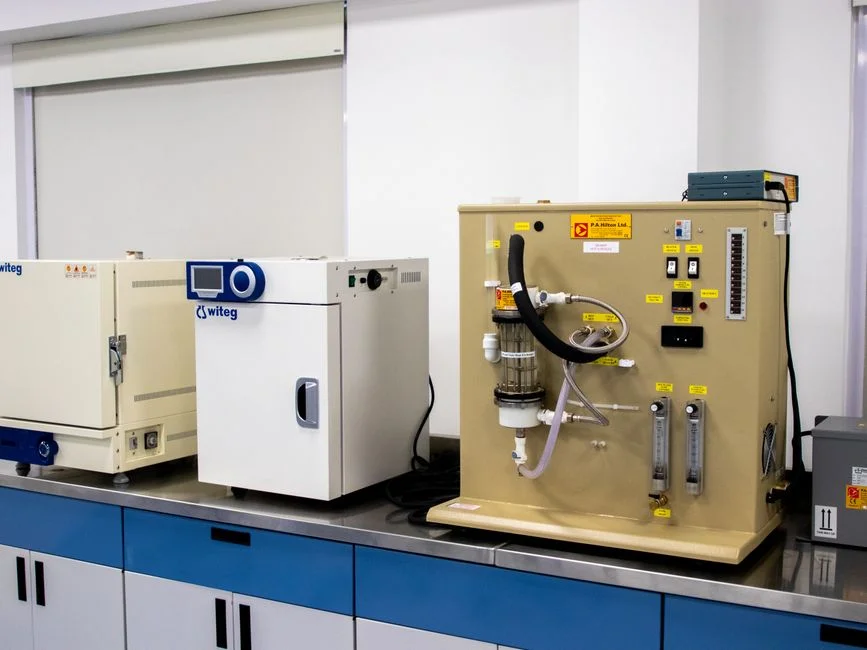
The City of Kokomo laboratory operates as both a process-control and quality-control mechanism, using 40 CFR 136 / Standard Methods under a QA/QC and GLP program tied to the NPDES permit, so any data a plant submits has to be defensible against the same analytical bench (City of Kokomo, November 2011). SIUs are expected to self-monitor, report, and allow POTW inspection, and the Pretreatment Team can escalate through enforcement actions when non-compliance is documented. The Petersburg / South Central Wastewater Authority case is the cleanest illustration of how that escalation plays out: after SCWWA revised local limits in 2009 — tightening FOG to 300 mg/L and setting TPH at 100 mg/L, effective January 2014 — a long-standing commercial laundry that had reduced water consumption by 55% under EPA's Environmental Stewardship Program was pushed out of compliance, and the parties signed a Consent Special Order in spring 2016 to resolve the issue (Hazen and Sawyer, undated). For a Kokomo plant, the operational lesson is to plan for additional pretreatment capacity, hauled-waste options, or process-water reduction before the next local-limits revision cycle, not after the first violation.
Frequently Asked Questions
What is the actual cost of building a compliant pretreatment train for a Kokomo-style EV/auto plant?
The research does not supply a price for a Kokomo-area pretreatment train, so the only defensible answer is to ask a vendor for a site-specific budget based on measured flow, oil and grease loading, dissolved metals, pH range, and the local sewer-use ordinance. A meaningful budgetary envelope requires the buyer's own wastewater characterization — not a generic price sheet — and the EPA Local Limits Development Guidance (EPA, 2021) lists the data a POTW will need to see before any local allocation is set.
How do I pick a pretreatment equipment supplier that will keep the plant in compliance?
Shortlist suppliers that can demonstrate prior work on 40 CFR Part 433 (Metal Finishing) and Part 465 (Automotive Parts) categorical standards, can deliver a DAF unit, emulsion-breaking chemistry, hexavalent chrome reduction, and PLC-controlled chemical dosing as an integrated train, and will provide performance guarantees tied to the plant's discharge permit rather than to a generic equipment specification. Confirm the supplier's references include plants of similar size and waste envelope, and require them to support the 40 CFR 136 self-monitoring program with documented QA/QC.
Which 40 CFR categorical standard applies to a Kokomo transmission or parts plant?
Metal-finishing rinsewater at a transmission or parts plant typically falls under 40 CFR Part 433 (Metal Finishing), while automotive parts operations can also trigger 40 CFR Part 465 (Automotive Parts), and the more stringent of the two governs any given wastestream. A supplier or compliance consultant should confirm the applicable subcategory by mapping every process bath and rinse to the Part 433 and Part 465 applicability tables before sizing equipment.
What compliance risk does a Kokomo SIU face if local limits are tightened?
The Petersburg precedent shows that a previously compliant plant can be pushed into non-compliance by a local-limits revision, with the formal remedy being a Consent Special Order negotiated with the POTW (Hazen and Sawyer, undated). The mitigation is operational: build margin into the train, track loadings against the MAHL allocation, and engage the POTW early when a revision is proposed so the plant is not the test case for the new number.