What 'Sanitary Hygienic Process Equipment' Means in a Data Center Context
Hygienic process equipment is a fabrication category defined by sanitary welding, controlled internal surface finish, and stainless steel material traceability — Rodem specifies 304 and 316 stainless steel for every cooling loop component, with materials and fabrication following sanitary processing standards (Rodem). The same self-healing chromium oxide layer that lets a dairy pipe survive caustic Clean-in-Place chemicals also lets it survive the inhibitor chemistry of a closed data center cooling loop.
Carbon steel corrodes under prolonged water-glycol exposure and releases particulate that fouls pumps and cold plates; dissimilar metals in a mixed loop create galvanic corrosion risk; and plastic components can creep or soften under repeated thermal cycling, compromising seals (Rodem). When those failure modes are mapped onto a high-density data center cooling loop, the relevance of dairy-grade fabrication becomes concrete: smoother internal surfaces limit scale and microbial buildup, which directly reduces biocide demand — a key pretreatment cost driver on the blowdown side (RSP Engineers). Sanitary construction is therefore not an over-spec for a cooling loop; it is a way of buying down internal fouling, longer seal life, and lower chemical demand at the same time.
The Engineering Problem: What Data Center Cooling Loops and Blowdown Put on Equipment
Cooling tower blowdown is the primary process wastewater stream at most large-scale data centers, and sanitary sewage volume is typically minor by comparison (RSP Engineers). The blowdown is not just concentrated source water — it carries the full chemical package the cooling loop itself must tolerate: elevated Total Dissolved Solids, chlorides, sulfates, and phosphates, plus added biocides to control algae and bacteria, corrosion inhibitors to protect piping, and anti-scaling agents (RSP Engineers). On the discharge side, the sewer authority will issue an industrial user permit that sets hard limits the data center must meet, including a pH range often between 6.0 and 9.0 enforced by acid or caustic dosing, a maximum temperature limit (the example given is 150°F) that requires cooling or holding tanks, and strict limits on total residual chlorine and specific biocidal compounds, addressed through dechlorination or non-persistent biocides (RSP Engineers). Other in-scope wastewater sources that interact with cooling equipment include backwash from on-site softeners and reverse osmosis units, equipment cleaning flows, and condensate from air handling units (RSP Engineers). The practical implication for an equipment evaluator is direct: any component that reduces internal fouling and chemical demand inside the cooling loop also reduces loading on the blowdown pretreatment skid.
| Parameter / Concern | Typical Source in Blowdown | On-Site Treatment Consideration |
|---|---|---|
| pH | Treatment chemicals can make water acidic or alkaline; extreme pH corrodes sewer infrastructure. | Required range, often between 6.0 and 9.0; pH neutralization system using acid or caustic dosing. |
| Total Dissolved Solids | Concentration of naturally occurring minerals from source water as pure water evaporates. | May have a specific numeric limit or be monitored as an indicator; difficult to remove; requires advanced treatment like reverse osmosis. |
| Temperature | Blowdown water can be hot, potentially impacting the receiving treatment plant's biology. | Maximum temperature limit (e.g., 150°F); cooling or holding tanks to allow for temperature reduction before discharge. |
| Biocides | Added to control biological growth; toxic to aquatic life and can disrupt treatment plants. | Strict limits on total residual chlorine or specific biocidal compounds; dechlorination systems or use of non-persistent biocides. |
| Heavy Metals (e.g., Copper, Zinc) | Leached from system components due to corrosion. | Specific, low concentration limits (parts per million or billion); chemical precipitation, ion exchange, or specialized filtration. |
Rodem's Equipment Portfolio Relevant to Data Center Cooling Loops
Rodem engineers and supplies stainless steel liquid cooling systems for high-density data centers, drawing on more than 50 years of hygienic process engineering originally rooted in dairy, food, and biotech processing, and is one of only two Alfa Laval Premium Master Distributors in the United States (Rodem). For facility-level loops, Rodem supplies gasketed and brazed plate heat exchangers sourced through that Alfa Laval relationship, plus stainless steel piping, fittings, and manifolds sized for cooling loop pressure and thermal cycling (Rodem). For the Coolant Distribution Unit side of a project, Rodem specifies brazed plate heat exchangers engineered for direct-to-chip and hybrid liquid cooling systems, including high-capacity units built for multi-megawatt CDU loads (Rodem). Free cooling and heat recovery systems are offered to reduce chiller runtime and lower overall data center energy use, and air-cooled and finned tube heat exchangers cover edge and lower-water-use applications (Rodem). After the equipment ships, Rodem provides instrumentation calibration, heat exchanger integrity and leak testing, and one of the largest stainless steel parts inventories in the country with same-day shipping on in-stock items from an onsite stocking warehouse in Harrison, Ohio (Rodem).
| Cooling Loop Component | Rodem Offering | Data Center Application |
|---|---|---|
| Brazed plate heat exchangers | Multi-megawatt units for CDU loads; direct-to-chip and hybrid liquid cooling. | High-density compute and AI training clusters. |
| Gasketed and brazed plate heat exchangers (Alfa Laval) | Premium Master Distributor access to Alfa Laval product line. | Facility-level cooling loops, chiller plant optimization. |
| Stainless steel piping, fittings, and manifolds | 304 and 316 stainless steel; sanitary welding standards. | Loop distribution, headers, and CDU skid piping. |
| Free cooling and heat recovery systems | Ambient air/water heat rejection; waste heat reuse. | Reducing chiller runtime and total facility energy use. |
| Air-cooled and finned tube heat exchangers | Compact, modular units. | Edge data centers and lower-water-use deployments. |
| Aftermarket support | Instrumentation calibration, heat exchanger integrity and leak testing, parts inventory with same-day shipping. | Commissioning, scheduled maintenance, and emergency spares. |
Evaluation Criteria: Scoring Rodem Against Data Center Requirements
Five criteria give a defensible scorecard for any vendor being evaluated against a 2026 high-density data center cooling loop, and Rodem's published positioning maps cleanly onto each one. The first is material compatibility: Rodem specifies 304 or 316 stainless steel for every cooling loop component, and the self-healing chromium oxide layer continues resisting corrosion as fluid chemistry changes over years of operation, including compatibility with water-glycol mixtures and changing inhibitor levels (Rodem). The second is internal surface finish and CIP readiness: smooth internal surfaces limit scale and microbial buildup, which supports Clean-in-Place approaches familiar from dairy and biotech and translates directly into reduced biocide demand inside the loop (Rodem). The third is thermal sizing: Rodem's in-house engineering team sizes heat exchangers and CDU configurations for the application's thermal load, with multi-megawatt CDU capacity available through brazed plate designs (Rodem). The fourth is sanitary documentation: materials and fabrication follow sanitary processing standards, which Rodem frames as a documentation package built to hold up to commissioning review on mission-critical projects (Rodem). The fifth is supply chain and lead time: Rodem maintains one of the largest stainless steel parts inventories in the country at its onsite warehouse, with in-stock items shipping same day, and established vendor relationships supporting expedited orders when project timelines compress (Rodem).
| Criterion | Rodem Position | Data Center Outcome |
|---|---|---|
| 1. Material compatibility | 304 or 316 stainless steel on every cooling loop component; self-healing chromium oxide layer. | Stable performance as water-glycol inhibitor levels change; reduced corrosion-induced fouling and heavy-metal leaching that blowdown permits constrain. |
| 2. Internal surface finish / CIP readiness | Smooth internal surfaces that limit scale and microbial buildup. | Lower biocide demand inside the loop; reduced loading on blowdown pretreatment where pH, residual chlorine, and TDS must be controlled to sewer authority limits. |
| 3. Thermal sizing | In-house engineering sizes heat exchangers and CDU configurations; multi-megawatt CDU capacity via brazed plate designs. | Direct-to-chip and hybrid liquid cooling deployment without undersizing the heat rejection path. |
| 4. Sanitary documentation | Materials and fabrication follow sanitary processing standards. | Documentation package that survives commissioning review on a mission-critical facility. |
| 5. Supply chain and lead time | One of the largest stainless steel parts inventories in the country; same-day shipping on in-stock items; established vendor relationships for expedited orders. | Schedule risk reduction on retrofit and fast-track hyperscale builds. |
Where Rodem Fits and Where It Doesn't in a 2026 Data Center Project
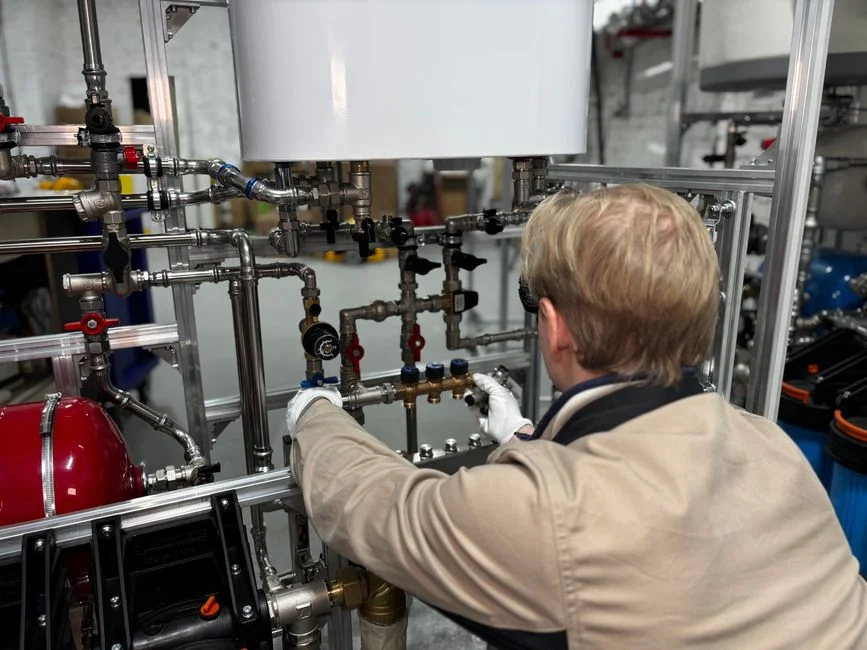
Rodem is strongest in the stainless steel liquid cooling components and CDU hardware that sit on the inside of a cooling loop. Hyperscale and colocation facilities needing facility-level cooling loops, chiller plant optimization, and free cooling integration are a direct fit (Rodem). AI and high-density compute environments needing CDU components for direct-to-chip and immersion cooling are a strong fit, since brazed plate heat exchangers engineered for those exact service conditions are part of the product line (Rodem). Edge data centers needing compact, modular air-cooled or liquid cooling systems, and retrofit or expansion projects upgrading existing cooling infrastructure to handle rising rack densities, are reasonable fits supported by the same product families (Rodem). The limit an evaluator should flag is on scope: Rodem's documented strength is stainless steel liquid cooling components and CDU hardware, not the blowdown pretreatment skid itself. Pretreatment equipment — pH neutralization, dechlorination, chemical precipitation, RO — is a separate scope that the civil or environmental engineer must specify. For the pretreatment side, buyers should request a process design that integrates the loop-side material choices above with the discharge limits a given sewer authority will enforce, which can include pH 6.0–9.0, the 150°F temperature ceiling, and strict residual chlorine limits (RSP Engineers). A complete facility scope may pair Rodem's loop-side equipment with an ultrafiltration system for cooling loop makeup pretreatment and PLC-controlled chemical dosing for blowdown neutralization, where the chemical package and the discharge permit are the binding constraints.
Frequently Asked Questions
Is Rodem sanitary hygienic process equipment actually built for data center cooling, or only adapted from dairy and biotech?
Rodem lists liquid cooling solutions for data centers as a published product line, not an adaptation, with brazed plate heat exchangers engineered for direct-to-chip and hybrid liquid cooling and multi-megawatt CDU loads, plus gasketed and brazed plate heat exchangers, stainless steel piping, fittings, and manifolds for facility-level cooling loops (Rodem). Rodem is also an Alfa Laval Premium Master Distributor, one of only two in the United States, which gives it direct access to Alfa Laval's product line and technical resources as part of its equipment offering (Rodem). Buyers should still request project-specific submittals confirming the heat exchanger model, plate material, and pressure rating for the design conditions on their project.
What lead time should we expect for Rodem-supplied cooling loop components?
Rodem maintains one of the largest stainless steel parts inventories in the country at its onsite warehouse, with in-stock items shipping the same day, and established vendor relationships supporting expedited orders when project timelines compress (Rodem). For non-stocked items, lead time depends on the specific manufacturer and the project configuration, so the actionable check for a buyer is to request a written schedule with separate in-stock and non-stocked line items before signing a purchase order.
Will using hygienic stainless components reduce our blowdown pretreatment cost?
Rodem's published position is that smooth internal surfaces limit scale and microbial buildup, and that a cooling loop built in stainless steel requires less chemical treatment to control corrosion and biofouling (Rodem). On the discharge side, the blowdown chemistry the loop must tolerate is also the chemistry the pretreatment system must neutralize — pH 6.0–9.0, residual chlorine limits, TDS, and added corrosion inhibitors and biocides (RSP Engineers). The qualitative link is direct: lower biocide demand inside the loop means less residual chlorine to dechlorinate downstream. There is no published per-gallon cost reduction in the supplied research, so the actionable check is to request a site-specific biocide mass balance from the bidder that compares a stainless hygienic loop against a mixed-metal baseline, and to confirm with the local sewer authority what residual chlorine limit applies to the discharge permit.
Does Rodem provide engineering support during the bid and specification phase, or only at delivery?
Rodem's stated model is to work with engineering firms and mechanical contractors from early design through equipment delivery and installation support, with direct access to in-house engineers for thermal performance, sizing, and system integration questions during specification and bid phases rather than routing through a manufacturer's engineering queue (Rodem). The actionable check is to ask the Rodem team to name the assigned engineer for your project and to confirm that engineer's availability for design review meetings and RFI responses during the bid window. Buyers evaluating competing suppliers should ask the same question of each bidder, since design-phase responsiveness is a schedule risk on retrofit and fast-track hyperscale builds. For a deeper look at the discharge side of the same problem, see this 2026 engineering guide to data center cooling blowdown treatment and this 2026 engineering guide to data center wastewater and cooling blowdown treatment; for a parallel process-water case study on a different influent, this 2026 engineering guide to ultrafiltration for process wastewater shows the same pretreatment logic applied to a food-grade wastewater stream.