
Why the DAF vs Clarifier Question Matters for Buffalo Auto and EV Plants
Auto and EV plants in the Buffalo area discharge a mixed wastewater stream — stamping oils, drawing compounds, machining coolants, parts-wash detergents, and, on EV lines, residual battery electrolyte — so primary clarification requires a specific selection. Clearwater/SigmaDAF documents that DAF systems separate suspended solids, oils, and fats using 30-50 micron micro-bubbles, which is why the same vendor markets the unit as a dissolved air flotation clarifier rather than a simple float cell [S1, S3]. A gravity/lamella clarifier behaves differently: it uses inclined plates to settle heavy solids, with the Hydropure lamella datasheet specifying 20-40 m/h surface loading as the design basis [Hydropure lamella]. The two technologies overlap on TSS but diverge on free and emulsified oil, which defines a 2026 Buffalo capital decision.
Compliance pressure sharpens that decision. Any discharge to the Buffalo Sewer Authority is evaluated against the authority's current local pretreatment limits on FOG, TSS, and metals, and the choice between float and settle is a choice about which pollutants you can afford to leave in the upstream stream. A stamping line shedding metal fines is a different problem from a machining center generating emulsified coolant, and a 2026 capital request must defend the match between the technology and the worst stream on the site. The following sections outline the technical requirements for each unit.
How a DAF Clarifier Works on Oily Automotive Wastewater
A dissolved air flotation clarifier pressurizes a side stream of clarified water with air, then depressurizes it inside the separation tank so that 30-50 micron micro-bubbles form and attach to flocculated particles and oil droplets, lifting them to the surface [S1, S3]. Because the bubbles are the lifting mechanism, chemical conditioning is a documented prerequisite: coagulants, pH adjusters, and polymer flocculants are mixed in serpentine flocculation tubes or mix tanks for 15-45 seconds of contact time, growing particles to a size the micro-bubbles can capture efficiently [S1, S3]. For an auto or EV line, that chemistry stage is where emulsified coolant, drawing compound, and light FOG become removable.
Once the float blanket forms, a paddle or flight skimmer scrapes the surface scum into a collection trough, while heavier settleable solids drop to a bottom collection zone and are augered out [S1, S3]. That bottom zone matters for an auto plant: even a DAF will capture some metal fines and grit, so the unit is not a pure float device. Clearwater/SigmaDAF explicitly position the DAF as a industrial DAF system with multiple model families — FPAC for high solids at small-to-medium flows, FPBC for low-to-medium solids, FPHF for large flows, and COMPACT for skid-mounted turnkey operation [S1, S3]. The startup requirement is also documented: the unit must be filled with clean water before wastewater is introduced, or the recirculation pump and air saturation system can be damaged and dirty water will be discharged for an extended period [S3]. For a Buffalo plant, that translates into a clean-water source on site and a startup sequence the operators must drill.
How a Gravity/Lamella Clarifier Handles Metalworking and EV Streams
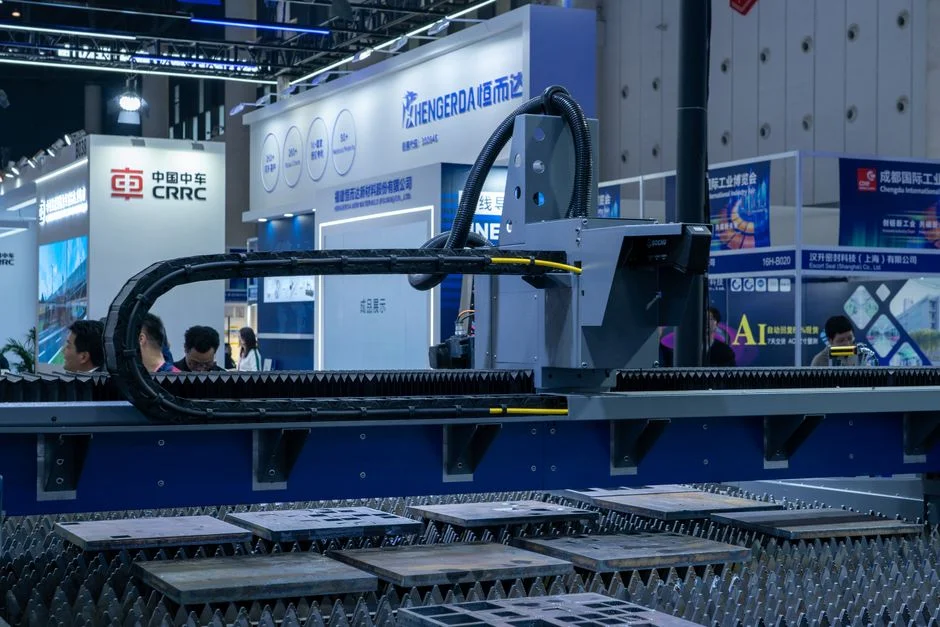
A lamella clarifier stacks inclined plates inside a compact tank so that each particle only has to settle a short vertical distance before it slides down a plate into a collection hopper. The Hydropure lamella product datasheet specifies 20-40 m/h surface loading and combines flocculation, sludge recirculation, and inclined-plate separation in a single compact structure [Hydropure lamella]. That geometry is the reason lamella units dominate on heavy, settleable grit and metal fines — the kind of load a stamping press or a Blanchard grinder puts on a floor drain.
The same datasheet states that the inclined-plate arrangement reduces chemical consumption by up to 30% compared with conventional settling, which is a real OPEX lever for plants watching polymer budgets [Hydropure lamella]. For Buffalo stamping, machining, and grinding lines, gravity settling is the natural first step; free and emulsified oil is the fraction that does not respond to gravity alone, so a lamella clarifier is the right primary only when the floatable fraction is small. Where the load is dominated by heavy solids and grit, the lamella clarifier is the better-documented answer; where oil and FOG dominate, DAF wins on mechanism. The plant rarely has only one stream, necessitating a side-by-side evaluation.
DAF vs Lamella Clarifier: Head-to-Head Comparison
The table below summarizes the documented, citable differences between the two technologies for a 2026 Buffalo capital review. Every value is taken from the supplied research; where the research does not publish a number, the cell calls out the input a buyer must request.
| Parameter | DAF Clarifier | Lamella Clarifier |
|---|---|---|
| Separation mechanism | 30-50 micron micro-bubbles attach to floc, float to surface [S1, S3] | Inclined-plate settling at 20-40 m/h surface loading [Hydropure lamella] |
| Primary target pollutants | FOG, free and emulsified oil, light TSS [S1, S3] | Heavy suspended solids, metal fines, grit [Hydropure lamella] |
| Chemical demand | Coagulant + pH adjustment + polymer flocculant upstream [S1, S3] | Documented up to 30% lower vs conventional settling [Hydropure lamella] |
| Footprint | Tank height plus skimmer/auger clearance; skid options to 66 GPM [S3] | Compact inclined-plate stack; shorter profile for the same hydraulic area [Hydropure lamella] |
| Startup and operation | Clean-water fill required; saturated recycle loop; PLC-controlled skimmer and sludge [S3] | Closer to passive once running; sludge blowdown control still required |
| Published capacity | 4-300 m³/h across 13 standard models [Hydropure DAF] | 20-40 m/h surface loading; total flow depends on plate area selected [Hydropure lamella] |
| Material options | 304SS standard, 316SS and polypropylene on request [S1] | Confirm per quote — not specified in supplied research |
| Compliance check | Verify FOG/TSS removal against Buffalo Sewer Authority local limits [implied by S1, S3] | Same — confirm with pretreatment coordinator before selection |
Two procurement takeaways emerge from the matrix. First, capacity is not directly comparable: the DAF figure is total flow handled, while the lamella figure is hydraulic loading rate per unit area, so a like-for-like bid requires the lamella bidder to publish plate area and tank geometry. Second, neither datasheet publishes a 2026 price, chemical consumption in kg/m³, or a Buffalo-specific lead time — those are quote inputs. The next section maps the technology to the actual streams a Buffalo line generates.
Matching the Technology to Each Auto/EV Wastewater Stream
A Buffalo plant rarely has one waste stream; it has four or five, and the right primary is stream-specific. The map below ties the dominant pollutant in each line to the technology the research supports, with the dosing system added where the chemistry step is part of the documented process.
| Stream | Dominant pollutants | Recommended primary | Why |
|---|---|---|---|
| Stamping and press lines | Heavy oils, drawing compounds, metal fines | Lamella clarifier first | Positioned for heavy suspended solids and grit; smaller chemical load [Hydropure lamella] |
| Machining and grinding | Emulsified coolants, fine metal fines | DAF with coagulant/flocculant | Emulsified oil responds poorly to gravity alone; micro-bubbles capture floc [S1, S3] |
| Parts wash and phosphating | Surfactants, oils, pH swings | DAF + automatic chemical dosing system | Documented pairing of DAF with pH/coagulant control [S1, S3 + Hydropure DAF] |
| EV battery and cathode lines | NMP, binders, electrolyte salts | DAF after dedicated precipitation | Treat as chemical waste first; DAF is a polish, not a standalone [S1 application list] |
The implication for a 2026 capital request: do not buy one unit for the whole plant. A lamella clarifier on the stamping sump and a DAF on the machining and parts-wash sump is a defensible configuration, with the two effluents combined only after primary removal. For EV lines, the NMP and electrolyte load should be precipitated upstream; the DAF then handles carryover FOG and TSS rather than the full chemical load. The industrial DAF system and the lamella clarifier are not mutually exclusive in this layout.
2026 Sizing, Cost, and Compliance Inputs for a Buffalo Plant
Published hydraulic data is a starting point, not a quote. The Hydropure DAF is published at 4-300 m³/h across 13 standard models [Hydropure DAF], and the lamella clarifier is published at 20-40 m/h surface loading [Hydropure lamella]. Neither number is a final sizing — actual unit selection requires site flow, peak factor, influent TSS and FOG, and temperature, because both micro-bubble formation and plate settling slow as viscosity rises [S3]. The supplied research does not publish a 2026 price for either unit, a Buffalo-specific lead time, or a chemical-consumption figure in kg/m³; all of those must be requested per site, and any vendor quoting them without a jar test and a flow profile should justify the assumption.
Compliance is the other non-negotiable input. Any DAF or clarifier discharge to the Buffalo Sewer Authority is evaluated against the authority's current local pretreatment limits on FOG, TSS, and metals; readers should request the latest BSD/FOG limits from their pretreatment coordinator before final selection. OPEX levers that are documented: DAF chemical demand is meaningful (coagulant + flocculant upstream) [S1, S3], and the Hydropure lamella datasheet states up to 30% chemical reduction vs conventional settling [Hydropure lamella]. On lead time, VanAire flags that lead times on wastewater projects can be significant [S5]; readers should request current lead times for both DAF and lamella options in writing. For an industrial DAF system, the supporting automatic chemical dosing system and the lamella clarifier each have their own delivery path that needs to be on the project schedule separately.
Decision Checklist Before You Specify
Bring this list into the next vendor meeting; it converts the article into a tool you can use in the room.
- Confirm which streams on the site are FOG/emulsion-dominated vs grit-dominated, because the answer is rarely "pick one unit for the whole plant" [S1, S3].
- Request the published 30-50 micron micro-bubble size on any DAF bid and verify it against the lamella bidder's 20-40 m/h surface loading rate [S1, S3 + Hydropure lamella].
- Ask each bidder for chemical consumption (kg/m³ treated), clean-water startup volume, and skimmer/auger power draw — these must be quoted per site [S3].
- Confirm the local discharge envelope with the Buffalo Sewer Authority before signing, since FOG, TSS, and metals limits drive the final removal spec.
- Cross-check the 2026 lead time for the DAF, the lamella, and any supporting dosing skid as separate line items in the schedule.
For a comparison of how the two technologies perform on sludge handling and OPEX, the sludge thickening cost reduction in 2026 guide covers what happens to the float and settled fractions after primary clarification.
Frequently Asked Questions
What budget range should a Buffalo plant plan for a DAF or lamella clarifier in 2026
Frequently Asked Questions
Which is better for a Buffalo auto plant in 2026, a DAF or a lamella clarifier?
For EV battery and stamping lines, a Dissolved Air Flotation (DAF) unit is generally superior due to the high concentration of emulsified oils, coolants, and light particulates often found in automotive wastewater. DAF systems utilize micro-bubbles to float contaminants to the surface for mechanical skimming, which is highly efficient at removing low-density materials that would otherwise remain suspended in a traditional gravity-fed clarifier.
A lamella clarifier is better suited for high-volume, inorganic-heavy waste streams where heavy solids (such as metal fines or glass particles) can be easily settled by gravity. In a 2026 Buffalo factory setting, a DAF is the preferred choice for oil-water separation, whereas a lamella clarifier is best utilized as a secondary polishing step or for pretreatment of stamping press fluids that are pre-settled.
What is the typical 2026 budget range for an industrial DAF system versus a lamella clarifier?
In 2026, a skid-mounted industrial DAF system typically ranges from $85,000 to $220,000 depending on flow rate, material of construction (304 vs 316 stainless steel), and the inclusion of automated sludge thickening systems. Higher-end models with integrated PLC controls and advanced chemical dosing skids fall at the upper end of this spectrum.
A lamella clarifier is generally more cost-effective regarding initial capital expenditure, typically ranging from $45,000 to $130,000. While the unit cost is lower, factories must account for additional costs related to larger footprint requirements, concrete pad reinforcements, and potential sludge handling equipment, which can narrow the total project cost gap between the two technologies.
How do I size a DAF or lamella clarifier for an EV battery or stamping line?
Sizing must be based on the peak hydraulic flow rate (GPM) plus a 20% safety factor to account for batch dumping of process tanks. For DAF systems, the sizing is primarily governed by the surface loading rate, typically ranging from 2.0 to 4.0 gallons per minute per square foot (gpm/ft²), ensuring sufficient residence time for the micro-bubbles to lift oils.
Lamella clarifiers are sized based on the projected surface area of the inclined plates, rather than the footprint of the tank itself. For automotive wastewater containing metal fines, the target rise rate is usually 0.25 to 0.50 gpm/ft² of projected plate area. Engineering calculations must also include a jar testing analysis to determine the specific settling velocity of the floc produced by your chosen chemistry.
What Buffalo Sewer Authority or NY SPDES pretreatment limits apply to FOG and TSS in 2026?
The Buffalo Sewer Authority (BSA) typically enforces a local limit for Fats, Oils, and Grease (FOG) at 100 mg/L for industrial discharges. Total Suspended Solids (TSS) limits vary by specific industrial user permit but are generally capped at 300 mg/L to prevent sewer line sedimentation and surcharge fees.
New York State Pollutant Discharge Elimination System (SPDES) permits may impose stricter, site-specific limits if the plant discharges into sensitive watersheds. Operators must monitor pH levels (typically 5.5 to 9.5) and heavy metal concentrations (such as Nickel or Zinc) alongside FOG and TSS, as the BSA imposes significant surcharges for exceeding these baseline pretreatment parameters.
What lead time should a Buffalo factory expect when ordering a DAF or lamella clarifier in 2026?
As of 2026, standard lead times for custom-fabricated stainless steel DAF units range from 16 to 24 weeks from the date of approved submittals. This timeline accounts for the procurement of specialized components like air saturation pumps, pressure vessels, and PLC automation modules, which remain subject to global supply chain fluctuations.
Lamella clarifiers often have shorter lead times, typically ranging from 10 to 16 weeks, due to their simpler mechanical design. However, factories should account for an additional 4 to 6 weeks for onsite integration, plumbing, and electrical commissioning, especially if the installation requires specialized Buffalo-based plumbing contractors familiar with local industrial codes.