Why industrial wastewater treatment in Poland faces tighter EU enforcement in 2026
Industrial wastewater treatment in Poland must meet EU Directive 91/271/EEC discharge limits in 2026, with COD below 125 mg/L, BOD below 25 mg/L, and TSS below 35 mg/L. WIOŚ raised unannounced audits by 30% in 2025. Repeat COD breaches can cost up to PLN 500,000 per year.
In 2025, a textile plant in Łódź paid a PLN 450,000 fine after effluent COD stayed above 150 mg/L on an outdated Dissolved Air Flotation (DAF) train. Food processing (high BOD), metalworking (heavy metals), textiles (dyes), and pulp and paper (TOC) face the highest inspection pressure. Missed limits also risk production stops and exclusion from EU green funding such as the Just Transition Fund. Most plants we size for these sectors still run pretreatment near the low end of design capacity, so seasonal peaks leave little spare headroom.
Enforcement pressure is no longer limited to large municipal dischargers. Mid-size industrial sites with 50–500 m³/h flows now see the same unannounced sampling pattern. When COD drifts above 125 mg/L for several shifts, the fine path and the production-halt path both open. Keeping a calibrated online COD or TOC analyzer on the final effluent line is one of the cheapest insurance steps plants add during 2026 upgrades.
For plants already close to the COD limit, the fastest compliance move is often better equalization and chemical control, not a full process swap. Two to four hours of equalization volume at peak hourly flow dampens bath dumps that drive day-average COD above 125 mg/L. Pair that tank with redundant dosing pumps and a standby polymer tote. Many Polish food and textile sites recover 10–20 mg/L COD headroom this way before they authorize an MBR CAPEX line.
EU Directive 91/271/EEC and Poland’s industrial wastewater standards
EU Directive 91/271/EEC sets the numeric discharge limits that Polish industrial permits enforce in 2026. WIOŚ intensified checks in 2026 while the baseline numbers stay aligned with the directive. The core industrial effluent targets are:
| Parameter | EU Directive 91/271/EEC Limit | Polish National Standard (2026 Enforcement) |
|---|---|---|
| COD (Chemical Oxygen Demand) | <125 mg/L | <125 mg/L |
| BOD (Biochemical Oxygen Demand) | <25 mg/L | <25 mg/L |
| TSS (Total Suspended Solids) | <35 mg/L | <35 mg/L |
| Nitrogen (Total) | <15 mg/L | <15 mg/L |
| Phosphorus (Total) | <2 mg/L | <2 mg/L |
Sector permits often go tighter than the baseline table. Food plants may need BOD below 20 mg/L. Metalworking discharge permits often cap heavy metals below 0.5 mg/L. Textile color limits commonly sit below 50 Pt-Co units. A Polish water permit (Pozwolenie wodnoprawne) needs full wastewater characterization plus treatment design data and usually takes 3 to 6 months. Common failures include ignoring warm-season BOD peaks in food plants and not leaving room for expected PFAS limits discussed for 2027.
Permit files that clear WIOŚ review on the first pass usually include three items: a full year of influent composite data, a mass-balance for each treatment unit, and a contingency plan for maintenance bypass. Files that skip seasonal composites are the ones that stall. If your food plant BOD doubles in summer, show that swing in the design basis instead of averaging it away. The same rule applies to textile dye campaigns and metal finishing bath dumps.
Treatment technologies compared: DAF vs. MBR vs. hybrid systems
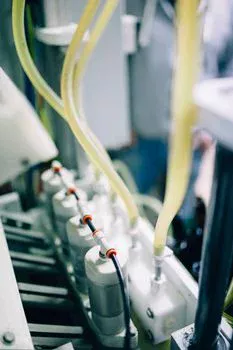
Technology choice for Polish industrial effluent depends on influent solids, dissolved organics, and reuse targets. Dissolved Air Flotation (DAF) fits high TSS and FOG loads. Micro-bubbles lift solids for skimming. CAPEX is lower and operation is simpler, but dissolved COD and BOD removal stays limited. Polish market references such as Ekowater report 92–97% TSS removal at 50 to 500 m³/h. DAF systems are sized for that TSS and FOG duty when used as pretreatment or as a solids polishing step.
Integrated MBR systems treat higher organic loads and can reach COD below 50 mg/L with membranes around 0.1 μm. That effluent quality suits textile and pharmaceutical plants aiming near reuse. CAPEX runs 30–40% above DAF, and membrane fouling must be managed in design and OPEX. EU suppliers such as Veolia and Marex are active in larger MBR packages. Integrated MBR systems are the usual next step when a DAF-only train cannot hold COD under the permit. Hybrid trains that pair DAF with RO or MBR can recover up to 80% of water. They suit metalworking, electronics, and pharma streams with salinity or complex dissolved loads. CAPEX for those hybrids often sits between PLN 3 million and PLN 5 million. A 2025 Ecokube metalworking case reported a 3–5 year ROI from water savings.
| Parameter | DAF Systems | MBR Systems | Hybrid (DAF-RO/MBR) Systems |
|---|---|---|---|
| CAPEX (PLN) | 800K – 2.5M | 1.1M – 3.5M (30-40% premium over DAF) | 3M – 5M |
| OPEX (PLN/m³) | 1.2 – 2.0 | 2.5 – 3.5 | 1.8 – 2.8 (with significant savings from water reuse) |
| Footprint (m²) | Larger | ~60% smaller than conventional activated sludge | Variable, often more compact than separate systems |
| TSS Removal (%) | 92 – 97% | >99% | >99% |
| COD Removal (%) | 50 – 70% | 85 – 95% (achieving <50 mg/L) | 85 – 98% (depending on RO stage) |
| BOD Removal (%) | 50 – 70% | 90 – 98% | 90 – 98% |
| Sludge Production (kg/m³) | Higher (dense sludge) | Lower (more concentrated sludge) | Variable, can be optimized |
| Ideal Use Cases | High TSS, FOG, pre-treatment | High organic load, water reuse, stringent discharge | Complex wastewater, high salinity, maximum water recovery, resource recovery |
Chemical conditioning decides whether DAF or MBR holds its design removal. PLC-controlled chemical dosing systems keep pH and coagulant dose stable when influent swings, which is common on Polish food and textile lines. Most plants we size for 50–200 m³/h still under-instrument jar-test feedback; that is where COD spikes start.
A practical selection rule used on many Polish retrofit bids is simple. If FOG and TSS dominate and COD after flotation already sits near 125 mg/L, stop at DAF plus polishing. If dissolved COD stays above 150–200 mg/L after flotation, budget for biological or MBR capacity. If the buyer needs 70–80% reuse, plan the RO stage and the brine disposal path at the same time. Brine handling often decides whether the hybrid ROI holds.
CAPEX, OPEX, and ROI cost models for industrial plants in Poland
CAPEX for DAF systems typically ranges from PLN 800,000 to PLN 2.5 million by flow and package scope. A 100 m³/h DAF train, including equipment, installation, and civil works, often lands between PLN 1.2 million and PLN 1.8 million. MBR packages cost more: a 200 m³/h MBR can sit between PLN 2.2 million and PLN 3.0 million. Hybrid DAF-RO systems usually start near PLN 3 million and can reach PLN 5 million on larger sites.
OPEX drives ownership cost after commissioning. DAF OPEX typically runs PLN 1.2 to PLN 2.0 per cubic meter, mainly chemicals and sludge haulage. MBR OPEX is usually PLN 2.5 to PLN 3.5 per cubic meter, including about 0.3 kWh/m³ energy plus membrane replacement that can reach PLN 50,000 per year on a 200 m³/h unit. Hybrid DAF-RO OPEX often falls between PLN 1.8 and PLN 2.8 per cubic meter before reuse credits. A metalworking hybrid with 70% reuse can save about PLN 800,000 per year and pay back near 3 years. Compliance-only ROI is the avoided fine path. Reuse ROI is the freshwater purchase cut. Resource recovery ROI can include biogas from sludge or metal recovery where the stream allows it.
Hidden costs still break many Polish project budgets. Permit delays can cost PLN 50,000–100,000 per month in lost production. Operator training often needs PLN 20,000–50,000. Emergency membrane repairs can run PLN 100,000–300,000 when fouling or failure was not priced in. Build those line items into the bid before you compare headline CAPEX alone.
| System Type | Project Size | Estimated CAPEX (PLN) | Estimated OPEX (PLN/m³) | Typical ROI Scenario | Payback Period (Years) |
|---|---|---|---|---|---|
| DAF | <50 m³/h | 800K – 1.2M | 1.2 – 1.8 | Compliance | 2-4 (based on avoided fines) |
| DAF | 50–500 m³/h | 1.2M – 2.5M | 1.5 – 2.0 | Compliance | 3-5 (based on avoided fines) |
| MBR | 50–500 m³/h | 1.8M – 3.5M | 2.5 – 3.5 | Stringent Discharge/Reuse | 4-6 (based on reduced discharge fees & potential reuse) |
| Hybrid (DAF-RO) | >500 m³/h | 3M – 5M+ | 1.8 – 2.8 (excluding reuse savings) | Maximum Water Reuse (70-80%) | 3-5 (based on substantial freshwater savings) |
When finance teams compare options, ask for a 10-year cash view, not a CAPEX quote. Include membrane sets, polymer, sludge tipping fees, electricity at the site tariff, and one major overhaul. For a 200 m³/h MBR, the PLN 50,000 annual membrane allowance alone can exceed the difference between two DAF bids after year four. For hybrid reuse plants, credit only the water volume you can actually reuse inside the process. Do not bank on selling surplus permeate unless a contract already exists.
Cost models also need a sludge path. DAF float cake is denser but higher in mass per cubic meter treated. MBR waste sludge is lower in volume yet often needs more dewatering polymer. Hybrid plants that recover 70–80% water still pay to haul or treat the concentrate. Ask bidders for sludge kg/m³ and expected dry-solids percent at the belt or filter press, then price disposal at local Polish tipping rates before you rank OPEX claims.
Supplier selection weighted framework for Polish buyers
Supplier selection for industrial wastewater equipment in Poland should be scored, not decided on price alone. A 100-point weighted sheet keeps compliance, local service, warranty, references, and cost in one view:
| Category | Criteria | Weight (%) | Score (Example) | Notes |
|---|---|---|---|---|
| Compliance & Certifications | ISO 9001 Certification | 15 | 15 | Demonstrates quality management systems. |
| EU Directive 91/271/EEC Compliance Assurance | 15 | 12 | Supplier's proven ability to meet or exceed these standards. | |
| Local Support & Service | Local Service Depots (<200 km) | 15 | 15 | Ensures rapid response times for maintenance and repairs. |
| 24/7 Technical Support Availability | 10 | 8 | Critical for minimizing downtime. | |
| Warranty & Guarantees | 5+ Years on Membranes (MBR/RO) | 10 | 10 | Crucial for long-term operational cost predictability. |
| 2+ Years on Mechanical/Electrical Components | 10 | 8 | Covers major equipment reliability. | |
| References & Track Record | 3+ Polish Case Studies (Same Industry) | 15 | 15 | Verifiable success in similar Polish industrial environments. |
| Cost & Value | Competitive CAPEX & OPEX | 10 | 8 | Balanced against performance and reliability. |
| Total | 100 | 91 |
Selection checklist for Polish buyers:
- Confirm ISO 9001 and written EU Directive 91/271/EEC compliance method statements.
- Require a service depot within 200 km and documented 24/7 technical coverage.
- Lock membrane warranty at 5+ years and mechanical/electrical cover at 2+ years.
- Collect at least three same-industry Polish references with effluent data.
- Model OPEX with sludge, chemicals, energy, and membrane replacement, not CAPEX only.
- Write a 12-month performance bond on named effluent limits into the contract.
- Price liquidated damages for missed installation milestones before award.
Red flags include missing ISO 9001, no local service base, under five years of Poland work, vague pro-rated warranties, or no Polish client references. Negotiation levers that protect buyers include a 12-month performance commitment on named effluent limits, liquidated damages for late handover, and bundled chemical/consumable OPEX packages that fix annual spend. Market names often cited for EU-compliant local support include Ekowater (DAF up to 500 m³/h), Marex (MBR above 500 m³/h), Ecokube (hybrid trains), AQT Water (decentralized packages), and Veolia (large multi-site projects).
Scorecards fail when buyers inflate the cost row and shrink the service row. A PLN 200,000 CAPEX saving disappears after one membrane emergency callout from outside Poland. Ask each bidder for mean response time on the last five Polish service tickets, not a brochure claim. If they cannot show ticket data, treat the local-support score as incomplete.
If two suppliers score within five points on the 100-point sheet, break the tie on spare-parts lead time inside Poland and on who owns commissioning risk until 30 consecutive compliant days. Those two clauses protect production more than another CAPEX discount. Document both in the award memo so operations and procurement stay aligned after the PO is signed.
Who this is for, who should look elsewhere, and next step
This guide fits plant engineers, EPC contractors, and procurement teams sizing or upgrading industrial wastewater treatment in Poland against EU Directive 91/271/EEC limits. It is less useful for municipal-only utilities with no industrial surcharge, or for sites that only need a portable oil-water separator with no COD or nutrient targets. If you already have flow, COD/BOD/TSS, and permit limits, send those figures for a sized DAF, MBR, or hybrid package via request a technical quote before you freeze CAPEX.
Frequently Asked Questions
What are the penalties for exceeding COD limits in Poland in 2026?
Penalties for exceeding COD limits in Poland in 2026 can reach PLN 500,000 per year for repeat violations, and production stops are also possible. WIOŚ audits rose about 30% in 2025, with unannounced checks focused on food processing and textiles. Plants that stay above 125 mg/L COD after warnings face cash penalties plus weaker eligibility for EU green funding programs.
Can I use a DAF system for textile wastewater with high dye content?
DAF alone is usually not enough for dissolved textile dyes on Polish permits. DAF can remove about 90–95% of TSS and 50–70% of COD, but color often remains above the limit. To reach color below 50 Pt-Co units, add advanced oxidation such as ozone or UV/H₂O₂, or an MBR stage that can push COD below 50 mg/L and color below 10 Pt-Co units under stable dosing.
How much does it cost to treat 1 m³ of industrial wastewater in Poland?
OPEX typically ranges from PLN 1.2 to PLN 3.5 per cubic meter by technology and industry. DAF for food processing often sits at PLN 1.2–2.0/m³. MBR for textiles or pharmaceuticals is usually PLN 2.5–3.5/m³. Hybrid DAF-RO for metalworking with 70–80% recovery commonly falls in PLN 1.8–2.8/m³ before reuse credits are subtracted from the net unit cost.
What is the lead time for a 200 m³/h wastewater treatment plant in Poland?
Lead time for a 200 m³/h industrial plant in Poland is typically 6 to 12 months end to end. Permitting takes 3–6 months, fabrication about 3–4 months, and installation plus commissioning another 1–2 months. Extra WIOŚ document requests are the most common reason projects slip beyond that planning window.
Are there subsidies for industrial wastewater upgrades in Poland?
Yes. The National Fund for Environmental Protection and Water Management (NFOŚiGW) can cover 30–50% of CAPEX for EU-compliant industrial treatment projects. Stronger applications usually show water reuse, sludge energy recovery, or low-discharge designs. Windows often open in the first and third quarters; Warsaw CAPEX and OPEX benchmarks remain a useful national check when you build the grant model.