An industrial dust collection system removes up to 99.9% of airborne particulates by pulling contaminated air through a network of ducts into a filtration unit, where dust is trapped in filter media (e.g., fabric bags or cartridges). A pulse-jet cleaning mechanism dislodges accumulated dust into a hopper, while purified air is either recirculated or discharged. Systems must meet EPA emission limits (e.g., <10 mg/Nm³ for baghouses) and are tailored to dust type, facility size, and regulatory standards. Key components include blowers (5–50 HP), filter media (polyester or PTFE), and automated cleaning systems to maintain efficiency.
Why Industrial Dust Collection Matters: Compliance, Health, and Operational Risks
Poor industrial air quality leads to significant regulatory non-compliance, jeopardizes worker health, and accelerates equipment degradation, often resulting in substantial financial penalties and operational downtime. For example, a factory manager facing repeated OSHA fines due to respirable silica dust exceeding permissible exposure limits understands the direct impact on both budget and workforce morale. OSHA mandates permissible exposure limits (PELs) for various airborne contaminants, such as 5 mg/m³ for respirable silica and 15 mg/m³ for nuisance dust, with violations carrying fines up to $15,625 per instance as of 2025. Beyond OSHA, facilities must adhere to EPA emission standards, with baghouses typically required to maintain emissions below 10 mg/Nm³ (per HydropureWater analysis of EPA guidelines). Failure to meet these standards not only incurs fines but also increases the risk of worker compensation claims due to occupational lung diseases.
Operationally, unchecked dust accumulation significantly reduces equipment lifespan and efficiency. Dust buildup can clog machinery, foul electrical components, and abrade moving parts, potentially reducing equipment longevity by 30–50% and increasing maintenance costs (HydropureWater field data, 2025). combustible dusts, governed by NFPA 68 and 69, pose a severe explosion risk, demanding robust industrial air filtration solutions to prevent catastrophic incidents. Effective dust collection is not merely a regulatory burden; it is a critical investment in worker safety, operational continuity, and long-term financial stability.
Core Components of an Industrial Dust Collection System: Engineering Breakdown
Every industrial dust collection system integrates several key components, each engineered to perform a specific function in the capture, filtration, and discharge of particulate matter. Understanding the technical specifications of each component is crucial for effective system design and performance evaluation.
- Blower/Fan: The heart of the system, the blower generates the necessary airflow (CFM) and static pressure (in. w.g.) to draw dust-laden air through the ductwork and filtration unit. Industrial blowers typically range from 5 to 50 HP, capable of moving 500 to 50,000 CFM, and generating static pressures between 6 and 20 in. w.g. The selection depends on the total system resistance and required airflow for effective capture.
- Ductwork: This network of pipes conveys dust-laden air from the capture points to the dust collector. Materials commonly include galvanized steel for general applications or stainless steel for corrosive environments. Duct diameters typically range from 4 to 36 inches, designed to maintain transport velocities of 3,500–4,500 FPM (feet per minute) for most applications to prevent dust settling and accumulation.
- Filter Media: The core of the industrial air filtration process.
- Baghouse filters: Utilize fabric bags made from polyester, aramid, or PTFE (Teflon), offering high filtration efficiency (up to 99.9%) and excellent dust cake release. Pore sizes can vary, but effective filtration often occurs across a dust cake layer.
- Cartridge filters: Typically constructed from pleated polyester/cellulose blends, often with nanofiber coatings, providing a larger surface area in a compact form. These are effective for fine particulates (0.3–10 µm) and offer good pulse-jet cleaning characteristics.
- Cleaning Mechanism: Essential for maintaining filter performance by dislodging accumulated dust.
- Pulse-jet systems: The most common, delivering short, high-pressure bursts of compressed air (0.1–0.3 seconds at 60–100 PSI) through the filters at intervals of 1–30 minutes, depending on dust load.
- Reverse-air systems: Use a low-pressure, high-volume flow of air in the reverse direction to gently collapse and clean fabric bags.
- Shaker systems: Mechanically shake the filter bags to dislodge dust, typically used in smaller, intermittent-duty collectors.
- Hopper: A pyramidal or conical bottom section of the dust collector where dislodged dust accumulates. Hoppers are engineered with a slope of 45–60° to facilitate gravity-assisted dust flow into a discharge device. Capacities range from 0.5 to 10 cubic yards.
- Discharge Methods: Remove collected dust from the hopper. Common methods include rotary valves (airlocks) to maintain negative pressure and screw conveyors for continuous discharge into drums, bins, or other material handling systems.
| Component | Key Parameter | Typical Range/Specification |
|---|---|---|
| Blower/Fan | Horsepower (HP) | 5 – 50 HP |
| Blower/Fan | Airflow Capacity (CFM) | 500 – 50,000 CFM |
| Blower/Fan | Static Pressure (in. w.g.) | 6 – 20 in. w.g. |
| Ductwork | Transport Velocity (FPM) | 3,500 – 4,500 FPM |
| Filter Media (Cartridge) | Effective Pore Size | 0.3 – 10 µm (with nanofiber) |
| Cleaning (Pulse-jet) | Pulse Duration | 0.1 – 0.3 seconds |
| Cleaning (Pulse-jet) | Compressed Air Pressure | 60 – 100 PSI |
| Hopper | Slope Angle | 45 – 60° |
How Dust Collection Systems Work: Step-by-Step Engineering Process
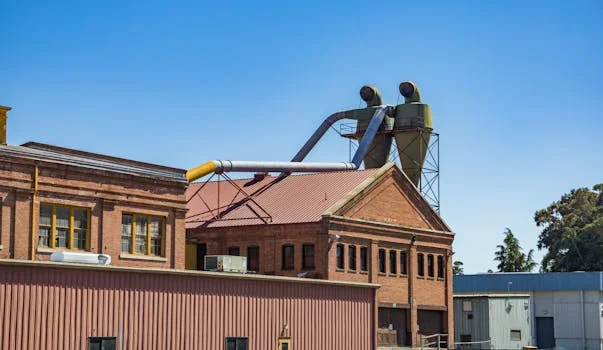
The functionality of an industrial dust collection system is a precisely engineered sequence of operations designed to efficiently capture, filter, and contain airborne particulates. This process, driven by principles of industrial ventilation, ensures clean air discharge and effective dust management.
- Step 1: Dust Capture at Source. The process begins with strategically placed capture hoods or enclosures at the dust generation points. These hoods are designed to create a localized airflow that entrains dust particles before they can disperse into the ambient air. Capture velocity, the speed at which air enters the hood opening, is critical and typically ranges from 100–500 FPM, depending on the dust's characteristics and disturbance, as guided by ACGIH (American Conference of Governmental Industrial Hygienists) standards.
- Step 2: Air Conveyance through Ductwork. Once captured, the dust-laden air is drawn into a network of ductwork by the system's blower. The ductwork is sized to maintain an optimal transport velocity, usually between 3,500–4,500 FPM, to prevent heavier dust particles from settling and accumulating within the ducts (per HydropureWater design guidelines). Maintaining this velocity minimizes blockages and ensures consistent delivery of dust to the collector.
- Step 3: Filtration. The contaminated airstream enters the dust collector's dirty air plenum, where heavier particles may drop out due to reduced velocity. The air then passes through the filter media (e.g., fabric bags or cartridge filters). As air moves through the filter, dust particles are physically trapped on the surface or within the media matrix. A key design parameter here is the air-to-cloth ratio, which represents the volume of air passing through a given area of filter media. For baghouses, typical ratios are 3:1–6:1 (CFM per square foot of filter media), while for cartridge collectors, they are lower, often 0.5:1–1.5:1, reflecting their higher surface area density.
- Step 4: Pulse-Jet Cleaning. As dust accumulates on the filter surface, it forms a "dust cake," which initially enhances filtration efficiency but eventually increases airflow resistance (pressure drop). To maintain optimal airflow and filtration, a pulse-jet cleaning mechanism periodically blasts compressed air (at 60–100 PSI) into the interior of the filters for 0.1–0.3 seconds. This sudden expansion dislodges 90–95% of the accumulated dust cake, which then falls into the hopper below. The cleaning cycle is typically automated and initiated by a differential pressure sensor across the filters.
- Step 5: Dust Discharge. The dislodged dust collects in the hopper, which is designed with a minimum slope of 45–60° to promote gravity flow. From the hopper, the dust is continuously or intermittently discharged using a rotary valve (airlock) operating at 10–30 RPM, a screw conveyor, or other material handling equipment, into sealed drums, bins, or other disposal containers. This prevents dust re-entrainment and maintains the system's negative pressure.
- Step 6: Air Discharge or Recirculation. After passing through the filter media, the now-cleaned air exits the collector through the clean air plenum. This purified air can either be discharged directly to the atmosphere, meeting EPA emission standards (<10 mg/Nm³ for baghouses), or recirculated back into the facility. For recirculation, an additional safety filter, such as a HEPA filter, is often employed, achieving 99.97% efficiency at 0.3 µm to ensure worker safety and comply with indoor air quality regulations.
Types of Industrial Dust Collectors: Efficiency, Cost, and Use-Case Comparison
Selecting the appropriate industrial dust collection system hinges on understanding the distinct characteristics, efficiencies, and cost implications of each type relative to specific industrial applications. Different dust collector designs are optimized for varying particulate sizes, dust loads, and facility requirements.
- Baghouse Dust Collectors: These systems achieve high removal efficiencies, typically 99.9% or greater for particles down to 1 micron. They are best suited for high-volume air applications (5,000–50,000 CFM) and excel at handling heavy dust loads, including abrasive dusts like coal, cement, and woodworking particulates. While offering excellent performance, baghouses generally have a larger footprint and can incur higher maintenance costs due to filter replacement, though individual bag filters can last 1–3 years.
- Cartridge Dust Collectors: Known for their compact footprint and high filtration efficiency, cartridge collectors typically achieve 95–98% efficiency for fine particulates ranging from 0.3 to 10 µm. They are ideal for applications with moderate dust loads, such as welding fumes, metal grinding, and pharmaceutical powders. Cartridge systems often consume less energy, typically 0.3–1.0 kW per 1,000 CFM, due to their efficient pulse-jet cleaning and lower static pressure requirements. However, filters generally have a shorter lifespan (6–18 months) compared to baghouse bags.
- Cyclone Separators: Operating on centrifugal force, cyclone separators are primarily used as pre-filters for removing large, coarse particles (>10 µm) before they reach more sensitive downstream filters. They offer 70–90% efficiency for larger particulates and are characterized by low maintenance requirements since they have no moving parts or filter media. Cyclones are cost-effective for high-dust-load applications where bulk material recovery is a priority, but they are insufficient for meeting stringent emission standards on their own.
- Electrostatic Precipitators (ESPs): ESPs utilize electrostatic forces to charge and collect particulate matter. They are highly efficient, achieving 99%+ removal for sub-micron particles, including fumes and mists. ESPs are often deployed in power generation, cement, and chemical industries. While offering exceptional performance and low pressure drop, they entail a high capital cost, typically ranging from $500–$2,000 per CFM, and require significant space.
- Wet Scrubbers: These systems capture dust by contacting it with a scrubbing liquid, typically water, making them suitable for sticky, hot, or explosive dusts (e.g., aluminum, pharmaceuticals). Wet scrubbers achieve 95–99% efficiency depending on the design. They can also simultaneously remove gaseous pollutants. Key considerations include water consumption (0.5–2 GPM per 1,000 CFM), wastewater treatment, and corrosion potential. For integrated SO₂ removal and particulate collection, an integrated FGD scrubber for SO₂ removal and particulate collection offers a comprehensive solution.
| Dust Collector Type | Typical Efficiency | Ideal Particle Size | Typical Application | Energy Consumption (per 1,000 CFM) |
|---|---|---|---|---|
| Baghouse | 99.9%+ | >1 µm | High-volume, abrasive dust (cement, coal) | 0.5 – 1.5 kW |
| Cartridge | 95 – 98% | 0.3 – 10 µm | Fine particulates (welding, grinding, pharma) | 0.3 – 1.0 kW |
| Cyclone | 70 – 90% | >10 µm | Pre-filter, large particles (wood chips) | 0.1 – 0.3 kW (no filter media) |
| Electrostatic Precipitator (ESP) | 99%+ | Sub-micron | Fumes, mists, very fine particles | 0.1 – 0.3 kW |
| Wet Scrubber | 95 – 99% | >1 µm (sticky, explosive) | Sticky, explosive, hot dusts (aluminum, pharma) | 1.0 – 2.0 kW (plus water) |
Selecting the Right Dust Collection System: Decision Framework for Engineers
Choosing the optimal industrial dust collection system requires a structured, multi-faceted evaluation that considers the specific characteristics of the dust, regulatory mandates, operational costs, and maintenance implications. A systematic decision framework helps engineers and EHS managers specify a system that meets both performance and financial objectives.
- Step 1: Dust Characterization. Begin by thoroughly analyzing the dust to be collected. This includes particle size distribution (e.g., D50, D90), abrasiveness, explosivity (Kst and Pmax values for NFPA 68/69 compliance), moisture content, temperature, and chemical composition. This data dictates filter media selection, explosion protection requirements, and potential for caking or bridging.
- Step 2: Air Volume Requirements. Calculate the total air volume (CFM) needed for effective capture. This involves determining the number and type of capture hoods, their capture velocities (e.g., 100–500 FPM per ACGIH), and the total system static pressure drop. Accurate CFM calculation is crucial for sizing the blower and ensuring adequate ventilation for industrial air filtration.
- Step 3: Regulatory Compliance. Identify and prioritize all applicable environmental and safety regulations. This includes EPA emission standards (e.g., <10 mg/Nm³ for baghouses, <5 mg/Nm³ for HEPA-filtered recirculation systems), OSHA Permissible Exposure Limits (PELs), and NFPA standards for combustible dust. Compliance is non-negotiable and dictates fundamental system design features.
- Step 4: Energy Efficiency. Evaluate the system's potential energy consumption. Consider the blower's horsepower (HP) and efficiency, the frequency and duration of pulse-jet cleaning cycles, and the pressure drop across the filter media. Higher efficiency motors, variable frequency drives (VFDs), and filter media with longer lifespans can significantly reduce operational expenditure (OPEX).
- Step 5: Cost Analysis. Conduct a comprehensive cost analysis, encompassing both Capital Expenditure (CAPEX) and Operational Expenditure (OPEX). CAPEX typically ranges from $10–$100 per CFM, depending on system complexity and type. OPEX, including energy, filter replacements, and labor, can range from $0.50–$2.00 per CFM/year. Consider the total cost of ownership (TCO) over the system's lifespan.
- Step 6: Maintenance Requirements. Assess the long-term maintenance needs. This includes filter replacement schedules (e.g., 1–3 years for baghouse bags, 6–18 months for cartridge filters), hopper cleaning frequency, ductwork inspection intervals, and ease of access for component servicing. A system like the Pulse Jet Baghouse is designed for ease of maintenance in demanding environments like coal-fired boilers.
Real-World Efficiency Data: How Dust Collectors Perform in Industrial Applications
Understanding the practical performance benchmarks of industrial dust collection systems is essential for validating vendor claims and setting realistic expectations for air quality improvement. Real-world efficiency data provides concrete evidence of particulate removal capabilities and operational characteristics across various applications.
- Baghouse Systems: In heavy industrial settings, such as cement plants or coal-fired power facilities, baghouse systems consistently achieve 99.9% removal efficiency for coal dust (particle size 1–100 µm). Typical operating pressure drop ranges from 4–8 in. w.g. across the filter bags, indicating effective dust cake formation and cleaning cycles (HydropureWater field data, 2025). This high efficiency is critical for meeting stringent EPA emission standards for industrial facilities.
- Cartridge Systems: For metalworking operations involving grinding or welding, cartridge collectors demonstrate approximately 98% removal efficiency for fine metal dust (0.3–10 µm). These systems often exhibit energy consumption around 0.5 kW per 1,000 CFM, making them an energy-efficient choice for fine particulate removal in compact spaces.
- Cyclone Separators: As primary separators, cyclones typically achieve 85% removal efficiency for coarser wood dust (>10 µm) in sawmills or woodworking shops. Their main advantage lies in their low operating cost due to the absence of filter media replacement, though they are not suitable for fine particulate capture alone.
- Wet Scrubbers: In pharmaceutical manufacturing, wet scrubbers effectively capture sticky or hydroscopic dusts, achieving up to 99% removal efficiency. These systems typically consume about 1 GPM of water per 1,000 CFM of air treated, a factor that must be balanced with wastewater treatment costs.
- Electrostatic Precipitators (ESPs): For applications requiring the removal of sub-micron particles, such as oil mist or fine fumes, ESPs demonstrate exceptional performance, often exceeding 99.5% removal efficiency. Their energy consumption is relatively low, ranging from 0.1–0.3 kW per 1,000 CFM, primarily for charging the plates and maintaining airflow.
| Dust Collector Type | Application Example | Achieved Removal Efficiency | Key Operating Parameter |
|---|---|---|---|
| Baghouse | Coal/Cement Dust | 99.9% (>1 µm) | Pressure drop: 4–8 in. w.g. |
| Cartridge | Metalworking Dust | 98% (0.3–10 µm) | Energy consumption: 0.5 kW/1,000 CFM |
| Cyclone | Wood Dust | 85% (>10 µm) | No filter media replacement costs |
| Wet Scrubber | Pharmaceutical Dust | 99% | Water consumption: 1 GPM/1,000 CFM |
| Electrostatic Precipitator | Sub-micron Fumes | 99.5% | Energy consumption: 0.1–0.3 kW/1,000 CFM |
Troubleshooting Common Dust Collection Problems: Solutions for Operators

Operators frequently encounter several common issues that can compromise the efficiency and compliance of an industrial dust collection system. Prompt diagnosis and resolution are critical to maintaining air quality and operational continuity.
- High Pressure Drop (>10 in. w.g.): This indicates excessive resistance to airflow, often caused by filter blinding or an ineffective cleaning mechanism.
- Causes: Overloaded filters, improper pulse-jet timing/pressure, incorrect filter media for the dust type, or moisture in the compressed air.
- Solutions: Adjust pulse-jet duration (0.1–0.3 seconds) or pressure (60–100 PSI), increase cleaning frequency, inspect solenoids and diaphragms, or replace clogged filter media. Consider filters with different coatings or pore sizes if blinding persists.
- Dust Leakage: Visible dust escaping from the collector or exhaust indicates a breach in containment.
- Causes: Damaged filter media (tears, holes), poor seal integrity (gaskets around filters or access doors), or cracks in the collector housing.
- Solutions: Conduct a thorough inspection for damaged filters (e.g., using a fluorescent leak detection powder), replace filters every 1–3 years for bags or 6–18 months for cartridges as needed, inspect and replace worn gaskets or seals, and repair any housing damage.
- Low Airflow: Insufficient suction at capture points, leading to visible dust escape.
- Causes: Blockages in ductwork, worn blower impeller, incorrect blower rotation, motor failure, or excessive system static pressure.
- Solutions: Inspect and clean ductwork for obstructions, check blower RPM and static pressure readings, verify motor functionality, and ensure proper belt tension on belt-driven fans.
- Hopper Bridging: Dust accumulating in the hopper and not discharging, leading to collector overload.
- Causes: High moisture content in dust, cohesive dust characteristics, insufficient hopper slope (<45°), or non-functional discharge device.
- Solutions: Install hopper vibrators or air cannons to promote flow, increase hopper slope to 60° if possible, ensure discharge devices (e.g., rotary valve) are operating correctly, and consider insulation or heating for moist applications.
- Excessive Energy Consumption: Higher-than-normal power bills for the dust collection system.
- Causes: Oversized blower operating inefficiently, clogged filters requiring more frequent cleaning, or leaks in compressed air lines for pulse-jet systems.
- Solutions: Adjust blower speed with a Variable Frequency Drive (VFD) to match actual airflow requirements, replace clogged filters, repair compressed air leaks, and ensure cleaning cycles are optimized for dust load, not excessive frequency.
Frequently Asked Questions
Understanding the fundamental differences and operational aspects of industrial dust collection systems is crucial for making informed decisions. Here are answers to common technical and operational questions.
What is the difference between a baghouse and a cartridge dust collector?
Baghouse dust collectors utilize fabric bags (e.g., polyester, PTFE) as filter media, typically achieving 99.9% efficiency for high-volume applications and abrasive dusts. Cartridge dust collectors employ pleated, compact filters (often polyester/cellulose with nanofiber coatings) that achieve 95–98% efficiency for fine particulates and offer a smaller footprint, making them suitable for moderate dust loads and space-constrained environments.
How often should dust collector filters be replaced?
The replacement frequency for filters varies significantly based on dust load, type, and cleaning effectiveness. Baghouse filters typically last 1–3 years, while cartridge filters generally require replacement every 6–18 months. Regular monitoring of pressure drop is the best indicator for filter replacement.
What is the typical energy consumption of a dust collection system?
Energy consumption primarily depends on blower size and cleaning mechanism. For pulse-jet baghouses, typical consumption ranges from 0.5–1.5 kW per 1,000 CFM. Cartridge systems, often designed for lower static pressure, may consume 0.3–1.0 kW per 1,000 CFM. This includes power for the blower and compressed air for cleaning.
Can dust collection systems handle explosive dust?
Yes, industrial dust collection systems can be engineered to handle explosive dusts, but they require specific safety features to comply with NFPA 68 (Explosion Protection by Deflagration Venting) and NFPA 69 (Standard on Explosion Prevention Systems). These designs may include explosion vents, spark detection and extinguishing systems, chemical suppression systems, isolation valves, and specific construction materials to mitigate explosion risks.
What are the EPA emission limits for industrial dust collectors?
EPA emission limits vary by industry and specific regulations (e.g., New Source Performance Standards - NSPS). For general industrial baghouses, a common benchmark is <10 mg/Nm³ (milligrams per normal cubic meter). For systems recirculating air into a facility or requiring ultra-fine particulate removal, HEPA-filtered systems can achieve <5 mg/Nm³ (per EPA NSPS guidelines) or even lower, ensuring compliance with strict air quality standards.
Related Equipment
- integrated FGD scrubber for SO₂ removal and particulate collection — view specifications, capacity range, and technical data
Need a customized solution? Request a free quote with your specific flow rate and pollutant parameters.