Singapore's municipal sewage treatment plants feed NEWater production through water reclamation plants that treat domestic and industrial used water under PUB oversight. The planned Tuas WRP is sized for 800,000 m³/day as a dual-stream plant, 650,000 m³/day domestic plus 150,000 m³/day industrial, before RO polishing for NEWater. Earlier programme materials cited a 2026 readiness date; PUB's DTSS page now schedules phased commissioning from 2027. A municipal sewage treatment plant Singapore cost review here covers effluent targets, process trains, CAPEX/OPEX bands (SGD 2–5M/MGD class estimates in older tender framing), and equipment checks for PPP suppliers.
Municipal Sewage Treatment Plant Singapore Cost
A municipal sewage treatment plant Singapore cost benchmark for a 100,000 m³/day water reclamation plant is SGD 200–300 million in capital, or about SGD 2–3 million per MLD. Operating cost sits at SGD 0.30–0.50 per m³ treated. Mechanical and electrical equipment is about 40% of that capital band. Civil works take about 30%.
Three items move a scheme inside that SGD 200 million to SGD 300 million band. A higher industrial share raises DAF, odour control and RO fouling allowance. Full duty-standby on blowers, membranes and UV adds capital with little extra average flow. Sludge drying and incineration interfaces add civil height and power.
Most plants we size for a domestic-only stream, at the same 100,000 m³/day, land nearer the lower end of SGD 2–3 million per MLD. Older tender framing still uses SGD 2–5M/MGD class estimates when bidders scale from million-gallon units. Treat that MGD band as a cross-check, not as a second budget. The line-item SGD table sits in the CAPEX section below.
Operating cost benchmarks sit at SGD 0.30–0.50/m³. Energy is about 40% of OPEX, maintenance about 25%, and chemicals about 20%. Sludge incineration disposal runs about SGD 150–250 per ton, so cake dryness moves the PPP return. Do not compare this unit OPEX with a whole-programme tunnel budget.
DTSS Deep Tunnel Sewer Treatment Plant Equipment
DTSS deep tunnel sewer treatment plant equipment serves a network that, across both phases, totals about 206 km of deep tunnels and link sewers to three centralised WRPs at Changi, Kranji and Tuas. Phase 2 is a 98 km deep-tunnel and link-sewer network to Tuas. Tuas is dual-stream at 650,000 m³/day domestic plus 150,000 m³/day industrial. PUB's 21 August 2023 press release said Tuas WRP would be ready in 2026.
The current DTSS page and PUB's Green Bond Report for FY2024 both schedule phased commissioning from 2027. According to PUB's DTSS page, the whole system cost about $10 billion and is designed for a 100-year life. Phase 1, completed in 2008, is a 48 km deep sewer from Kranji to Changi plus 60 km of link sewers. Changi WRP sits on 32 hectares and is designed for 800,000 m³/day, with an ultimate 2,400,000 m³/day.
PUB's 21 August 2023 press release lists current Changi capacity at 1,020,000 m³/day, against that initial 800,000 m³/day. The facility table below keeps an earlier combined figure of 416,000 m³/day for Changi WRP Phase 1 and 2. Use 1,020,000 m³/day when you size interfaces to the live plant. Ulu Pandan remains listed at 361,000 m³/day, and Kranji at 150,000 m³/day, in that same table.
| Facility Name | Design Capacity (m³/day) | Primary Technology | Output Destination |
|---|---|---|---|
| Tuas WRP | 800,000 | Dual-stream MBR + RO | NEWater / Industrial Supply |
| Changi WRP (Phase 1 & 2) | 416,000 (Combined) | Step-feed Activated Sludge | NEWater Feedstock |
| Ulu Pandan WRP | 361,000 | MBR + RO | NEWater / Industrial Supply |
| Kranji WRP | 150,000 | Conventional Activated Sludge | Sea Discharge / NEWater |
How does gravity conveyance change the plant concession?
Gravity conveyance changes a Singapore WRP concession by removing many intermediate pumping stations and by freeing surface land. PUB runs collection, treatment, reclamation and discharge as one agency. The Four National Taps are local catchment, imported water, desalinated water and NEWater. Earlier industry briefings often cited NEWater at about 40% of national demand (PUB 2024 framing in prior project notes).
Four NEWater factories remain online after Bedok closed on 31 July 2024. PUB states the used-water land footprint falls by half, freeing up to 150 hectares, once intermediate stations and conventional plants are phased out. Before DTSS, six catchments used over 130 pumping stations. Equipment on the remaining nodes must suit large centralised trains and long DBOO horizons, typically around 25 years.
Phase 1 discharges through a 5 km outfall. Phase 2 uses a near-shore outfall at Tuas (PUB, 21 August 2023). Outfall length does not relax the NEWater-path target. Sea discharge is the excess route, not the design case for MBR filtrate.
PUB tenders weight technical merit and financial viability heavily (commonly cited as about 60%/40% in market practice). KPIs centre on effluent quality, specific energy (kWh/m³) and uptime. For smaller satellite or industrial pre-treatment packages outside the mega-WRP scope, an Underground Package Sewage Treatment Plant (WSZ Series) can serve constrained sites before sewer discharge.
Phase 2 conveyance gear is sized to the tunnel, not to a shallow sewer. The south domestic tunnel is 28 km, 3–6 m in diameter and 35–55 m deep. The industrial tunnel is 7 km, 3.3–4 m in diameter and 45–55 m deep. Link sewers add 63 km at 0.3–3 m diameter (PUB, 21 August 2023).
Phase 2 tunnels sit roughly 35–55 m deep on domestic lines and 45–55 m on industrial lines (PUB, 2023). Isolation gates, air jumpers and fibre-optic structural monitoring sit in that tunnel contract. Concrete resistant to microbiologically influenced corrosion lines the sewer. Screening and grit removal must resist abrasion and ragging, or pump wear and MBR fouling follow.
Singapore PUB WRP Effluent Compliance Standards
Singapore PUB WRP effluent compliance standards used in this guide hold final effluent BOD below 20 mg/L and TSS below 30 mg/L before NEWater feedstock or sea discharge. The comparison table keeps those values under a PUB Singapore (Standard A) column, beside EU Directive 91/271/EEC and US EPA secondary figures. Total Nitrogen is typically held near 10 mg/L to protect membranes and RO recovery, against the 15 mg/L band often cited under EU Urban Waste Water Directive practice.
Those 20 mg/L and 30 mg/L figures are final-effluent targets in this guide. They are not the public-sewer trade limits. PUB's requirements for discharge into public sewers cap 5-day BOD at 20°C at 400 mg/L, COD at 600 mg/L and TSS at 400 mg/L. Temperature must not exceed 45°C, and pH must stay between 6 and 9, at the point of entry.
A fee scheme allows BOD or TSS above 400 mg/L and up to 6,000 mg/L if PUB agrees. COD must stay at or below 10,000 mg/L, or three times the BOD, whichever is lower. The 401–600 mg/L band is charged at 37.45 cents per cubic metre for BOD₅ and the same rate for TSS. Most plants we size for trade premises still fail first on grease, not on BOD.
Grease and oil limits at the sewer are 60 mg/L for hydrocarbon oil and 100 mg/L for non-hydrocarbon oil. Caustic alkalinity must not exceed 2,000 mg/L as calcium carbonate. TDS is capped at 3,000 mg/L in the same sewer standard. Poor FOG control shortens membrane life on the WRP that receives the flow.
State the limit you are designing to in the bid data sheet. A package that meets only the sewer cap of 400 mg/L BOD will not meet a final-effluent target below 20 mg/L BOD. The reverse also wastes energy: designing every trade premise to NEWater filtrate quality. Pick the table column that matches the discharge point, then show the sampling location.
| Parameter | PUB Singapore (Standard A) | EU Directive 91/271/EEC | US EPA Secondary Standards |
|---|---|---|---|
| BOD₅ (mg/L) | < 20 | < 25 | < 30 |
| TSS (mg/L) | < 30 | < 35 | < 30 |
| Total Nitrogen (mg/L) | < 10 | < 15 | N/A (State dependent) |
| Total Phosphorus (mg/L) | < 1 | < 2 | N/A |
| E. coli (CFU/100mL) | < 100 | N/A | < 200 |
Newer plants also face a dual-stream influent profile. Tuas separates domestic used water from high-strength industrial used water at source. Industrial streams carry FOG from food premises and residuals from biomedical hubs. Utilizing MBR systems for NEWater-compliant effluent remains the usual compact baseline when RO-ready filtrate is required.
Tuas WRP MBR RO Process Design
Tuas WRP MBR RO process design treats domestic and industrial used water as separate modules, then polishes domestic filtrate for NEWater. According to PUB's Green Bond Report for FY2024, Tuas WRP will treat 800 MLD (800,000 m³/day) and house the world's largest membrane bioreactor facility. The same report states NEWater recovery up to 85% from domestic used water at Tuas NEWater Factory 1. That factory is described as producing up to 25 million gallons per day.
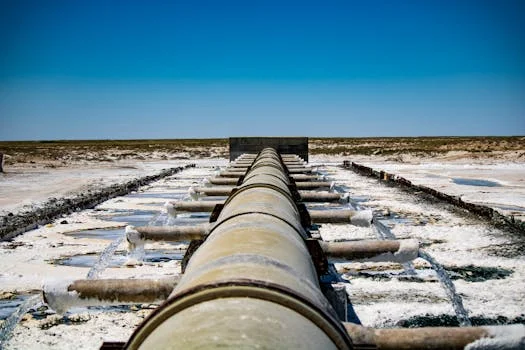
Domestic and industrial modules should not share one biological basin. Domestic used water at Tuas is the NEWater feedstock path, with MBR filtrate sent onward to RO. Industrial used water carries higher FOG and variable COD, so it needs its own protection before any reuse. Mixing the streams to average the load undoes the dual-tunnel investment.
At Tuas-class plants, fine screening (6 mm to 1 mm) precedes primary sedimentation. For lipid-rich industrial streams, dissolved air flotation (DAF) systems protect membranes from FOG fouling. Primary clarifiers are commonly sized at hydraulic loading rates of 0.5–1.0 m³/m²·h so solids capture holds during tropical peak wet weather. Most plants we size for industrial FOG spikes still run DAF ahead of MBR rather than relying on screens alone.
Secondary treatment often uses membrane bioreactor trains. MBRs in Singapore projects typically run at 15–25 L/m²·h flux. Energy use sits near 0.6–0.8 kWh/m³ versus 0.3–0.5 kWh/m³ for conventional activated sludge, but filtrate quality supports RO. PUB's FY2024 estimate for the whole Tuas WRP is 0.17 kWh/m³, and that figure excludes DTSS pumping and renewable energy consumption.
RO then cuts TDS to < 50 mg/L, with UV disinfection and pH conditioning. For residual control on distribution networks, engineers often specify PUB-approved ClO₂ generators for NEWater disinfection to limit chlorinated DBPs relative to free chlorine alone. Sludge stays onshore under Singapore's zero-sludge-export practice. Anaerobic digestion typically cuts volatile solids by 30–35%, then thermal drying precedes incineration; ash goes to construction use or Semakau Landfill.
Dewatering gear should deliver about 25–35% dry solids so incineration fuel demand stays manageable. Cake dryness is the lever on the SGD 150–250 per ton incineration cost. Do not drop the press specification to chase a cheaper machine if the cake falls below that band. Keep two influent sampling points in the control narrative, one per stream.
How should aeration equipment be specified for municipal plants?
Aeration packages for Singapore municipal plants should match peak oxygen demand, tropical diffuser fouling risk and tender energy KPIs. Fine-bubble diffused air remains the default for MBR and CAS basins. Turndown, DO control and spare blowers decide whether biology holds 0.6–0.8 kWh/m³. Bid packages must cover airflow design, operating envelopes, maintenance access and 25-year spares, not nameplate efficiency alone.
Singapore's M&E-heavy WRPs differ from modular builds such as package wastewater treatment plants in India, where compact aeration skids dominate. Prove blower turndown under wet-weather dilution and industrial COD spikes before claiming energy savings in a PUB bid. Most plants we size for tropical basins foul fine-bubble diffusers faster in the first year than the clean-water curve. State that fouling margin on the data sheet.
What Do Disinfection Systems Typically Cost?
Disinfection systems for a Singapore WRP are usually a small share of capital, yet they drive a recurring operating cost and shutdown risk. UV reactors cover protozoa barriers on NEWater trains; chlorine dioxide or chloramine residuals protect long distribution mains. Project teams usually fold disinfection into chemical and M&E budgets rather than a standalone megawatt package. Plant OPEX still clusters near SGD 0.30–0.50/m³, with chemicals about 20% of that band in the cost section below.
Capital for generators, UV trains and contact systems scales with flow and redundancy. Pair residual chemical cost with membrane CIP chemicals; both move with recovery and fouling. Buyers comparing cities can start from a wastewater treatment plant cost breakdown for Tashkent, then adjust for Singapore's automation and membrane intensity. Most plants we size for NEWater mains keep a residual chemical, because UV alone leaves the network unprotected.
UV dose should be stated at end-of-lamp life and at the design transmittance, not at new-lamp clear water. Chlorine dioxide dose should state the residual at the furthest main, plus generator redundancy. A single duty generator with no installed standby is a shutdown risk on a NEWater main. Keep chemical storage inside the same hazardous-area rules as the rest of the WRP.
NEWater Reuse Membrane Bioreactor Singapore Tender
A NEWater reuse membrane bioreactor Singapore tender is scored on filtrate quality, specific energy and 25-year life-cycle cost. MBR trains often claim 50–70% space savings versus conventional layouts. Buyers should score 25-year LCC, not purchase price alone. Centrifuges save floor area in sludge halls, yet a high-solids sludge dewatering for PUB’s zero-export policy with a plate and frame press can reach about 35% cake dryness and cut incineration fuel.
Membrane choice drives NEWater reliability. PUB's 2023 durability testing notes favour PVDF MBR membranes over polyamide where aggressive CIP is routine. RO stages standardise on low-fouling composites. UV remains the primary barrier for Cryptosporidium and Giardia; chlorine dioxide often supplies the network residual.
Sites that cannot wait on DTSS links sometimes stage an interim package, similar in role to package wastewater treatment plants in Nigeria. Flows then migrate once deep-tunnel capacity opens. For large municipal bids, engineers should consult an MBR vs. CAS vs. SBR for municipal sewage treatment comparison when defending energy-to-effluent ratios in the technical score.
Put four numbers on the first technical page: design flux in L/m²·h, filtrate turbidity, specific energy in kWh/m³ and cake dryness. Add the membrane replacement year and a 25-year spare list. PUB's weight on technical merit, commonly cited as about 60% beside 40% financial, means a cheap skid with a thin spare list loses. Most plants we size for PUB technical scores lose points on spares, not on nameplate flux.
| Technology Category | Preferred Option in Singapore | Selection Rationale | Key KPI |
|---|---|---|---|
| Biological Treatment | MBR (Membrane Bioreactor) | Small footprint; RO-ready filtrate | < 0.1 NTU Turbidity |
| Primary Clarification | DAF (Dissolved Air Flotation) | Superior FOG removal for industrial streams | > 95% FOG removal |
| Sludge Dewatering | Plate & Frame Filter Press | Highest cake solids for incineration | > 30% DS (Dry Solids) |
| Disinfection | UV + Chlorine Dioxide | No DBP formation; residual protection | Zero Coliforms |
Municipal Sewage Treatment CAPEX OPEX Singapore SGD
Municipal sewage treatment CAPEX and OPEX in SGD for a 100,000 m³/day Singapore WRP currently range between SGD 200 million and SGD 300 million, depending on industrial influent complexity. That equates to roughly SGD 2–3 million per MLD for a standard MBR-based plant. Civil works take about 30% of CAPEX; mechanical and electrical (M&E) equipment takes about 40%, reflecting automation and membrane intensity. Commissioning and testing take about 20%, and land plus preliminary costs take about 10%.
Programme money is a different pile. According to PUB's 21 August 2023 press release, DTSS Phase 1 cost $3.4 billion and DTSS Phase 2 is estimated at $6.5 billion, tunnels and Tuas WRP included. The DTSS page puts the full DTSS at about $10 billion. Do not paste the $6.5 billion figure into a 100,000 m³/day equipment bid.
Operational expenditure benchmarks typically sit at SGD 0.30–0.50/m³. Energy dominates at about 40% of OPEX, then maintenance (25%) and chemicals (20%). MBR membranes are commonly replaced every 8–10 years; RO membranes every 3–5 years. Based on PUB's 2024 tender data cited in prior market notes, RO membrane replacement averages SGD 50–80 per square meter.
Sludge incineration disposal runs about SGD 150–250 per ton, so cake dryness directly moves PPP returns. Most plants we size for cake below 25% dry solids watch incineration fuel erase the press saving. Read each row below as a share of the SGD 200M – 300M total, not as an extra adder on top of that total.
| Cost Component | Estimated Benchmark (SGD) | Percentage of Total |
|---|---|---|
| Mechanical & Electrical (M&E) | SGD 80M – 120M | 40% |
| Civil & Structural Works | SGD 60M – 90M | 30% |
| Commissioning & Testing | SGD 40M – 60M | 20% |
| Land & Preliminary Costs | SGD 20M – 30M | 10% |
| Total CAPEX (100k m³/day) | SGD 200M – 300M | 100% |
Who This Checklist Serves
EPC contractors, membrane OEMs and M&E packagers bidding PUB WRP or NEWater packages are the readers this checklist serves. Buyers needing only small rural packages without sewer rules should look elsewhere, because those needs diverge from DTSS-scale KPIs. Next step: map FOG load, energy in kWh/m³ and cake dryness, then request a quote with flow, COD/FOG and discharge standard attached. Attach the numeric sewer limit you must meet, not a generic clean-water note.
- Confirm dual-stream vs combined influent and FOG peaks.
- State MBR flux, turbidity and RO feed SDI assumptions.
- Show aeration turndown and specific energy at average and peak flow.
- Prove dewatering dry solids ≥25–35% for incineration economics.
- Include UV plus residual disinfectant redundancy for network stability.
- Submit 25-year LCC with membrane replacement intervals stated.
- Document integration interfaces to existing WRP/NEWater assets.
Frequently Asked Questions
How many municipal water reclamation plants are currently operating in Singapore?
Singapore operates five major Water Reclamation Plants for domestic and industrial used water, feeding NEWater factories where applicable. Catchments cover Changi in the east, Tuas, Ulu Pandan and Jurong in the west, and Kranji in the north. Tuas is the dual-stream DTSS Phase 2 node, and PUB schedules phased commissioning from 2027. The plant table below is the location checklist suppliers still use. Four NEWater factories remain online after Bedok closed on 31 July 2024.
| Plant Name | Location | Primary Function |
|---|---|---|
| Changi WRP | East | Largest current plant; feeds NEWater |
| Tuas WRP | West | Dual-stream treatment (Domestic/Industrial) |
| Ulu Pandan WRP | West | MBR-focused; feeds industrial sector |
| Kranji WRP | North | Serves northern residential zones |
| Jurong WRP | West | Industrial-heavy influent management |
What energy targets apply to Singapore sewage plants?
PUB scores Singapore sewage plants on kWh/m³. The FY2024 Green Bond Report estimates Tuas WRP at 0.17 kWh/m³, excluding DTSS pumping and renewable energy. MBR basins still sit near 0.6–0.8 kWh/m³, versus 0.3–0.5 kWh/m³ for conventional activated sludge. An often-cited MBR goal is near 0.4 kWh/m³, and MBR plus RO plants sit around 0.8–1.0 kWh/m³. Bids showing ≥10% savings versus those benchmarks gain technical weight, including in Oman’s PPP tender requirements for municipal sewage treatment.
Can industrial wastewater enter Singapore's municipal plants?
Yes. Industrial wastewater can enter Singapore's municipal plants only after pre-treatment meets the sewer limits, including BOD₅ of 400 mg/L and TSS of 400 mg/L. Tuas adds a dedicated industrial module of 150,000 m³/day for higher organic loads once that stream is online. Highly concentrated wastes often need an on-site MBR systems for NEWater-compliant effluent so sewer discharge does not upset the municipal biology. Off-spec trade effluent risks WRP upset and NEWater feedstock quality.
How does DTSS change equipment selection?
DTSS changes equipment selection by delivering gravity flow to Changi, Kranji and Tuas and by cutting many intermediate pumping stations. Phase 2 tunnels sit roughly 35–55 m deep on domestic lines and 45–55 m on industrial lines (PUB, 2023). Domestic tunnel diameter is 3–6 m over 28 km, and the industrial tunnel is 3.3–4 m over 7 km. Screening and grit removal must resist abrasion and ragging, because failures cascade into pump damage and MBR fouling.
Which wastewater equipment suppliers fit municipal facilities?
Suppliers that fit Singapore municipal facilities document MBR and RO integration, FOG protection, energy in kWh/m³ and 25-year LCC spares. PUB awards on technical and financial scoring, commonly cited as about 60%/40% in market practice, not on brand lists. Bring WRP-scale references, a PVDF-compatible CIP regime and clear interfaces to NEWater UV plus residual disinfection. PUB's 2023 durability testing notes favour PVDF MBR membranes over polyamide where aggressive CIP is routine.