Decide Whether the Feed Water Supports Industrial RO
An industrial reverse osmosis system can be suitable for a Gambian facility when the required permeate quality justifies membrane separation and the site can control feed-water solids, scaling, energy use and concentrate disposal. A 2025 study describes the Gambia River as tidal and tropical and reports that its downstream saline region is expanding farther inland. RO produces permeate and a concentrated reject stream, so feasibility depends on the actual source water, production demand, pretreatment requirements and a responsible concentrate route—not on regional context alone.
Begin with a representative sample from the intended source, not a general description of the river or borehole. Ask the laboratory to determine salinity, turbidity, suspended solids, organics, microorganisms, target contaminants and scaling indicators. These results must come from the same source and operating condition that the proposed plant will treat.
The 2025 Gambia River study identifies the river as covering 12% of the country’s area and notes that seawater intrusion is expanding the downstream tidal and saline region inland. It also identifies potential for water reuse in the urban area near the river mouth. That observation provides application context; it does not demonstrate that a particular site has suitable feed water or a viable reject route.
Before requesting equipment quotations, record the following site inputs:
- The feed-water source and location, including whether it is surface water, groundwater, a municipal supply or a process stream.
- A representative analytical report covering the parameters identified above.
- Required production flow, operating hours and whether demand is steady or intermittent.
- The required permeate quality, expressed as the parameters that matter for the intended industrial process water application.
- The recovery objective, feed-water temperature, available electrical supply and permitted pressure-drop conditions.
- Site footprint, equipment access, drainage arrangements and the intended treatment-route constraints.
- The proposed status of the RO concentrate: discharge, reuse in another process or transfer to a separate desalination system.
If these inputs are incomplete, request a design review or conditional quotation tied to a defined feed-water basis. A bidder that prices a plant without stating its feed assumptions has not made the equipment comparable.
Compare the Treatment Route Against the Project Objective
Select RO when dissolved contaminants must be separated from the feed and the required permeate quality cannot be met reliably by the available pretreatment or polishing route alone. The decision should follow the product-water specification, not a generic assumption that one treatment train suits every site.
RO applies pressure to force water through a semi-permeable membrane. Water enters the purified stream while contaminants are retained in a reject stream, according to Veolia Water Technologies. The same commercial source states that the process eradicates over 99% of contaminants including dissolved solids, organics, bacteria and pyrogens. Treat that as a supplier claim, not a project-specific guarantee; the guaranteed result must refer to the buyer’s stated feed and permeate parameters.
The academic reverse-osmosis reference explains that RO removes dissolved material by reversing the natural osmotic flow of solvent across a semi-permeable membrane. It also identifies reverse osmosis as a nitrate-removal method where required. Whether that capability is useful at a specific Gambian site depends on the measured contaminant and the intended water-quality limit.
Use EDI only when the project requires further polishing of RO permeate beyond the defined industrial RO duty. The industrial reverse osmosis system and EDI system should therefore be compared as sequential duties where polishing is required, not as interchangeable descriptions for the same product water.
| Discharge route or influent problem | Governing rule or process option | What data settles it |
|---|---|---|
| Saline or brackish source requiring dissolved-solids separation | Compare a brackish-water treatment or saline-water treatment route using RO when the permeate specification requires membrane desalination. | Feed-water salinity analysis, required permeate quality, production flow and recovery objective. |
| Feed water containing suspended solids, turbidity, colloids or microorganisms | Add membrane pretreatment or other confirmed pretreatment before RO and specify how each unit protects the membranes. | Representative source-water analysis and supplier design basis, including the proposed pretreatment train. |
| RO permeate requires additional deionization | Use EDI as a downstream polishing step; otherwise specify RO alone. | Finished-water conductivity, remaining ionic requirements, intended use and site water-quality specification. |
| Wastewater or process stream is a potential reuse feed | Assess the reuse treatment train against the source contaminants and the required industrial process water quality. | Influent characteristics, target contaminants, flow variation and the required product-water parameters. |
| RO concentrate has no confirmed destination | Do not approve the route until discharge, reuse or transfer arrangements are identified. | Concentrate flow and composition estimate, drainage limits, receiving process and named responsible party. |
Build the Pretreatment and Reject-Management Scope
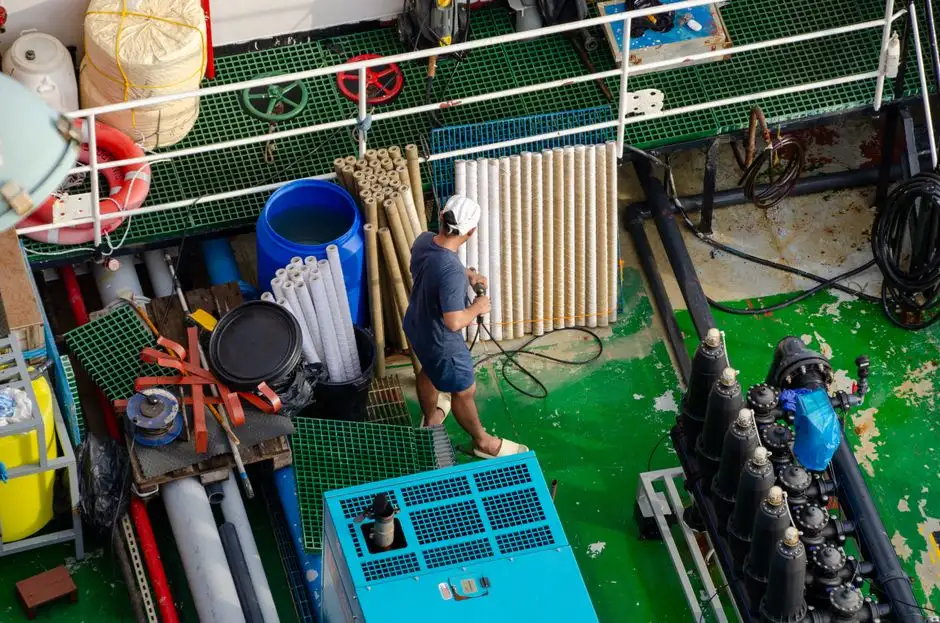
Price the complete water-treatment train, not only the membrane skid. A credible RO package should connect the confirmed feed analysis to specific pretreatment equipment, the recovery approach and a documented concentrate route.
Ask each bidder to explain its pretreatment recommendation against the laboratory results and stated recovery target. The [RO pretreatment multi-media filter](https://example.com/product/7-multi-media-filter-ultrapure-water.html) is described as removing suspended solids, turbidity and colloidal matter to produce SDI values suitable for downstream RO membrane protection. Confirm that applicability through the supplier’s design calculation; the equipment description alone does not establish suitability for the site feed.
Ultrafiltration may be required where the design basis calls for it. Veolia Water Technologies states that RO can be combined with processes such as ultrafiltration and that reject can be discharged or recycled in other processes. For comparison, the buyer can also compare UF and MBR for reuse treatment when the real feed is wastewater rather than a saline source.
Require a written concentrate-management statement that identifies collection, disposal or reuse, hydraulic conditions and responsible parties. It should explain how the concentrate flow and composition will be influenced by the feed-water basis, recovery approach and operating schedule. An undefined disposal route is an unresolved commercial and technical exclusion.
For installation scope, ask the supplier to identify included membranes, high-pressure pumps, controls, valves, tanks, pretreatment and commissioning. Product and component options can be reviewed through the supplier’s water-treatment parts, valves and media scope, but the quotation must state which items are actually included.
Issue an RFQ That Exposes Missing Scope and Red Flags
Issue the same design basis to every bidder. Require each response to identify the design feed water, permeate flow, permeate quality, recovery approach, pretreatment scope and concentrate route; otherwise the offers cannot be compared on a common technical basis.
Ask for proposed factory acceptance testing and site acceptance testing criteria covering flow, permeate quality, electrical controls, alarms, leak checks and documentation. These criteria should state the measured parameter, test method, acceptance limit, test condition and responsible witness. Do not accept a general statement that the plant will “meet specification.”
| Quote line item | Technical scope to specify | Red flags to check before signing |
|---|---|---|
| Design basis and feed-water analysis | Source, sample date, analytical results, required flow, operating hours, recovery objective and permeate-quality limits. | Unstated assumptions, generic “typical” feed data or no named sample source. |
| RO membrane system | Stated design feed and permeate flow, recovery approach, membrane arrangement, operating controls and supplied documentation. | Unqualified permeate claims or a performance guarantee unsupported by the stated feed analysis. |
| Permeate quality | Parameters to be tested, test methods, acceptance limits and conditions for each guarantee. | Removal percentages without defining the contaminant, feed condition or test protocol. |
| Pretreatment | Scope, duty basis, required inlet conditions, control sequence and evidence of membrane-protection criteria. | Generic filtration claims without a feed-water basis or unresolved pretreatment exclusions. |
| Concentrate management | Collection, discharge, reuse or transfer route; hydraulic conditions; required collection equipment; and named responsibilities. | Concentrate omitted from the offer or referred to as the buyer’s responsibility without parameters. |
| Pumps, valves, tanks and controls | Equipment list, materials offered, duty requirements, instrument scope, alarm list and control narrative. | Major components excluded, substituted without approval or not identified in the battery limits. |
| Testing and commissioning | FAT and SAT methods, measured parameters, acceptance criteria, documentation, training and handover responsibilities. | Commissioning offered without performance tests, spares, manuals or trained operating personnel. |
| Commercial exclusions | Installation, electrical works, foundations, drainage, permits, analytical services, start-up chemicals, freight, duties and operator training. | Exclusions remain unpriced or material obligations appear after award. |
Review membrane replacement elements and consumables against the proposed duty through the supplier’s RO and UF membrane filter-element scope. Their inclusion does not by itself confirm that the membrane material, geometry or operating limits are appropriate. The bidder must connect the selected elements to the design feed, recovery target and cleaning strategy.
Further Reading
Frequently Asked Questions
How should an industrial RO system be sized for a facility in The Gambia?
Size the system from the required permeate flow, operating hours, measured feed-water quality, recovery objective and permeate specification—not from the membrane skid’s nominal capacity. Obtain a representative laboratory analysis and ask the bidder to state the design feed and calculation basis used for each train.
What should an industrial RO quotation include besides the membrane skid?
Request explicit line items for pretreatment, high-pressure pumps, membranes, controls, valves, tanks, electrical interfaces, concentrate collection, installation, commissioning, FAT, SAT, training and documentation. Also request a list of exclusions so that an industrial reverse osmosis system offer can be normalized before prices are compared.
How can a buyer compare supplier technical capability without accepting unsupported performance claims?
Require every claim to be tied to a stated feed-water basis, parameter, test method and acceptance limit. A supplier that cannot provide this linkage—or cannot explain the concentrate route and pretreatment selection logic—has not demonstrated a project-specific technical basis.
What site and performance tests should be included before final acceptance?
Include FAT and SAT checks for production flow, the specified permeate-quality parameters, controls, alarms, leaks and handover documentation. Before final acceptance, obtain confirmation that the plant operates on the agreed feed basis and that the concentrate route is operational, with exceptions and responsibilities recorded in the acceptance certificate.