Choose the discharge route before choosing equipment
The immediate decision for a South Sudan hospital is identifying which treatment route fits the discharge location and site conditions: a packaged A/O plant, an MBR system, or a compact medical-wastewater unit. South Sudan’s national healthcare-waste guidance assigns healthcare facilities responsibility for safe management and recommends uniform practices, but it does not establish a specific hospital wastewater treatment process or equipment selection. A buyer should compare routes using site wastewater tests, peak flow, land availability, power reliability, reuse requirements, and the receiving authority’s applicable discharge conditions. Overseas hospital data can inform questions, but only the project site and receiving environment can settle the final design.
Obtain written confirmation from the facility, municipal authority, or other receiving authority to identify the discharge point, available sewer connections, the receiving environment, the applicable approval route, and any permitted reuse destination. No South Sudan hospital-effluent discharge limits are supplied in the cited healthcare-waste guidance, so equipment should not be selected against an assumed numerical standard.
Request current site testing for COD, BOD, suspended solids, pH, turbidity, and microbiological indicators. The buyer also needs average and peak wastewater flow, the available footprint, soil and groundwater conditions, power supply, installation access, operator capability, and the intended reuse application. This project-specific information is more useful for preliminary sizing than data from another hospital.
Keep solid healthcare waste and liquid hospital wastewater as separate procurement workstreams. South Sudan’s healthcare-waste guidance calls for uniform waste-management practices throughout healthcare institutions and covers segregation, collection, handling, storage, treatment, and disposal of waste generated from healthcare activities. That responsibility does not, by itself, specify a wastewater process. Use the hospital wastewater treatment engineering and compliance guide to frame technical questions, while treating its discharge and compliance points as items to verify for the South Sudan site rather than local limits.
Compare A/O, MBR and compact treatment systems
Selecting the right architecture requires separating biological treatment, membrane separation, solids removal, and disinfection. These are different design functions; a compact package should not be assumed to provide the same treatment train, control capability, or reuse suitability as a biological plant with membrane separation.
| Discharge route or influent problem | Governing rule or process option | What data settles it |
|---|---|---|
| Site treatment followed by discharge to a receiving environment | Require the proposed A/O, MBR or compact unit to cover the agreed treatment stages, solids removal and disinfection, with the discharge route stated in the design basis. | Discharge-point approval, current effluent analysis, average and peak flow, receiving conditions and required monitoring. |
| Land and installation constraints | Compare footprint, buried or above-ground installation, access requirements, soil and groundwater conditions. A packaged A/O hospital wastewater plant may be evaluated against other layouts without assuming suitability. | Surveyed footprint, soil report, groundwater level, delivery route and installation access. |
| Tight effluent or reuse requirements | Evaluate an MBR hospital wastewater treatment system by the required separation performance, treatment stages, controls and operator intervention. | Effluent targets, reuse application, membrane maintenance provisions and verified site wastewater results. |
| Smaller or segregated wastewater stream | Ask whether a medical wastewater package plant serves only the intended stream or depends on separate collection, equalization and downstream treatment. | Stream inventory, flow profile, segregation limits and confirmation that the package covers the complete duty. |
Require each supplier to state design flow, treatment stages, disinfection method, residual-handling requirements, expected effluent basis, utilities, and operating assumptions. The hospital treatment and disinfection comparison can help frame those questions, but it does not replace site-specific acceptance criteria.
Use overseas measurements carefully. A Kano, Nigeria study of hospital discharge points and other wastewater sources reported mean dissolved oxygen of 3.7 mg/l, mean turbidity of 14.59 NTU, and mean BOD of 1.92 mg/l. These are Nigerian comparative data, not South Sudan discharge limits and not a sizing basis for the proposed hospital.
Make the final selection only after checking land, power, access, operator capability, and the receiving authority’s applicable conditions. If the hospital expects reuse, identify the application and the infection-control constraints before comparing a general wastewater package with a system designed for a defined reuse duty.
Set the disinfection and residual-control requirement
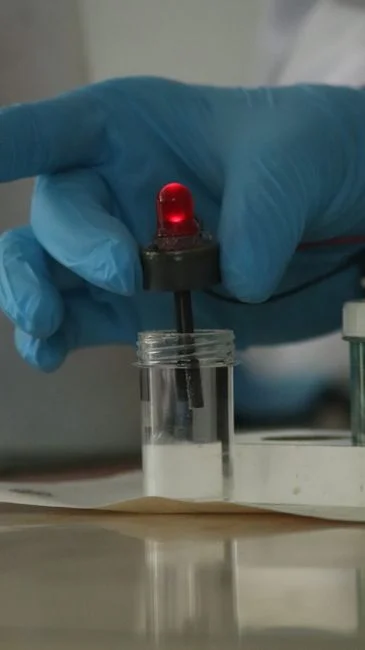
Disinfection must be treated as a controlled treatment stage with measurable operating and residual-management evidence. Ask whether the proposed process uses ozone, chlorine-based treatment, UV, or another validated route, then request the operating-control and residual-monitoring method for the selected option.
The supplier should state the contact time, dose, or intensity applicable to the design flow, how the operating parameter is adjusted, what instruments are supplied, and how the operator verifies performance. Also require procedures for reagent storage, operator exposure controls, chemical handling, and the consequences of an excessive or insufficient residual before discharge.
Research into disinfection by-product formation provides context for comparing peracetic acid and sodium hypochlorite, but it does not establish a South Sudan requirement or authorize either chemical for this project. Ask the receiving authority and the hospital’s infection-control lead which evidence they require for the intended discharge or reuse route.
Compare the disinfection package on operating control and residual consequences, rather than simply on whether it includes a disinfectant generator. The medical wastewater treatment system and the chlorine dioxide generator are equipment references whose proposed application must be checked against the complete wastewater treatment train, site utilities, and the approved residual-handling method.
Build an RFQ scope and acceptance checklist
The RFQ must resolve ownership and evidence rather than merely comparing equipment prices. Attach the measured flow data, effluent analysis, receiving-point requirements, footprint, power supply, soil and groundwater information, access constraints, and reuse needs. State clearly which data the buyer will obtain and which confirmations the supplier must provide.
| Quote line item | Technical scope to specify | Red flags to check before signing |
|---|---|---|
| Design basis and process route | Design flow, wastewater characterization, treatment stages, solids handling, disinfection method, residual management, utilities and expected operating conditions. | Omitted flow basis, missing influent data, unexplained treatment stages or an effluent guarantee with no stated test basis. |
| Equipment and civil interface | General arrangement, process drawings, P&IDs, equipment data sheets, duty points, installation requirements, access and utilities. | Equipment shown without a design duty, undefined civil interfaces or omitted site-specific installation conditions. |
| Disinfection and controls | Contact time, dose or intensity, instruments, control logic, residual monitoring, reagent storage and operator safeguards. | Disinfection named without control or monitoring, or no procedure for residual consequences and chemical handling. |
| Commissioning and acceptance | Commissioning plan, factory and site tests, test certificates, training, O&M manual, spare parts and measurable acceptance criteria. | No test protocol, handover deliverables or pass/fail requirements; critical exclusions left unnamed. |
| Site and long-term responsibilities | Allocate civil works, electrical supply, local approvals, water, chemicals, waste removal, operator training and continuing maintenance. | Supplier and buyer each assume the other will provide utilities, approvals, consumables or trained operators. |
Require process drawings, P&IDs, equipment data sheets, duty points, control philosophy, O&M manuals, training, commissioning plans, and test certificates. Acceptance criteria should identify the sample point, parameter, test method, acceptance condition, and responsible witness. Do not allow “commissioned and operating” to substitute for measurable evidence.
The 30 m³/day hospital MBR case study can inform the structure of a hospital-facility RFQ, but its capacity and project conditions cannot be transferred to the South Sudan site without verified flow data. Flag quotations that omit the design basis, disinfection controls, effluent guarantees, commissioning boundaries, or acceptance tests.
Frequently Asked Questions
How much does a hospital wastewater treatment and disinfection system in South Sudan cost?
Defensible pricing cannot be stated without the treatment capacity, site conditions, and scope. Ask each bidder to price the same design basis and separately identify the package, civil works, electrical works, installation, commissioning, training, chemicals, and long-term O&M. Request payment milestones tied to defined deliverables and test certificates, and ask which site works and approvals are excluded.
How should a supplier be selected for a South Sudan hospital wastewater system?
Select a supplier based on demonstrated suitability for the measured hospital duty and the receiving route, not on treatment-technology labels alone. Require the supplier to provide the design flow and influent basis, treatment stages, disinfection controls, residual-management method, P&IDs, O&M information, training plan, and measurable commissioning tests. Check whether proposed operator tasks require capabilities and consumables that will be available at the site.
Can A/O, MBR and compact medical-wastewater packages be compared on the same basis?
These systems can be compared if the assessment separates biological treatment, membrane separation, solids removal, disinfection, footprint, utilities, maintenance, and reuse capability. A compact unit may suit a defined segregated stream, while an A/O route or MBR system may be considered for a broader duty, but no route should be preferred without the site flow, wastewater quality, land, power, and receiving requirements.
What evidence proves the system is ready for handover?
The commissioning and acceptance schedule should be included in the contract before signature. It must identify tests, sample points, methods, pass/fail criteria, responsible parties, training completion, and the O&M records to be delivered. Verify that the hospital has received the approved process information, site procedures, and operating responsibilities before handover is accepted.