A DAF system in Mongolia is used to treat industrial wastewater from mining, food processing, and refining. Typical removal of suspended solids, oils, and grease is 92–97% under MNS 4943:2020 discharge rules. Common effluent targets are TSS below 50 mg/L and FOG below 10 mg/L. Equipment budgets usually run from $80,000 for 4–20 m³/h units to $450,000 for 100–300 m³/h plants, with many projects seeing payback in 2–5 years through fewer fines and water reuse.
Why Mongolian Industries Specify a DAF System in Mongolia
Mongolian industrial plants specify dissolved air flotation to meet MNS 4943:2020 limits of TSS below 50 mg/L, FOG below 10 mg/L, and COD below 120 mg/L. Field removal for those parameters is often 92–97%. Mining, food plants, and refineries use DAF to protect discharge permits and reclaim water in arid basins.
The Ministry of Environment and Tourism (MET) has tightened enforcement of MNS 4943:2020. Dissolved Air Flotation (DAF) technology consistently achieves 92–97% removal efficiency for these parameters, according to JICA 2023 proposals for water environment improvement.
Demand splits across four sectors. Mining accounts for about 45% of DAF installations, with high-volume process-water duty at sites such as Oyu Tolgoi and Tavan Tolgoi. Food processing takes roughly 30%, including plants such as APU Company’s Ulaanbaatar facility that handle high organic loads. Refineries contribute about 15%, and textile manufacturers about 10%. Mongolian Environmental Protection Agency 2024 data indicates fines for illegal discharge can reach ₮50 million ($15,000) per violation, often with mandatory shutdowns until compliance is proven.
Water scarcity around Ulaanbaatar and the Gobi makes reuse part of the business case. After solids and FOG are removed, many mines reuse DAF effluent for dust suppression, and food plants reuse it for secondary irrigation. That circular use can cut freshwater procurement by 30–40% where industrial water permits are rising in arid provinces.
How DAF Systems Work: Technical Mechanisms for Mongolian Conditions
DAF systems lift suspended solids by attaching them to microbubbles that rise to a skimmable sludge blanket. Coagulation and flocculation come first: PLC-controlled chemical dosing for DAF systems in Mongolia destabilizes particles and builds flocs. Flocs then meet a pressurized recycle stream of air-saturated water. When pressure drops, microbubbles form, float the flocs, and a skimmer removes the sludge blanket.
Mongolian mining effluent often carries heavy mineral solids, so bubble size matters. A 2020 study by the German-Mongolian Institute of Resources and Technology (GMIT) showed 30–50 μm microbubbles reaching about 95% flotation efficiency, while conventional ~100 μm bubbles fell near 70% on the same heavy mineral loads. Ulaanbaatar sits above 1,300 m elevation, which lowers air solubility. Most plants we size for that altitude run air-to-solids ratios 10–15% higher than sea-level catalogs. The Dissolved Air Flotation (DAF) System is calibrated for those atmospheric pressures on Mongolian industrial wastewater.
Cold-weather hardware is non-negotiable in Darkhan and Erdenet, where winter air temperatures can reach −30°C. Insulated tanks, heated recycle streams, antifreeze dosing, and heat-traced piping keep the saturation manifold from freezing and protect skimmer drives during peak winter months.
DAF System Types Compared: Which Design Fits Mongolian Industries?
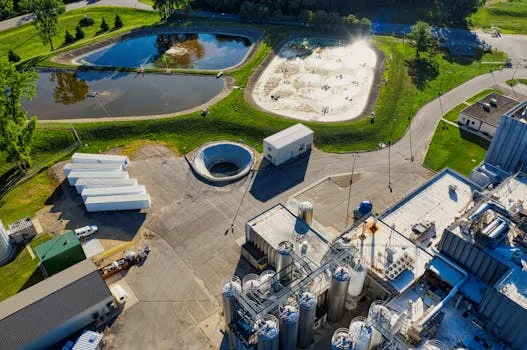
Circular DAF units suit high-volume mining tailings because 360° skimming often captures 10–15% more solids than linear layouts. Those units typically cost about 20% more and need a larger footprint, so urban food plants often reject them. Rectangular trains are modular and easier to expand as production grows. They are the usual choice for DAF applications in Mongolia’s food processing industry, where Ulaanbaatar industrial plots are tight. Rectangular packs can cut footprint by about 15%, but they need tighter flow control to avoid dead zones where solids settle instead of float.
| DAF Type | Removal Efficiency (TSS) | Primary Use Case (Mongolia) | Relative Cost Index |
|---|---|---|---|
| Circular DAF | 96–98% | Mining Tailings (e.g., Oyu Tolgoi) | High (1.2x) |
| Rectangular DAF | 92–95% | Food & Beverage (e.g., APU Plant) | Standard (1.0x) |
| Microbubble DAF | 95–97% | Refineries & Textiles | Moderate (1.1x) |
| Hybrid DAF + Lamella | 98%+ | Coal Washing (Tavan Tolgoi) | Very High (1.4x) |
Off-grid mines with thin chemical supply chains often prefer microbubble DAF such as HydropureWater’s. Better bubble-to-particle attachment can cut coagulant use by up to 30%. Those trains may draw about 25% more energy for the high-pressure recycle loop, yet chemical logistics savings in the Gobi often outweigh the power premium. Conventional DAF remains a lower CapEx path for smaller plants, though JICA 2023 data suggests a 10–20% efficiency drop below 5°C if insulation is weak. Buyers comparing pretreatment layouts sometimes also review prefabricated versus traditional pump station costs when DAF feed and sludge transfer pumps sit on the same plot.
DAF System Costs in Mongolia: Budget Benchmarks and ROI
Small DAF packages (4–20 m³/h) typically land between $80,000 and $150,000. Large industrial trains (100–300 m³/h) often fall between $200,000 and $450,000. Freight, Zamyn-Üüd customs clearance, and certified installation usually add another 15–20% on top of equipment price.
Regional OpEx for HydropureWater references sits near $0.15–$0.30 per cubic meter treated. That split is roughly chemicals $0.05–$0.10/m³, energy $0.03–$0.08/m³, and specialized labor $0.02–$0.05/m³. ROI usually stacks three items: avoided ₮50 million-class fines, water reuse covering 30–40% of freshwater spend, and 20–30% lower sludge haul costs because DAF sludge is thicker than primary sedimentation sludge.
| Cost Component | Small Scale (10 m³/h) | Large Scale (200 m³/h) |
|---|---|---|
| Equipment Capital (CapEx) | $95,000 | $380,000 |
| Installation & Logistics | $18,000 | $75,000 |
| Annual Chemical Cost | $4,500 | $85,000 |
| Annual Energy Cost | $2,800 | $52,000 |
Project finance options available in 2025 include JICA grants for SMEs that can cover up to 70% of cost when environmental benchmarks are met. Mongolia’s Green Credit Fund has offered about 5% interest loans for water-saving technologies. Some international manufacturers, including HydropureWater, offer 3–5 year payment plans or leasing to spread CapEx.
Mongolian Compliance and Permitting for DAF Systems
Core rules for industrial discharge remain MNS 4943:2020, the Law on Water (2012), and Environmental Impact Assessment (EIA) duties. An approved EIA typically takes 3–6 months before a DAF train can be commissioned. MET then issues the discharge permit once design proof shows the selected process can meet local limits. Operators tracking how other jurisdictions structure discharge permits sometimes compare notes with guides such as Thailand wastewater treatment regulations and compliance standards, then map only the Mongolian statutes that actually govern their site.
Permitting usually runs in three stages. Detailed design and EIA go to MET first. After EIA approval, soum authorities grant land-use and water-use permits. After installation, inspectors observe a 30-day performance test to confirm TSS removal exceeds 90% and pH stays between 6 and 9. Plants that discharge to the Ulaanbaatar municipal sewer must also meet Central Wastewater Treatment Plant pre-treatment rules, including residual chlorine below 0.5 mg/L.
Inspection frequency rose under 2024 MET guidelines. Mining and food plants now face quarterly inspections; other industrial sectors are audited twice a year. Missing water-quality logs or proof of licensed sludge disposal can suspend a permit immediately. Integrated data logging on the DAF skid simplifies state audits. For broader Mongolia’s industrial wastewater treatment requirements beyond flotation alone, buyers still need a full train design that covers equalization, sludge handling, and discharge monitoring.
DAF Supplier Selection Checklist for Mongolian Buyers
Local Ulaanbaatar vendors such as Mongolian Engineering LLC or EcoTech Mongolia can deliver small packages quickly and support Mongolian-language O&M. Many still focus on small-scale units or distribute older designs. Large industrial projects that need performance guarantees and compliance documentation usually shortlist international manufacturers.
International suppliers such as HydropureWater (China), Xylem (US), or Sigmadaf (Spain) quote high-efficiency packages with typical lead times of 8–12 weeks. Turnkey EPC scopes that cover EIA support through commissioning carry a 10–20% premium over equipment-only buys, yet they cut permitting delay and installation error risk that can trigger fines.
| Selection Criteria | Local Vendors | International Manufacturers |
|---|---|---|
| Typical capacity focus | Small packages, fast local delivery | 4–300 m³/h industrial trains |
| Lead time | Short if stocked in Ulaanbaatar | 8–12 weeks plus border logistics |
| Cold-climate package | Varies by distributor kit | Insulated tanks, heat-traced recycle |
| Performance guarantee | Limited on older designs | TSS/FOG guarantees tied to MNS limits |
| EPC / EIA support | Local liaison strength | Full design-to-commission scopes (+10–20%) |
Use this short selection checklist before issuing an RFQ:
- Confirm design flow (m³/h) and peak TSS/FOG loads from 7-day composite samples.
- Require winter package details for sites that see air temperatures near −30°C.
- Ask for altitude correction of air-to-solids ratio at 1,300 m or higher.
- Verify the vendor will support the 30-day MET performance test and data logging.
- Budget 15–20% above equipment for freight, Zamyn-Üüd clearance, and installation.
- Compare chemical use (kg/m³) and power (kWh/m³) at the stated recycle pressure.
- Check spare-parts lead time into Ulaanbaatar and Gobi mine sites.
Who This Is For / Who Should Look Elsewhere / Next Step
This guide is for plant engineers, EPC contractors, and procurement managers sizing flotation for Mongolian mining, food, refining, or textile wastewater. Teams that only need municipal secondary clarification or membrane polish without FOG/TSS pretreatment should look at other unit processes first. If you already have influent data and a target discharge permit, request a sized DAF budgetary proposal for your Mongolia site with CapEx, OpEx, and winterization scope in one package.
Frequently Asked Questions
How much does a DAF system cost in Mongolia?
Small 4–20 m³/h packages typically cost $80,000–$150,000, while 100–300 m³/h industrial trains often run $200,000–$450,000 before logistics. Add 15–20% for freight, Zamyn-Üüd customs, and certified installation. OpEx commonly falls between $0.15 and $0.30 per cubic meter treated when chemicals, power, and skilled labor are included.
What discharge limits must Mongolian DAF effluent meet?
Under MNS 4943:2020, industrial effluent targets commonly include TSS below 50 mg/L, FOG below 10 mg/L, and COD below 120 mg/L. DAF trains sized for Mongolian loads often reach 92–97% removal of TSS and FOG when coagulation is controlled. Plants feeding the Ulaanbaatar sewer must also keep residual chlorine below 0.5 mg/L for CWWTP pre-treatment rules.
Do DAF units need special design for Mongolian winters?
Yes. Sites in Darkhan and Erdenet can see −30°C air temperatures, so insulated tanks, heated recycle water, antifreeze dosing, and heat-traced piping are standard for outdoor or semi-exposed units. Without that package, air saturation manifolds freeze and skimmer drives seize. JICA 2023 notes also flag a 10–20% efficiency drop below 5°C water temperature when insulation is inadequate.
How long does DAF permitting take in Mongolia?
An EIA typically needs 3–6 months before commissioning can proceed, then MET issues the discharge permit after design proof is accepted. Local soum land-use and water-use permits follow EIA approval. After installation, inspectors run a 30-day performance test to verify TSS removal above 90% and pH between 6 and 9 before full operation is accepted.
Should Mongolian buyers choose local or international DAF suppliers?
Local vendors suit small packages that need fast Ulaanbaatar delivery and Mongolian-language support. International manufacturers are usually preferred for large industrial guarantees, altitude-corrected design, and EPC scopes. Turnkey EPC adds about 10–20% to equipment-only price but reduces permitting and installation failure risk on remote mine and food-plant projects.